
Last updated on February 6th, 2026 at 09:31 am
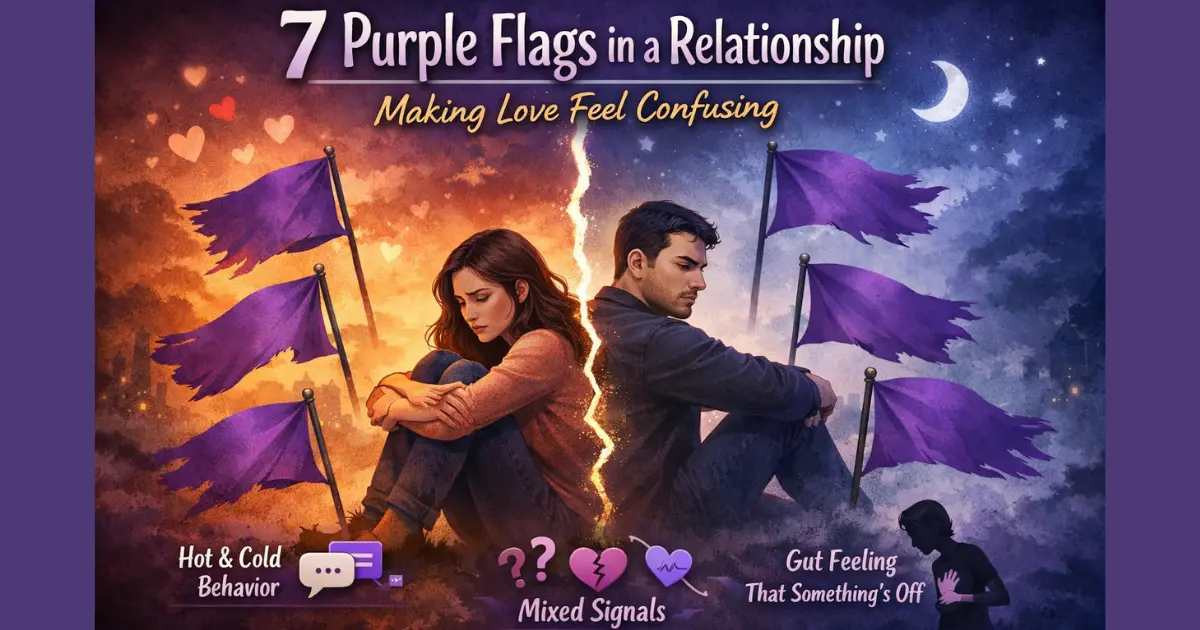
Key Takeaway: Think of purple flag in a relationship as that frustrating gray area where a partner is hot one minute and cold the next. They aren’t as loud as red flags, but they slowly drain your confidence. Catching these patterns early is the best way to protect your peace of mind and self-respect.
One day, your partner is affectionate, responsive, and deeply connected. Next, they are distant or emotionally unavailable without explanation. You replay conversations, analyze texts, and wonder if you imagined the closeness. This emotional confusion is often the first sign of a purple flag in a relationship.
Key Takeaway: Think of purple flag in a relationship as that frustrating gray area where a partner is hot one minute and cold the next. They aren’t as loud as red flags, but they slowly drain your confidence. Catching these patterns early is the best way to protect your peace of mind and self-respect.
One day, your partner is affectionate, responsive, and deeply connected. Next, they are distant or emotionally unavailable without explanation. You replay conversations, analyze texts, and wonder if you imagined the closeness. This emotional confusion is often the first sign of a purple flag in a relationship.
Purple flags are subtle. They don’t scream danger, which is why many people ignore them. But over time, they create anxiety, self-doubt, and emotional exhaustion.
Modern relationship research shows a clear shift:
In 2026, over 64% of singles say emotional clarity matters more than chemistry (Tinder Year in Swipe Report).
This article will help you understand:
- What a purple flag really means in a relationship
- The psychology behind inconsistent behavior
- 7 purple flags people miss too often
- The long-term risks of ignoring them
- How to handle purple flags in a healthy, mature way
Healthy love feels steady, not confusing.
What Is a Purple Flag in a Relationship?
simple definition:
A purple flag in a relationship is a recurring pattern of mixed signals or inconsistent behavior that causes emotional confusion but is not immediately abusive or toxic.
These behaviors often seem harmless when viewed once, but become harmful when repeated.
Examples include:
- Hot-and-cold communication
- Intense affection followed by withdrawal
- Vague commitment talk
- Different behavior in public and private
“Inconsistency creates emotional attachment, but consistency creates emotional safety.”
Why Do Purple Flags Happen? (Psychology Behind Inconsistency)
Purple flags often arise from attachment style mismatches:
- Anxious attachment seeks closeness and reassurance
- Avoidant attachment pulls away when intimacy increases
When these two styles interact, they create a push–pull dynamic that feels exciting at first—but becomes emotionally draining. Psychologists call this intermittent reinforcement:
Random affection mixed with emotional withdrawal keeps the brain hooked, similar to gambling reward patterns. Understanding this helps you see why a purple flag in a relationship can feel so addictive yet draining.
Dr. John Gottman:
“Trust is built in very small moments. In every interaction, we either turn toward our partner—or away.”
Key Characteristics of Purple Flags:
- Ambiguous intent: Is it stress, fear, or emotional unavailability?
- Pattern-based: One incident is normal; repetition is the warning
- Emotionally confusing: You feel unsettled without knowing why
- Escalation risk: Ignored purple flags often become red flags
Purple Flags vs Other Relationship Flags
| Flag Color | Meaning | Examples | What to do |
| Red Flag | Immediate danger | Abuse, gaslighting, control | Leave |
| Yellow Flag | Minor concern | Habits, preferences | Observe |
| Purple Flag | Inconsistent patterns | Hot-cold behavior | Address early |
| Green Flag | Healthy traits | Respect, clarity | Build |
Purple flags are not about leaving immediately; they are about paying attention early.
read more: All Flags in Dating Explained
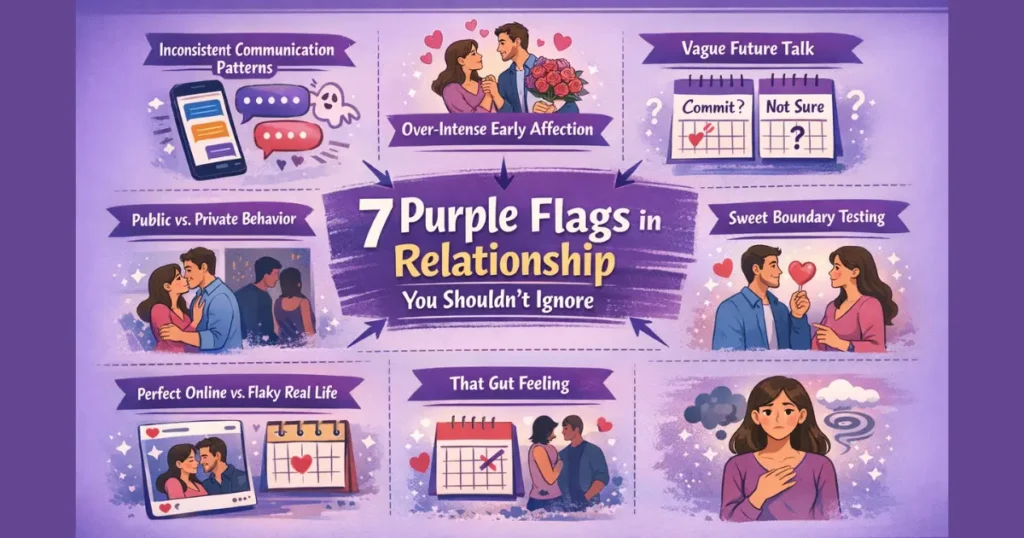
7 Purple Flag in a Relationship You Shouldn’t Ignore
Each sign below includes real-life context + why it matters + what to do.
1. Inconsistent Communication Patterns
The sign:
Warm, frequent communication followed by sudden silence or minimal effort—without explanation.
Example:
“He’d text me all day, then disappear for three days and return like nothing happened.”
Why it matters:
Research links inconsistent communication with lower trust and relationship satisfaction.
What to do:
Track patterns for two weeks. Then communicate calmly:
“I feel confused when communication suddenly changes without context.”
2. Over-Intense Early Affection (Love Bombing Lite)
The sign:
Strong emotional declarations very early—followed by a sharp drop in effort.
Example:
“By week three, he talked about marriage. By month two, the attention vanished.”
Why it matters:
Healthy attachment grows gradually. Sudden intensity often masks insecurity or emotional regulation issues.
Dr. Esther Perel:
“Intensity is not intimacy. Consistency creates intimacy.”
What to do:
Slow the pace and observe whether actions match words over time.
read more: Situationships: Meaning, Signs
3. Vague or Flip-Flopping Future Talk
The sign:
Statements about the future keep changing—commitment one week, hesitation the next.
Example:
“One month it was meeting parents, the next month he needed ‘freedom.’”
Why it matters:
Consistent future language is a strong marker of relationship stability.
What to do:
Ask directly:
“What are you genuinely hoping this relationship becomes?”
4. Different Behavior in Public vs Private
The sign:
Affectionate in private, emotionally distant around others.
Example:
“He was loving when alone, but ignored me in social settings.”
Why it matters:
This may indicate social anxiety—or reluctance to fully claim the relationship.
What to do:
Address it gently:
“I feel disconnected when we act distant in public.”
5. Sweet Boundary Testing
Sign:
Your boundaries are pushed gently—but repeatedly.
Example:
“Every ‘no’ became a negotiation wrapped in sweetness.”
Why it matters:
Respecting boundaries should not require persuasion.
Dr. Stan Tatkin:
“Safety in relationships comes from predictability and respect.”
What to do:
Say no without explanation and observe the response.
6. Perfect Social Media, Flaky Real Life
The sign:
Online affection looks perfect, but real-life effort is inconsistent.
Example:
“Couple goals online—missed birthdays and canceled plans offline.”
Why it matters:
Studies show social media inconsistency predicts lower relationship satisfaction.
What to do:
Judge effort in real life—not an online presentation.
read more: improve communication in relationships
7. The Lingering Gut Feeling That Something Is Off
The sign:
Everything looks fine, but you feel emotionally unsettled.
Example:
“He checked every box—except my peace of mind.”
Why it matters:
Your intuition recognizes patterns before logic catches up.
Exercise:
Free-write for 10 minutes:
“What exactly feels off, and when did it start?”
read more: Types of Relationships
Why Purple Flags Matter Long-Term
Ignoring purple flags often leads to:
- Chronic self-doubt
- Emotional burnout
- Weak boundaries
- Loss of intuition
Recent studies show that communication inconsistency is a leading predictor of breakups.
Dr. Sue Johnson:
“At the core of every relationship question is this: Can I count on you?”
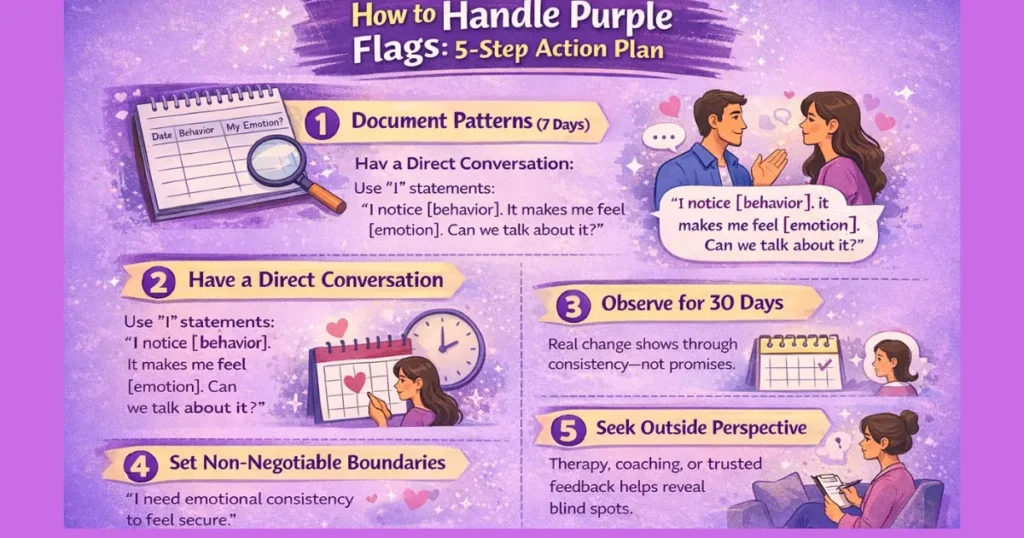
How to Handle Purple Flags: 5-Step Action Plan
- Document Patterns (7 Days)
text
Date | Behavior | My Emotion | Pattern?
2. Have a Direct Conversation
Use “I” statements:
“I notice [behavior]. It makes me feel [emotion]. Can we talk about it?”
3. Observe for 30 Days
Real change shows through consistency—not promises.
4. Set Non-Negotiable Boundaries
“I need emotional consistency to feel secure.”
5. Seek Outside Perspective
Therapy, coaching, or trusted feedback helps reveal blind spots.
Final Thoughts: Choose Peace Over Confusion
Purple flags in a relationship are not meant to scare you. They are meant to guide you toward healthier emotional boundaries and clearer communication. Healthy love feels calm, steady, and predictable—not like a puzzle you must solve.
“Confusion is information. Peace is the standard.”
When you recognize a purple flag in a relationship, it’s your mind’s way of signaling something needs attention. Don’t ignore these subtle warning signs.
- Recognize patterns early.
- Speak openly and honestly.
- Protect your emotional energy and self-worth.
By paying attention to purple flag in a relationship, you empower yourself to build trust and emotional safety—because love should never feel confusing or draining.
FAQs
1. What is a purple flag in a relationship?
A purple flag is a recurring pattern of inconsistent or confusing behavior that creates emotional uncertainty. Unlike red flags, they aren’t immediately toxic, but they signal a lack of reliability—like hot-and-cold communication—that can damage trust if the pattern isn’t addressed early.
2. Purple flag vs. Red flag: What’s the difference?
A red flag indicates clear danger or abuse, requiring immediate action. A purple flag in a relationship shows emotional instability or mixed signals that need attention and honest communication to resolve.
3. Can purple flags turn into green flags?
Yes. Since purple flags often stem from poor communication or different attachment styles, they can become green flags. If both partners are willing to have honest conversations and show consistent, long-term changes in behavior, the relationship can become healthy and secure.
4. Is ghosting a purple flag or a red flag?
It depends on the pattern. Intermittent ghosting (disappearing for a few days then returning) is a purple flag of emotional unavailability. However, total disappearance or “no-contact” ghosting without explanation is a major red flag that shows a complete lack of respect.
5. What are some common purple flags?
Common purple flags include hot-and-cold communication, mixed messages about commitment, and emotional unavailability. Other signs are “sweet” boundary pushing, a mismatch between social media and real-life effort, and a persistent gut feeling that something is “off.”
6. What is the meaning of “you are my purple”?
“You are my purple” is a popular romantic term of endearment meaning someone is deeply trusted, cherished, and considered a soulmate. It symbolizes a unique emotional bond and is completely unrelated to “purple flags” used as relationship warnings.
7. What is the purple flag system?
There is no formal “purple flag system” in academic psychology. It is an informal, color-coded metaphor used in modern dating advice to help people identify inconsistent behaviors that sit between minor concerns (yellow) and major dangers (red).

Ayanshi is the founder of PersonaGuru.in, a blog dedicated to personality development, relationships, and mental health. With 3+ years of writing experience and 250+ published articles, she simplifies psychology into practical, everyday advice for real people.