
Last updated on June 27th, 2026 at 05:45 pm
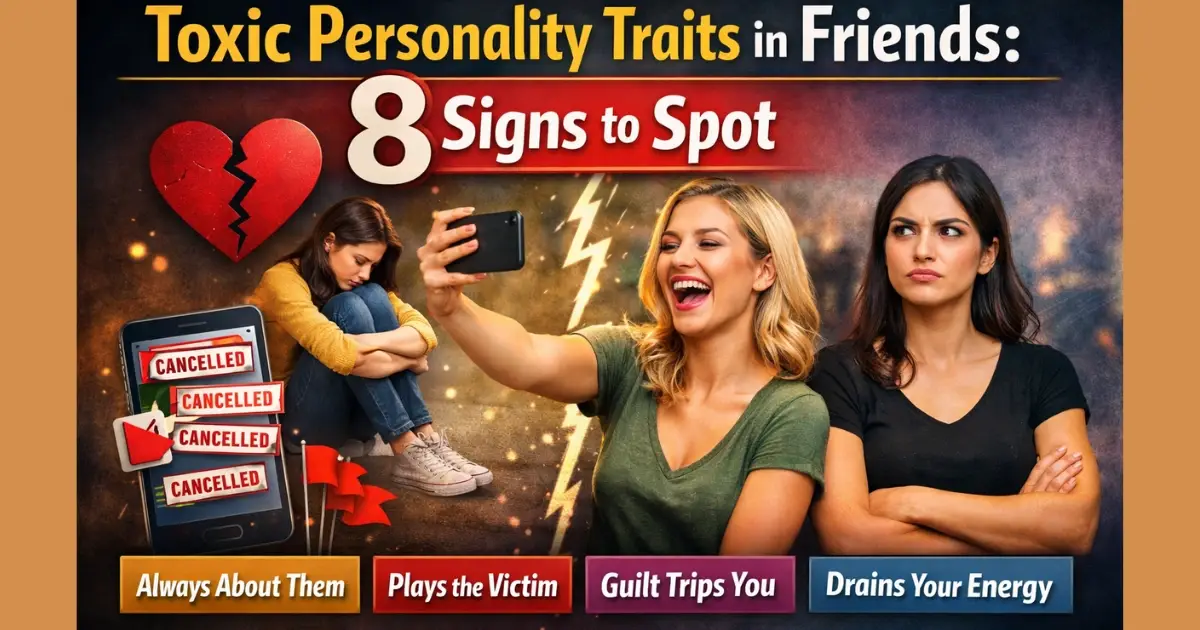
Your friend cancels plans at the last minute again. You feel exhausted after every conversation. Something feels off, but you cannot quite put your finger on it.
If this sounds familiar, you are not alone. Toxic personality traits in friends can quietly slip into your life, hurting your confidence and happiness over time. These are not just small fights; they are patterns that can damage your mental health just as much as a bad romantic relationship.
Recent surveys show that over 80% of people have dealt with at least one toxic personality trait in a friend’s situation at some point. Since research suggests the average friendship lasts around 17 years, learning to spot these red flags early can save you from decades of emotional pain.
Dr. Andrea Bonior, a clinical psychologist, explains it perfectly: “The worst friendships are the ones where the toxicity creeps in slowly. By the time you notice the pattern, real emotional damage has already happened.”
Understanding Toxic Personality Traits in Friends
What exactly are toxic personality traits in friends? These are ongoing patterns of behavior that hurt your emotional health. The big difference is “ongoing patterns” versus a one-time mistake. We all have bad days, but for a toxic friend, being difficult is their default mode of operation.
(For more on how personality involves enduring patterns of thoughts, feelings, and behaviors that shape how people interact, check out the American Psychological Association’s overview on personality.)
Latest health data from early 2026 confirms that toxic personality traits in friends raise your stress levels significantly. This spike in cortisol can lead to chronic anxiety and even physical issues like high blood pressure or a weakened immune system.
Normal Fighting vs. Toxic Patterns
Normal Conflict in Healthy Friendships:
- Both people share feelings without fear of a blow-up
- You talk things through and find actual solutions
- The same problem does not keep repeating over and over
Toxic Pattern in Unhealthy Friendships:
- The same hurtful behavior keeps repeating despite your talks
- They never genuinely apologize or try to change
- You feel like you are walking on eggshells around them
- Your needs and personal limits are mocked or ignored
Not every unhealthy behavior is instant toxicity. Many start as subtle patterns and early warning signs. Understanding the relationship red flags and green flags can help you recognize these changes much earlier.
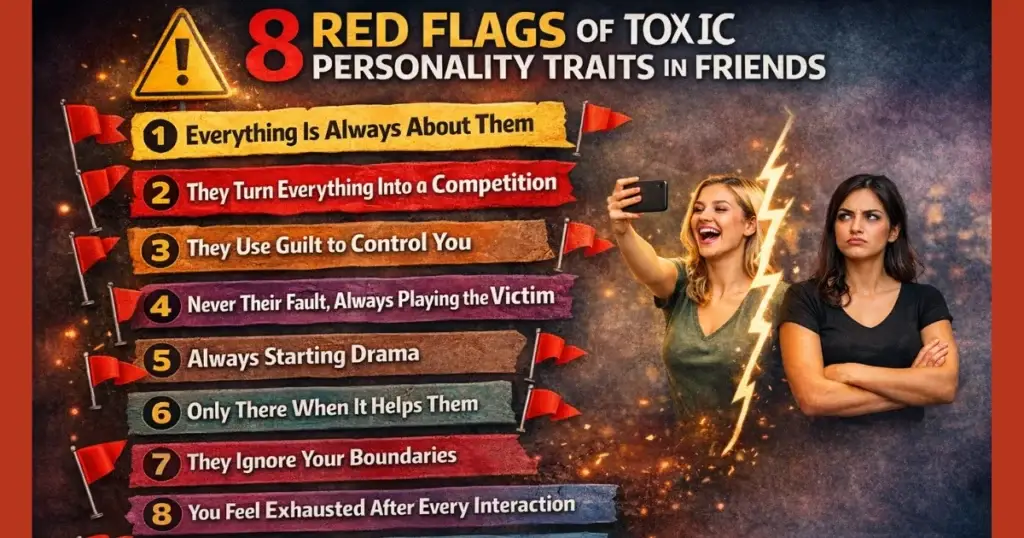
8 Red Flags of Toxic Personality Traits in Friends
Let’s examine the most prevalent toxic personality traits in friends and how they manifest in real-world situations, backed by psychological research and relationship science.
1. Everything Is Always About Them
This is a classic sign of chronic self-centeredness and one of the clearest toxic personality traits in friends. The friendship feels one-sided because they act like only their life, their problems, and their wins matter.
Watch For:
- Every conversation becomes about them
- They show zero interest in your life
- They forget your big moments but expect you to remember theirs
Example: You tell them about your promotion. They say “Cool” and immediately start talking about their own day for 30 minutes without asking a single follow-up question.
2. They Turn Everything Into a Competition
Healthy friends are happy for you. Competitive friends feel threatened by your success. This is another common form of toxic personality traits in friends.
Watch For:
- They try to top every story you share
- They cannot be happy for you without mentioning their own wins
- They get weird when good things happen to you
Example: You show them your engagement ring. They say, “Nice, but mine was bigger and the proposal was more romantic.”
3. They Use Guilt to Control You
Manipulation is a huge warning sign of toxic personality traits in friends. They use your kindness and loyalty as a tool to get what they want.
Watch For:
- They say things like “A real friend would…”
- They give you the silent treatment when you say “no.”
- They make you feel bad for having your own life
Example: You cannot help them move because of work. They say, “Wow, good to know where I stand. I always help you, but I guess you do not care about me.”
4. Never Their Fault, Always Playing the Victim
Toxic friends fundamentally cannot take responsibility. They are the masters of the “non-apology.”
Watch For:
- They blame everyone else for their problems
- Fake apologies like “I am sorry you feel that way.”
- Every argument somehow becomes about how you hurt them
Expert Insight: A real apology requires admitting the mistake and actually changing the behavior. Anything else is just a tactic to keep you quiet.
read more: Toxic Personality Traits in a Relationship
5. Always Starting Drama
Some people just feed on drama. There is always a new fight or a new “enemy” in their life.
Watch For:
- They are always fighting with someone
- They love gossip and spreading rumors
- Being around them feels stressful and loud
Example: Every time you meet up, they are fighting with someone new. Last month it was a coworker; this month it is a neighbor. They are always at the center of the mess.
read more: Toxic Personality Traits in the Workplace
6. Only There When It Helps Them
These are “fair-weather” friends. They are around when things are fun, but vanish when things get real.
Watch For:
- They disappear when you are going through hard times
- They only call when they need a favor
- Everything feels one-sided
The 2 AM Test: Real friends show up for the 2 AM crisis call, not just the 2 PM coffee chat when they want to vent.
7. They Ignore Your Boundaries
Boundaries are limits we set for our own peace. People with toxic personality traits in friends see these limits as a challenge to break.
Watch For:
- They share your secrets after promising not to
- They get mad when you say “no” to an invite
- They make you feel selfish for having limits
Example: You tell them something private and ask them to keep it between you two. The next day, your whole friend group knows. When you get upset, they tell you that you are “overreacting.”
8. You Feel Exhausted After Every Interaction
This is the most honest sign of toxic personality traits in friends. Listen to what your body is telling you.
Watch For:
- You feel exhausted after seeing them
- You need hours alone to recover
- You feel nervous before meeting up
- You feel relieved when they cancel plans
Trust Your Gut: If you consistently feel worse after spending time with someone, your nervous system is warning you that the relationship is draining.
The 4 Types of Toxic Friends
While toxic personality traits in friends show up in different ways, they usually fall into these four types:
1. The Taker
Values you only for the tangible benefits (money, rides, ego boost) you provide.
2. The Critic
Constantly puts you down while calling it “being honest.”
3. The Chaos Lover
Feeds on drama and always has a new person to hate.
4. The Ghost
Inconsistent and unreliable; they disappear when they do not need anything.
When to Walk Away: 5 Clear Signs
1. Repeated Boundary Violations
They ignore your “no” despite clear communication.
2. Consistent Disrespect
Mockery or broken promises become a habit.
3. Mental Health Suffering
You feel measurably worse about yourself after seeing them.
4. Zero Responsibility
They never admit fault or try to change.
5. It Is All Work, No Joy
The relationship feels like a heavy chore.
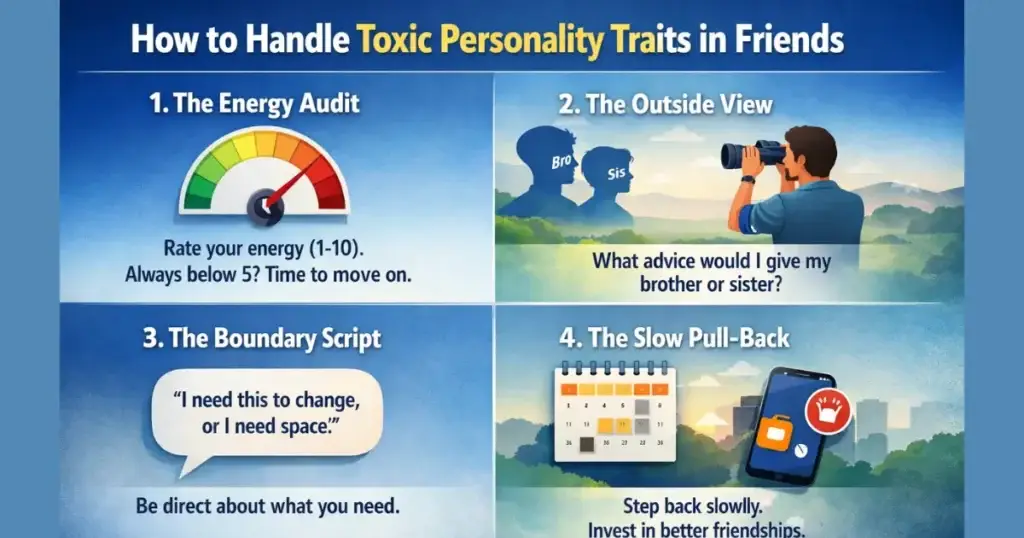
How to Handle Toxic Personality Traits in Friends
1: The Energy Audit
Rate your energy (1-10) after each meeting. If it is always below 5, it is time to move on.
2: The Outside View
Ask yourself: “If I saw my brother or sister in this friendship, what would I tell them to do?”
3: The Boundary Script
Be direct: “I care about you, but I need [this change] to feel respected. If that cannot happen, I need to take some space.”
4: The Slow Pull-Back
If a big confrontation feels too scary, slowly become less available. Respond slower and invest your time in people who actually make you feel good.
Conclusion: Protecting Your Peace from Toxic Personality Traits in Friends
Life is too short to spend it with people who do not respect you. In 2026, make it your goal to fill your inner circle with people who celebrate your wins and show up when things get hard.
If you recognize toxic personality traits in friends within your current circle, it is time to think about whether those relationships are actually good for you. You deserve friends who are happy for your wins, who show up when things get tough, and who own their mistakes.
Jim Rohn said it best: “You are the average of the five people you spend the most time with.” Make sure those five people are actually adding good things to your life, not draining them away.
Your Action Step: Take a moment to look at your current friend group. Does anyone consistently show toxic personality traits in friends that make you feel drained or undervalued? It might be time to set a firmer boundary or create some distance. You deserve friends who celebrate you, not exhaust you.
Have you dealt with toxic personality traits in friends? How did you handle it? Share your experience in the comments below to help others going through the same thing.
FAQs
1. How do I know if my friend has toxic personality traits?
Look for patterns. Everyone has bad days, but if they consistently make you feel bad or ignore your needs, that is toxicity. Watch for the 8 red flags mentioned above.
2. What are the most common toxic personality traits in friends?
The most common ones include chronic self-centeredness, manipulation through guilt, refusing to take responsibility, creating constant drama, and only showing up when it benefits them.
3. How long do friendships usually last?
Studies show about 17 years on average. But remember: history is not a reason to stay in a relationship that hurts you today.
4. What is the 11-6-3 rule?
Social psychology suggests we aim for 11 lifelong connections, 6 close friends, and 3 intimate confidants. People with toxic personality traits in friends should not hold any of these spots.
5. Can toxic personality traits in friends change?
While people can change, it requires genuine self-awareness and effort on their part. If you have addressed the issues clearly and seen no improvement over time, the relationship may not be worth maintaining.

Ayanshi is the founder of PersonaGuru.in, a blog focused on personality development, career, relationships, and mental well-being. With over 3 years of writing experience, she turns psychology and everyday experiences into practical, easy-to-understand advice for real life.