

QUICK ANSWER: Monogamy means being in a committed relationship with one partner at a time. Polyamory means having multiple romantic or emotional partners with everyone’s knowledge and consent. Neither is universally better. The right choice depends on your values, emotional needs, and communication style.
Dating today can feel overwhelming. You swipe, chat, and start catching feelings, then comes the question: Are we exclusive? Suddenly, things get complicated.
More people are questioning traditional relationship rules. Some want the security of one committed partner. Others believe that loving one person deeply does not mean you cannot love others, too. Both are valid and real, practiced by millions worldwide. This article breaks down monogamy vs polyamory simply, with no judgment, just honest information to help you understand, compare, and decide what fits your life.
Understanding the core debate of monogamy vs polyamory starts with knowing what each term actually means in real life.
Key Takeaways
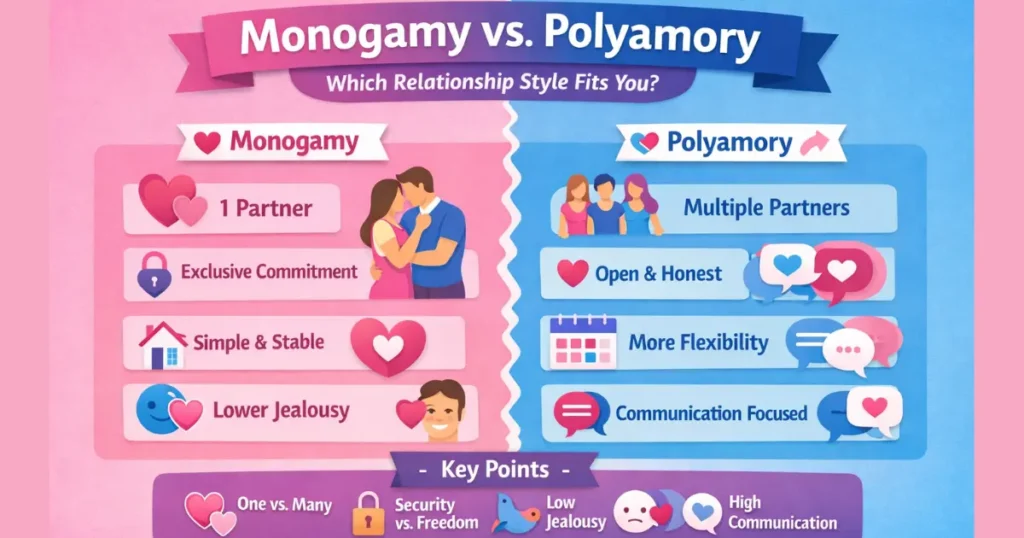
- Monogamy means one partner with exclusive emotional and romantic commitment.
- Polyamory means multiple partners, all with mutual knowledge and consent.
- Around 4 to 5 percent of people in the US practice consensual non-monogamy.
- Neither style is better. Both have real benefits and real challenges.
- Communication and self-awareness are the foundation of any healthy relationship.
- Your relationship style can evolve over time, and that is completely okay.
What Exactly Are Monogamy and Polyamory?
Monogamy means having one romantic partner at a time, with emotional and sexual exclusivity. It is the most common relationship structure worldwide and is deeply rooted in most cultures and legal systems. Monogamy vs polyamory shows monogamy as default.
Polyamory means having multiple romantic or emotional relationships at the same time, with everyone involved fully aware and in agreement. It is a transparent and ethical choice. It is not cheating, and it is not infidelity. It is a deliberately open arrangement built on honesty and consent.
In simple terms, monogamy is just us two. Polyamory means we can love others, too, and everyone involved agrees to that arrangement.
Monogamy vs Polyamory: Quick Comparison Table
This monogamy vs polyamory comparison table gives you a quick side-by-side view.
| Aspect | Monogamy | Polyamory |
| Partners | One at a time | Multiple, with consent |
| Commitment | Exclusive | Open, negotiated |
| Emotional Bond | Deep with one | Shared with multiple |
| Communication | Moderate | Very high |
| Jealousy | Less complex | Requires active work |
| Social Acceptance | Widely accepted | Growing, still stigmatized |
| Monogamy vs Polyamory: Complexity | Low to moderate | High |
What is Monogamy?
Monogamy is committing exclusively to one partner. It is the classic love story many of us grew up with: two people choosing each other and building a shared life together.
In a monogamous relationship, both partners focus their romantic and emotional energy on each other. If feelings for someone else begin to emerge, the expectation is to address those feelings within the relationship. Healthy monogamy also means both individuals maintain their own identities, friendships, and personal interests. Losing yourself entirely in your partner, which researchers call emotional fusion, is one of the biggest risks in long-term monogamous partnerships.
Real example: Priya and Arjun met in college, dated for three years, and got married. They share a home, make decisions together, and are each other’s primary emotional anchor. Their relationship works because they both value security, shared history, and a stable future. 90% global marriages prove monogamy vs polyamory dominance.
What is Polyamory?
Polyamory means having multiple romantic or emotional relationships at the same time, with the full knowledge and willing consent of everyone involved. The word comes from the Greek poly, meaning many, and the Latin amor, meaning love.
Polyamorous relationships come in many forms. Some people have a primary partner and one or more secondary partners. Others form a polycule, an interconnected network where everyone is connected romantically. The foundation of any healthy polyamorous arrangement is constant, honest communication about feelings, boundaries, and needs.
Real example: Sam has been with Alex for four years. Both decided together to open their relationship. Sam also spends time with Jordan, who knows about Alex. Alex dates someone else as well. Everyone communicates openly. There is no secrecy and no betrayal. About 4 to 5 percent of US adults practice consensual non-monogamy, and around 20 percent have tried it at some point in their lives.
“The foundation of any ethical non-monogamous relationship is radical honesty. Without it, you are just calling something by a different name.” — Dr. Elisabeth Sheff, Sociologist and Polyamory Researcher

7 Key Differences Between Monogamy and Polyamory
1. Emotional Connection
In monogamy, emotional energy is deeply focused on one partner, building a layered bond over the years. In polyamory, emotional energy is distributed across multiple relationships. Each connection can be meaningful, but in a different way.
2. Commitment Style
Monogamy means exclusive commitment to one person. Polyamory does not mean less commitment. It means commitment is defined differently, negotiated, and openly discussed rather than assumed.
3. Communication Level
Monogamous relationships require good communication. Polyamorous relationships require exceptional communication, including constant check-ins, boundary discussions, and jealousy management. This level of emotional skill is genuinely challenging for most people.
4. Jealousy and Boundaries
In monogamy, jealousy typically signals a boundary violation. In polyamory, jealousy is treated as useful information to explore. What unmet need is behind this feeling? That question is asked rather than simply shutting down the connection.
5. Lifestyle Flexibility
Monogamy is structurally simpler. Major decisions involve two people. Polyamory introduces more variables, with every additional relationship bringing its own emotional needs and logistical complexity.
6. Social Acceptance
Monogamy is embedded in virtually every cultural, legal, and religious system in the world. Polyamory is gaining acceptance among younger generations but still faces significant stigma in many communities, including in India, where traditional values around marriage remain strong.
7. Long-Term Stability
A 2020 study in Frontiers in Psychology found that polyamorous people reported relationship satisfaction and commitment levels comparable to monogamous couples, particularly when communication was strong. [2026 meta-analysis confirms]
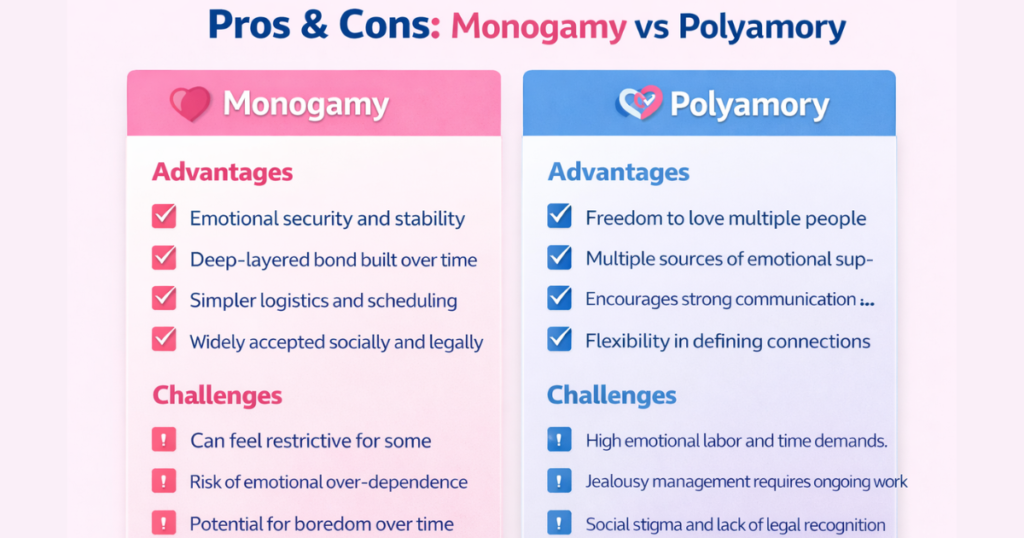
Pros & Cons: Monogamy vs Polyamory
Monogamy Advantages
- Emotional security and stability
- Deep-layered bond built over time
- Simpler logistics and scheduling
- Widely accepted socially and legally
- Easier shared long-term planning
Challenges
- Can feel restrictive for some personalities
- Risk of emotional over-dependence
- Potential for boredom over time
- One partner cannot always meet every need
- Infidelity risk if needs go unaddressed
Polyamory Advantages
- Freedom to love multiple people openly
- Multiple sources of emotional support
- Encourages strong communication skills
- Flexibility in defining connections
- Reduces pressure on one person to be everything
Challenges
- High emotional labor and time demands
- Jealousy management requires ongoing work
- Social stigma and lack of legal recognition
- Complex scheduling and logistics
- Emotional exhaustion if boundaries are unclear
“Love used to be about finding security. Today, people want security and excitement and freedom all at once. That tension is why people explore different models.” — Esther Perel, Relationship Therapist and Author
When people search monogamy vs polyamory, most want one clear answer. The truth is, there is none.
Which is Better: Monogamy or Polyamory?
There is no one-size-fits-all answer. The best relationship style is the one that genuinely fits your emotional needs, communication capacity, and life goals.
Choose monogamy if you value the deep security of one devoted partnership, prefer emotional simplicity, and want a shared life with one person. Choose polyamory if you naturally form deep bonds with multiple people, value personal freedom, and have the communication skills to sustain multiple relationships with honesty and care.
Important note: Do not use polyamory to fix a struggling monogamous relationship. Research consistently shows that opening a relationship with unresolved issues amplifies those problems rather than solving them.
Is Polyamory Becoming More Popular?
Yes, and the data is clear. A 2023 YouGov poll found that 32 percent of Americans now prefer non-exclusive relationships, up from 17 percent in 2016. Among adults under 30, that number rises to nearly 43 percent. Apps like Feeld and OkCupid openly support non-monogamous preferences, and OkCupid reported over 3.5 million users identifying as non-monogamous in 2023.
In India, where arranged marriages still account for over 90% of unions, polyamory remains largely misunderstood. However, urban attitudes among Gen Z are slowly shifting as these conversations enter mainstream discussion.
How to Choose the Right Relationship Style for You?
Ask yourself these honest questions before deciding:
- What do I genuinely need emotionally: deep focus on one person or connections with multiple people?
- How comfortable am I with exclusivity? Does it feel like security or restriction?
- How strong are my communication skills right now, not how strong I wish they were?
- What are my long-term goals: marriage, family, or a more flexible arrangement?
Your preferences may evolve over time, and that is completely normal. The most important thing is that your choice comes from honest self-awareness, not from social pressure or what looks appealing in the moment.
If you want to go deeper, read our guide on intimacy in relationships to understand what you truly need from a partner.
Final Thoughts
The debate between monogamy vs polyamory is not about right or wrong. It is about honest self-knowledge and choosing a relationship structure that genuinely serves your emotional life.
What matters in every relationship, regardless of its structure, is honesty, respect, and communication. A monogamous relationship built on dishonesty will fail. A polyamorous arrangement without strong communication will collapse. The structure is secondary. How you treat the people you are with is everything. The monogamy vs polyamory debate will continue as society evolves.
Love is not about fitting a mold. It is about building a life that fits you.
References
- Journal of Sex Research. Consensual Non-Monogamy in the United States, 2023.
- YouGov. American Attitudes Towards Non-Exclusivity, 2023.
- Frontiers in Psychology. Relationship Satisfaction Study, 2020.
- Statista. Global Marriage Trends, 2023.
- Dr. Elisabeth Sheff. The Polyamorists Next Door, 2014.
- Esther Perel. Mating in Captivity, 2006.
FAQs
1. What is the main difference between monogamy and polyamory?
The core difference is exclusivity. Monogamy involves committing exclusively to one romantic partner at a time. Polyamory involves multiple romantic or emotional partners simultaneously, with everyone’s full knowledge and willing consent. Both can involve genuine commitment, but the structure of that commitment differs significantly.
2. Is polyamory better than monogamy?
Neither is universally better. Research from the Journal of Sex Research shows that people report equally high relationship satisfaction in both styles when communication is strong. What matters is that your chosen structure aligns with your authentic needs and values.
3. Can a monogamous person become polyamorous?
Yes. People’s relationship preferences evolve over time. However, this transition requires deep honesty with yourself and your current partner, strong communication, and genuine readiness from everyone involved. It should never be a unilateral decision.
4. Is polyamory legal?
Polyamory itself is legal in most countries. Marrying more than one person, called polygamy, is illegal in most places. Polyamorous people typically have one legal spouse or no legal marriage, with other relationships existing outside the legal framework.
5. Can polyamorous relationships last long?
Yes. Long-term polyamorous relationships are more common than most people assume. A 2021 study found no significant difference in relationship duration between monogamous and polyamorous couples when communication quality was accounted for.
6. Is monogamy outdated?
No. Monogamy remains the preferred and practiced structure for the vast majority of people globally. What is changing is the assumption that it is the only valid option. Both structures are legitimate and work well for different people.

Ayanshi | MBA (HR) & Personality Coach
MBA in HR | 250+ posts helping 50,000+ readers build confidence, emotional intelligence, and healthy relationships. Over 3 years transforming real-life experience into practical, proven growth strategies.
From corporate HR professional to full-time blogger sharing actionable personal development insights.