

Last updated on February 21st, 2026 at 06:58 am
Let me ask you something. Have you ever been in a heated argument and said something you deeply regretted the moment it left your mouth? Or maybe you had a colleague going through a hard time, and you just did not know how to help, even though you wanted to?
Most of us have been there. And the reason is not that we are bad people. It is that nobody really taught us how to handle emotions, our own or anyone else’s.
That is exactly what emotional intelligence (EQ) is about. It is the ability to understand, manage, and use emotions in a way that helps you and the people around you. And here is the thing — unlike your IQ, your EQ can genuinely improve with practice. At any age.
In this guide, you will find 15 powerful tips to boost your emotional intelligence, along with the latest research, expert quotes, and answers to the most common questions people are searching for right now.
Key Takeaways
Emotional intelligence is not a fixed trait. You can build it deliberately over time with tips to boost your emotional intelligence.
High EQ is linked to better relationships, stronger mental health, and higher earnings.
- Self-awareness is the starting point for all other EQ skills.
- Small daily habits — like journaling, listening deeply, and pausing before reacting — add up over time.
- The tips to boost your emotional intelligence in this guide are backed by Harvard, Talent Smart, and leading psychologists.
 |
| Powerful Tips to Boost Your Emotional Intelligence |
What is Emotional Intelligence?
Emotional intelligence is your ability to notice emotions in yourself and others, understand what those emotions mean, and then choose how to increase EQ rather than just react.
Psychologist Daniel Goleman, who brought this concept into the mainstream with his 1995 book, describes it as a set of skills that matter just as much as IQ — if not more — for success in life and work.
What really matters for success, character, happiness, and lifelong achievements is a definite set of emotional skills, not just purely cognitive abilities.— Daniel Goleman
In plain terms, EQ is knowing when you are about to explode and choosing to breathe instead. It is noticing your friend seems off even before they say anything. It is being able to say “I am feeling overwhelmed right now” instead of snapping at the nearest person.
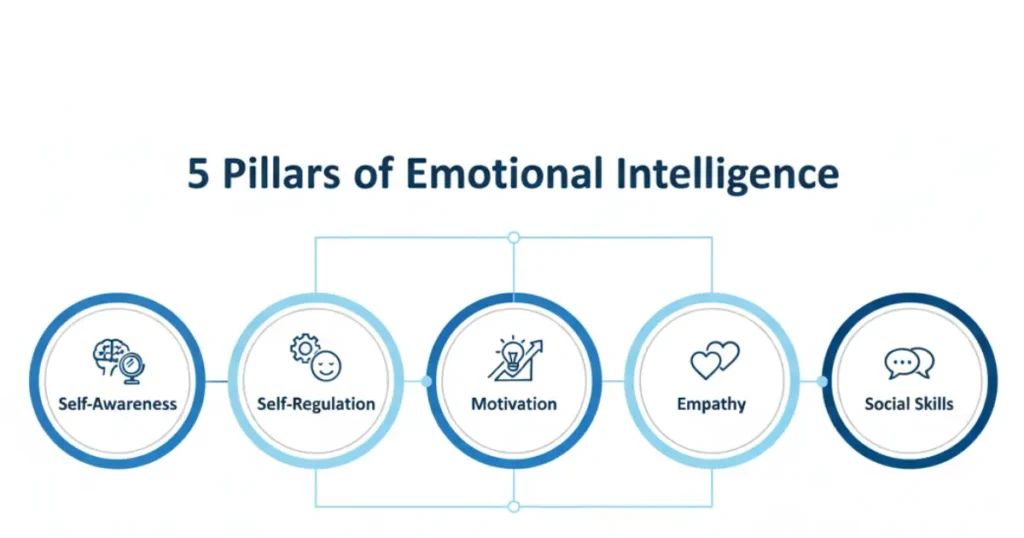
What Are the 5 Pillars of Emotional Intelligence?
Goleman’s model breaks emotional intelligence into five core areas. Think of these as five muscles you build every time you use the tips to boost your emotional intelligence in your daily life:
- Self-Awareness: You can spot your own emotions as they happen. You know your triggers, your strengths, and your habits.
- Self-Regulation: You do not let emotions run the show. You can stay calm under pressure and think before acting.
- Intrinsic Motivation: You are driven by internal reasons, not just money or status. You find meaning in what you do.
- Empathy: You genuinely try to understand how others are feeling. You listen without judgment.
- Social Skills: You communicate well, resolve conflicts, and build trust with people around you.
Most people are stronger in some areas than others. The goal is not to be perfect at all five but to be honest about which ones need work.
Why Is Emotional Intelligence So Important Today?
Think about the world we live in right now. Remote work, constant notifications, high stress, and fast change. In this environment, the ability to manage your inner world and connect genuinely with others is not a soft skill anymore. It is a survival skill – perfect reason for tips to boost your emotional intelligence.
Here is what the research actually says:
- Talent Smart’s analysis of over a million professionals found that 90% of top performers score high on EQ, while just 20% of low performers do.
- Emotional intelligence accounts for 58% of leadership performance, according to a widely cited Harvard Business Review study.
- Workers with high EQ earn an average of $29,000 more annually than those with low EQ, per research in the Journal of Organizational Behavior.
- A 2024 Gallup report found that employees who feel their manager understands them are 3.4 times more likely to be engaged at work.
- The World Economic Forum listed emotional intelligence among the top 10 most critical skills for the future of work in its 2023 Future of Jobs Report.
15 Powerful Tips to Boost Your Emotional Intelligence
Here are fifteen tips to improve emotional intelligence that actually work. They are not complicated. What makes the difference is practicing them consistently, not perfectly.
1 Start a Daily Emotion Journal
Among all the tips to boost your emotional intelligence, this one is the most underrated. Every evening, spend five minutes writing down one emotional moment from your day. What happened? What did you feel? How did you react? What would you do differently?
Over time, you start noticing patterns. Maybe you always get defensive when someone questions your work. Maybe you shut down when you feel unappreciated. Seeing these patterns on paper is the first step to changing them. You do not need a fancy journal. The notes app on your phone works perfectly.
read more: Good Habits for Personality Development
2 Name Your Emotions More Precisely
Most people describe their feelings with three or four words: happy, sad, angry, stressed. But research by neuroscientist Lisa Feldman Barrett shows that the more precisely you can label an emotion, the better your brain can regulate it — making this one of the most science-backed tips to boost your emotional intelligence.
Instead of “I am upset”, try to identify: are you disappointed? Embarrassed? Jealous? Anxious? Frustrated? Each one has a different cause and a different solution. This practice is called emotional granularity, and it genuinely changes how your brain processes difficult feelings.
People who are more emotionally granular are better able to regulate their emotions, are less likely to drink when stressed, and are less likely to retaliate against people who have harmed them.
— Lisa Feldman Barrett, Neuroscientist
3 Practice the 90-Second Rule
Neuroanatomist Dr. Jill Bolte Taylor discovered that the physical rush of chemicals in your body during a strong emotion lasts only about 90 seconds. After that, the emotion continues only if your thoughts keep feeding it.
So when you are about to react badly — notice the feeling, name it, and then wait 90 seconds before doing or saying anything. Take deep breaths. The intensity drops significantly. This is one of the most practical tips to boost your emotional intelligence you can use in real situations immediately.
4 Listen to Understand, Not to Reply
Be honest. When someone is talking to you, how often are you already thinking about what you are going to say next? This is the most common listening habit, and it kills real connection.
Active listening means giving the other person your full attention. No phone. No thinking about your response. Just listening, noticing their tone, watching their expression, and trying to understand what they are actually feeling — not just what they are saying.
The biggest communication problem is we do not listen to understand. We listen to reply.
— Stephen Covey
A simple way to practice: after someone finishes speaking, wait two seconds before responding. Then reflect back what you heard: “So it sounds like you are feeling…” This one habit makes people feel genuinely heard, which is rarer than you think.
5 Observe Your Emotional Triggers
Your triggers are the specific situations, words, tones of voice, or behaviors that reliably set you off. Maybe it is being interrupted. Maybe it is a certain dismissive tone. Maybe it feels like your effort is not noticed.
When you identify your triggers, they lose some of their power. Start a trigger log. Each time you react more strongly than the situation seems to warrant, write it down. What happened right before? What did it remind you of? What was the deeper fear or unmet need underneath it?
6 Put Yourself in Someone Else’s Position
Empathy is not a feeling you either have or do not have. It is a skill you can practice deliberately. One of the best ways is to consciously ask yourself, before judging or reacting to someone’s behavior: what might they be going through right now? This shift in perspective is one of the simplest yet most powerful tips to boost your emotional intelligence in everyday life.
The driver who just cut you off might have a sick child in the backseat. The colleague who snapped at you in the meeting might be dealing with something at home that they have not told anyone. This does not mean excusing bad behavior. It means giving people the benefit of the doubt as a starting position.
7 Control What You Share and When
Emotional honesty is a good thing. But there is a difference between being open and oversharing out of impulse. High EQ means knowing what to share, with whom, and at what moment.
If you are angry with a colleague, sending a sharp email at 11pm is not emotional honesty. It is emotional impulsiveness. Write the email, save it as a draft, and read it again in the morning. You will often be glad you did not send it.
8 Do a Regular Self-Check on Your Behavior
Once a week, ask yourself three honest questions: Did I react more harshly than necessary to anyone this week? Did I avoid a conversation I should have had? Did I listen as well as I could have?
This is not about beating yourself up. It is about noticing patterns before they become habits. The simple act of reflecting honestly on your behavior regularly is one of the most powerful EQ-building practices there is.
9 Ask for Honest Feedback
The people around you see things about your behavior that you genuinely cannot see in yourself. Ask a trusted friend, family member, or colleague: “Is there anything about how I communicate or react that you think I could improve?”
When they answer, do not defend yourself. Do not explain. Just listen, say thank you, and think about it later. This takes courage, but the insights you get are invaluable and often eye-opening.
Feedback is a gift. It costs nothing to give but can be worth everything to the person who receives it.
— Ken Blanchard
10 Protect Your Own Emotional Well-being
Emotional intelligence does not mean being endlessly patient with people who repeatedly hurt you. Knowing when a relationship is unhealthy and setting clear limits is also a sign of high EQ.
If someone consistently dismisses your feelings or speaks to you disrespectfully, address it directly and calmly. “When you do this, I feel that. I would like us to handle this differently going forward.” You cannot pour from an empty cup. Taking care of your emotional health is what makes sustained empathy possible.
11 Think Practically Alongside Emotionally
One trap people fall into when building EQ is becoming so focused on feelings that they lose sight of facts. Emotional intelligence is not about letting emotions make every decision. It is about letting emotions inform your decisions alongside clear thinking.
When you are in a difficult situation, ask both: “What am I feeling right now?” and “What does the evidence actually tell me?” Both questions matter. The first without the second leads to impulsive decisions. The second without the first leads to missing important information.
12 Learn from Every Difficult Interaction
Some of the best EQ growth happens after hard conversations and conflicts. Instead of replaying the event with frustration, try to approach it like a case study. What happened? What role did my emotions play? What could I have done differently?
This does not mean obsessing or overanalyzing. A five-minute reflection after a difficult interaction is enough. Think of it as on-the-job emotional training.
13 Build a Simple Mindfulness Practice
Even five to ten minutes of focused breathing in the morning can make a real difference in how emotionally reactive you are throughout the day. Research from Harvard Medical School shows that regular mindfulness physically changes the brain — reducing amygdala reactivity and strengthening the prefrontal cortex. If you are looking for tips to boost your emotional intelligence with real brain science behind them, mindfulness is at the top of the list.
14 Practice the Pause in Every Conversation
Breathe before replying – instant how to improve emotional intelligence. This is not weakness or hesitation. It is giving your thinking brain a moment to catch up with your feeling brain.
People who pause before speaking are seen as more thoughtful, more confident, and better communicators. It also dramatically reduces the number of times you say something you later regret.
15 Read Fiction and Practice Perspective-Taking
A 2013 study published in the journal Science found that reading literary fiction measurably improves your ability to understand other people’s emotions and perspectives — a core component of emotional intelligence. Among all the tips to boost your emotional intelligence, this one is the most enjoyable. Pick up a novel where the main character is very different from you and pay attention to how their inner world works.
For further reading on the science behind EQ, visit the American Psychological Association’s guide on Emotion.
What Are the 7 Signs of High Emotional Intelligence?
Here are seven signs that someone has well-developed emotional intelligence:
- They respond instead of react. They rarely say things they regret, even in difficult conversations.
- They are curious about their own emotions. They ask, “Why am I feeling this?” before acting on an emotion.
- They are good listeners. They make others feel genuinely heard and understood.
- They are not quick to judge. They can see situations from multiple perspectives before forming an opinion.
- They handle criticism well. Hard feedback does not destroy them. They listen, reflect, and adapt.
- They pick up on others’ moods. They notice when someone around them is struggling, often before that person says anything.
- They set healthy limits. They know their own values and needs, and communicate them clearly.
What Causes Low Emotional Intelligence?
Low EQ is not a character flaw. It usually develops for understandable reasons — and understanding the cause is itself one of the best tips to boost your emotional intelligence over time:
- Growing up in a home where emotions were dismissed, minimized, or punished. If you were told “stop crying” or “do not be so sensitive” as a child, you may have learned to suppress rather than process emotions.
- Trauma or chronic stress can rewire the brain toward hyperreactivity, making emotional regulation genuinely harder.
- Never being taught emotional vocabulary. If you could not name your feelings as a child, you likely struggle to identify them as an adult.
- Cultural norms that discourage emotional expression, especially for men, can suppress EQ development.
- Burnout and exhaustion deplete the mental resources needed for empathy and self-control.
What Are the Signs of Low EQ?
Here are common signs that emotional intelligence may be an area to work on. Be honest with yourself as you read these:
- You often blame others for how you feel.
- You find it hard to recover quickly after an argument or setback.
- You regularly feel misunderstood by people around you.
- You tend to interrupt or finish other people’s sentences.
- Criticism, even gentle criticism, makes you want to shut down or fight back.
- You struggle to understand why other people react the way they do.
- You sometimes feel like your emotions control you rather than the other way around.
Recognizing these patterns is not a reason to feel bad about yourself. It is the starting point for real growth — and the reason these tips to boost your emotional intelligence exist.
Is EQ More Important Than IQ?
This question comes up a lot, and the honest answer is: it depends on what you are measuring. IQ predicts how quickly you can learn technical skills and solve structured problems. EQ predicts how well you will manage relationships, lead others, handle stress, and navigate complex social situations.
A landmark study by Carnegie Institute of Technology found that 85% of financial success comes from skills in human engineering — your ability to communicate, negotiate, and lead — while only 15% comes from technical knowledge alone.
It is not the strongest of the species that survives, nor the most intelligent. It is the one most responsive to change.
— Charles Darwin
The best professionals and leaders have both. But if you had to invest in developing one, EQ gives a bigger return for most people in most careers.
What Are the 4 R’s of Emotional Intelligence?
The 4 R’s are a practical framework for applying emotional intelligence in the moment:
- Recognize: Spot the emotion in yourself or the other person. Do not ignore it or push it down.
- Reason Through It: Try to understand where it is coming from. What triggered it? What need is underneath it?
- Respond Consciously: Choose your response thoughtfully. Give yourself a moment before saying or doing anything.
- Regulate and Recover: Help yourself or the other person come back to a balanced state after a difficult moment.
What Are the 5 C’s of Emotional Intelligence?
- Consciousness: You are aware of what you are feeling in real time.
- Control: You manage your reactions thoughtfully rather than impulsively.
- Compassion: You care genuinely about how others feel, not just how things affect you.
- Communication: You can express your feelings and needs clearly, without blaming or attacking.
- Conflict Resolution: You approach disagreements with a problem-solving mindset rather than a winning mindset.
What Is the 90-Second Rule for Emotions?
Neuroscientist Dr. Jill Bolte Taylor found that the biological component of an emotion, the actual chemical response in your body, lasts about 90 seconds. After 90 seconds, if you are still feeling the emotion, it is because your thoughts are actively regenerating it.
This is one of the most useful tips to boost your emotional intelligence in real time. When you feel a strong emotional surge, breathe, wait 90 seconds, and notice whether the intensity drops. It usually does — enough for you to respond wisely rather than react impulsively.
How Does EQ Differ from IQ?
IQ measures cognitive abilities: logical reasoning, pattern recognition, memory, and verbal comprehension. It is mostly fixed from early adulthood onward. EQ measures your ability to perceive, understand, manage, and use emotions effectively. Unlike IQ, it can be significantly developed throughout your life with the right practices. The two work best together. IQ gets you in the room. EQ keeps you there and helps you thrive.
Benefits of High Emotional Intelligence
- Stronger, more fulfilling relationships at home and at work.
- Better ability to handle stress without burning out.
- Faster career growth, especially into leadership roles.
- Greater confidence because you understand yourself better.
- Less conflict and more productive disagreements.
- Improved mental health and emotional resilience.
- Better physical health, since chronic emotional stress is directly linked to inflammation and heart disease.
Simple Daily Habits to Build EQ Over Time
You do not need to overhaul your life. These small daily habits are the simplest tips to boost your emotional intelligence you can start right now:
- Evening emotion journaling (5 minutes): Write 3 sentences about your emotional experience of the day. What triggered you? How you handled it.
- One listening-only conversation: Make one conversation today about the other person. Ask a question, listen fully, and do not bring it back to yourself.
- Precise emotion labeling: When you feel something strongly, identify the exact emotion. Specificity matters.
- Morning mindfulness: Even 5 to 10 minutes of breathing focus strengthens emotional regulation over time.
- Weekly emotional review: Once a week, ask yourself: Who did I misread this week? What could I have handled better?
- Practice one empathetic response: Say to one person this week, “That sounds really hard. I can see why you would feel that way.” Mean it.
Final Thoughts
Emotional intelligence is not about becoming a perfectly calm, eternally patient, always-understanding person. That is not real, and honestly, it sounds exhausting.
It is about becoming more aware. A little quicker to pause. A little better at listening. A little kinder in how you interpret other people’s behavior. A little more honest with yourself about your own.
Knowing yourself is the beginning of all wisdom.
— Aristotle
Pick one tip from this guide. Try it for a week. Notice what changes. Then add another. That is how emotional intelligence actually grows.
Quick Action Checklist
- Write tonight about one emotional moment from today.
- Tomorrow, have one conversation where you only listen. No advice. Just listen.
- Next time you feel a strong emotion, wait 90 seconds before reacting.
- Ask one trusted person this week: “How do I come across when I am stressed?”
- Label your emotions precisely. Not “bad” but exactly what you feel.
- Practice one genuinely empathetic response every day for the next week.

Ayanshi | MBA (HR) & Personality Coach
MBA in HR | 250+ posts helping 50,000+ readers build confidence, emotional intelligence, and healthy relationships. Over 3 years transforming real-life experience into practical, proven growth strategies.
From corporate HR professional to full-time blogger sharing actionable personal development insights.