

We are quick to spot toxic behavior in other people. The controlling partner. The jealous friend. The coworker who drains every room they enter. But the question that actually changes your life is a harder one:
“Could I be the toxic one sometimes?”
Asking that question is not a weakness. It is emotional intelligence. And recognizing toxic traits in yourself does not make you a bad person. It means you are ready to grow.
As psychologist Nathaniel Branden said, “The first step toward change is awareness. The second step is acceptance.” Research by organizational psychologist Tasha Eurich supports this. While 95% of people believe they are self-aware, only 10 to 15% actually are. That gap creates most of our relationship problems.
Start with our main guide on Toxic Personality Traits for the full psychological behind these pattern.
In this guide, you will learn:
- What toxic traits in yourself really are, and how they differ from normal flaws
- The 10 most common negative personality traits and how they quietly damage relationships
- 12 honest warning signs that you may be the problem
- A clear 7-step action plan to replace toxic patterns with healthy ones

What Are Toxic Traits in Yourself?
Toxic traits in yourself are persistent patterns of thinking, behaving, or communicating that consistently harm your relationships and personal growth. They are not one-off mistakes. They are habits that repeat, drain energy, and damage real connections over time.
Flaws vs. Toxic Traits
This distinction matters.
A flaw: Forgetting to reply to a message because you were genuinely busy.
A toxic trait: Deliberately ignoring someone repeatedly to punish or control them.
Flaws are part of being human. Toxic traits are patterns that, if left unchecked, slowly push people out of your life.
What Are Toxic Personalities?
A toxic personality is not a clinical diagnosis. It describes someone who consistently leaves others feeling drained, manipulated, or emotionally unsafe. It is a behavioral pattern that is usually built from unresolved pain, not from deliberate malice.
As psychiatrist Gabor Maté explains, “It is our woundedness, or how we cope with it, that dictates much of our behavior.”
Why Do Toxic Traits Develop?
Most toxic patterns are old coping mechanisms. They are survival strategies that made sense at one point but now cause damage. They typically grow from:
- Unresolved childhood experiences or emotional wounds
- Deep insecurity or fear of rejection
- Low self-esteem and a fragile sense of identity
- Growing up around poor communication models
- Emotional survival strategies that were never updated as you grew
Carl Jung observed that what we dislike most in others often reflects something unhealed within ourselves. Self-reflection is where that cycle breaks.
Key takeaway: Toxic traits in yourself are not your identity. They are patterns, and patterns can change.
See how these traits damage close bonds in our guide on Toxic Personality Traits in Friendships.
What Are the 10 Negative Personality Traits?
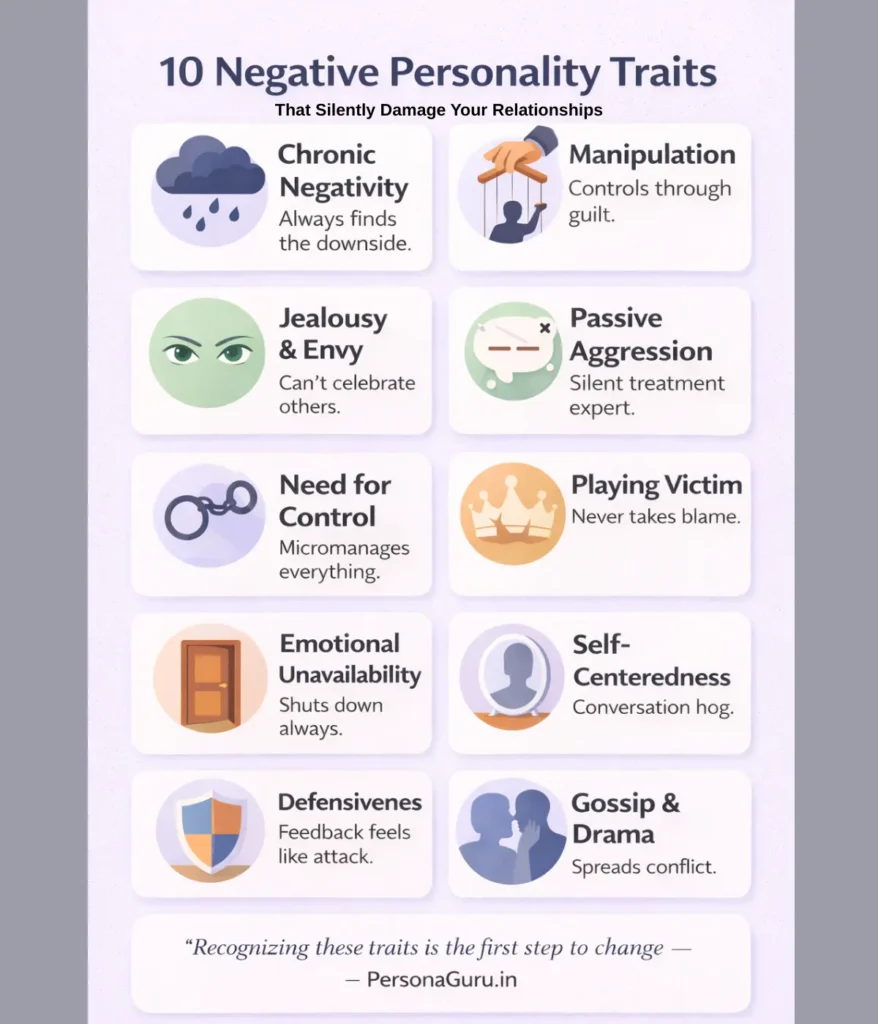
These are the most common toxic traits in yourself that quietly destroy relationships and inner peace. They also answer a closely related question that people often search for: What are the 10 negative attitudes of a person? Be honest with yourself as you read through.
1. Chronic Negativity
You always find the downside. Complaining is your default response. When a friend shares exciting news, your instinct might be, “That probably will not work out.” This drains everyone around you and trains people to stop sharing good things in your presence.
2. Manipulative Behavior
Using guilt, silence, or emotional pressure to control outcomes or other people’s behavior. This includes gaslighting, which makes someone question their own memory or perception. Ramani Durvasula, a leading researcher on toxic relationships, calls it one of the most psychologically damaging behaviors in any relationship.
3. Jealousy and Envy
Struggling to genuinely celebrate others’ success. Backhanded compliments. Quiet resentment that slowly poisons even your closest relationships from the inside.
4. Passive-Aggressive Communication
The silent treatment. Heavy sarcasm. Indirect digs instead of honest conversations. You avoid direct communication and then act like everything is fine. This builds enormous unspoken resentment on both sides.
5. The Need for Control
Micromanaging people and situations because uncertainty feels genuinely unsafe. It communicates deep distrust and stifles the freedom of everyone around you.
6. Playing the Victim
Every story ends with you being wronged and someone else as the villain. This pattern dodges accountability entirely and exhausts the people who care about you most.
7. Emotional Unavailability
Shutting down during deep conversations. Mocking sensitivity. The people closest to you feel alone even when you are physically present.
8. Self-Centeredness
Conversations always circle back to you. You listen to respond, not to understand. A consistent lack of empathy leaves others feeling invisible and unheard.
9. Defensiveness
Any feedback, even gently given, feels like a personal attack. Your instinct is to justify, deny, or counterattack: “But you do it too.” Relationship researcher John Gottman identifies defensiveness as one of the four key predictors of relationship breakdown.
10. Gossiping and Drama Creation
Bonding through negativity, rumors, and stirred-up conflict. It feels connected in the moment, but quickly destroys trust. People eventually learn they cannot safely confide in you.
These ten patterns also help answer another common question: What are the six traits of a bad character? Dishonesty, disrespect, irresponsibility, unfairness, lack of empathy, and absence of accountability. Most of the traits above contain one or more of these at their root.
Key takeaway: Spotting these in yourself is uncomfortable but powerful. Recognition, as John Gottman’s research shows, is always the first real step toward change.
What Is Your Biggest Toxic Trait? (An Honest Self-Assessment)
Your dominant toxic trait is usually the one you defend the most. It hides behind “That is just how I am.” It is the pattern quietly repeating in every failed relationship or friendship.
Answer these questions honestly. The one that makes you most uncomfortable is usually pointing to your biggest blind spot:
- Do people walk on eggshells around you?
- When someone hurts you, do you apologize or explain why they are wrong?
- Are you the common thread in your failed relationships?
- Do people avoid confronting you even when something is clearly wrong?
- Do you struggle to give a genuinely sincere apology?
- Does someone else’s success feel threatening to you?
- Do you hold grudges long after others have moved on?
- Do you justify hurtful behavior with “that is just me”?
- Do you need to win every argument?
- Is it genuinely hard to sit with being wrong even when the evidence is clear?
Three or more “yes” answers? Do not panic. Journal about one specific recent situation where the pattern showed up. Then ask a trusted person, “What makes closeness with me harder?” and listen without defending.
Key takeaway: Your biggest toxic trait is the one you feel most compelled to protect. Revisit these questions regularly as you do the work.
What Are 5 Negative Character Traits?
Some toxic traits go deeper than surface behavior. These five reflect core character patterns, and they answer a question many people search for: what are 5 negative things about yourself that matter most to address?
- Narcissism: Inflated self-importance combined with a lack of empathy. Exploits relationships without fully realizing the damage it causes.
- Habitual Dishonesty: A consistent pattern of small deceptions that slowly erodes all trust. Once established, even your truths become suspect.
- Lack of Accountability: Always blaming others. Never genuinely owning a mistake. This stalls your personal growth completely.
- Emotional Manipulation: Using guilt, fear, or pressure to control how others think, feel, or behave. It causes lasting psychological harm.
- Arrogance: Believing you are always right and others have little worth hearing. It pushes people away and signals deep insecurity underneath.
Key Takeaway: These five cause the most long-term damage. Recognizing them early in yourself creates the real possibility of change.
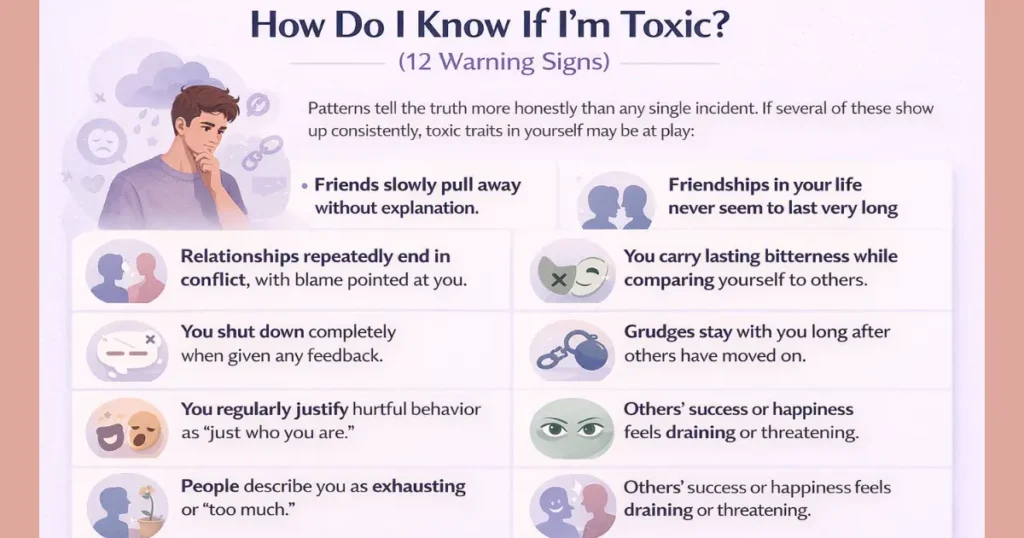
How Do I Know If I’m Toxic? (12 Warning Signs)
Patterns tell the truth more honestly than any single incident. If several of these show up consistently, toxic traits in yourself may be at play:
- Friends slowly pull away without explanation
- Relationships repeatedly end in conflict, with blame pointed at you
- You shut down completely when given any feedback
- You regularly justify hurtful behavior as “just who you are.”
- People describe you as exhausting or “too much.”
- You consistently position yourself as the victim in every story
- Friendships in your life never seem to last very long
- You carry lasting bitterness while comparing yourself to others
- Grudges stay with you long after others have moved on
- You need to win arguments rather than understand the other person
- Others’ success or happiness feels draining or threatening
- Taking genuine accountability feels impossible or deeply uncomfortable
For how these patterns show up in romantic partnerships, see our article on Toxic Personality Traits in a Relationship.
What Is Toxic Behavior? (Real-Life Examples)
Toxic behavior is rarely dramatic. It lives in small, repeated actions that quietly build into serious emotional damage.
- At home: Snapping over minor things, using silence as punishment, dismissing someone’s feelings as overreacting.
- In relationships: Controlling your partner’s decisions, emotional withdrawal when you don’t get your way, and keeping a mental score of past mistakes.
- At work: Taking credit for team efforts, subtly undermining colleagues, and constant criticism that chips away at morale.
What Are Examples of Toxic Habits?
Toxic habits are the small, daily versions of toxic behavior. Common ones include: chronic complaining, always needing the last word, interrupting constantly, guilt-tripping to get your way, checking a partner’s phone out of insecurity, and using humor to deflect accountability.
What Are the 8 Types of Toxic Relationships?
Understanding toxic behavior means knowing where it lands. The eight most recognized types of toxic relationships are: controlling, codependent, competitive, manipulative, one-sided, jealousy-driven, emotionally abusive, and enabling. Each is driven by one or more of the toxic traits covered in this guide.
What Are Some Toxic Characteristics? (Quick Self-Check)
These are the behaviors that push people away, even when you have no intention of doing so:
- Consistent lack of empathy for others’ feelings and experiences
- A constant need for external validation and approval
- Frequent emotional outbursts out of proportion to the situation
- Stonewalling, shutting completely down during conflict
- Habitual blame-shifting so that nothing is ever your fault
- Finding fault in others as a default way of relating
What Are 5 Examples of Traits? (Negative vs. Positive)
| Toxic Trait | Healthy Alternative |
| Defensiveness | Openness to feedback |
| Jealousy | Genuine celebration of others |
| Manipulation | Direct, honest communication |
| Victim mentality | Personal accountability |
| Arrogance | Humble confidence |
What Are Your Top 5 Positive Traits to Build?
Replace toxic patterns by intentionally growing these five: genuine empathy, honest accountability, emotional self-regulation, openness to feedback, and the ability to maintain consistent and reciprocal relationships.
How to Change Toxic Traits in Yourself: 7 Practical Steps
Awareness without action is just uncomfortable self-knowledge. Here is a practical plan that actually works:
Step 1: Acknowledge Without Shame
Say it directly to yourself: “Yes, I do this. And I am going to work on it.” Shame shuts growth down. Honest acknowledgment opens it.
Step 2: Identify the Root Cause
Ask: When did this pattern start? What was I protecting myself from?
Journal this prompt: “The first time I remember feeling this way was…” Understanding the origin removes much of its unconscious power over you.
Step 3: Practice Self-Compassion While You Change
Brené Brown’s research is clear. Shame is the least effective motivator for lasting behavioral change. Treat yourself the way you would treat a good friend who is genuinely trying to grow.
Step 4: Seek Honest Feedback
Ask someone you trust, “What is one thing I do that makes closeness harder?” Then listen without defending. You cannot see your own blind spots alone. This step is not optional.
Step 5: Set Boundaries With Yourself
- Gossip → Say something genuinely kind about that person behind their back instead
- Defensiveness → Ask “Help me understand what hurt you” before responding
- Control → Consciously allow flexibility in one small situation every single day
Step 6: Build Daily Self-Awareness Habits
At the end of each day, write down one situation where you could have responded better. One situation. That single habit, practiced daily, rewires your real-time awareness faster than almost anything else.
Daily journal prompts:
- What triggered me today and what was I really feeling underneath that reaction?
- Where did I react from fear or insecurity rather than genuine care?
- What would a healthier version of me have done differently?
Step 7: Consider Professional Support
Cognitive Behavioral Therapy (CBT) is especially effective for changing toxic thought patterns and habitual behaviors. For deeper patterns rooted in early trauma, professional support is the most efficient and compassionate path forward.
Helpful resources: Emotional Intelligence by Daniel Goleman | The Gifts of Imperfection by Brené Brown | Psychology Today Therapist Finder
Key takeaway: Viktor Frankl wrote, “Every human being has the freedom to change at any instant.” Small, consistent steps, not grand gestures, are how permanent transformation actually happens.

Final Thoughts
Identifying toxic traits in yourself is one of the most uncomfortable and most rewarding things you will ever do for your relationships and your peace of mind.
The moment you stop asking “Who hurt me?” and start asking “How can I grow?” is where your life genuinely shifts.
Growth is not about becoming perfect. It is about becoming aware, taking responsibility, and showing up differently, one interaction at a time.
Start today. At the end of this day, write down one situation where you could have responded more healthily. That single daily habit can transform your relationships over time.
FAQs
1. What are the three bad personality traits?
The Dark Triad includes Narcissism, Machiavellianism (strategic manipulation), and Psychopathy (emotional coldness). These three destroy trust and emotional safety in any relationship they enter.
2. What are 10 unhealthy habits linked to toxic traits?
Chronic gossiping, holding long grudges, blame-shifting, avoiding sincere apologies, habitual complaining, emotional manipulation, passive aggression, excessive need for validation, persistent victim-playing, and creating unnecessary drama.
3. What are the 5 main personality traits?
Psychology uses the Big Five model: Openness, Conscientiousness, Extraversion, Agreeableness, and Neuroticism. Toxic traits most commonly emerge from high Neuroticism and very low Agreeableness.
4. Can a toxic person truly change?
Yes, but only when the motivation is genuinely internal. Real change requires honest self-awareness, genuine accountability, and consistent effort over time. Therapy dramatically improves both the speed and durability of that change.
5. How do I know if I’m toxic or just struggling emotionally?
Emotional struggles usually involve self-withdrawal and internal suffering. Toxic patterns consistently harm or manipulate others. The two often overlap, and both deserve compassion and professional support.

Ayanshi | MBA (HR) & Personality Coach
MBA in HR | 250+ posts helping 50,000+ readers build confidence, emotional intelligence, and healthy relationships. Over 3 years transforming real-life experience into practical, proven growth strategies.
From corporate HR professional to full-time blogger sharing actionable personal development insights.