

They never say they are angry. They just go quiet. They agree to your face and disappear when it is time to follow through. And somehow, you always end up feeling like the problem.
Passive-aggressive personality traits are difficult to spot because the anger is never direct. There is no argument. No confrontation. Just silence, delay, sarcasm, and emotional distance, leaving you confused and questioning yourself.
This pattern shows up in relationships, families, and workplaces. And the people on the receiving end often spend months wondering what they did wrong before they realize the problem was never theirs to fix.
In this article, you will learn what passive-aggressive personality traits really are, what causes them, how to recognize the signs, and what you can actually do about them.
Just like other toxic personality traits, passive-aggressive behavior follows a clear pattern once you know what to look for.
What Does Passive-Aggressive Actually Mean?
Passive-aggressive behavior is indirect anger. Instead of saying “I am upset,” a person expresses that frustration through silence, avoidance, sarcasm, or deliberate inaction.
The definition is simple: it is hostility that wears a calm face.
The important thing to understand is the difference between doing this occasionally and it being a consistent pattern. Everyone avoids a difficult conversation sometimes. But passive-aggressive personality traits mean this is the default way someone handles conflict — every time, with most people, across years.
Psychologist Scott Wetzler, who has researched this behavior extensively, puts it this way:
“Passive aggression is anger that has gone underground.”
It is worth noting that passive-aggressive personality disorder was removed from the DSM-5 as a standalone diagnosis. However, clinical research confirms these traits are still widely present and cause real damage in relationships and mental health. Studies show passive-aggressive behaviors appear in patients with adjustment disorders, mood disorders, and anxiety-related conditions at significant rates.
According to Psychology Today, passive-aggressive behavior is one of the most difficult patterns to identify because it is designed to hurt and confuse without leaving obvious evidence.
6 Passive-Aggressive Personality Traits
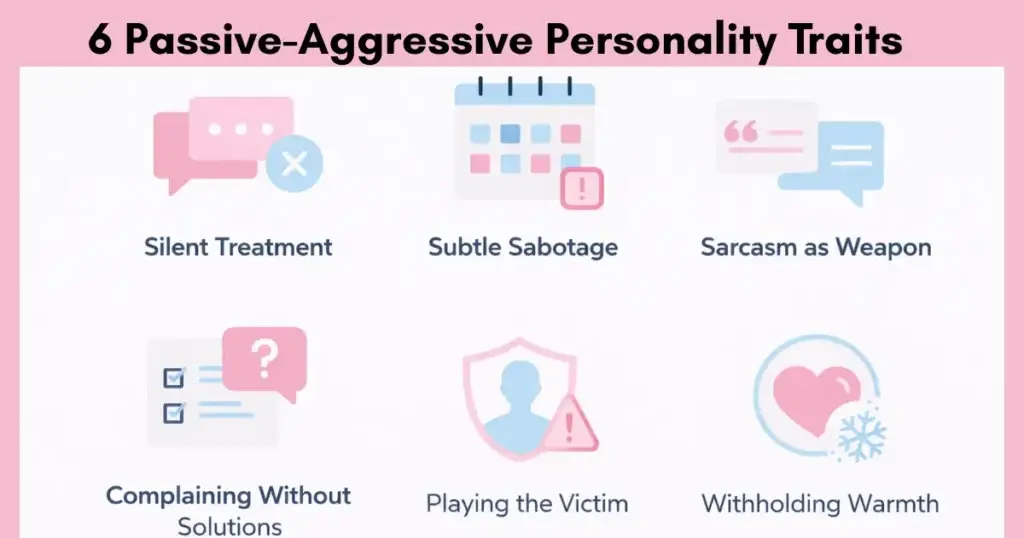
1. Silent Treatment
This is one of the most common passive-aggressive personality traits and one of the easiest to miss at first.
Characteristics:
- Goes completely quiet without explaining why
- Says “nothing is wrong” when clearly something is
- Creates anxiety by making you guess what happened
Example: You ask, “What is wrong?” They say “Nothing.” But they have not had a real conversation with you in three days. You replay every interaction, trying to figure out what you did. That confusion is the point.
2. Subtle Sabotage
They agree to do something and then make sure it does not get done, or gets done badly. This is a common example of workplace passive-aggression.
Characteristics:
- Agrees to tasks but delivers late or poorly on purpose
- Procrastinates on things that matter to you
- Acts completely innocent when you bring it up
Example: They said they would handle it. The deadline passed. “I completely forgot.” But they remembered every other commitment that week without a problem.
To understand self-sabotage more deeply, read our article on Self-Sabotage Meaning in 2026: Causes and Solutions.
3. Sarcasm Used as a Weapon
This is where passive-aggressive communication becomes most visible. Criticism is wrapped inside a joke, so it cannot be directly addressed.
Characteristics:
- Backhanded compliments disguised as praise
- “I was just joking” when called out
- Comments that leave you unsure whether to be upset
Example: “Wow, you actually finished on time. I was not expecting that.”
When you react, they say you are too sensitive. When you do not react, the behavior continues.
4. Complaining Without Ever Wanting a Solution
Every suggestion you make gets rejected. This is not about solving the problem — it is about staying stuck and keeping you engaged.
Characteristics:
- Has a “but” for every idea you offer
- Keeps venting without taking any action
- Rejects help while continuing to complain
Example: You offer five different suggestions. Each one gets “yeah, but that won’t work.” After a while, you realize solving the problem was never the goal. The goal was your attention and your guilt.
5. Playing the Victim
When you raise an issue with their behavior, they immediately become the ones who are hurt. The original concern disappears, and now you are managing their feelings.
Characteristics:
- Frames every confrontation as you attacking them
- Uses guilt to shut down honest conversations
- Never takes responsibility for their part
Example: “I guess I just can’t do anything right for you.”
Now you are consoling them instead of addressing what actually happened.
This behavior overlaps closely with manipulative personality traits, where emotional reversal is used as a control tool.
6. Withholding Warmth
Instead of talking about what is bothering them, they pull back emotionally. Affection, attention, and kindness become tools for punishment.
Characteristics:
- Pulls back warmth and affection when upset
- Gives one-word answers and minimal engagement
- Never directly says what is wrong
Example: You had good news and wanted to share it. They gave short answers and looked elsewhere. You went to bed wondering what you did. That emotional withdrawal was deliberate, even if they would never admit it.
What Causes Passive-Aggressive Behaviour?
Most passive-aggressive behavior starts in childhood.
When someone grows up in a home where expressing anger is unsafe, punished, or simply not modeled as acceptable, they learn to hide it. Anger does not disappear — it just goes sideways.
Psychologist Tim Murphy explains it this way:
“People who grow up in families where anger was forbidden learn to express it indirectly.”
Research published in 2021 found that passive-aggressive behavior is linked to symptoms of depression, anxiety, and low self-esteem across multiple studies.
This connects to what psychologists call Attachment Theory. When direct communication feels risky because of unpredictable parents, high-conflict homes, or emotional neglect, children develop indirect ways of expressing their needs and frustrations. Those patterns follow them into adult relationships.
Do passive-aggressive people know what they are doing?
Sometimes yes, sometimes no.
Some people use it consciously as a strategy. Others genuinely do not see the pattern; they only know they feel angry and cannot say it directly. Research links passive-aggressive behaviour to depression, anxiety, low self-esteem, and fear of confrontation.
What Personality Type Is Passive-Aggressive?
Passive aggression is not tied to one specific personality type. It shows up across different personalities, particularly in people who struggle with emotional regulation, conflict tolerance, and direct self-expression.
Is it connected to narcissism? Sometimes, but not always. The overlap happens when a narcissistic person uses passive-aggressive tactics to maintain control without appearing aggressive. But passive aggression on its own does not mean someone is narcissistic.
You can read more about the specific overlap in our article on narcissistic personality traits.
Is it a personality disorder? No. The DSM-5 removed passive-aggressive personality disorder as a standalone diagnosis because of its overlap with other conditions. However, these traits remain clinically significant and do real damage in relationships and mental health when left unaddressed.
Is it immature behavior? From a psychological standpoint, yes — because it replaces honest communication with avoidance. That does not mean people who do it are bad people. It usually means they never learned a better way.
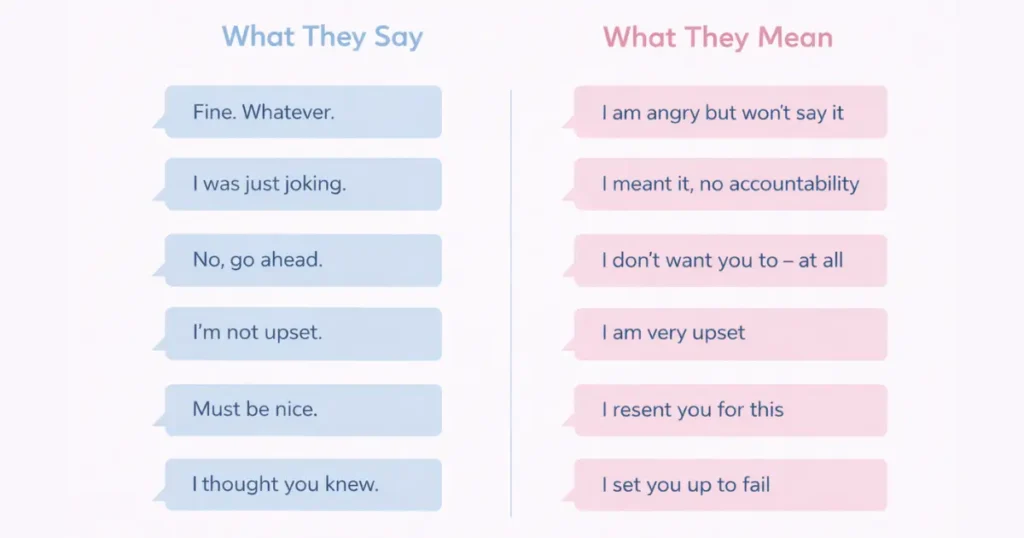
What Do Passive-Aggressive People Actually Say?
Understanding passive-aggressive communication means reading between what is said and what is meant.
| What They Say | What They Actually Mean |
| “Fine. Whatever.” | I am angry but will not say it |
| “I was just joking.” | I meant it and want no accountability |
| “No, go ahead.” | I do not want you to — and I will bring this up later |
| “I’m not upset.” | I am very upset |
| “Must be nice.” | I resent you for this |
| “I thought you knew.” | I set you up to fail |
The most passive-aggressive thing someone can say is often what they do not say at all, the feeling they refuse to put into words.

How to Deal with a Passive-Aggressive Person
You do not need to decode everything they do. You need to stop getting pulled into the confusion.
Stay calm. Reacting emotionally gives them the confirmation that their behavior is working. A neutral, steady response removes that reward.
Name the behavior, not the person. Instead of “You are being passive-aggressive,” try: “It seems like something is bothering you. I am happy to talk when you are ready.” This is direct without being an attack.
Stop trying to guess what they mean. Respond only to what is actually said. When you stop trying to decode hidden messages, the dynamic shifts. They either have to say what they mean, or the conversation ends on your terms.
Set clear boundaries. Decide what you will and will not accept, and follow through consistently. “If this keeps happening, I am going to handle it this way.” Then do exactly that.
Is passive aggression a form of bullying? In many cases, yes. Silent treatment, deliberate sabotage, and emotional withdrawal used as control cause real psychological harm even without a single raised voice.
For a full guide on protecting yourself, read our article on setting boundaries with toxic people.
What Happens Long-Term If This Goes Unaddressed?
For the person on the receiving end, living with unaddressed passive-aggressive personality traits creates a specific kind of exhaustion. You start questioning your own perceptions. You walk on eggshells. You over-explain and over-apologize without knowing why.
Over time, this leads to chronic self-doubt and emotional burnout. Your nervous system stays on high alert, constantly trying to read between the lines of someone who refuses to speak directly.
For the passive-aggressive person, the long-term effects include damaged relationships, chronic dissatisfaction, and an inability to experience real closeness because real closeness requires honest communication.
Can passive-aggressive people change? Yes, but only with genuine self-awareness and consistent effort. Change has to come from them. Therapy, particularly cognitive behavioral therapy, helps people learn direct communication skills that replace the passive-aggressive patterns they developed early in life.
To understand more about how and when personality patterns shift, read our article on whether toxic personality traits can actually change.
Conclusion
You cannot force someone to communicate directly. But you can stop letting their confusion control how you feel about yourself.
Recognizing passive-aggressive personality traits is not about labeling someone. It is about understanding what is actually happening so you can stop taking responsibility for behavior that was never yours to fix.
Their inability to express anger directly is not a reflection of your worth.
Clarity is your protection.
To see how these traits connect to the wider picture, read our complete guide on toxic personality traits.
If this helped you name something you have been feeling for a long time, share it with someone who might need this clarity today.
FAQs
1. What are passive-aggressive personality traits?
Passive-aggressive personality traits are patterns of indirect anger, including silent treatment, subtle sabotage, sarcasm, victim-playing, and emotional withdrawal, used instead of direct communication about feelings or needs.
2. What is the root cause of passive-aggressive behavior?
Most passive-aggressive behavior develops in childhood, in environments where expressing anger directly felt unsafe or was punished. It becomes a learned pattern of hiding frustration rather than expressing it openly.
3. Do passive-aggressive people realize what they are doing?
Sometimes yes, sometimes no. Some people use it consciously as a strategy. Others follow an automatic pattern and genuinely do not recognize their own behavior until it is pointed out — often in therapy.
4. Is passive aggression a personality disorder?
No. The DSM-5 removed passive-aggressive personality disorder as a standalone diagnosis. However, these traits remain clinically significant and can seriously affect relationships and mental health when they become a consistent pattern.
5. How can I set boundaries with passive-aggressive people?
Stay calm, respond only to what is directly said, name behaviors without personal attacks, and follow through on consequences. The key is to stop trying to decode what they mean and start responding only to what they actually say.

Ayanshi is the founder of PersonaGuru.in, a blog focused on personality development, career, relationships, and mental well-being. With over 3 years of writing experience, she turns psychology and everyday experiences into practical, easy-to-understand advice for real life.