
Last updated on August 10th, 2026 at 07:01 am
Emotional intelligence in personality development is the one skill that decides whether your other strengths, confidence, discipline, communication, actually work in your favor. Most people think personality is fixed. You are either confident or shy, patient or short tempered, and that is that. But personality development research tells a different story.
The traits people notice most, how calm you stay under pressure, how well you read a room, how you handle disagreement, are shaped, day after day, by this one underlying skill. This guide breaks down what emotional intelligence in personality development actually looks like in real situations, not just in theory, and gives you a practical way to build it over the next eight weeks.
Direct Answer Box
Emotional intelligence in personality development works by training four connected abilities: noticing your own emotions, managing your reactions, reading other people accurately, and handling relationships with skill. A person with strong emotional intelligence does not just feel calmer. Their personality becomes steadier, more trustworthy, and easier to work with, because their behaviour stops swinging with their mood.
Key Takeaways
- Emotional intelligence has four core parts: self-awareness, self-management, social awareness, and relationship management.
- The World Economic Forum’s Future of Jobs Report 2025 places empathy, active listening, and self-awareness among the top ten skills employers want, based on a survey of 14 million workers across 55 economies.
- Emotional intelligence is not the same as emotional suppression. Suppression drains energy. Real emotional intelligence saves it.
- A short daily practice, not a personality overhaul, is what actually builds EQ over time.
- Personality traits like confidence or leadership only work well when emotional intelligence supports them.
Kabir joined his first job at a Bangalore startup three months ago. He is sharp, he finishes work on time, and his manager likes his output. But in every team meeting, the moment someone questions his idea, his tone changes. He interrupts. Then he goes quiet for the rest of the discussion. Nobody has told him this directly, but he has noticed people choosing their words carefully around him now.
Kabir does not have a skills problem. He has an emotional intelligence problem, and it is quietly shaping how his personality is read by everyone around him.
This is the part most articles on emotional intelligence skip. They explain the theory, list the components, and stop there. This guide connects emotional intelligence to something more specific: how it actually builds, or damages, the personality other people experience when they deal with you.
What Is Emotional Intelligence in Personality Development?
Emotional intelligence in personality development is the ability to notice your emotions, manage them well, and use that awareness to build stronger relationships. Psychologist Daniel Goleman, who popularised the concept in the 1990s, argued that the ability to manage feelings mattered as much as raw intellect in determining how far a person goes in life. Decades of workplace research since then have backed that claim up.
Personality development is often described as building confidence, communication, or leadership. But underneath all three sits one skill that decides whether the others land well: emotional regulation. A confident person who cannot manage frustration comes across as arrogant. A good communicator who cannot read the room comes across as tone deaf. Emotional intelligence is the layer that decides whether your other personality traits help you or work against you.
Connection Between Emotional Intelligence and Personality Development
Emotional intelligence influences personality development by changing how a person responds to everyday situations. This shows up in a few specific ways:
- Confidence stays respectful. A person may naturally be confident, but emotional intelligence decides whether that confidence holds its shape under disagreement, instead of turning into defensiveness or arrogance.
- Communication becomes sharper. Recognizing frustration in the moment, reading another person’s reaction, and adjusting tone accordingly makes communication skills far more effective than they would be without that awareness.
- Small behaviors compound into personality. These are not one-time actions. Repeated over weeks and months, they become the pattern other people actually experience as your personality.
Why Employers Now Rank Emotional Intelligence Above Technical Skill
According to the World Economic Forum’s Future of Jobs Report 2025, which surveyed employers representing 14 million workers across 55 economies, empathy, active listening, motivation, and self-awareness all rank inside the top 10 of 26 core workplace competencies. Analytical thinking still leads the list, but the report is clear that technical skill alone no longer decides who succeeds.
Ron Siegel, assistant professor of psychology at Harvard Medical School, explained in a Harvard Gazette interview on workplace emotional intelligence that emotional intelligence is a distinct kind of intelligence, separate from the analytical smarts most of us grew up being tested on. As artificial intelligence takes over more routine technical work, this human layer of skill is becoming harder to automate and easier to notice by its absence.
Nowhere is this shift more visible than in management roles. For a closer look at why this matters specifically for people managing teams, see Emotional Intelligence in Leadership: Why It’s Important for Success.
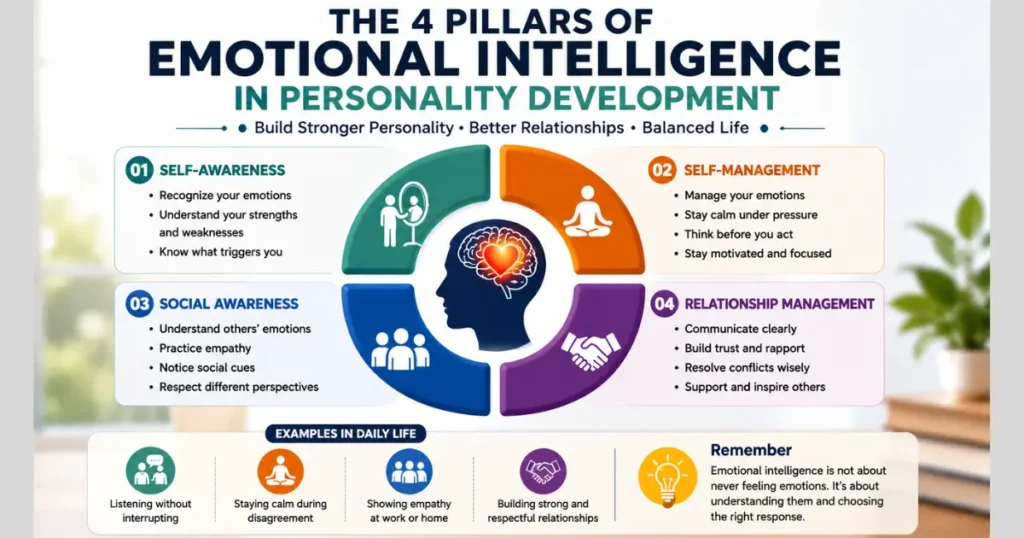
Four Abilities That Make Up Emotional Intelligence
1. Self-Awareness:
Self-awareness means catching an emotion while it is still small, before it decides your behaviour for you. Naina, a college topper preparing for her CAT exam, used to freeze completely during mock tests. It took weeks of journaling after each test to spot a pattern. Her freeze was not about the questions. It showed up specifically during time pressure sections, and it started as a tightness in her chest two minutes before she noticed it in her thinking.
Once she could name that physical signal early, she built a small ritual around it: a slow exhale and a five second pause before starting any timed section. Her scores did not jump because she suddenly understood the syllabus better. They jumped because she stopped losing the first ninety seconds of every section to a feeling she could not previously name.
Self-awareness is the foundation the other three abilities are built on. If you want to see how it plays out differently across each type, 4 Types of Emotional Intelligence & How to Improve Them breaks the full model down type by type.
2. Self-Management:
Self-management includes emotional regulation, impulse control, and choosing a deliberate response instead of an automatic one. Kabir’s story from the opening is a self-management gap. He feels criticised, and within two seconds that feeling becomes an interruption or a shutdown. There is no space in between for a choice.
Building that space is trainable, not something you either have or do not. A simple technique is to pause for a few seconds before responding when you feel a strong reaction rising. It sounds almost too simple to matter. In practice, it is often the entire difference between a reactive comment you regret and a considered one that keeps your credibility intact.
This kind of discipline is closely linked to how controlling the mind helps in personality development, which goes deeper into techniques for slowing down an automatic reaction.
3. Social Awareness:
Social awareness is picking up on what a person communicates without words. In Indian workplaces and families, a lot of communication happens this way. Someone saying “it is fine” in a flat tone. A family member going unusually quiet at dinner. A colleague who stops asking questions in meetings they used to be vocal in.
This ability is harder to build over video calls, where tone and body language get compressed into a small window and often lost entirely on a bad connection. Teams working remotely often need to compensate deliberately, by checking in with a direct question rather than assuming silence means agreement.
Empathy sits at the centre of this ability. If you want a closer look at how it develops, 7 Ways Empathy Shapes Your Personality Development breaks down the mechanics in more depth.
4. Relationship Management:
Relationship management is where the first three abilities get used. It shows up in how you deliver hard feedback, how you resolve a disagreement without it turning personal, and how you keep a relationship intact even when you disagree strongly with the other person.
Aryan, a team lead at a Pune manufacturing firm, had two engineers who disagreed constantly in planning meetings. Instead of picking a side or avoiding the topic, he started restating each person’s point before responding to it. “So you are saying the deadline is unrealistic because of the vendor delay, and you are saying we can absorb it if we start testing early. Is that right?” This one habit, repeated over a few months, cut the friction in half. Neither engineer felt unheard, and the meetings stopped turning into standoffs.
This restate-before-respond habit is a direct extension of good communication practice. For a wider set of techniques, see Role of Communication in Personality Development.
Emotional Intelligence vs Emotional Suppression: What Is the Difference?
A common mistake in Indian workplaces and families is confusing emotional intelligence with emotional suppression. They look similar on the surface. Both can produce a calm exterior. But they work completely differently underneath, and one of them causes long term damage.
| Aspect | Emotional Intelligence | Emotional Suppression |
|---|---|---|
| What happens internally | The emotion is noticed and processed | The emotion is pushed down and ignored |
| Energy cost | Low once practised | High, because the feeling has to be actively held back |
| Long term effect | Better relationships, steady personality | Burnout, sudden outbursts, resentment |
| Example | Naming frustration, then choosing a calm response | Smiling through frustration until it explodes later |
If your calm is costing you energy every single day, it is very likely suppression, not emotional intelligence. This distinction matters because a lot of personality development advice accidentally teaches suppression while calling it composure.
How to Build Emotional Intelligence: A Practical Weekly Plan
Reading about the four abilities does not build them. Practice does. Here is a plan that works because it targets one ability at a time instead of trying to improve all four at once.
- Week 1 and 2, build the awareness habit. Every evening, write down one moment where an emotion clearly influenced your behaviour. Do not judge it, just record it.
- Week 3 and 4, practice the pause. Use the ten second rule in any conversation where you feel a reaction rising. Aim for a two to three second delay before you respond.
- Week 5 and 6, practice reading, not assuming. In three conversations each week, ask one clarifying question instead of assuming you understand the other person’s tone or intent.
- Week 7 and 8, practice the restate before respond habit. In any disagreement, restate the other person’s point in your own words before giving your response, exactly as Aryan did with his engineers.
Habits like journaling and the pause technique work best alongside broader discipline. If you want a structured framework for building habits that stick, How to Build Willpower is a useful next read. For a shorter, checklist-style version of these habits, Powerful Tips to Boost Your Emotional Intelligence covers additional quick wins not included here.
Common Mistakes That Quietly Undo Emotional Intelligence
- Treating self-awareness as a one time insight instead of a daily habit. Recognising a pattern once during a hard week does not mean it stays recognised.
- Confusing being agreeable with being emotionally intelligent. Saying yes to avoid conflict is not social awareness. It often skips the honest conversation that awareness was supposed to lead to.
- Practising the pause only in low stakes situations. The ten second rule matters most exactly when it feels hardest to use, in the meeting where you feel attacked or the argument where you feel certain you are right.
- Ignoring how emotions show up in the body. Naina’s breakthrough came from noticing chest tightness before the thought itself. Most people skip this physical layer entirely.
These mistakes show up most often close to home, not just at work. For a focused look at applying these same four abilities in personal relationships, see How to Build Emotional Intelligence for Relationships.
Final Thought
Kabir’s story is not unusual. Most people never get direct feedback about how their emotional reactions shape their reputation. They only notice the effect, colleagues going quiet, friends pulling back, without ever connecting it to the cause.
Emotional intelligence in personality development is not about becoming a different person. It is about closing the small gap between what you feel and how you act on it. That gap, closed a little more each week, is what actually builds a personality people trust.
Frequently Asked Questions About Emotional Intelligence in Personality Development
1. Is emotional intelligence the same as being calm all the time?
No. A person can be emotionally intelligent and still feel anger, disappointment, or anxiety. The difference lies in what happens between feeling the emotion and acting on it, not in whether the emotion appears at all.
2. Can emotional intelligence be developed after childhood, or is it fixed early?
Yes. Emotional intelligence can be developed at different stages of life. Skills such as self-awareness, emotional regulation, empathy, and relationship management can improve through deliberate practice and honest feedback, which is why structured habits like journaling and the pause technique work even for adults who have never focused on this skill before.
3. How is emotional intelligence different from personality traits like extroversion?
Personality traits describe your natural tendencies, such as how much social interaction energises or drains you. Emotional intelligence describes a skill set that works alongside any personality type. An introvert and an extrovert can both have high or low emotional intelligence.
4. Why do some intelligent, hardworking people still struggle with emotional intelligence?
Academic or technical intelligence and emotional intelligence draw on different abilities. A person can excel at problem solving and still lack the self-awareness or social awareness needed to manage relationships well, simply because these skills were never specifically practised.
5. What is the fastest way to see improvement in emotional intelligence?
The self-management pause, counting to ten before responding in a charged moment, tends to show visible results the fastest, because it directly interrupts the pattern that causes most relationship damage.

Ayanshi is the founder of PersonaGuru.in, a blog focused on personality development, career, relationships, and mental well-being. With over 3 years of writing experience, she turns psychology and everyday experiences into practical, easy-to-understand advice for real life.