
There is a particular kind of frustration that builds when you have clearly said no to someone, and they have looked you in the eye, nodded, and then done the exact same thing a week later. You replay the conversation in your head. Was I too soft? Too vague? Should I have said it differently?
The answer is none of those things. The real problem seldom lies in what you said. It lives in what came after, whether crossing your limit had any real consequence at all.
Most people treat setting boundaries with toxic people like a one-time conversation. Say the right thing clearly enough, and the person will finally get it. That is not how it works. Setting boundaries with toxic people is less about the speech and more about the steady, quiet action that follows it. This guide covers that part.
Key Takeaways
- Setting boundaries with toxic people means deciding what you will do, not what you hope they will stop doing
- Over-explaining your boundary hands the other person something to argue against
- Some people will not change regardless of how clearly or calmly you communicate
- Pulling back from someone does not always require a confrontation or formal announcement
- Guilt after setting a limit is extremely common and does not mean you did something wrong
What Counts as Toxic Behavior and What Does Not
The word “toxic” is used these days loosely, sometimes to describe anyone who disagrees with us or is having a rough week. That makes it harder to spot the real thing when it shows up. When we talk about setting boundaries with toxic people, we are talking specifically about patterns of behavior that consistently damage your mental and emotional well-being over time, not isolated incidents.
According to Mental Health America, toxic relationships are defined by a steady lack of support, regular disrespect, and a persistent feeling of walking on eggshells around the other person. One bad month does not make someone toxic. A repeating pattern does.
For the full breakdown, read our guide on toxic personality traits.
4 Behaviors Worth Paying Attention To
1. Blame always lands on you
You raise a valid concern, and by the end of the conversation, you are the one apologizing. Therapists call this DARVO, which stands for Deny, Attack, Reverse Victim and Offender. You came in with a concern and left defending yourself.
2. Your feelings get treated as the problem
You explain that something hurt you, and they come back with “you are way too sensitive” or “you always overreact.” Your reasonable response gets reframed as the issue. Over time, this makes people stop trusting their own instincts.
3. They act like previous conversations never happened
You asked them not to call after 9 pm. They agreed. Your phone rings at 10:30 the following week. Therapist Harriet Lerner, author of The Dance of Anger, notes this kind of selective amnesia is rarely accidental. It is a way of testing whether your limits are real.
4. You consistently feel worse after spending time with them
Not occasionally, but as a steady pattern. Tired, smaller, confused, or vaguely guilty. That cumulative effect is worth taking seriously.
Why Boundaries Fail with Toxic People
A 2025 survey by the Thriving Center of Psychology found that 72% of Americans struggle to maintain healthy limits in their relationships. The most common reason was not a lack of confidence. It was guilt, followed closely by not knowing what to do when someone pushes back hard.
Most people who struggle with setting boundaries with toxic people are not doing it wrong because they are weak. They are doing it wrong because nobody explained why limits collapse in the first place.
3 Mistakes That Keep Quietly Undoing Your Efforts
1. Giving too much explanation
You set a limit and then justify it at length because you want the other person to understand and agree. The problem is that every reason you give becomes something they can argue against. “I cannot come over this weekend because I am tired” becomes a debate about whether you should be tired. The cleaner version is “I am not available this weekend.” There is nothing there to argue with.
Dr. Ramani Durvasula, a clinical psychologist who specializes in narcissistic abuse, says it directly: the moment you start justifying a boundary, you have turned a decision into a negotiation.
2. Setting limits when you are already emotional
If you are visibly upset when you speak, the other person stops hearing your words and starts reacting to your tone. The conversation shifts from your limit to your “outburst.” Wait until you are calm. Not cold, just settled. The same words land very differently in a calm place.
3. Not following through the first time it is tested
This one quietly undoes everything. When you set a consequence and then back down the first time, you have taught the other person that your limits are movable. The next round of pushing will be harder. Consistency is not about being rigid. It is about being believable.
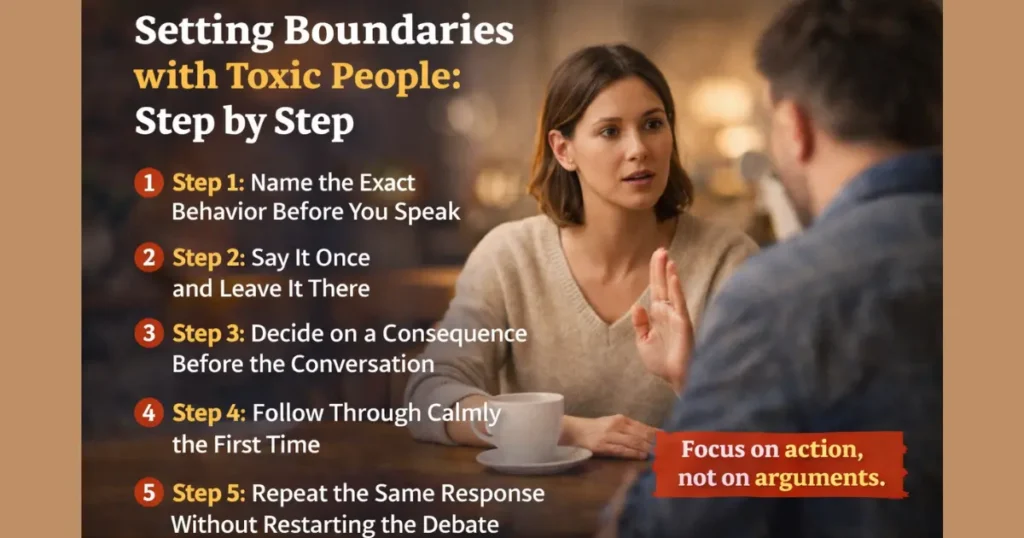
Setting Boundaries with Toxic People: Step by Step
These steps come from cognitive behavioral therapy practice and from what genuinely works for people navigating difficult relationships. None of them requires confrontation or a prepared speech.
Step 1: Name the Exact Behavior Before You Speak
Before you say anything, write down what is actually bothering you. Not a character judgment but a specific action.
| What people often say | What actually works |
|---|---|
| You never respect me | You go through my phone without asking |
| You are so controlling | You changed our plans on the day without checking with me |
| You are so manipulative | You bring up old arguments when we are discussing something completely different |
Specific behavior leads to a specific, workable limit. Vague complaints lead to circular arguments.
Step 2: Say It Once and Leave It There
One sentence. No apology attached, no lengthy explanation. Real examples of setting boundaries with toxic people that actually hold:”
- “I will not be discussing my finances with you.”
- “If you raise your voice, I am going to hang up the call.”
- “I am not in a position to lend money.”
- “I need at least a day’s notice if plans are going to change.”
If they ask why, “Because that is what I need” is a complete answer.
Step 3: Decide on a Consequence Before the Conversation
A boundary without a consequence is a suggestion. Before the conversation, know exactly what you will do if the line is crossed.
- Leave the room
- End the call
- Stop responding for the rest of that day
- Cut the visit short
- Take a break from contact for a set period
It has to be something you will genuinely follow through on. Do not say it if you will not do it.
Step 4: Follow Through Calmly the First Time
They will test it. That is almost guaranteed. When it happens, carry out the consequence you said you would, quietly and without drama.
Example:
You told your sister that if she brings up your weight at family dinners you will excuse yourself from the table. She does it. You put your napkin down, say “I am going to take a minute,” and walk to another room. No scene. No speech. Just the action you said you would take.
The calmer you are, the less rewarding it is for someone who relies on emotional reaction. You are not punishing them. You are simply doing what you said you would do.
Step 5: Repeat the Same Response Without Restarting the Debate
Once is enough. After that, a short and consistent reply covers it.
“As I mentioned, I am not going to discuss this.”
Then stop. No new reasoning, no fresh argument. When someone hears the same calm response several times, they start to accept that the subject is closed. It takes repetition, but it works.
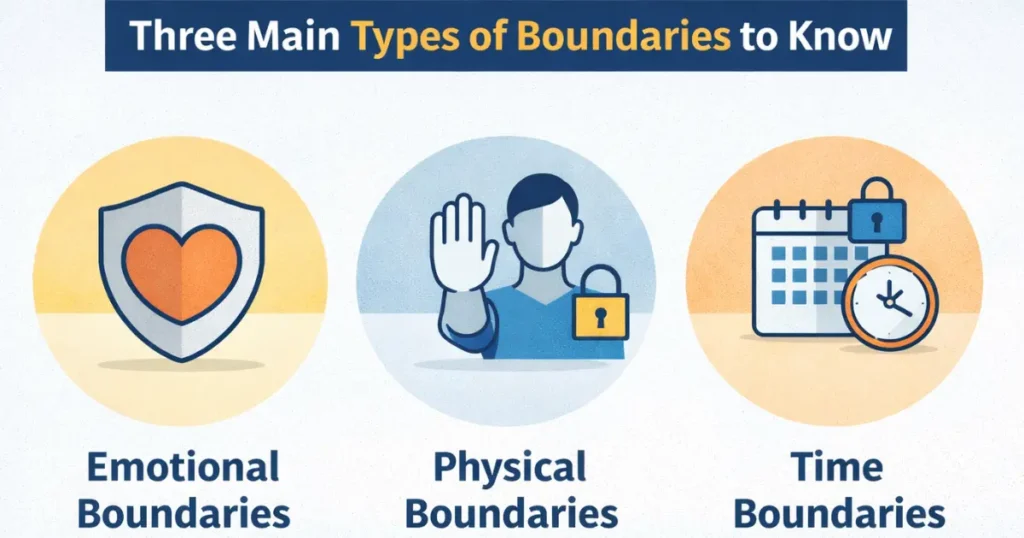
Three Main Types of Boundaries to Know
When setting boundaries with toxic people, it helps to know which type of limit you are dealing with so you can be specific about what you need.
- Emotional boundaries: Protecting your feelings, mental space, and how much you share with someone. Example: “I will not be discussing my personal problems with you.”
- Physical boundaries: Your personal space, body, and belongings. Example: “Please do not go through my things without asking.”
- Time boundaries: How and when someone can access your time and attention. Example: “I do not take calls after 9 pm.”
Boundaries with Unavoidable Toxic People
Not every toxic person in your life is someone you can walk away from easily. Some are a parent, a sibling, a coworker, or a manager. When that is the case, setting boundaries with toxic people is not about fixing the relationship. It is about protecting your own experience of it.
Gray Rock Method
The gray rock approach means becoming deliberately uninteresting to the other person. Short, factual, neutral answers only. No personal updates. No emotional reactions, positive or negative.
A lot of difficult behavior is driven by the need for emotional response. When you stop providing that consistently, many people naturally shift their attention elsewhere.
In practices it looks like this:
- A coworker fishing for personal information: “Things are fine, thanks. Did the project deadline get moved?”
- A family member trying to start an argument at dinner: “Interesting point. Can you pass the bread?”
It feels odd at first. Give it time.
Dealing with this in a professional setting? Read our guide on toxic people at work.
Reduce Contact Without Making a Declaration
You do not always need a formal conversation to create distance. Responding to non-urgent messages more slowly, shortening visits, and stopping the habit of volunteering personal updates are all quiet adjustments that add up. None of them requires an announcement or a confrontation you are not ready for.
When Setting Boundaries with Toxic People Does Not Seem to Change Anything
This is the part most guides avoid because it is uncomfortable. Some people will not respect your limits, no matter how clearly or consistently you hold them. That has nothing to do with how well you communicated. It reflects their capacity, not yours.
Research in personality psychology points to what is called the Dark Triad: narcissism, Machiavellianism, and psychopathy. People who score high in these traits tend to understand limits intellectually but feel no real motivation to honor them. The empathy that makes most people care about how their actions affect someone else is either absent or significantly reduced.
read more: 12 traits of a narcissist: Protect Yourself Today!
A 2025 review in Personality and Social Psychology Review found that people with high narcissistic traits showed 45% higher rates of boundary violations in close relationships compared to the general population.
When you are dealing with someone like this, you are looking at two honest options. Accept the relationship as it is, knowing it is unlikely to change, or create enough distance that it stops significantly affecting your daily life. Both are harder than hoping for a breakthrough. Both are more realistic than waiting for the right conversation to finally land.
For more on the psychology behind these patterns, read our guide on toxic personality traits in a relationship. For practical daily strategies when you cannot cut contact, see our guide on how to deal with toxic personality traits.
Conclusion
Go back to the beginning. The person who kept crossing the line after you said no was not confused about what you wanted. They were figuring out whether there was any real cost to ignoring you.
Setting boundaries with toxic people works when it is grounded in your own behavior, not in the hope that the other person will eventually get it. When you shift from “I need you to stop doing this” to “this is what I will do if it happens again,” the whole dynamic changes. You stop waiting for their permission to protect yourself.
It will feel uncomfortable at first, especially if you have spent years putting other people’s comfort ahead of your own. That discomfort is not a sign you are doing something wrong. It is just what it feels like to do something new. Start with one small, specific limit. Follow through once. Then again. It builds from there.
Which step felt hardest to read? Drop it in the comments below. And if someone you know is dealing with this right now, send it their way.
FAQs
1. What are the 3 C’s of boundaries?
The three C’s are Clear, Calm, and Consistent. When setting boundaries with toxic people, your limit needs to be stated clearly so there is no room for misinterpretation, delivered calmly so the conversation stays on your actual words rather than your tone, and maintained consistently so the other person learns it is not going to shift.
2. What are the 4 toxic behaviors to watch out for?
The four behaviors that most reliably indicate a toxic dynamic are blame-shifting, where every disagreement ends with you apologizing; emotional invalidation, where your feelings are treated as overreactions; selective memory, where limits you have stated get ignored as if never voiced; and consistent energy drain, where you reliably feel worse about yourself after spending time with them.
3. Why do I feel guilty after setting a boundary?
Guilt after setting a boundary is extremely common, particularly for people who grew up in households where prioritizing their own needs was not encouraged. Research from the Lukin Center for Psychotherapy suggests many people develop automatic guilt responses that fire the moment they put themselves first. That guilt is a learned reaction. It is not evidence that your boundary was wrong.
4. What triggers a toxic person when you set a limit?
Toxic people, particularly those with narcissistic patterns, often experience a boundary as a personal rejection or a threat to their control. This is why they push back, argue, or guilt-trip. They are not reacting to your words. They are reacting t
5. How long does it take for a boundary to actually work?
There is no fixed timeline. Some people adjust within a few consistent interactions. Others push harder for weeks before accepting that a limit is real. What matters most is not the speed of their adjustment but the consistency of yours. Every time you follow through, you reinforce that the boundary is not negotiable.
6. Can a toxic person change?
Some people do change, usually when they genuinely want to and have access to support like therapy. But change that sticks almost always comes from internal motivation, not from repeated conversations with someone they are hurting. Be honest with yourself about whether you are seeing any real movement over time.

Hi, I am Ayanshi. I share simple and practical tips to help you grow your personality and build healthy relationships. My blog provides easy-to-follow advice that empowers you to improve your life and connect better with others. For over three years, blogging has been my passion and a way to earn income doing what I love.