
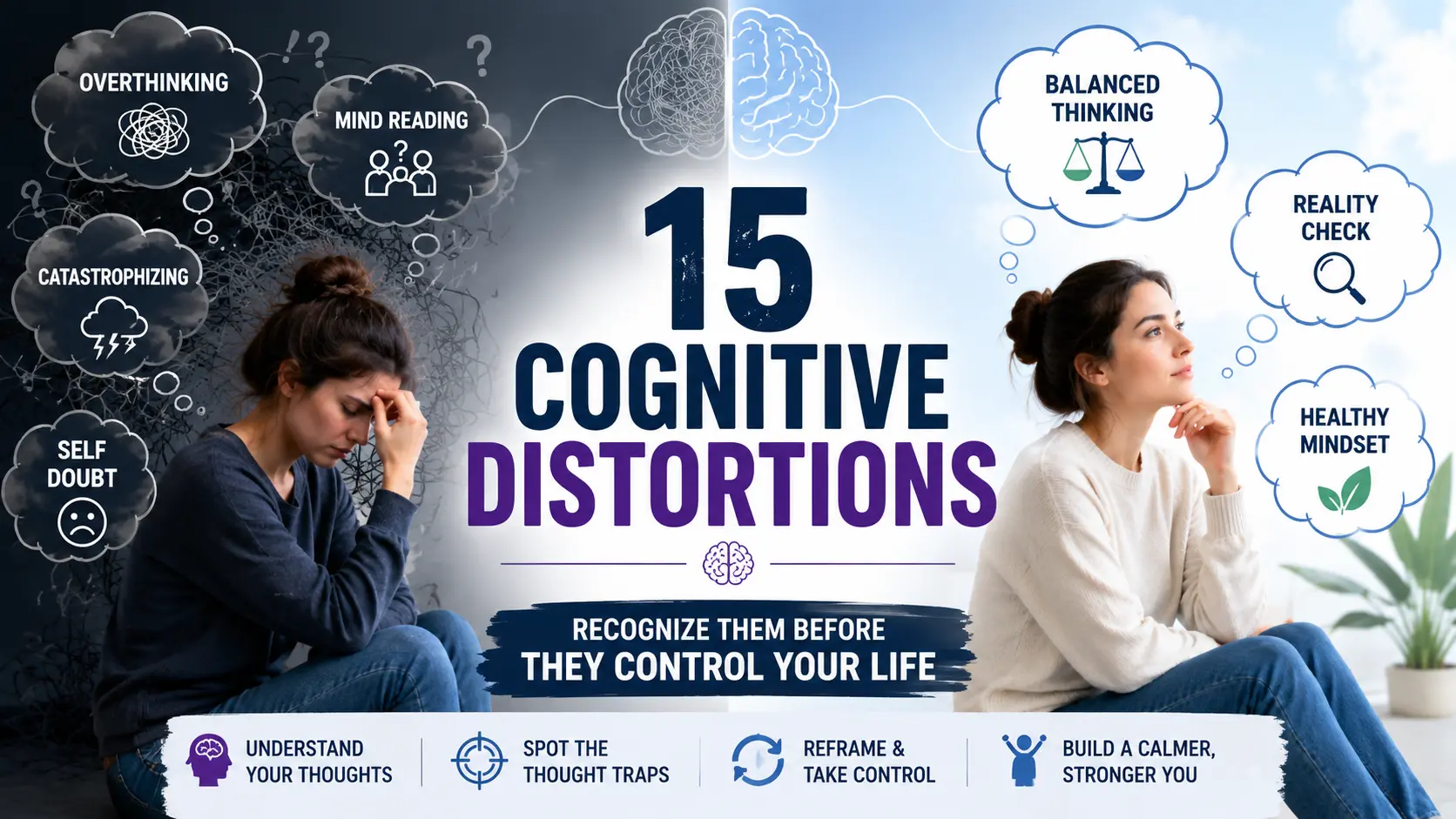
Cognitive distortions examples help you understand how everyday thinking mistakes can affect your emotions, relationships, and decisions. Cognitive distortions are inaccurate thinking patterns that make situations look worse or more threatening than they really are.
They quietly shape how you see yourself, your relationships, and your work, often without you noticing. This guide explains 15 common cognitive distortions with real-life and relationship examples so you can recognize these thought traps and learn how to reframe them.
What Are Cognitive Distortions?
Cognitive distortions are biased mental shortcuts the brain uses to make quick sense of events. They save effort but can twist facts, leading to strong emotions and unhelpful behavior. According to Healthline, these thinking patterns are habitual errors that can negatively impact your mental health and decision-making.
15 Cognitive Distortions Examples at a Glance
| Distortion | Meaning | Real-Life Examples |
| All-or-Nothing Thinking | Seeing things in black-or-white terms. | Missed a deadline, so you see yourself as a total failure. |
| Overgeneralization | Drawing broad conclusions from a single event. | After one job rejection you think you will never be hired. |
| Mental Filtering | Focusing only on the negatives and ignoring positives. | You get compliments but obsess over one criticism. |
| Discounting the Positive | Rejecting positive experiences as flukes. | “They only said that to be nice.” |
| Jumping to Conclusions | Making negative interpretations without evidence. | Assuming a friend is upset with you without asking. |
| Mind Reading | Believing you know what others think. | “She thinks I am boring,” without checking. |
| Fortune Telling | Predicting bad outcomes as certain. | “I will mess up the presentation.” |
| Magnification and Minimization | Exaggerating negatives, downplaying positives. | Blowing a small mistake out of proportion. |
| Emotional Reasoning | Treating feelings as facts. | “I feel worthless, so I must be worthless.” |
| Should Statements | Rigid rules about how you or others must behave. | “I should always be productive.” |
| Labeling and Mislabeling | Attaching a negative label to yourself or others. | Calling yourself “lazy” after one slow day. |
| Personalization and Blame | Taking excessive responsibility or blaming others unfairly. | Blaming yourself for a team failure you did not control. |
| Fallacy of Change | Believing others must change for you to be happy. | Expecting a partner to change habits to fix your unhappiness. |
| Comparison Thinking | Measuring yourself against others unfairly. | Comparing your start to someone else’s peak. |
| Polarized Thinking | Treating things as extremes with no middle ground. | Seeing people as all good or all bad. |
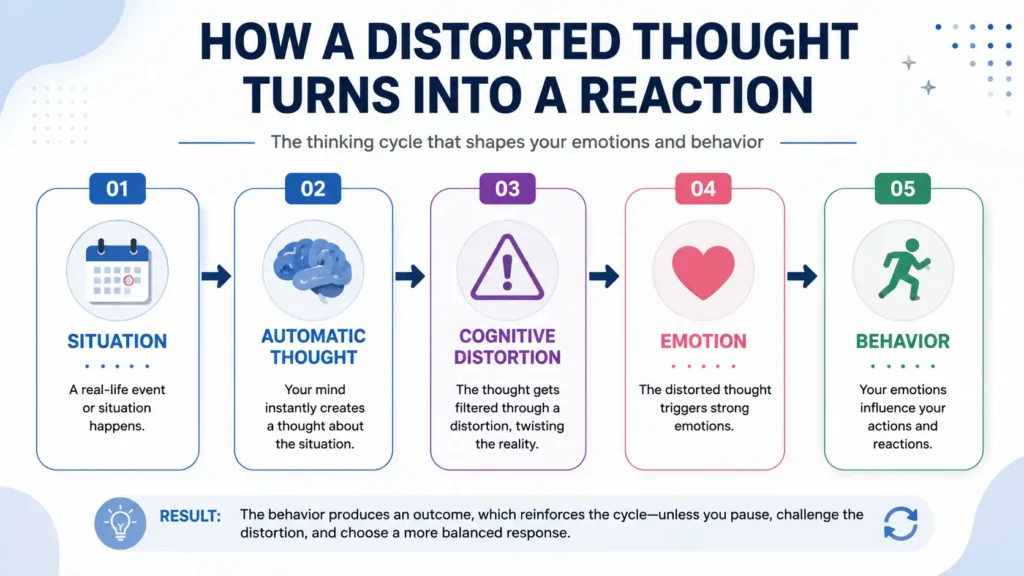
How a Distorted Thought Turns Into a Reaction
Situation → Thought → Distortion → Emotion → Behavior
For example: You text a friend, and they do not reply (Situation) → “They must be ignoring me” (Thought) → Mind Reading and Jumping to Conclusions (Distortion) → Anxiety and anger (Emotion) → You send an accusatory message or withdraw (Behavior).
15 Cognitive Distortions Examples Explained
1. All-or-Nothing Thinking
Meaning: Viewing situations as entirely good or bad, with no middle ground.
Real-life example: You miss one workout and decide you are out of shape and will not try again.
Relationship example: One argument means the relationship is doomed.
Reframe: Notice the middle ground. One slip does not erase progress.
2. Overgeneralization
Meaning: Using one event to make a sweeping conclusion about everything.
Real-life example: Failing one interview and thinking you will never get hired.
Relationship example: After one disagreement, you think your partner never listens.
Reframe: Treat each event as specific, not proof of a universal rule.
3. Mental Filtering
Meaning: Only noticing negative details and ignoring positive ones.
Real-life example: You focus on one critical comment and forget three praises.
Relationship example: You replay one hurtful phrase and ignore many caring actions.
Reframe: List the positives alongside the negatives to balance the view.
4. Discounting the Positive
Meaning: Rejecting positive feedback as insignificant or fake.
Real-life example: “That praise does not count. They were just polite.”
Relationship example: “They only said they love me because they feel sorry.”
Reframe: Accept positive evidence and test it against the negative belief.
5. Jumping to Conclusions
Meaning: Making negative assumptions without enough evidence.
Real-life example: A colleague looks distracted, so you assume they dislike you.
Relationship example: Partner is quiet; you assume they want to end things.
Reframe: Ask a clarifying question before drawing conclusions.
6. Mind Reading
Meaning: Assuming you know what others are thinking.
Real-life example: “My boss thinks I am incompetent,” with no feedback.
Relationship example: “She thinks I am unattractive,” without asking.
Reframe: Treat thoughts about others’ minds as guesses and verify them.
7. Fortune Telling
Meaning: Predicting a specific negative future as if it is certain.
Real-life example: “I will fail the exam,” before studying.
Relationship example: “This date will go badly, so I will not enjoy it.”
Reframe: Consider alternative outcomes and focus on controllable steps.
8. Magnification and Minimization
Meaning: Exaggerating negatives and shrinking positives.
Real-life example: Fixating on a typo on your report while ignoring the good content.
Relationship example: Emphasizing your partner’s flaws and minimizing their support.
Reframe: Scale things fairly. Is this really as big or as small as you think?
9. Emotional Reasoning
Meaning: Treating feelings as proof of truth.
Real-life example: “I feel anxious, so something terrible must be happening.”
Relationship example: “I feel unloved; therefore, they do not care.”
Reframe: Recognize feelings as information, not facts.
10. Should Statements
Meaning: Using rigid “should,” “must,” or “ought” rules that generate guilt.
Real-life example: “I should never make mistakes at work.”
Relationship example: “They should always know what I need.”
Reframe: Replace “should” with preferences: “I prefer to,” then plan steps.
11. Labeling and Mislabeling
Meaning: Assigning global negative labels based on one event.
Real-life example: Calling yourself “stupid” after a mistake.
Relationship example: Labeling your partner “selfish” after a single thoughtless act.
Reframe: Describe the behavior instead of naming the person.
12. Personalization and Blame
Meaning: Taking responsibility for events you did not fully cause, or blaming others unfairly.
Real-life example: Blaming yourself for a team project’s poor outcome when multiple factors were involved.
Relationship example: “It is my fault they are unhappy,” when their choices matter too.
Reframe: Separate what you control from what you do not.
13. Fallacy of Change
Meaning: Believing others must change to make you happy.
Real-life example: Expecting a friend to stop habits you dislike for your comfort.
Relationship example: Waiting for a partner to change before committing emotionally.
Reframe: Focus on changing your responses or setting boundaries.
14. Comparison Thinking
Meaning: Constantly comparing yourself to others and finding yourself lacking.
Real-life example: Comparing your early career to someone else’s ten-year success.
Relationship example: Comparing your relationship to an idealized couple online.
Reframe: Compare yourself to your past self and note progress.
15. Polarized Thinking
Meaning: Viewing choices or people as all good or all bad, with no nuance.
Real-life example: If a client rejects your idea, you think they are against you entirely.
Relationship example: Thinking your partner is perfect one week and terrible the next.
Reframe: Look for shades of gray and mixed motives.
“We do not see things as they are. We see them as we are.”
(Often attributed to Anaïs Nin.)
How Cognitive Distortions Affect Daily Life
- Relationships: These traps create severe misunderstandings, toxic assumptions, and emotional distance. If left unchecked, these communication patterns can quickly turn into destructive relationship red flags that damage trust.
- Work: Leads to burnout, missed opportunities, and poor decisions.
- Parenting: Amplify guilt and unrealistic expectations.
- Self-esteem: Reinforce negative self-image and reduce resilience.
How to Identify and Reframe Your Own Distortions
Three-step method
- Notice the thought: Pause and write the exact thought when you feel strong emotion.
- Name the distortion: Match the thought to one of the 15 distortions.
- Reframe and test: Write a balanced alternative and look for evidence for and against the original thought. Developing this habit also supports better stress management because it breaks the automatic cycle between distorted thinking and emotional overreaction.
Worked example
Situation: You send a message and do not get a reply.
Thought: “They are ignoring me; they must be upset with me.” (Mind Reading, Jumping to Conclusions)
Reframe: “They might be busy, phone dead, or forgot. I will wait or ask calmly.”
Test: Wait a few hours, then check in with a neutral message. Notice the outcome and update the belief.
If this exact scenario tends to happen right at bedtime, our guide on how to stop overthinking at night walks through techniques built specifically for when these thought loops show up after dark.
Key Takeaways
- Cognitive distortions are common mental shortcuts that can mislead you.
- Recognize them by naming the exact thought and matching it to a distortion.
- Reframe with balanced alternatives and test beliefs with evidence.
- Small shifts in thinking reduce stress and improve relationships and decision-making.
Conclusion:
Your thoughts do not always tell you the objective truth. Reviewing these cognitive distortions examples shows how easily a small shortcut in the brain can turn a minor misunderstanding into a stressful situation. Naming the distortion when it happens takes away its automatic power over your daily choices.
Unchecked distortions can also fuel self-sabotage, where your own thinking quietly blocks the progress you want to make in your career, relationships, or personal growth. Recognizing the pattern is the first step to interrupting it.
You do not need to change your thinking patterns overnight. By practicing the simple three-step method of catching the thought, naming the specific pattern, and applying a realistic reframe, you can train your brain to see situations clearly. Start small, challenge your automatic assumptions with objective facts, and feel more in control of your daily life.
When to Seek Professional Support
If you notice these patterns are constant, overwhelming, or harming your daily life, a therapist can help you identify and challenge them properly. Coaching can help with personality and behavior patterns, but clinical treatment is best for severe or persistent issues. For more on emotional maturity, see signs of an emotionally mature partner.
FAQs
1. Do all people have cognitive distortions?
Yes. Distortions are normal mental shortcuts. Everyone uses them; problems arise when they become frequent and rigid.
2. Are cognitive distortions a symptom of ADHD?
They are not a core symptom, but ADHD can make emotional reactions, impulsivity, and negative thinking more frequent, which can increase distorted thinking.
3. Are cognitive distortions the same as OCD?
No. Cognitive distortions are biased thinking patterns found in many conditions and everyday life. OCD is a clinical disorder with intrusive thoughts and compulsive behaviors. Distorted thinking can appear in OCD but is not the same thing.
4. What is a real-life example of a cognitive distortion?
Example: After one date that felt awkward, telling yourself “I am terrible at dating” (overgeneralization and labeling).
5. What are the 4 main types of cognitive distortions?
Different sources group distortions in different ways, but four common categories are black-and-white thinking, negative filtering, overgeneralization, and emotional reasoning.

Ayanshi is the founder of PersonaGuru.in, a blog dedicated to personality development, relationships, and mental health. With 3+ years of writing experience and 250+ published articles, she simplifies psychology into practical, everyday advice for real people.