
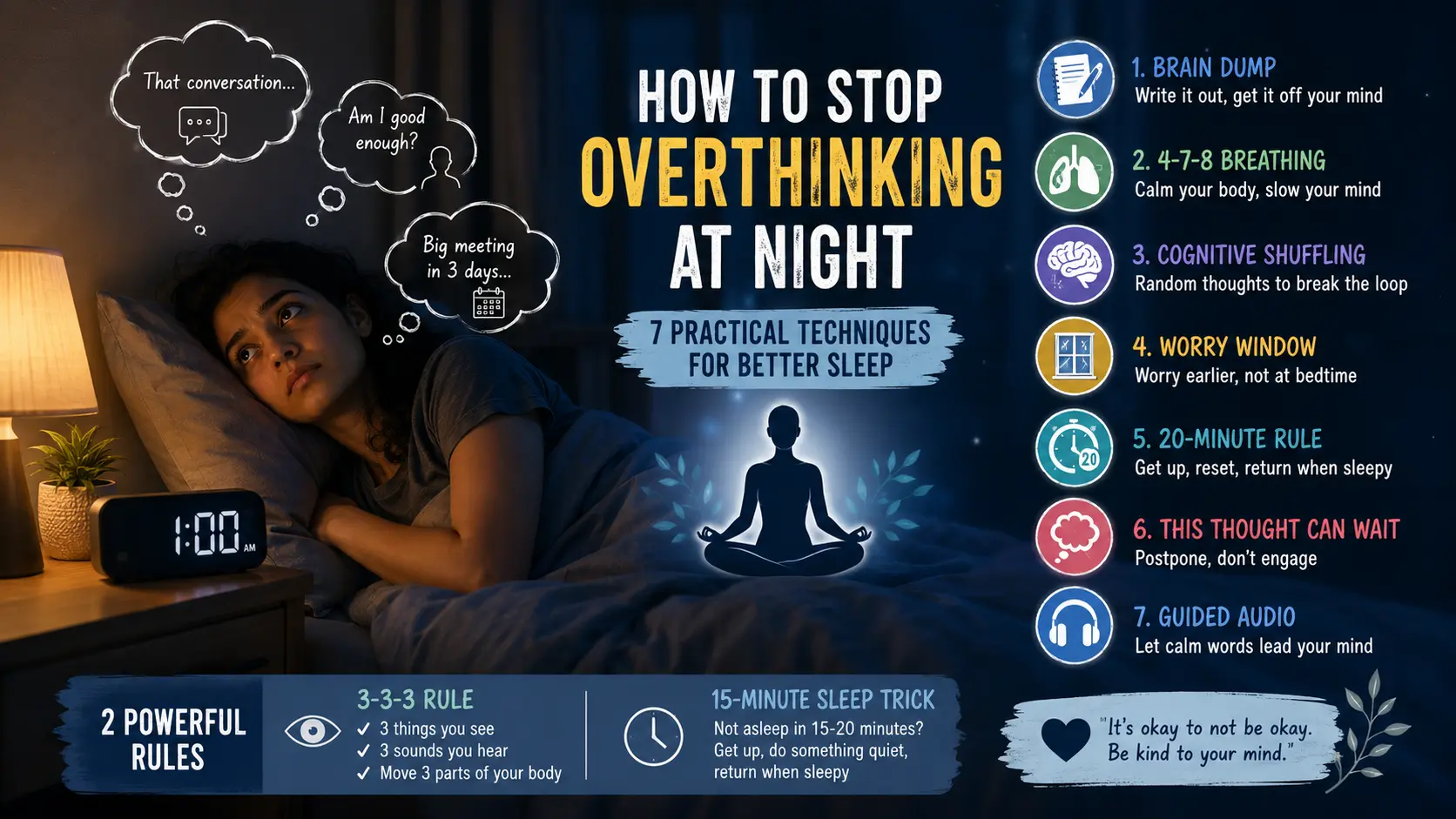
It is 1 AM. You are tired. But your mind will not stop replaying a conversation or planning for a meeting that is still three days away.
If this happens to you often, you are not broken. Your brain is just doing what brains do when the day finally goes quiet.
A real note on nighttime thoughts: Let us be completely honest. At 1 AM, you rarely overthink your grocery list. Most of the time, you overthink your relationships and your personal growth. A slightly short text message from a friend, a quiet mood from a partner, or a feeling that you are not doing enough in your career suddenly turns into a massive problem. The truth is, midnight is simply the worst possible time to evaluate your life, your work, or your relationships.
This guide covers how to stop overthinking at night with seven practical techniques, two rules people search for by name, and a few habits that reduce the problem over time.
Why Do You Overthink So Much at Night?
During the day, your brain stays busy. Work, phone, people, traffic.
At night, all of that stops. And your mind finally has room to open every tab it kept closed all day.
Two things make this worse:
- Your body’s stress hormone, cortisol, can rise slightly in the evening for some people, keeping the mind alert exactly when you want to rest.
- There is nothing to distract you from a worry, so it gets louder simply because it has your full attention.
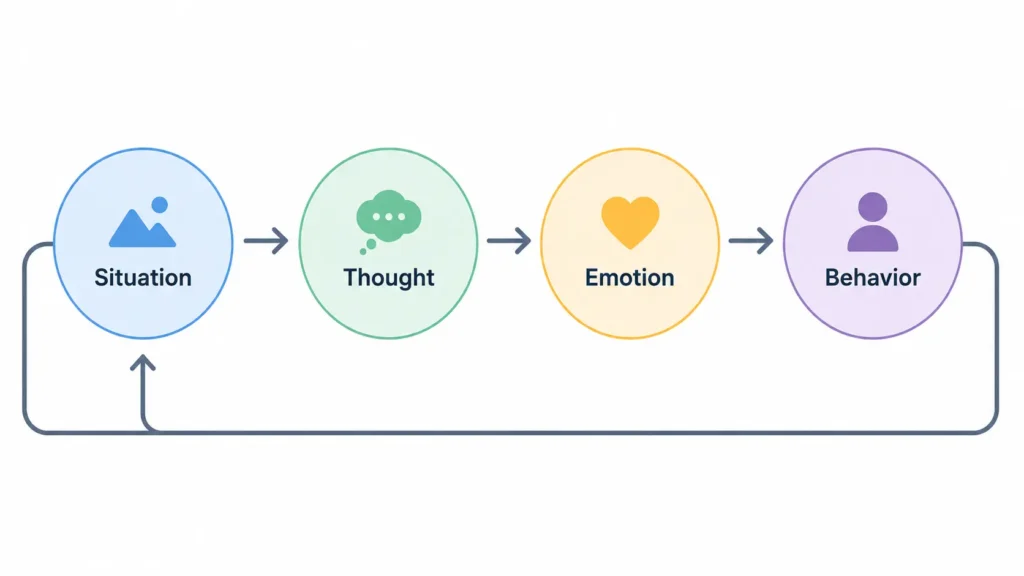
This creates a loop: you try to sleep, a worry shows up, you engage with it, and sleep moves further away. Understanding why this happens is the first step in learning how to stop overthinking at night for good.
7 Techniques to Stop Overthinking at Night
If you want to know how to stop overthinking at night quickly, start with the table below.
| # | Technique | Best For |
|---|---|---|
| 1 | Brain Dump | Too many unfinished tasks in your head |
| 2 | 4-7-8 Breathing | Racing heart, physical tension |
| 3 | Cognitive Shuffling | A single thought stuck on repeat |
| 4 | Worry Window | Worry that shows up at the same time every night |
| 5 | 20-Minute Rule | Lying awake for a long time already |
| 6 | “This Thought Can Wait” | Sudden anxious spikes |
| 7 | Guided Audio | Restless mind, needs external focus |
1. The Brain Dump:
Keep a notebook outside your bedroom. Before bed, write down every worry, task, and stray thought.
Writing it down tells your brain the information is safe. It does not need to keep replaying it to “remember” it. This is one of the simplest starting points if you are only just learning how to stop overthinking at night.
2. The 4-7-8 Breathing Technique:
This one is simple. You just count.
- Breathe in for 4 seconds
- Hold for 7 seconds
- Breathe out slowly for 8 seconds
- Repeat 4 times
The long exhale calms your nervous system and slows your heart rate. This method was popularized by physician Andrew Weil.
3. Cognitive Shuffling
Pick a random word. Say “lamp.” Now picture something for each letter: a lion, an apple, a mountain, a puddle.
It sounds odd. But it works because it copies the loose, random thoughts your brain naturally has right before sleep. Cognitive scientist Dr. Luc Beaudoin developed this technique, and it pulls your mind out of problem-solving mode.
4. The Worry Window
Set a 15-minute slot earlier in the evening, around 7 or 8 PM. Sit down and worry on purpose. Write it out.
When that same worry shows up at bedtime, tell yourself: “I already gave that time today. It can wait.” For many people, this single habit is the real answer to how to stop overthinking at night when the same worry returns every evening.
5. 20-Minute Rule
Still awake after 20 minutes? Get up.
Go to another room. Read something in dim light. Come back only when you feel sleepy.
This protects your bed from becoming a place your brain associates with anxiety instead of sleep.
6. Four-Word Reframe
When a thought shows up, say: “This thought can wait.”
Do not argue with it. Do not solve it right now. Just set it down.
Fighting a thought usually makes it louder. Postponing it quiets it down.
7. Guided Audio or Sleep Stories
A calm, narrated story or slow nature sounds give your mind something neutral to hold onto, instead of your own thoughts.
What Is the 3-3-3 Rule for Anxiety Sleep?
This is a grounding exercise. Use it when anxiety spikes suddenly.
- Name 3 things you can see.
- Name 3 sounds you can hear.
- Move 3 parts of your body (fingers, toes, shoulders).
Anxiety lives in “what if” thinking about the future. This rule pulls you straight back into the present moment.
At night, adapt it to the dark: the weight of your blanket, the sound of a fan, your feet against the mattress.
What Is the 15-Minute Sleep Trick?
This is a simplified form of sleep restriction therapy, used in CBT-I. If you are not asleep within 15 to 20 minutes, get up. Do something quiet in another room. Return only when you feel genuinely sleepy.
It feels backward at first. But it rebuilds one simple thing: the link between your bed and actual sleep, not your bed and lying awake worried. This trick is one of the most reliable long-term answers to how to stop overthinking at night for people with chronic sleep struggles.
How to Stop Overthinking Long-Term (Not Just Tonight)
The seven techniques above help you stop overthinking at night in the moment, but these habits reduce how often you need them.
- Keep a consistent sleep schedule. An irregular one keeps your internal clock unsettled, and that makes anxious thinking more likely at night.
- Move your body during the day. Even a 20-minute walk lowers baseline anxiety.
- Deal with emotions earlier in the day. Journal, talk to someone, or just sit with it for five minutes in the afternoon. Less gets left over for midnight.
- Put screens away an hour before bed. Blue light and heavy news both work against you here.
For more on this, our stress management guide covers daily habits that reduce overall anxiety load.
Overthinking at Night in Hindi-Speaking Households
Growing up in a joint family changes what nighttime overthinking looks like.
The worry is rarely only yours. It includes family expectations, a relative’s health, or a decision that affects more people than just you.
There is also often less physical privacy at night, which means the brain never fully gets the signal that the day is over.
One reframe that helps: most family matters are not solved at 1 AM. Write the worry down. Tell yourself, “kal dekhenge.” Give yourself permission to rest.
Rest is not avoidance. It is what lets you handle the same problem better tomorrow. For many people in Hindi-speaking households, how to stop overthinking at night also means learning to separate family worry from personal rest.
When Overthinking Is About a Relationship
A lot of nighttime overthinking is really about one person. A message that was not returned. A tone you cannot stop analyzing.
This kind of overthinking sticks harder because you cannot fully know what the other person is actually thinking.
The techniques above will help with the loop itself. If this is a frequent pattern for you, our cognitive distortions examples article breaks down mind reading and fortune telling, the two thought patterns most often behind this exact kind of overthinking. If a relationship is the main driver of your sleepless nights, how to stop overthinking at night starts with separating the immediate anxiety from the deeper pattern.
Key Takeaways
- Nighttime overthinking happens because your brain finally has space to process the day.
- Start with one technique, not all seven at once.
- The 20-minute rule and worry window work well together.
- Long-term habits like consistent sleep and daytime movement reduce how often this happens.
- Knowing how to stop overthinking at night starts with naming the loop, not fighting it.
Conclusion
Learning how to stop overthinking at night is not about forcing your brain to go blank. It is not a character flaw either. It is what an unoccupied brain does with the day’s leftover worries.
The techniques in this guide, from the brain dump to the 20-minute rule, work because they give your mind a structured place to put its concerns instead of running them on a loop at bedtime. Start with one technique tonight rather than trying all seven at once, and give it a few nights before judging whether it helps.
This article is for educational purposes and does not replace professional mental health diagnosis or treatment. If overthinking is persistent and significantly affects your sleep or daily life, consider speaking with a mental health professional.
FAQs
1. Why do I overthink so much at night?
Distractions disappear, so your brain finally processes what it set aside during the day. This is normal. It becomes a problem when it turns into a repeating loop.
2. What is the 3-3-3 rule for anxiety and sleep?
Name 3 things you see, 3 sounds you hear, and move 3 parts of your body. It grounds you in the present and interrupts anxious thinking.
3. What is the 15-minute sleep trick?
If you are not asleep in 15 to 20 minutes, get up and do something quiet until you feel sleepy again. It rebuilds your bed’s link to actual sleep.
4. Do overthinkers have high IQs?
Not necessarily. Overthinking is a habit tied to anxiety, not a sign of intelligence. Smart people overthink. So does everyone else.
5. Is overthinking a form of OCD?
No. Overthinking is a common repetitive worry. OCD is a clinical condition with intrusive thoughts and compulsive behavior. If your thinking feels uncontrollable, talk to a professional.

Ayanshi is the founder of PersonaGuru.in, a blog focused on personality development, career, relationships, and mental well-being. With over 3 years of writing experience, she turns psychology and everyday experiences into practical, easy-to-understand advice for real life.