
Can you guess someone’s temperament just by looking at their body shape? A German psychiatrist named Ernst Kretschmer believed you could, and his theory shaped an entire branch of personality psychology for decades.
Kretschmer’s body types and personality theory link physical build to emotional tendencies and mental health risk. Some parts of it sound outdated today. Other parts still show up in psychology textbooks and exam papers. This guide breaks down exactly what he found, in plain language, with real context you can actually use.
Key Takeaways
- Kretschmer’s body types and personality theory link four physical builds to specific temperaments.
- The four types are Pyknic, Asthenic, Athletic, and Dysplastic.
- Kretschmer originally proposed three core constitutional groups, with Dysplastic added later as a mixed category.
- His work directly influenced William Sheldon’s later somatotype theory.
- Modern research treats his conclusions with caution, since they came from psychiatric patients, not the general public.
Who Was Ernst Kretschmer and What Is He Known For?
Ernst Kretschmer studied philosophy and medicine at the University of Tübingen, where he later worked as a clinical psychiatrist. He is best known for developing one of the earliest constitutional theories of personality, one that connects physical build directly to psychological temperament.
His main work, Physique and Character, was published in 1921, the same decade Carl Jung published his own theory of psychological types. If you want to see how Jung’s classification compares, our guide on Jung’s theory of personality covers his very different approach to sorting personality.
Kretschmer built his ideas by observing hospital patients closely, over years of clinical practice. That detail matters a lot, and we will come back to it when we discuss the limitations of Kretschmer’s body types and personality theory later.
How Many Personality Types Did Kretschmer Identify?
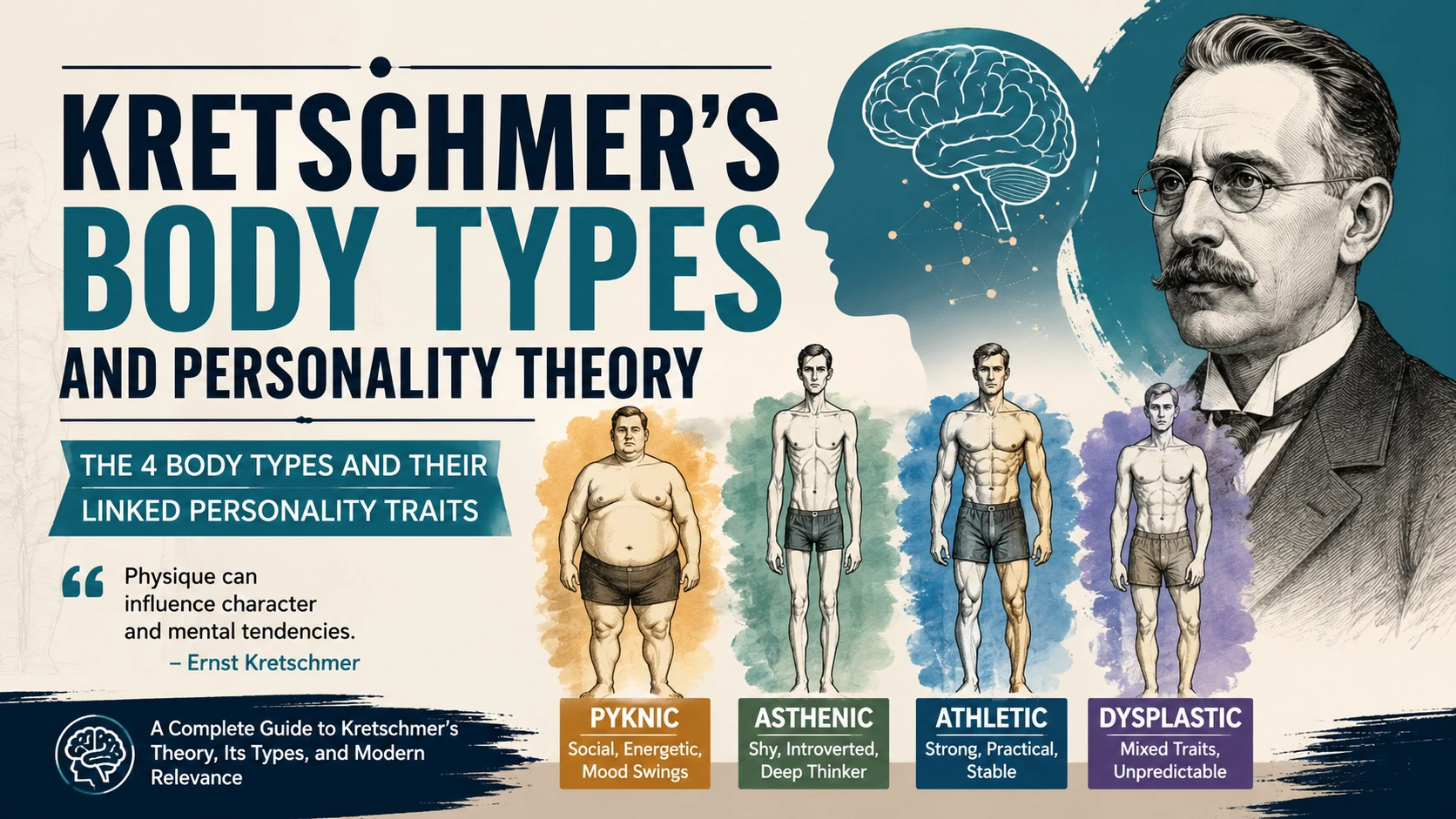
Kretschmer identified four personality types linked to physical build: Pyknic, Asthenic, Athletic, and Dysplastic.
Here is a detail most articles skip. Kretschmer’s original classification actually centered on three core constitutional groups: Pyknic, Asthenic, and Athletic. Dysplastic was treated more as a mixed or irregular category, one that did not fit cleanly into the other three. Over time, textbooks began listing it as a fourth type for simplicity, which is why you will see both “three” and “four” mentioned depending on the source.
Think of it like this. The first three are the clean, well-defined categories. Dysplastic is the “everything else” bucket for people whose build did not match a clear pattern.
What Are Kretschmer’s 4 Body Types?
Each type in Kretschmer’s body types and personality theory pairs a physical build with a specific temperament and mental health tendency.
1. Pyknic Type
Pyknic individuals have a short, round, stocky build with a thick neck. Kretschmer linked this build to a cyclothymic temperament, meaning friendly, social, and outgoing, but prone to mood swings between high energy and low energy. He associated this type with a higher tendency toward manic-depressive illness, now called bipolar disorder.
2. Asthenic Type
Also called the Leptosome type, Asthenic individuals are tall, thin, and frail, often with narrow shoulders and weak muscle tone. Kretschmer linked this build to a schizoid temperament, meaning shy, quiet, introverted, and prone to daydreaming. He associated this type with higher vulnerability to schizophrenia.
3. Athletic Type
Athletic individuals are strong, muscular, and well-proportioned, with broad shoulders. Kretschmer described this type as energetic, stable, and practical, often sitting between the other two temperaments rather than leaning strongly one way.
4. Dysplastic Type
Dysplastic individuals have an unproportioned or mixed body shape, often linked to hormonal irregularities. Kretschmer treated this as the catch-all category for people who did not fit clearly into the other three builds, with unpredictable or mixed emotional patterns.
| Type | Physical Build | Linked Temperament |
|---|---|---|
| Pyknic | Short, round, stocky | Cyclothymic, social, mood swings |
| Asthenic (Leptosome) | Tall, thin, frail | Schizoid, shy, introverted |
| Athletic | Muscular, broad shoulders | Energetic, stable, practical |
| Dysplastic | Mixed, unproportioned | Unpredictable, mixed |
What Did Kretschmer Actually Call His Theory?
You will often see the word somatotype used alongside Kretschmer’s name, but that term technically belongs to William Sheldon, who built on Kretschmer’s work years later. Kretschmer himself called his framework a theory of constitutional types, focused on physique and character.
This distinction matters for exams and quizzes. If a question asks which term Kretschmer himself used, the answer is constitutional type, not somatotype. This is a common confusion when students first encounter Kretschmer’s body types and personality theory.
Kretschmer’s Theory vs Sheldon’s Somatotypes
Kretschmer’s work paved the way for William Sheldon, an American psychologist who developed a more detailed version in the 1940s using three body types: Endomorph, Mesomorph, and Ectomorph.
| Feature | Kretschmer | Sheldon |
|---|---|---|
| Number of core types | 3 constitutional groups (plus Dysplastic) | 3 somatotypes |
| Terminology | Pyknic, Asthenic, Athletic | Endomorph, Mesomorph, Ectomorph |
| Sample used | Psychiatric hospital patients | College-age men, measured systematically |
| Focus | Physique linked to mental illness risk | Physique linked to general temperament |
A common exam trick question asks which term does not belong to Kretschmer. If you see Endomorph, Mesomorph, or Ectomorph listed as one of Kretschmer’s types, that is incorrect. Those three terms belong to Sheldon, not Kretschmer. Understanding this difference is key when comparing Sheldon and Kretschmer personality theories.
Is Kretschmer’s Theory Still Accurate Today?
Modern psychology treats Kretschmer’s conclusions carefully, and there is a good reason why.
Kretschmer based his entire theory on hospital patients, not a representative sample of the general population. That is a serious limitation. If you only study people already diagnosed with a mental illness, you are far more likely to find patterns that do not hold for everyone else.
A 2018 re-evaluation published in a genetics journal on PubMed Central looked back at classical body type theories, including Kretschmer’s body types and personality theory, using modern genetic correlation data. The researchers found only weak and inconsistent links between physique and personality traits when tested against larger, more representative datasets.
That does not erase Kretschmer’s contribution. His work still shaped an entire generation of personality research, and it directly led to Sheldon’s more rigorous somatotype studies. It simply means his exact conclusions should be read as a historical stepping stone, not a diagnostic tool.
Reema, a psychology student preparing for her B.Com personality development exam, told her study group she used to think Kretschmer’s theory sounded like body shaming dressed up as science. Once she understood the hospital sample bias behind it, the criticism made far more sense to her than just memorizing “outdated theory” as an answer.
Why This Theory Still Matters for Students
Even though modern psychologists do not use Kretschmer’s exact typing system, his work remains a fixture in personality development coursework across Indian universities. Examiners often test the four types, the constitutional groups debate, and the comparison with Sheldon in the same question set.
A few quick tips if you are studying this for an exam:
- Memorize the four types with one keyword each: Pyknic (round), Asthenic (thin), Athletic (muscular), Dysplastic (mixed).
- Remember Kretschmer’s terms are different from Sheldon’s terms, even though they get confused constantly.
- Always mention the hospital-patient sample bias when asked about limitations. It is the single most commonly tested criticism.
If you want a fuller picture of how personality theories evolved after Kretschmer, our guide on the journey of personality development from genes to Freud walks through the wider historical timeline these ideas fit into.
Final Thoughts
Kretschmer’s body types and personality theory were one of the earliest attempts to connect the body and mind scientifically. Its exact conclusions have not held up well under modern research, but its influence on later work, especially Sheldon’s somatotypes, is undeniable. Understanding where this theory came from, and where it fell short, tells you as much about the history of psychology as the theory itself.
For a broader look at how personality traits get classified today, our guide on the key aspects of personality development covers the modern frameworks that replaced type-based theories like this one. You can also read the comprehensive original research behind the criticism in this 2018 PMC genetic re-evaluation study, or see Kretschmer’s complete biography on his Wikipedia page.
FAQs
1. What are the 4 types of personality according to Kretschmer?
Pyknic, Asthenic, Athletic, and Dysplastic. The first three are his original constitutional groups, and Dysplastic was later added as a mixed category. These are the core Kretschmer personality types taught in most courses.
2. What is dysplastic according to Kretschmer?
Dysplastic describes an unproportioned or mixed body build, often linked to hormonal irregularities, paired with unpredictable emotional patterns.
3. What is a Pyknic personality?
A Pyknic personality is typically social, friendly, and outgoing, but prone to mood swings, based on Kretschmer’s cyclothymic temperament category.
4. Which of the following is not a type of personality given by Kretschmer?
Endomorph, Mesomorph, and Ectomorph are not Kretschmer’s terms. Those belong to William Sheldon’s later somatotype theory.
5. Is Kretschmer’s theory scientifically accurate?
It is historically significant but scientifically limited. His conclusions came from hospital patients, and later genetic research found only weak support for his physique-personality links in the general population. This is a standard criticism of Kretschmer’s body types and personality theory in modern psychology.

Ayanshi is the founder of PersonaGuru.in, a blog focused on personality development, career, relationships, and mental well-being. With over 3 years of writing experience, she turns psychology and everyday experiences into practical, easy-to-understand advice for real life.