
Last updated on September 13th, 2026 at 11:54 am
You already know what a personal development plan is supposed to do. You have probably even tried to write one before, in a notebook that is now buried in a drawer somewhere.
This personal development plan template fixes the part most guides skip: the actual document itself. Something you can open right now, fill in for real, and use this week instead of just reading about it.
That is what this page is. A free, one-page template you can download, plus one filled-out example so you know exactly what to write in each box.
Direct Answer
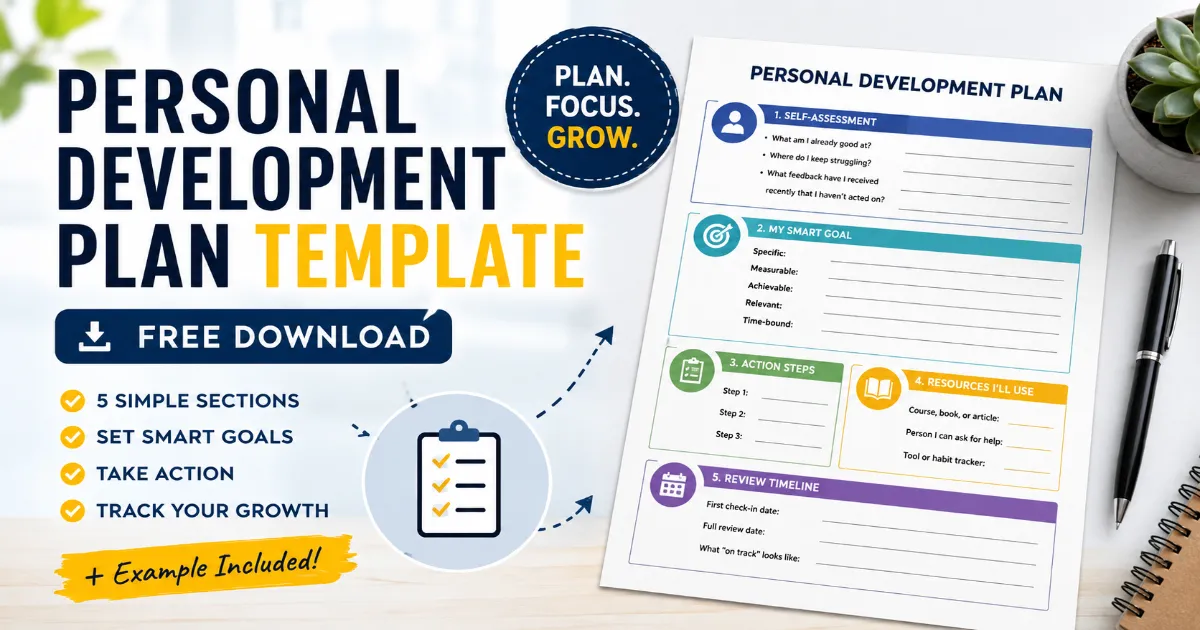
A personal development plan template is a simple, fill-in-the-blank document with five sections: self-assessment, one SMART goal, action steps, resources, and a review date. You can download the printable version below or copy the plain-text version into a Google Doc.
If you want the full explanation of how to build a plan from scratch, our complete guide on creating a professional development plan walks through that in depth. This page is the tool itself.
Key Takeaways
- The personal development plan template has five sections: self-assessment, one SMART goal, action steps, resources, and a review date.
- A 2026 ScholarshipOwl survey of nearly 30,000 students found that most young professionals feel confident about their career direction, but confidence drops sharply once they start actively job hunting, which is exactly the gap a written plan helps close.
- A plan you actually revisit works. A plan you write once and forget does not. The review date matters as much as the goal itself.
- You do not need an app or a plugin to use this. Print it, or copy it into any doc you already use.
Download the Template
Download the free PDF template
Prefer to type it out? Copy the plain-text version below into a Google Doc or Notes app instead.
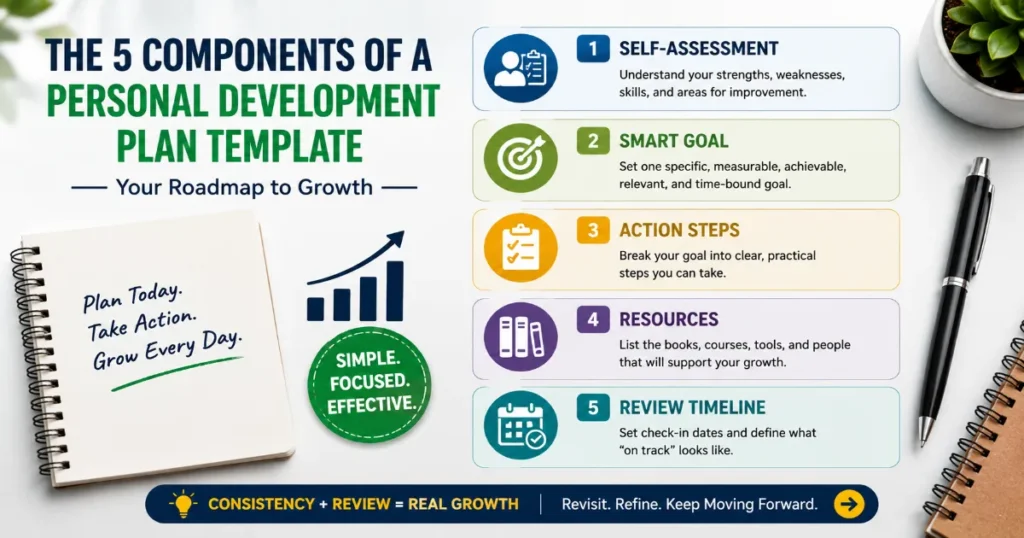
1. Self-Assessment
- What am I already good at?
- Where do I keep struggling?
- What feedback have I received recently that I haven’t acted on?
2. My SMART Goal
- Specific:
- Measurable:
- Achievable:
- Relevant:
- Time-bound:
3. Action Steps
- Step 1:
- Step 2:
- Step 3:
4. Resources I’ll Use
- Course, book, or article:
- Person I can ask for help:
- Tool or habit tracker:
5. Review Timeline
- First check-in date:
- Full review date:
- What “on track” looks like:
A Filled-Out Example
Here is what the personal development plan template looks like in practice, based on a working professional’s situation.
Name: Rohan, Software Engineer, Bengaluru
Self-assessment: Strong at technical problem-solving. Struggles to explain technical decisions clearly to non-technical stakeholders in meetings.
SMART goal: Lead two client-facing project updates over the next quarter, explaining technical decisions in plain language.
Action steps:
- Watch two recorded internal presentations by senior engineers to study their communication style
- Practice explaining one technical concept in plain language to a non-technical friend each week
- Ask a manager for direct feedback after each client update
Resources: A practical action plan for workplace communication, one internal mentor, 15 minutes of weekly practice. Indeed’s guide on individual development plans is also a solid reference if Rohan wanted a manager’s perspective on tracking this.
Review timeline: Check in every 3 weeks, full review once the quarter ends
Notice there is nothing fancy here. Five honest sections, filled in with real specifics instead of vague hopes, are what actually make a plan work.
Why a Template Beats Writing From Scratch
You could open a blank document and start typing your goals right now. Most people do exactly that, and most of those documents get abandoned within a month.
A template removes the blank-page problem. It forces you to fill in the parts people usually skip, like the actual review date, instead of stopping at “I want to get better at my job” and never going any further.
The personal development plan template also gives you a consistent structure that you can revisit and update as your priorities change.
3 Mistakes to Avoid When Using This Template
Filling in every box with something vague. “Get better at communication” is not specific enough to act on. “Speak up once in every team meeting this month” is.
Setting more than one or two goals at a time. A template with five goals crammed into it usually gets none of them finished. One focused goal, done well, beats five that never get past the first step.
Skipping the review section entirely. This is the box people leave blank most often, and it is the one that decides whether the plan actually works. Put the review date on your calendar, not just on the page.
Explore More on Career and Growth
- Career and Workplace Growth: The Complete Guide
- How to Create a Professional Development Plan (full guide)
- Personal Development Goals for Work
- How to Stay Focused on Your Goals
- The Role of Deadlines in Goal Setting
Conclusion
A personal development plan does not need theory or a long framework to work. It needs five honest answers and a date to check back in.
If you want to understand the broader skills and habits behind personal growth, see Personality Development: The Complete Guide (2026). This template then gives you a practical way to turn one area of improvement into a clear plan.
Your next step: Download the template above, or copy the plain-text version into a doc right now. Fill in just the self-assessment and one SMART goal today. That alone puts you ahead of the version of you that keeps meaning to start.
Frequently Asked Questions
Q1. Is this template free?
Yes. Download the PDF above or copy the plain-text version; no signup required.
Q2. What are the 5 components of a personal development plan?
Self-assessment, a SMART goal, action steps, resources, and a review timeline. That is exactly what the template above walks you through, box by box.
Q3. What are the 6 components of a personal development plan?
Some versions split “obstacles you might face” into its own section, making six instead of five. Both work. Use whichever version you’ll actually fill in.
Q4. What is an example of a personal development plan?
A short document listing where you stand today, one specific SMART goal, the steps to reach it, and a date to check progress. See the filled-out example above for a full version.
Q5. What are the 7 pillars or 4 P’s of personal development?
There is no single official version of either. Different writers use different frameworks, and none of them is more “correct” than another. Treat any version you come across as one lens, not a fixed rule, and use the five-part template above instead if you want something practical.
Q6. How do I write a personal development plan?
Fill in the template above: assess yourself honestly, set one SMART goal, list your action steps and resources, then set a review date. For the reasoning behind each step, our full guide covers it in depth.
Q7. What can I write in a personal development plan?
Anything genuinely important to you right now: a career skill, a communication habit, a fitness goal, or a confidence goal. Pick one real area instead of listing everything you’d like to improve at once.
Q8. What if I want the full explanation of each step, not just the template?
Our complete guide on creating a professional development plan walks through each section in depth, with more examples and reasoning behind each step.
Q9. Can I use this for personal goals, not just career ones?
Yes. The same five sections work for a fitness goal, a habit, or a relationship goal, not only a career one. Just swap the resources and action steps to match.
Q10. How often should I review my plan?
Every 3 to 4 weeks works for most goals. Put the date on your calendar when you first fill in the template, not after.

Ayanshi is the founder of PersonaGuru.in, a blog focused on personality development, career, relationships, and mental well-being. With over 3 years of writing experience, she turns psychology and everyday experiences into practical, easy-to-understand advice for real life.