
Last updated on September 15th, 2026 at 06:56 am
Leadership is the ability to guide and influence people toward a shared goal through trust, not authority. It rests on nine core objectives, from building a clear vision to handling resistance to change, and it shows up through traits like honesty, emotional intelligence, and decisiveness rather than a job title. Leadership is not something you either have or do not have, it is built through practice, feedback, and consistent effort, and the 2026 Gallup data shows a clear gap: managers inside the best-run organisations stay engaged at nearly four times the global average.
Think about that one teacher who made you believe in yourself. Or that senior at work who always had your back on a bad day. That calm they gave you, that direction, that trust. That is leadership.
Leadership has nothing to do with a big title or a corner office. It is about how you make people feel, and how well you help them move forward together.
In this guide, you will learn what leadership actually means, why it matters, and the traits every effective leader builds over time. Before we get into the objectives and traits, let’s get the leadership meaning clear first.
Key Takeaways
- Leadership works through influence, not force. People follow because they trust the person, not because they have to.
- Manager engagement dropped from 27% to 22% between 2024 and 2025 worldwide, the sharpest single-year fall Gallup has recorded.
- Inside the best-run organisations, 79% of managers stay engaged at work, nearly four times the global average.
- Emotional intelligence is one of the strongest predictors of leadership success identified in Harvard Business Review research, alongside self-awareness and social skill.
- The leadership meaning most people assume (authority) isn’t the same as real leadership (influence).
- Leadership exists at every level of a team, not only at the top.
What Is the Leadership Meaning?
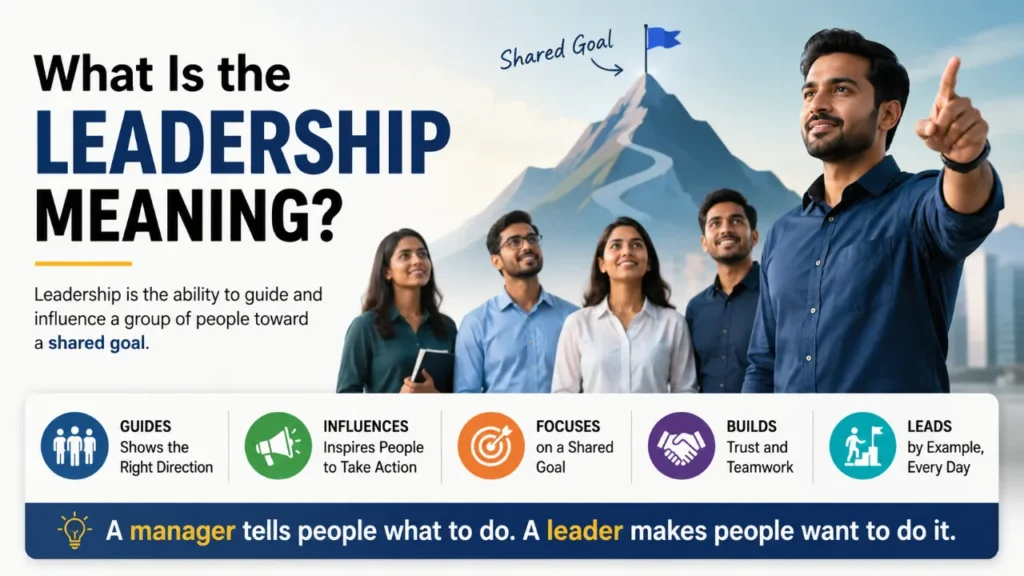
Leadership is the ability to guide and influence a group of people toward a shared goal. It shows up at work, but also in families, classrooms, and sports teams.
A manager tells people what to do. A leader makes people want to do it.
Put another way, management is mostly about doing tasks correctly and on time, while leadership is about deciding what the right direction is in the first place. Both matter, but they solve different problems.
Leadership is not reserved for people at the top of an org chart either. A junior employee who takes ownership of a problem is showing leadership just as much as a CEO drafting a five-year vision.
At its core, leadership is a mix of character, communication, and consistent action over time.
What Are the Objectives of Leadership?
Every leader works with a purpose. Here are the nine objectives that matter most, cleaned up from what is often a messy list of overlapping ideas.
1. Provide direction. Work does not move without someone pointing the way. A leader turns a vague goal into a clear starting point people can act on.
2. Create a shared vision. Ratan Tata had a clear vision of making Tata Motors a global brand, and that single vision shaped major company decisions for years. A team without a shared picture of “where we are going” tends to pull in different directions.
3. Achieve common goals. Individual targets matter, but a leader connects them to something bigger. When people understand why a task matters, they bring more energy to it.
4. Motivate and support people. Some people want recognition. Others want growth opportunities. A good leader learns what actually drives each person rather than using a one-size-fits-all approach.
5. Build trust and cooperation. Teams come from different backgrounds with different habits and working styles. A good leader finds common ground instead of letting those differences turn into walls. A project manager handling coders, designers, and writers has to keep everyone moving toward the same product, not separate agendas.
6. Improve team performance. A leader turns a plan into steps a team can actually execute, and avoiding common mistakes when communicating that plan matters just as much as writing it well.
7. Develop future leaders. One of the most overlooked objectives. A leader who only focuses on today’s output, without growing the people around them, leaves the team weaker once they move on.
8. Manage change effectively. Under Satya Nadella, Microsoft shifted its focus toward cloud computing and a more collaborative, growth-oriented culture, a clear example of leadership steering an organisation through real change instead of resisting it.
9. Maintain coordination and accountability. Change meets resistance. That is normal. A good leader listens to the concern first, explains the reasoning clearly, and helps the team adjust at a human pace instead of forcing it through.
Key Characteristics of Leadership
These are the traits that separate leadership from simply managing tasks.
- Influence, not authority. A leader does not depend only on position or power. People follow when they trust the person’s judgment and direction, not because a title says they have to.
- A two-way relationship. Leadership is not one person talking and everyone else listening. Ideas flow both ways, and decisions get better when leaders actually listen.
- A focus on shared goals. Every decision a leader makes should trace back to a purpose the whole team understands, not a personal agenda.
- Ongoing, not one time. Leadership needs constant attention. Teams need regular guidance and feedback to stay on track, not a single kickoff speech.
- Dependent on followers. A leader with no one following is just a person with a plan. The relationship between a leader and the team is what makes leadership function at all.
- Adaptable to the situation. A calm, open style works in a brainstorm. A clear, direct style works better during a deadline crunch. Good leaders read the room and adjust.
- Built on coordination. Regular check-ins and shared updates are what keep departments from working in silos and missing shared goals.
- A reflection of personal character. How a leader behaves under pressure sets the tone for everyone watching, and it directly shapes whether toxic personality traits take root in the workplace or get caught early.
Why Is Leadership Important? (Backed by 2026 Data)
According to Gallup’s 2026 State of the Global Workplace report, global employee engagement fell to 20% in 2025, the lowest level since 2020. Manager engagement fell even faster, dropping from 27% to 22% between 2024 and 2025 alone, the steepest single-year decline Gallup has recorded.
The same report found that inside best-practice organizations, manager engagement reached 79%, nearly four times the global average. Gallup does not attribute this gap to any single fix, but it does show that the difference between struggling and thriving workplaces sits largely at the leadership layer.
A few more reasons leadership carries this much weight:
- It sets things in motion. Work does not start without direction. A leader communicates the plan and gives people the clarity to begin.
- It keeps people motivated. Employees stay engaged when their work feels meaningful, not just paid.
- It guides and develops people. A leader is part supervisor, part mentor, helping team members grow their skills over time.
- It creates trust. Trust is built through consistency, not speeches.
- It prepares future leaders. When people are mentored and trusted with real decisions, they grow into stronger leaders themselves, and it strengthens working relationships across the team along the way.
- It shapes workplace culture. Gallup research shows managers account for roughly 70% of the variance in team engagement scores. Managers have a stronger influence on daily work experience than almost anyone else in an organization, and poor leadership is often where toxic personality traits quietly take root in a team.
Types of Leadership
There is no single leadership style that works everywhere. Most leaders lean on one style by default and shift into others when the situation calls for it.
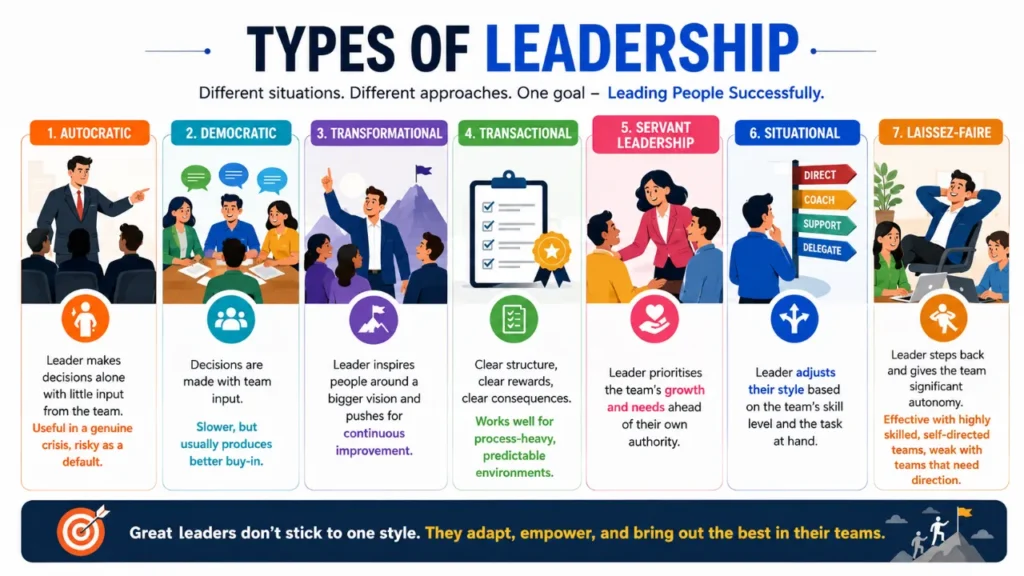
- Autocratic: The leader makes decisions alone with little input from the team. Useful in a genuine crisis, risky as a default.
- Democratic: Decisions are made with team input. Slower, but usually produces better buy-in.
- Transformational: The leader inspires people around a bigger vision and pushes for continuous improvement.
- Transactional: Clear structure, clear rewards, clear consequences. Works well for process-heavy, predictable environments.
- Servant leadership: The leader prioritizes the team’s growth and needs ahead of their own authority.
- Situational: The leader adjusts their style based on the team’s skill level and the task at hand, rather than sticking to one approach.
- Laissez-faire: The leader steps back and gives the team significant autonomy. Effective with highly skilled, self-directed teams, weak with teams that need direction.
There is also charismatic leadership, which sits outside the classic seven styles but shows up constantly in the real world, built almost entirely on personal presence and the ability to make people believe in a vision.
For a deeper breakdown of all seven styles with real examples, see our complete guide to leadership styles, and for the version built specifically for quiet, introverted leaders, we cover that separately too.
Essential Leadership Skills
Traits describe who a leader is. Skills describe what a leader can actually do, and skills are the part you can practice directly.
- Communication: Making sure your message actually lands, not just gets sent. Our action plan to improve workplace communication breaks this down step by step.
- Active listening: Listening to understand, not just to reply.
- Decision-making: Making a call with the information available, instead of waiting for a perfect answer that never comes.
- Delegation: Trusting people with real ownership instead of just tasks.
- Conflict resolution: Addressing disagreement directly instead of letting it fester.
- Time management: Protecting focus for what actually matters, not just what is urgent.
- Coaching and mentoring: Helping someone else get better, not just getting the task done yourself.
Leadership and Personality Development
Most leadership content treats it as a purely corporate skill. On PersonaGuru, we look at it differently, because leadership does not start in a boardroom. It starts with the same personality development habits that shape everything else about how you show up.
- Confidence shapes whether you speak up in a meeting or stay quiet and let the moment pass.
- Emotional intelligence is what lets you read a tense room and respond to it well, not just push through it, which is exactly why the EQ vs IQ debate matters so much in leadership circles.
- Communication decides whether your ideas actually land the way you meant them.
- Self-awareness helps you notice your own blind spots before a team has to point them out for you.
- Responsibility is what turns a good idea into something you actually follow through on.
This is why leadership development and personality development are really the same project, viewed from two angles. You are not just building a skill for a resume. You are building the version of yourself that other people find easier to trust and follow.
Traits of Effective Leaders
What actually separates a good leader from an average one? Ten traits show up again and again.
| Trait | Why It Matters |
|---|---|
| Continuous learning | The best leaders stay students of their field, not just experts in their current role |
| Honesty and integrity | People need to know they can trust your words and your decisions |
| Taking initiative | Separates someone who reacts from someone who actually leads |
| Strong communication | Clear communication reduces confusion and keeps people moving in the same direction |
| Listening well | Good leaders notice problems before they become bigger issues |
| Ability to inspire | Comes from genuine belief in the work, not big speeches |
| Confidence | Gives a team something steady to hold onto during uncertain times |
| Decisiveness | Waiting too long for a perfect answer is often the costlier mistake |
| Emotional intelligence | Helps a leader understand their own reactions and respond to other people more effectively |
| Humility | A leader who admits mistakes makes it easier for everyone else to speak up honestly |
On emotional intelligence specifically, Daniel Goleman’s original Harvard Business Review research found that truly effective leaders were distinguished less by IQ alone and more by self-awareness and social skill. IQ and technical ability still matter; they get you into the role. Emotional intelligence is often what determines how well you perform once you are in it, a theme we go deeper on in what 13 qualities separate good leaders from average ones.
Dr. A.P.J. Abdul Kalam is a good example of the inspiration trait in action. He moved millions of young people, not through authority, but through a genuine belief in their potential, the same kind of quiet conviction behind the Golden Rule of Leadership.
Leader vs Manager: What Is the Real Difference?
People use these words interchangeably, but they are not the same job.
| Aspect | Leadership | Management |
|---|---|---|
| Main question | Where are we going, and why? | How do we get this done efficiently? |
| Focus | Inspires and guides toward a vision | Plans, organizes, and executes tasks |
| Approach | Motivates and influences people | Relies on processes and structure |
| Attitude to change | Encourages change and innovation | Prioritizes stability and consistency |
| Core relationship | Builds trust and empowers people | Focuses on workflows and efficiency |
| Decision style | Takes risks, makes visionary calls | Makes practical, data-driven calls |
| Time horizon | Long-term and strategic | Short-term and operational |
Great organizations need both. But it is leadership specifically that shapes culture and pushes people beyond what a job description asks for.
How to Develop Leadership Skills
Small actions, done consistently, build leadership faster than any single course.
- Ask your team for honest feedback once a month, on you as a leader, not just on their own performance
- When someone brings you a problem, listen fully before you respond
- Practice active listening in every meeting, not just the important ones
- Delegate one task this week that you would normally keep for yourself
- Share the credit when things go well, own the mistake when things go wrong
- Keep a short journal. Note one leadership decision each week and what you learned from it
- Find a mentor. Even experienced people grow faster with a good guide
- Read outside your field. The best leaders read widely, not just business books
Modern leadership also increasingly means adapting your style for a digital, hybrid workplace, where the fundamentals stay the same but the delivery has to change.
If you want a broader look at how these habits fit into your career overall, our guide on career and workplace growth covers planning, mindset, and daily productivity alongside leadership.
Conclusion
Leadership is not a talent you either have or you do not. It is something you build over time, through real experience, honest reflection, and genuine care for the people around you.
The best leaders are not the loudest in the room. They are the ones who make others feel heard, respected, and capable. They set a clear direction, stay consistent, and grow the people around them. That is the real leadership meaning in action.
Whether you are leading a team of two or two hundred, the basics stay the same. Be honest. Keep learning. Put your team first.
Pick one trait from this guide. Work on it for the next 30 days. That is how real leadership development actually begins.
Your next step: Bookmark this guide, pick the one objective you are weakest at from the list above, and revisit it in 30 days to see what changed. If career growth is also on your mind right now, that guide is the natural next read.
Frequently Asked Questions
Q1. What is leadership in simple words?
The leadership meaning, in simple words, is the ability to guide and influence others toward a shared goal. It is not about authority alone. It is about earning trust and helping people do their best work together.
Q2. What are the most important qualities of a good leader?
Honesty, communication, emotional intelligence, decisiveness, and the ability to listen. These traits help leaders build trust and get real results from a team.
Q3. Why is leadership important in an organization?
Leadership gives direction, keeps teams motivated, and connects individual work to larger goals. Without it, coordination breaks down and performance drops, a pattern the 2026 Gallup data shows clearly at the manager level.
Q4. Can leadership skills be learned?
Yes. Some people show natural tendencies early, but most leadership skills come from practice, feedback, and deliberate effort over time.
Q5. What is the difference between a leader and a manager?
A manager focuses on processes, timelines, and output. A leader focuses on people, vision, and motivation. Most strong organizations need both working together.

Ayanshi is the founder of PersonaGuru.in, a blog focused on personality development, career, relationships, and mental well-being. With over 3 years of writing experience, she turns psychology and everyday experiences into practical, easy-to-understand advice for real life.