
Last updated on September 15th, 2026 at 06:56 am
Think about the best leader you have ever worked with. What made them stand out? Chances are, it wasn’t that they always took charge, or that they always listened, or that they always gave you space. It was probably that they somehow knew which one to do at the right moment.
That is the real skill behind leadership. Leadership Trends That Will Shape 2026 shows how these skills will evolve this year. Not picking one style and perfecting it, but understanding the different types of leadership well enough to move between them with confidence.
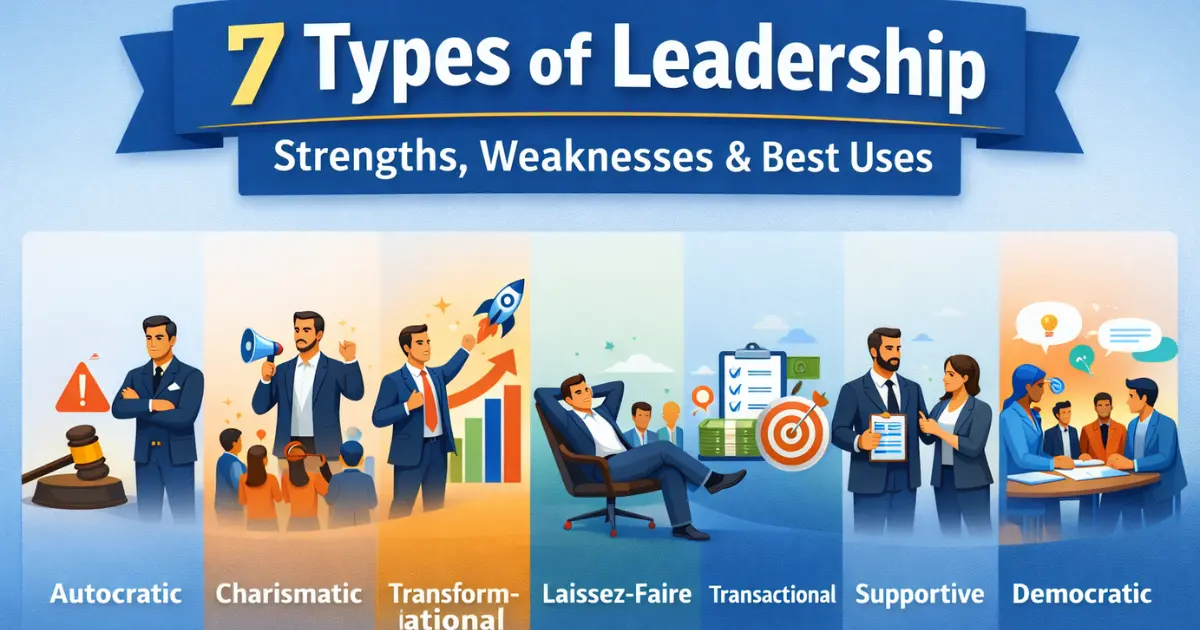
In this article, you will find a clear breakdown of all 7 leadership styles with honest strengths and weaknesses, real-world examples, and practical guidance on when each one actually works.
What are the types of leadership?
A leadership style is the pattern of behavior a leader consistently uses to guide, motivate, and manage the people around them. It shapes how decisions get made, how communication flows, and how the team responds to pressure and change.
Researchers and organizational psychologists have studied Leadership – Wikipedia leadership for decades and identified several core styles. Most fall into the 7 categories covered here. None of them is universally “the best.” Each one works extremely well in some contexts and can quietly damage a team in others.
Understanding all 7 gives you real options. Without that understanding, most people lead the same way in every situation, which is one of the most common reasons good managers plateau.
7 types of leadership explained
1. Autocratic Leadership:
Autocratic leadership is a style where the leader holds most of the decision-making authority. Instructions flow in one direction. The team is expected to follow and execute, not debate or question.
This style has a reputation for being harsh or old-fashioned, but that reputation mostly comes from leaders who apply it in the wrong situations. In the right context, such as a medical emergency, a safety crisis, or a high-stakes military operation, it is not just effective but necessary. When there is no time to consult, and the cost of a slow decision is high, clear authority matters.
The real problem with autocratic leadership is overuse. When leaders rely on it in everyday situations, team members gradually stop contributing ideas, flagging problems, and feeling that their work actually matters. Over time, the best people find places where their input is valued.
Example:
Martha Stewart built one of the most recognizable lifestyle brands in the world through meticulous attention to detail and strong personal control over every element of her business. Her standards were non-negotiable, and her teams knew it.
This consistency created a powerful brand identity, but her management style also generated high turnover and a culture that many employees found difficult to sustain. The brand succeeded because of her autocratic vision, but it was also limited by it.
Works well for
- Emergency response
- Safety-critical environments
- New teams needing structure
- Crisis situations
Watch out for
- Low morale over time
- Reduced creativity
- High performer turnover
- Blind spots (no one speaks up)
Key takeaway: Speed and control come at a cost. Use this style when the situation genuinely demands it, but build in feedback channels so the team can still flag what you might be missing.
read more: Action Plan to Improve Communication Skills in the Workplace
2. Charismatic Leadership:
Charismatic leaders draw people in through personality, energy, and a compelling vision. They are skilled communicators who make people feel genuinely excited about a direction or a mission. In this style, followership is earned through inspiration rather than authority.
At its best, charismatic leadership can move entire organizations, especially during moments of uncertainty or change when people need someone to believe in. The challenge is that it can create a culture that revolves around one person rather than a shared purpose. When the charismatic leader exits, the team sometimes loses its direction entirely because the vision was never truly embedded in the organization itself.
Another real risk is that charismatic leaders often surround themselves with people who agree with them. Their presence can be so strong that team members hesitate to challenge ideas, which means important problems can go unaddressed for longer than they should.
Example
Oprah Winfrey is one of the clearest examples of charismatic leadership in modern business. Her ability to connect with people on a personal and emotional level, articulate a vision clearly, and inspire genuine loyalty across teams and audiences made her brand far more than a media company. What makes her example instructive is that she also actively developed the people around her rather than making herself the only source of direction.
Works well for
- Brand and culture building
- Mission-driven organizations
- Public-facing leadership roles
- Change management
Watch out for
- Over-reliance on one person
- Groupthink
- Succession vulnerability
- Blind spots from an agreement culture
Key takeaway: Charisma is a powerful tool for building momentum, but sustainable leadership means transferring that energy into the team’s culture so it lives beyond any individual.
read more: 15 Powerful Oral Communication Examples
3. Transformational Leadership:
Transformational leadership is about changing how people think, not just what they produce. Leaders in this style challenge the status quo, set ambitious goals, and actively invest in the development of the people around them. The focus is not on managing tasks but on growing people and improving systems.
This is one of the most researched leadership styles in organisational psychology, and the evidence consistently shows that it correlates with higher engagement, stronger team performance, and better long-term outcomes.
But it also comes with real demands. Transformational leaders set high expectations, and when that pressure is not paired with genuine support and resources, it can lead to burnout rather than growth.
The style works best in environments where the team has some capacity for change, and the work itself benefits from innovation. It is less suited to environments where consistency and routine are more valuable than creativity.
Example
Walt Disney is the most cited example of transformational leadership in creative industries. He pushed his teams to build things that had never existed before and refused to accept “that’s impossible” as an answer. His leadership style created extraordinary innovation in animation, theme parks, and storytelling. At the same time, those who worked closely with him described intense pressure to meet near-impossible standards, which illustrates both the power and the cost of this approach.
Works well for
- Creative industries
- Fast-growing businesses
- Teams with high potential
- Innovation-focused projects
Watch out for
- Burnout from high pressure
- Unrealistic expectations
- Neglecting team wellbeing
- Moving too fast for the team
Key takeaway: Among types of leadership, high expectations can unlock great performance, but only when they are matched with real support, clear resources, and a leader who stays connected to how the team is actually doing.
4. Laissez-Faire Leadership:
Laissez-faire is a French phrase that roughly means “let them do.” In leadership, it describes a style where the leader provides minimal direction and allows the team to make decisions independently. There are a few check-ins, a few instructions, and few constraints.
In the right environment, this style produces remarkable results. Senior professionals, experienced researchers, and specialist creative teams often do their best work when they are not being managed closely. Autonomy signals trust, and trust tends to improve both motivation and output quality.
The problem comes when this style is applied to teams that are not ready for it. New employees without enough experience, teams working on unclear briefs, or projects with tight deadlines can suffer badly under laissez-faire leadership. Without direction, confusion builds quickly, and the leader who stays too distant often finds out about problems far too late to fix them effectively.
Example
Donna Karan built her fashion brand by surrounding herself with talented creative professionals and giving them space to do what they do best. She maintained oversight of the brand’s overall direction but trusted her teams to make creative and operational decisions within that frame. This approach worked because the team was genuinely skilled and self-motivated, which is the prerequisite for laissez-faire leadership to function well.
Works well for
- Senior specialists
- Research and design teams
- Highly experienced professionals
- Creative environments
Watch out for
- Direction gaps for newer staff
- Missed deadlines
- Unclear accountability
- Problems surfacing too late
Key takeaway: Autonomy works when the team is ready for it. The key is staying available without hovering, and having clear check-in points so small problems do not become big ones.
5. Transactional Leadership:
Among types of leadership transactional leadership operates on a clear exchange: you meet your targets, you get rewarded. You fall short, there are consequences. It is one of the most common leadership styles in corporate environments because it is practical, measurable, and easy to manage at scale.
This style creates clarity. Everyone knows what is expected, how performance is measured, and what success looks like. For teams that need structure, or for roles where output is easy to quantify, such as sales, logistics, or customer service, it can drive consistent and predictable results.
Where it falls short is in anything that requires creativity, ownership, or long-term motivation. When people are only working towards the next incentive, they rarely go beyond the minimum required. And when the incentives disappear or feel inadequate, performance drops sharply because there was no deeper motivation underneath.
Example
Bill Gates was known during Microsoft’s early years for setting precise, demanding performance standards and holding teams rigorously accountable to them. Engineers were expected to produce at a very high level, and Gates would challenge their work directly.
This transactional pressure helped Microsoft grow at extraordinary speed in a competitive industry. However, it also created a workplace culture that many described as stressful and that later required deliberate effort to change as the company matured.
Works well for
- Sales teams
- Operations and logistics
- Structured corporate environments
- Short-term performance goals
Watch out for
- Low creativity
- Weak team culture
- Minimum-effort mentality
- High turnover when incentives drop
Key takeaway: Structure and accountability are genuinely valuable, but the best transactional leaders pair clear goals with enough human connection to make the work feel meaningful beyond just the reward.
6. Supportive Leadership:
Supportive leadership puts people at the centre of how the work gets done. A supportive leader actively checks in with team members, removes obstacles, provides encouragement, and creates an environment where people feel safe to ask for help and speak up honestly.
The research on employee engagement consistently shows that people who feel supported at work are more productive, more loyal, and more likely to go beyond what is formally required. That makes this style particularly valuable in high-stress environments, during periods of change, and when retaining good people is a priority.
The challenge for supportive leaders is maintaining standards while prioritizing relationships. When the desire to be supportive leads to avoiding difficult conversations or tolerating underperformance, it actually does the team a disservice. True support includes honest feedback, not just encouragement.
Example
Larry Page, co-founder of Google, is known for creating an environment where employees were encouraged to pursue ambitious ideas and where management was expected to support those ideas rather than control them.
Google’s famous “20% time” policy, which gave employees a portion of their week to work on self-directed projects, was a direct expression of this philosophy. Products like Gmail originated from that policy, which shows what supportive leadership at scale can produce when it is backed by genuine investment in people.
Works well for
- High-stress teams
- Talent retention
- Post-change recovery
- Environments rebuilding trust
Watch out for
- Avoiding hard conversations
- Unclear accountability
- Tolerance of underperformance
- Leader becoming over-involved
Key takeaway: People perform better when they feel genuinely supported, but caring about someone also means being honest with them. The strongest supportive leaders combine warmth with clear expectations.
7. Democratic Leadership:
Democratic leadership invites the team into the decision-making process. Rather than deciding alone, a democratic leader gathers input, facilitates discussion, and incorporates different perspectives before reaching a conclusion. The team’s voice is not just heard, it is genuinely considered.
This style builds real trust and ownership. When people have a say in a decision, they are far more likely to commit to it and make it work, even when parts of it are challenging. It also surfaces better decisions, because more perspectives catch more blind spots.
The trade-off is time. Democratic leadership is slower than autocratic leadership, especially in large teams or complex discussions. If managed poorly, it can also create the appearance of participation without genuine influence, which is actually more damaging to trust than simply making decisions alone would have been.
Example
Indra Nooyi, during her tenure as CEO of PepsiCo, made open communication and collaborative thinking central to how the company operated. She regularly sought input from employees at different levels, challenged her leadership team to question assumptions, and built a culture where diverse perspectives were expected rather than tolerated.
Under her leadership, PepsiCo’s revenue grew significantly, and the company navigated major strategic shifts in the food and beverage industry, which many attribute partly to this inclusive approach to decision-making.
Key takeaway: Genuine participation is one of the most powerful tools for building trust and commitment, but the leader still needs to own the final decision and close the loop clearly so discussions do not drag on indefinitely.
Which type of leadership is most effective?
There is no single most effective leadership style. Research shows the best leaders practice situational leadership: they read the team’s needs, the task at hand, and the urgency of the situation, then adjust their approach accordingly. A style that works perfectly in a crisis may cause real damage in a creative, long-term environment.
This idea was formalized by Paul Hersey and Ken Blanchard as “Situational Leadership Theory.” The core argument is that leadership effectiveness is not about having the right personality; it is about matching your approach to what the person in front of you actually needs right now.
A newer team member on an unfamiliar task needs more direction and structure, which points toward autocratic or transactional approaches. An experienced professional working on something within their expertise needs trust and space, which points toward laissez-faire or supportive styles. Most situations fall somewhere between these two ends, which is exactly why range matters more than any single style.
Practical tip
The next time you are about to lead a conversation or make a decision, ask yourself: Does this person need direction, support, collaboration, or space? Your honest answer to that question will tell you which style to reach for.
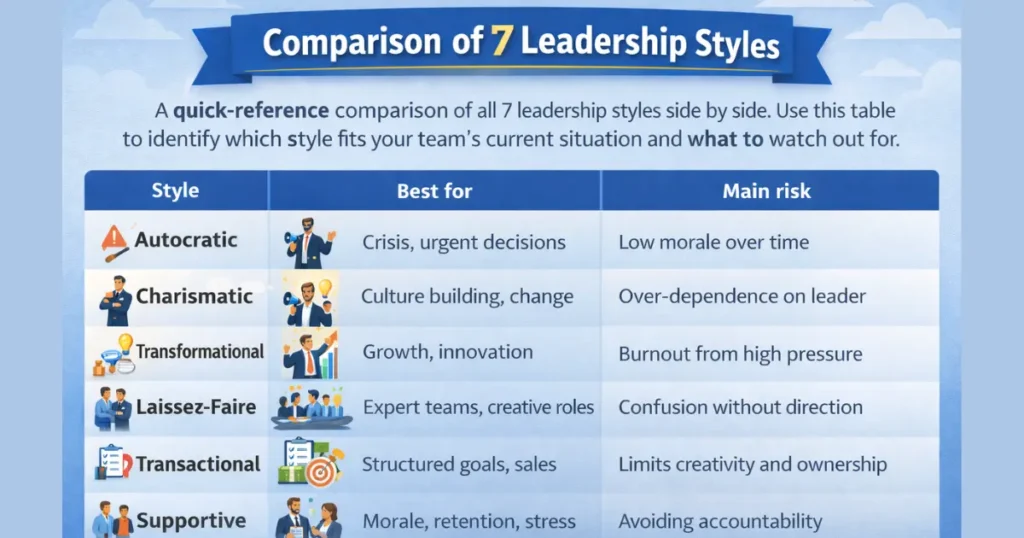
Quick comparison: all 7 leadership styles at a glance
| Style | Best for | Main risk |
|---|---|---|
| Autocratic | Crisis, urgent decisions | Low morale over time |
| Charismatic | Culture building, change | Over-dependence on leader |
| Transformational | Growth, innovation | Burnout from high pressure |
| Laissez-faire | Expert teams, creative roles | Confusion without direction |
| Transactional | Structured goals, sales | Limits creativity and ownership |
| Supportive | Morale, retention, stress | Avoiding accountability |
| Democratic | Strategy, buy-in, trust | Slow decisions |
How to identify and develop your leadership style
Most people have a dominant style they default to, especially under pressure. The goal is not to abandon that style but to understand it clearly enough to know when it is helping and when it is getting in the way.
From there, the practical work is in expanding your range. If you naturally lean toward democratic leadership, practice being more decisive when speed genuinely matters. If you lean toward autocratic, build in regular moments where you ask the team what they think before deciding. Small, deliberate adjustments over time are how leadership range actually develops.
Leadership development tip
Ask someone you trust, a peer, a direct report, or a mentor, how they experience your leadership. Most leaders are surprised by the gap between how they think they lead and how it actually lands. That gap is your development opportunity.
read more: 13 Leadership Qualities of a Good Leader
Conclusion
Understanding the different types of leadership is not an academic exercise. It is a practical tool for making better decisions about how you show up for the people who depend on your leadership.
Each of the 7 leadership styles covered here has real value in the right situation. Autocratic leadership saves time in a crisis. Democratic leadership builds commitment to a strategy. Transformational leadership unlocks potential that people did not know they had. The skill is knowing which one the moment calls for. For the full picture on leadership meaning, objectives, and core traits, see our complete leadership guide.
The most effective leaders are not the most confident or the most experienced in the room. They are the most self-aware, the most flexible, and the most genuinely interested in what their team actually needs. That kind of leadership is something anyone can work toward, regardless of their starting point.
FAQs about types of leadership
1. What are the 7 types of leadership?
The 7 main types of leadership are autocratic, charismatic, transformational, laissez-faire, transactional, supportive, and democratic leadership. Each style reflects a different approach to decision-making, team management, and motivation, and each works better in some situations than others.
2. What is the difference between leadership styles and types of leadership?
There is very little practical difference. Both terms refer to the patterns of behavior a leader uses to influence and guide others. “Leadership styles” tends to be used more in business and HR contexts, while “types of leadership” is more common in academic and general writing. They describe the same thing.
3. Which leadership style is most effective?
No single style is most effective in all situations. Research consistently shows that adaptive or situational leadership, the ability to shift between styles based on the team and context, produces the best long-term outcomes. The most effective leaders have range, not just one strong style.
4. Can a leader use more than one leadership style?
Yes, and this is actually what separates good leaders from great ones. Most effective leaders use different styles with different people and in different situations. The goal is not to pick one style but to develop the awareness and skill to use the right one at the right time.
5. How do I find out what my leadership style is?
The most reliable way is to reflect on how you naturally behave under pressure, in disagreements, and when making decisions. Notice whether you tend to decide alone or involve others, whether you focus first on the task or the person, and whether your instinct is to give direction or space. A leadership style assessment can help, but honest self-reflection and feedback from the people you lead are even more valuable.
6. What is the difference between autocratic and democratic leadership?
Autocratic leadership means the leader makes decisions independently, with little or no team input. Democratic leadership means the team is involved in the process before a decision is made. Autocratic leadership is faster but can reduce morale and ownership. Democratic leadership is slower but tends to produce stronger commitment to outcomes and better long-term trust.

Ayanshi is the founder of PersonaGuru.in, a blog focused on personality development, career, relationships, and mental well-being. With over 3 years of writing experience, she turns psychology and everyday experiences into practical, easy-to-understand advice for real life.