
Last updated on September 9th, 2026 at 04:55 pm
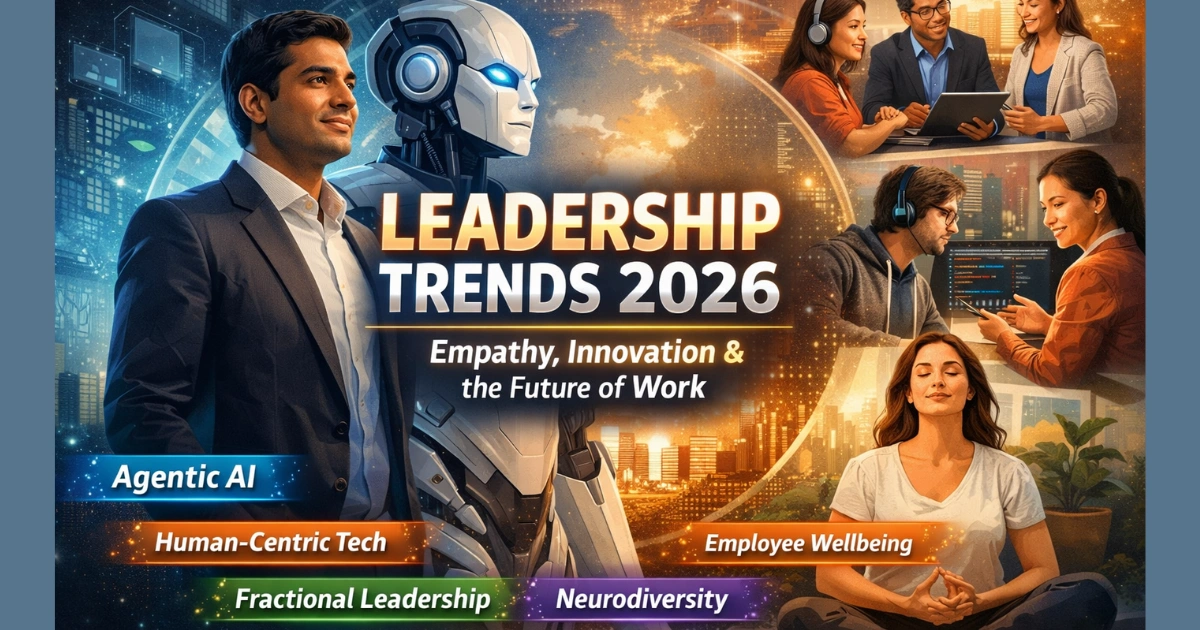
Leadership trends 2026 rest on six major shifts. Leaders now supervise Agentic AI instead of just using it. Empathy and creativity matter more, not less. Fractional leadership is rising fast. Companies are investing more in neurodiversity. Wellbeing is now a core performance metric. And a real pipeline crisis is pushing younger professionals away from traditional management roles. Real DDI research backs this. Leader stress is up 71%. Trust in immediate managers has fallen to just 29%, down 37% since 2022. For the full picture of what leadership means at its core, see our complete leadership guide.
Have you noticed how the definition of a “good boss” has changed almost overnight? As we move deeper into 2026, the workplace is no longer just about hitting targets. It is about navigating a world where technology is autonomous, but human expectations for empathy are at an all-time high.
According to the DDI Global Leadership Forecast 2026, organizations are facing a serious “capability strain.” To stay relevant, you must move beyond traditional management and embrace the specific leadership trends 2026 is defining right now.
“Credibility is the new currency. In 2026, leaders aren’t judged by their visibility, but by the consistency of their judgment under pressure.” — AIMS International Research
1. Agentic AI: Your Smart Co-Leader
In 2025, AI was a tool we talked to. In 2026, Agentic AI is a teammate that acts on its own. IBM reports that 61% of employees now expect their roles to change because AI agents can manage entire workflows autonomously.
The Trend: Leaders are becoming “Supervisors of AI Agents.” Your role is to set the goals, define the boundaries, and audit the results.
The Human Edge: While AI handles complex decision-making and routine tasks, only you can provide the contextual judgment and ethical oversight.
Real-World Example: Companies are already using AI-powered tools like IBM Watson to automate deep-level tasks in healthcare and finance, freeing leaders to focus on high-level strategy instead of routine data work. This is a core part of how AI is reshaping leadership decision-making across nearly every industry right now.
Quick Start: Give your team one small AI agent (auto-reports, scheduling). Train them to always ask: “Is this fair? Does it help people?”
2. A Human-Centric Approach to Technology
As technology moves faster, the focus has shifted toward Human-Centered Innovation. Instead of automating everything to save costs, smart leaders use AI to empower human skills like creativity and empathy.
Why it matters: Human ingenuity is irreplaceable. The most successful organizations in 2026 use technology to enhance the unique qualities of their people, not replace them.
How to Prepare: Invest in tools that simplify task management while protecting the creative and decision-making freedom of your team. This connects directly to why emotional intelligence matters so much in leadership, since EQ is exactly the skill AI cannot substitute.
3. The Boom in Fractional Leadership
The era of having a full-time executive for every role is fading. Fractional Leadership is on the rise, where experienced pros are hired part-time to provide specialized expertise during big transitions.
Real-World Example: Platforms like Toptal and On Deck have made it easy for businesses to hire “Fractional CMOs” or “Fractional CFOs” on demand, allowing them to scale without the heavy burden of 7-figure salaries.
The Strategy: Build a network of trusted fractional leaders so you can bring in specific expertise exactly when a project needs it.
4. Unlocking the Power of Neurodiversity
In 2026, diversity isn’t just about labels; it’s about Cognitive Diversity. Organizations are realizing that neuro divergent individuals (those with ADHD, Autism, or Dyslexia) bring incredible strengths in problem-solving and attention to detail.
Real-World Example: Microsoft’s Neurodiversity Hiring Program has run for close to a decade, redesigning its interview process around workability and skills assessment rather than traditional social cues, and SAP has run a similar program for years.
Action Step: Train your managers to recognize and support different ways of thinking. A neuro-inclusive culture leads to higher satisfaction and retention.
5. Wellbeing as a Business Strategy
Wellbeing is no longer a “perk” like a gym membership; it’s a core performance metric. Leadership trends 2026 judges leaders on the “Human Sustainability” of their teams.
The Shift: If your team is burned out, that now reads as a leadership failure, not bad luck. Leaders must model healthy boundaries, like not sending emails after 7 PM, if they want their team to actually believe it is safe to do the same. This is the same principle behind balancing leadership responsibilities with personal well-being.
Practical Steps: Train your middle managers to recognize early signs of quiet stress and provide mental health resources before productivity visibly drops.
6. Navigating the Leadership Pipeline Crisis
Young professionals are increasingly saying “no” to traditional management because of the stress. Leadership trends 2026 has created a “Pipeline Crisis” that organizations must solve.
The Solution: Move toward micro-leadership. Let emerging talent lead small projects or specific initiatives with dedicated mentorship, rather than handing them an entire department at once, following a structured leadership development process instead of throwing people in unprepared.
Why it works: It builds confidence and skill without the immediate pressure of a traditional top-down role.
Leadership Trends 2026 Practical Steps for Leaders
To lead effectively this year, embrace these leadership trends 2026 best practices:
Build Trust: Be transparent about changes and listen more than you talk.
Encourage Growth: Provide continuous learning opportunities so your team feels ready for AI shifts.
Promote Safety: Create a space where people feel safe taking risks and admitting mistakes, the same environment where toxic personality traits get caught early instead of spreading unchecked.
Model Wellbeing: Demonstrate work-life boundaries. You cannot pour from an empty cup.
What Organizations Must Do for Leadership Trends 2026
Organizations must support leaders in embracing these trends. Key steps include:
- Offer personalized development plans: Help leaders close skill gaps and grow into future roles.
- Create robust support systems: Provide mentorship, resources, and tools to foster leadership growth.
- Recognize and reward leaders: Acknowledge leaders who build trust, promote innovation, and prioritize employee wellbeing.
By staying ahead of leadership trends 2026, organizations can build resilient, innovative teams ready to face the challenges of 2026 and beyond. The future belongs to those who prioritize human connection, innovation, and ethical leadership, creating a workplace where everyone can thrive.
Conclusion
The future of leadership trends 2026 belongs to those who prioritize human connection alongside innovation. By staying ahead of these trends, you can build a resilient team that is ready for any challenge the new year brings.
Quick Challenge: Pick one trend from leadership trends 2026—perhaps a “Human Check-in” or exploring an AI agent—and try it this week. Which shift feels most urgent for your organization right now? Let’s discuss in the comments!
FAQs
1. What Is Agentic AI in Leadership Trends 2026?
Agentic AI refers to AI systems capable of performing tasks autonomously and making decisions. In leadership trends 2026, it enhances efficiency by automating routine tasks, allowing leaders to focus on strategy and innovation.
2. How Does Neurodiversity Benefit Workplace Leadership?
Neurodiversity in the workplace brings diverse cognitive abilities, such as creativity and problem-solving skills. Embracing neurodiverse employees can drive innovation and improve team performance, leading to a more inclusive and effective work environment.
3. What Is Fractional Leadership and Why Is It Growing?
Fractional leadership means hiring experienced executives on a part-time basis for specific projects or transitions. It gives organizations access to senior expertise without the cost of a full-time salary, which matters more as companies try to stay lean.
4. How Can Leaders Improve Employee Wellbeing in 2026?
Leaders can improve wellbeing by offering real mental health resources, modeling healthy work-life boundaries themselves, and creating flexible policies that are actually used, not just written into a handbook.
5. How Can AI and Humans Collaborate Effectively in Leadership?

Ayanshi is the founder of PersonaGuru.in, a blog focused on personality development, career, relationships, and mental well-being. With over 3 years of writing experience, she turns psychology and everyday experiences into practical, easy-to-understand advice for real life.