

Emotional intelligence examples in the workplace are everyday moments where you notice your own feelings and other people’s feelings, and then respond in a calm and helpful way. Staying polite when a client shouts is one. Asking a quiet teammate if they are okay is another.
You do not need a title or a degree to show it. You show it in small moments, many times a day. This guide gives you 12 real situations, signs of low emotional intelligence, and answers you can use in a job interview.
If you are new to the topic, start with our main guide on emotional intelligence in personality development. Then come back here for the real examples. A free one-page checklist is also included.
Key Takeaways
- Emotional intelligence examples in the workplace show how to notice feelings and choose a calm response.
- It shows in small moments: feedback, deadlines, meetings, and conflicts.
- Pause for a few breaths before you reply. This one habit changes a lot.
- Low emotional intelligence shows up as blaming, interrupting, and ignoring feelings.
- In an interview, tell one real moment with the STAR method.
- You can train this skill. It does not depend on your personality.
What Is Emotional Intelligence in the Workplace?
Emotional intelligence in the workplace is the ability to notice, understand, and manage your own feelings and other people’s feelings while you work. It is not about being soft. It is about being clear and calm when things get tense.
Think of two colleagues. Both get the same harsh feedback. One argues for ten minutes. The other says, “Thank you. Can you show me one example?” The second person is using emotional intelligence.
Psychologists often split it into parts. Our guide on the 4 types of emotional intelligence explains how each part helps.
Why Does Emotional Intelligence Matter at Work?
It matters because work runs on people. How you handle stress, feedback, and conflict decides how well a team works together.
Employers also value the skills behind emotional intelligence examples in the workplace. The World Economic Forum’s Future of Jobs Report 2025 ranks the core skills employers need. According to the World Economic Forum, resilience, flexibility, and agility are the second core skills. Motivation and self-awareness come fifth. Empathy and active listening come seventh.
Notice that all three are emotional intelligence skills. That is a strong sign that employers value them.
Some people ask which matters more, EQ or IQ. We answer this in EQ vs IQ.
What Are the 5 Components of Emotional Intelligence?
Daniel Goleman describes the five components as self-awareness, self-regulation, motivation, empathy, and social skills. You may also see a “5 Cs” list online. There is no single standard set of 5 Cs, so this guide uses the five components.
BusinessBalls describes them in short lines. According to BusinessBalls, self-awareness means understanding your own feelings and how they affect others. Self-regulation means keeping impulses and emotions in check. Empathy means recognising other people’s moods and responding in a way that strengthens the relationship.
| Component | What it means | How it looks at work |
|---|---|---|
| Self awareness | Knowing what you feel and why | You notice you are getting defensive |
| Self regulation | Managing your reactions | You pause before replying to an angry email |
| Motivation | Staying driven in tough times | You try again after a failed project |
| Empathy | Understanding other people’s feelings | You notice a teammate is quiet and check in |
| Social skills | Working well with people | You settle a disagreement calmly |
What Are 12 Real Life Examples of Emotional Intelligence in the Workplace?
Real examples include staying calm when a client shouts, accepting feedback without anger, asking for help before a deadline slips, and noticing when a teammate is quiet. Here are 12 emotional intelligence examples in the workplace. Change the names and details to match your job.
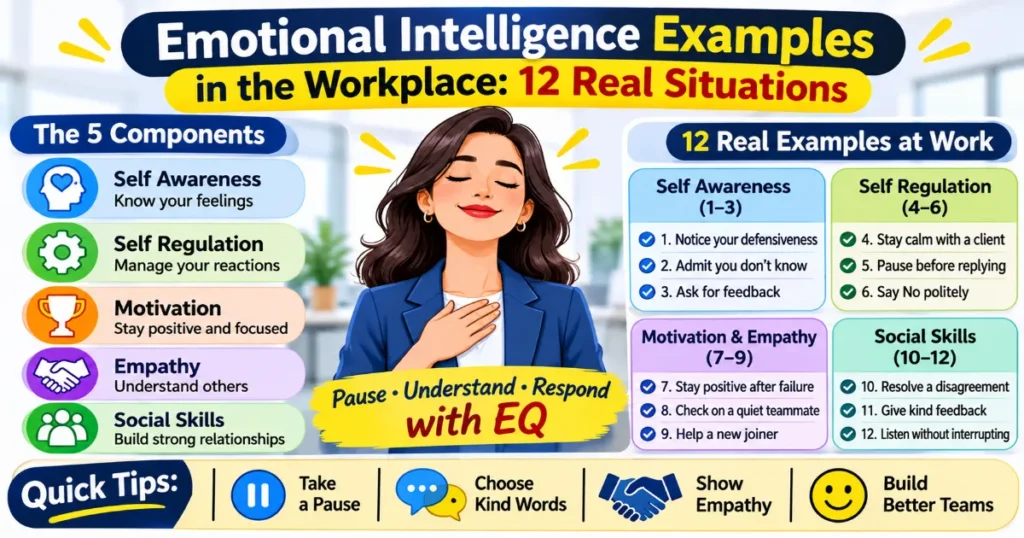
Self-Awareness Examples
1. Noticing You Are Getting Defensive in a Meeting
Your manager questions your numbers. You feel your face go hot. You want to argue.
An emotionally intelligent person notices this. They think, “I am getting defensive.” They take a breath. Then they say, “Good point. Let me check and come back to you.”
This is the first step. You cannot manage a feeling you have not noticed. To build this skill, read how to improve self-awareness.
2. Admitting You Do Not Know Something
A client asks a question you cannot answer.
Low EQ: you guess and hope for the best. High EQ: “I am not sure about that. Let me confirm and send you the answer by 5 pm.”
Honesty builds trust faster than a confident guess.
3. Asking for Feedback After a Presentation
“What is one thing I could do better next time?”
This single question shows you can look at your own work without fear. Most people do not ask it.
Self-Regulation Examples
4. Staying Calm When a Client Shouts
A client is angry about a delay. He is loud.
| Reaction | What you say | What happens |
|---|---|---|
| Weak | “It is not my fault. The vendor is late.” | The client gets angrier |
| Emotionally intelligent | “I understand this is frustrating. Let me check the status and call you back in 30 minutes.” | The client feels heard and calms down |
You still protect your work. You just do not add fuel to the fire. For quick ways to calm your body before a tough call, see these ways to reduce stress levels immediately.
5. Pausing Before Replying to an Angry Email
You read a rude email at 9 pm. You type a sharp reply. Then you stop.
You save it as a draft. You read it the next morning. Most of the time, you change it. Sometimes you delete it.
A good rule is to wait one night before replying to anything that makes your heart race.
6. Saying No to Extra Work Politely
Your manager gives you a new task on Friday evening. Your plate is full.
“I would like to help. I am at full capacity today. I can start on Monday morning. Does that work?”
You protect your limits and offer a real option. You will find more lines on how to say no to extra work.
Motivation and Empathy Examples
7. Staying Positive After a Failed Project
A project did not work. The team feels low.
A person with high EQ says, “That did not go as planned. What did we learn? What will we change next time?” They do not pretend it did not hurt. They also do not stay stuck in it.
8. Noticing a Teammate Is Unusually Quiet
Rohit usually jokes in the daily call. Today he said nothing.
You send a private message. “You seemed quiet today. Everything okay?” He may say it is nothing. Or he may tell you he is stressed. Either way, he knows someone noticed.
This is empathy at work. Read more about the role of empathy in building strong relationships.
9. Helping a New Joiner Without Being Asked
A new colleague looks lost on day one.
“I remember my first week was confusing. Want me to show you where things are?”
It costs you five minutes. It saves them a week of stress.
Social Skills Examples
10. Resolving a Disagreement With a Colleague
Two team members disagree on a plan.
| Reaction | What is said |
|---|---|
| Weak | “Your idea will never work.” |
| Emotionally intelligent | “I see a risk in this plan. Can we look at both options together?” |
Talk about the problem, not the person. For more lines, read our tips on communication for conflict resolution.
11. Giving Feedback Without Hurting the Person
“The report is almost ready. Three numbers on page two need a check. Can you fix them by noon?”
You name the work, not the person. You give a clear next step.
12. Listening Without Interrupting in a Team Meeting
A colleague is explaining an idea slowly. You already know your answer.
You wait. You let them finish. Then you say, “Let me repeat what I heard. Is that right?”
This shows respect, and it avoids mistakes. For drills, see how to practise active listening skills.
Can You Give Me 10 Examples of Emotional Intelligence?
Yes. Ten quick examples are: noticing you are defensive, admitting you do not know, asking for feedback, pausing before replying, staying calm under pressure, saying no politely, staying positive after failure, checking on a quiet teammate, helping a new joiner, and listening without interrupting. Each one is explained above with a real situation.
What Are Emotional Intelligence Examples in the Workplace for Leaders?
A leader with high EQ listens first, shares the reason behind a decision, and treats a mistake as something to fix, not someone to blame. The same skills apply, with higher stakes.
- A manager notices a team member is overloaded and moves one task.
- A leader says, “I made the wrong call. Here is what I will change.”
- A team lead gives hard feedback in private and praise in public.
- A senior person asks, “What do you think?” and waits for the answer.
For more, read about emotional intelligence in leadership.
How Do Emotionally Intelligent People Talk?
They speak calmly, ask questions, name feelings, and take responsibility for their part. Here is how the words change.
| Situation | Low EQ line | High EQ line |
|---|---|---|
| Deadline is missed | “You people always delay.” | “We missed the deadline. Let us find out what went wrong.” |
| You are criticised | “That is not true.” | “Thank you. Can you give me an example?” |
| You feel hurt | “Forget it. I am fine.” | “I felt hurt when I was left out of that email.” |
| A colleague is upset | “Do not be so sensitive.” | “That sounds hard. Do you want to talk?” |
| You made a mistake | “It was not just me.” | “I made a mistake. Here is how I will fix it.” |
| You disagree | “That is a bad idea.” | “I see it differently. Can I explain?” |
What Are 5 Signs of Someone Who Is Emotionally Intelligent?
Five signs are: they listen fully, stay calm under pressure, accept feedback, admit mistakes, and notice how others feel. You can use this list to check yourself, too.
- They let people finish speaking.
- They stay steady when plans change.
- They say thank you for feedback, even when it stings.
- They say “I was wrong” without a long excuse.
- They notice mood changes in the room.
What Are 7 Signs of Low Emotional Intelligence at Work?
Seven signs of low emotional intelligence are interrupting often, blaming others, reacting badly to feedback, ignoring feelings, struggling with change, holding grudges, and not listening. Everyone shows these sometimes. The pattern matters. They are the opposite of the emotional intelligence examples in the workplace shown above.
| Sign | What it looks like | A simple fix |
|---|---|---|
| Interrupting | Finishing other people’s sentences | Count to two before you speak |
| Blaming | “It was your fault” | Start with “What can I fix?” |
| Bad reaction to feedback | Arguing or going silent | Say “Thank you” first, think later |
| Ignoring feelings | “Just do your work” | Ask “How are you doing?” once a week |
| Struggling with change | Complaining about every new rule | Ask what you can control |
| Holding grudges | Not talking to someone for days | Have one honest talk |
| Not listening | Checking the phone in meetings | Put the phone face down |
Anger is a common problem here. If this is you, read about aggression management.
How Can You Control Your Emotions at Work?
Name the feeling, pause for a few breaths, and then choose your response. This takes less than a minute.
- Name it. Say to yourself, “I am angry” or “I am anxious.”
- Pause. Breathe in for four counts and out for six.
- Check the facts. What actually happened? What am I assuming?
- Choose your reply. Ask, “What do I want from this talk?”
- Speak slowly. A slow voice calms your own body too.
How Do You Identify Your Emotions?
Many people say “I am stressed” for everything. Try to be more exact.
- Name it. Is it anger, fear, sadness, or shame?
- Rate it. Give it a number from 1 to 10.
- Find the trigger. What happened just before?
This takes practice. For more habits, see these tips to boost your emotional intelligence. If stress is the main problem, also read how to handle stressful situations in the workplace.
How Do You Give Emotional Intelligence Examples in the Workplace in a Job Interview?
Use the STAR method: Situation, Task, Action, and Result. Pick one real moment where you stayed calm, listened, or solved a conflict. Interviewers often ask for emotional intelligence examples in the workplace.
Here is a sample answer. Change the details to match your own story.
“In my last project, a teammate and I disagreed about the plan. I noticed I was getting tense, so I asked for a short break. Then I asked him to explain his view first. We found a middle path, and we finished two days early.
| Interviewer asks | Skill it checks |
|---|---|
| “Tell me about a conflict at work.” | Self-regulation and social skills |
| “How do you handle feedback?” | Self awareness |
| “Describe a time you helped a teammate.” | Empathy |
| “How do you handle pressure?” | Self regulation |
For more preparation, read our list of top interview skills.
How Can You Build Emotional Intelligence at Work?
Practise one small habit a week. You do not need a course to turn these emotional intelligence examples in the workplace into daily habits.
| Week | Habit |
|---|---|
| Week 1 | Name your feeling three times a day |
| Week 2 | Pause for three breaths before replying to anything tense |
| Week 3 | Ask one colleague how they are, and listen to the answer |
| Week 4 | Ask for feedback and say thank you |
Download the free one-page emotional intelligence at work checklist (PDF). It has the five components, a daily check, and a weekly review.
You can also build your wider people skills with social intelligence.
What Mistakes Should You Avoid?
- Thinking emotional intelligence means hiding your feelings.
- Trying to fix everything at once.
- Using “I understand” and then not changing anything.
- Being kind to your boss but cold to juniors.
- Expecting results in a week.
- Giving up after one bad day.
Conclusion
Emotional intelligence examples in the workplace are small and simple. You notice a feeling. You pause. You choose a calm reply. You do this again tomorrow.
I would pick one of these emotional intelligence examples in the workplace and try it this week. Maybe it is the three-breath pause before you reply to a tense email. Small habits are what change how people see you at work.
FAQs
What are some real-life examples of emotional intelligence in the workplace?
Staying calm when a client shouts, accepting feedback without anger, asking for help before a deadline slips, and noticing when a teammate is quiet. Each of these emotional intelligence examples in the workplace shows that you notice feelings and choose a calm response.
Can you give me 10 examples of emotional intelligence?
Ten examples are: noticing you are defensive, admitting you do not know, asking for feedback, pausing before replying, staying calm under pressure, saying no politely, staying positive after failure, checking on a quiet teammate, helping a new joiner, and listening without interrupting.
What are the 5 components of emotional intelligence?
Self-regulation, motivation, empathy, and social skills. There is no single official set of 5 Cs, so most guides use these five.
What are signs of low emotional intelligence at work?
Interrupting, blaming others, reacting badly to feedback, ignoring feelings, struggling with change, holding grudges, and not listening. Look for a pattern, not one bad day.
How do you show emotional intelligence in an interview?
Tell one real moment with the STAR method: the situation, your task, your action, and the result. Choose a story about calm, listening, or solving a conflict.
How can I control my emotions at work?
Name the feeling, pause for a few breaths, check the facts, and then choose your reply. Speak slowly and keep it short.

Ayanshi is the founder of PersonaGuru.in, a blog focused on personality development, career, relationships, and mental well-being. With over 3 years of writing experience, she turns psychology and everyday experiences into practical, easy-to-understand advice for real life.