
Last updated on October 13th, 2026 at 10:25 am
How to practice active listening skills in real conversations: give the speaker your full, undivided attention, notice their body language, avoid planning your reply while they talk, and reflect what you heard before you respond. It is a skill you build through repetition, not something you either have or do not have.
Last month, a friend of mine, Kavya, called me upset after a fight with her manager. She said the same line three times: “He never actually listens to me.” I asked her what she meant. She said her manager nods, says “okay, okay,” and then repeats the same feedback he gave two weeks ago. He hears her voice. He does not hear her.
Knowing how to practice active listening skills is not just a soft skill for HR workshops. It is the difference between a conversation that actually goes somewhere and one that just wastes everyone’s time. This guide breaks it down into steps you can use today, in a meeting, on a phone call, or at your dinner table.
Key Takeaways
- How to practice active listening skills, in one line: fully focus on the speaker, notice their body language, stop planning your reply, and reflect back what you heard before you respond.
- Research covered by Harvard Business Review shows people retain only about 50% of what they hear immediately after a conversation, and this drops to 25% within a couple of months.
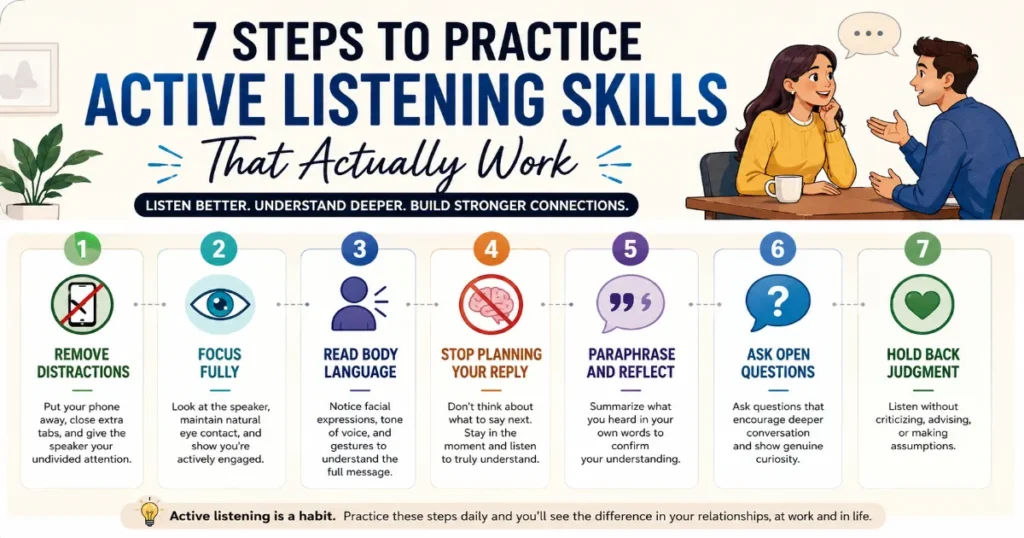
- The 7 core steps are: remove distractions, focus fully, read body language, stop planning your reply, paraphrase, ask open questions, and hold back judgment.
- A 2014 study published in the International Journal of Listening found that people who received active listening responses felt more understood and more satisfied with the conversation than people who only got advice.
- You can build this skill with two short daily exercises, explained near the end of this guide.
What Does Active Listening Actually Mean?
Active listening is a communication skill where you concentrate fully on the speaker, understand their message, and respond in a way that shows you actually understood it. It is not about staying quiet. It is about staying present. Learning how to practice active listening skills means turning this understanding into a repeatable habit during real conversations.
The term was first used seriously by psychologist Carl Rogers in the 1950s, in the context of therapy. Rogers argued that a person feels truly heard only when the listener reflects their feelings to them, without judgment. That idea moved out of therapy rooms and into offices, classrooms, and homes over the following decades. It still holds up.
Active Listening vs. Just Hearing Someone
Hearing is automatic. Your ears pick up sound waves whether you want them to or not. Listening is a choice.
| Just Hearing | Active Listening |
|---|---|
| You catch the words but miss the meaning | You catch the words and the intent behind them |
| You think about your reply while the other person talks | You wait, then respond to what was actually said |
| You nod out of habit | You nod because you are actually following along |
| You remember the gist, if that | You can repeat back the main point accurately |
Understanding this difference is the first step in learning how to practice active listening skills effectively.
Why Do I Struggle to Actively Listen?
If you find your mind wandering in conversations, you are not broken. You are human, and you are also busy. A few real reasons this happens:
- Speed mismatch. The average person speaks at around 125 to 150 words per minute, but your brain can process language much faster than that. The extra mental bandwidth wanders off, usually toward your phone or your to-do list.
- Rehearsing your response. Many of us listen only long enough to find our opening, then mentally draft what we plan to say next.
- Emotional triggers. If a topic touches a sore spot, like criticism at work or a sensitive family subject, your brain shifts into defense mode instead of listening mode.
- Digital habits. Constant notifications have trained our attention to jump every few seconds. Sitting still through someone else’s five-minute story now feels unnatural for a lot of people.
Signs You Are a Poor Listener
Be honest with yourself while reading this list.
- You often ask people to repeat what they just said.
- You interrupt before someone finishes their sentence.
- You advise being asked for it.
- You remember your own comments in a conversation better than theirs.
- People stop sharing personal things with you over time.
Active Listening Habit Many People Find Difficult
One of the hardest habits to build is staying silent without planning your reply. It sounds simple. In practice, it is difficult to break, because our instinct is to prepare a response the moment someone starts talking, instead of waiting until they finish.
How to Practice Active Listening Skills: The 7 Steps
Here is the full process, broken into steps you can practice one at a time. These steps show you how to practice active listening skills without making conversations feel forced or unnatural.
Step 1: Remove Distractions Before the Conversation Starts. Put your phone face down, or better, in another room. Close the laptop. If you are having an important conversation, choose a quiet spot. This is not optional. Environment shapes attention more than willpower does.
Step 2: Focus Fully on the Speaker. Give the person your eyes, not just your ears. Turn your body toward them. This single shift signals, “you have my attention,” before you say a word.
Step 3: Read Body Language and Tone. Words are only part of the message. A flat tone, crossed arms, or a hesitant pause often say more than the sentence itself. Notice these cues instead of only tracking the literal words. This is closely tied to body language in personality development more broadly, since how you read others is just as important as how you present yourself.
Step 4: Do Not Plan Your Reply While They Talk. This is the hard one from the section above. When you catch yourself drafting a response mid-sentence, gently pull your focus back to what is actually being said right now.
Step 5: Paraphrase and Reflect. Once they finish, restate the core idea in your own words. “So what you are saying is the deadline moved up, and nobody told the team in advance, is that right?” This confirms you understood, and it gives the speaker a chance to correct you if you did not.
Step 6: Ask Open-Ended Questions. Skip questions that get a one-word answer. Instead of “Are you okay?” try “What has been the hardest part of this for you?” Open questions invite people to say more, and they show genuine curiosity.
Step 7: Withhold Judgment and Advice Unless Asked. Most people share a problem because they want to feel heard, not because they want a solution handed to them. Resist jumping to “here’s what you should do.” Ask first: “Do you want my thoughts, or do you just need to vent?”
What Are the 5 Rules of Active Listening?
If seven steps feel like too much to remember mid-conversation, boil it down to five rules:
- Give your undivided attention.
- Show you are listening through body language.
- Provide feedback by paraphrasing.
- Defer judgment until they finish speaking.
- Respond appropriately, not automatically.
Keep these five in your back pocket for quick, everyday conversations where the full seven-step process feels like overkill.
What Does Active Listening Look Like in Real Life?
Theory is easy. Real conversations are messy. Here is how the same skill plays out in three common situations, since this is really where how to practice active listening skills matters most.
At Work: Your colleague Aryan says a client pushed back on a proposal. Instead of jumping straight to “let’s just redo the pricing,” you ask, “What exactly did the client push back on, the cost or the timeline?” This one question often saves an entire afternoon of solving the wrong problem.
In a Relationship: Your partner comes home frustrated about a family issue. Instead of offering an instant fix, you say, “That sounds really draining. Walk me through what happened.” Nine times out of ten, people want to feel understood before they want a solution.
With Family: Your mother mentions she is worried about a health checkup. Instead of brushing it off with “you’ll be fine,” you sit down and ask, “What part of it is worrying you the most?” This small act often means more than any reassurance you could offer.
Listening across cultures needs extra care. See how to improve your cross-cultural communication skills.
If you lead a team and want the leadership-specific version of this skill, our guide on listening skills specifically for leaders goes deeper into that context.
What Are Some Good Active Listening Exercises?
Skills need repetition, not just reading. Try these two exercises to make practicing active listening skills part of your daily routine.
- Paraphrase Drill: Pick any conversation today with a colleague, a friend, or family. Before you reply to their main point, say it back in your own words first. Do this five times today. It feels awkward at first. It becomes natural within a week.
- Silent Minute Exercise: Next time someone finishes talking, count to three in your head before responding. This tiny pause stops you from cutting in and gives your brain time to process what they actually said, not what you assumed they said.
Are You a Good Listener? Take This Quick Self-Test
Answer honestly, yes or no:
- Do I usually remember the details of what someone told me a day later?
- Do I wait for people to finish before I start speaking?
- Do I ask follow-up questions instead of changing the subject?
- Do I put my phone away during important conversations?
- Do people come to me when they need to talk something through?
4 to 5 yes answers: You are already a strong listener. Keep refining with the paraphrase drill. 2 to 3 yes answers: You have the basics. Focus on Step 4, not planning your reply while others speak. 0 to 1 yes answers: Start with removing distractions. It is the single biggest lever you have. This is also where your emotional intelligence and self-awareness play a role, since noticing your own wandering attention is a form of self-awareness in itself.
How Is Active Listening Tested in Exams and Interviews?
If you are a student preparing for a Business Communication paper, this connects directly to broader communication skills for students, and active listening shows up more often than people expect. A common exam question reads something like: “How should a listener practice active listening skills after receiving a message?” The expected answer covers three parts: acknowledging the message, clarifying anything unclear by asking a question, and responding appropriately rather than reacting emotionally.
In interviews, panels often test this without telling you, which is part of why communication skills matter so much in an interview beyond just what you say. If an interviewer asks a two-part question and you only answer the first part, that is usually noted as a listening gap, not a knowledge gap. The fix is the same one from Step 6 above: if you are unsure you caught the full question, it is fine to say, “Just to confirm, you are asking about both X and Y, correct?” This one small habit shapes how you come across in a job interview far more than most people realize.
This one habit, confirming before answering, has quietly saved many candidates from losing marks or missing the point of a question entirely.
Conclusion
Knowing how to practice active listening skills will not make every conversation easy. It will make most of them shorter, clearer, and less frustrating, for both sides. Start with just one step this week, removing distractions or holding back your reply, and build from there. The goal is not perfection in one day. It is a small, repeatable habit that compounds over months.
This skill connects directly to your wider personality development and career and workplace growth, and it works alongside core leadership traits and emotional intelligence and self-awareness, since listening well is really just applied EQ vs IQ in action.
FAQs
1. How can I develop my active listening skills?
Start small. Pick one conversation a day and practice the paraphrase drill from this guide. If you want to know how to practice active listening skills consistently, focus on one small listening habit at a time. Consistency matters more than intensity. Doing it in short bursts daily builds the habit faster than one long practice session a week.
2. What are the signs of a good listener?
A good listener maintains eye contact, asks relevant follow-up questions, remembers details from earlier conversations, and does not interrupt. They also know when to stay quiet instead of offering advice.
3. What are the disadvantages of active listening?
Active listening takes real mental energy, so it is not sustainable for every single conversation of your day. It can also slow down fast-paced discussions where quick decisions matter more than deep understanding. The goal is to use it where it counts, not to force it into every casual exchange.
4. What are the 4 components of active listening?
Most communication trainers group it into four parts: receiving the message, understanding it, responding appropriately, and remembering the key points afterward. Each part builds on the one before it.

Ayanshi is the founder of PersonaGuru.in, a blog focused on personality development, career, relationships, and mental well-being. With over 3 years of writing experience, she turns psychology and everyday experiences into practical, easy-to-understand advice for real life.