
Last updated on October 13th, 2026 at 08:24 am
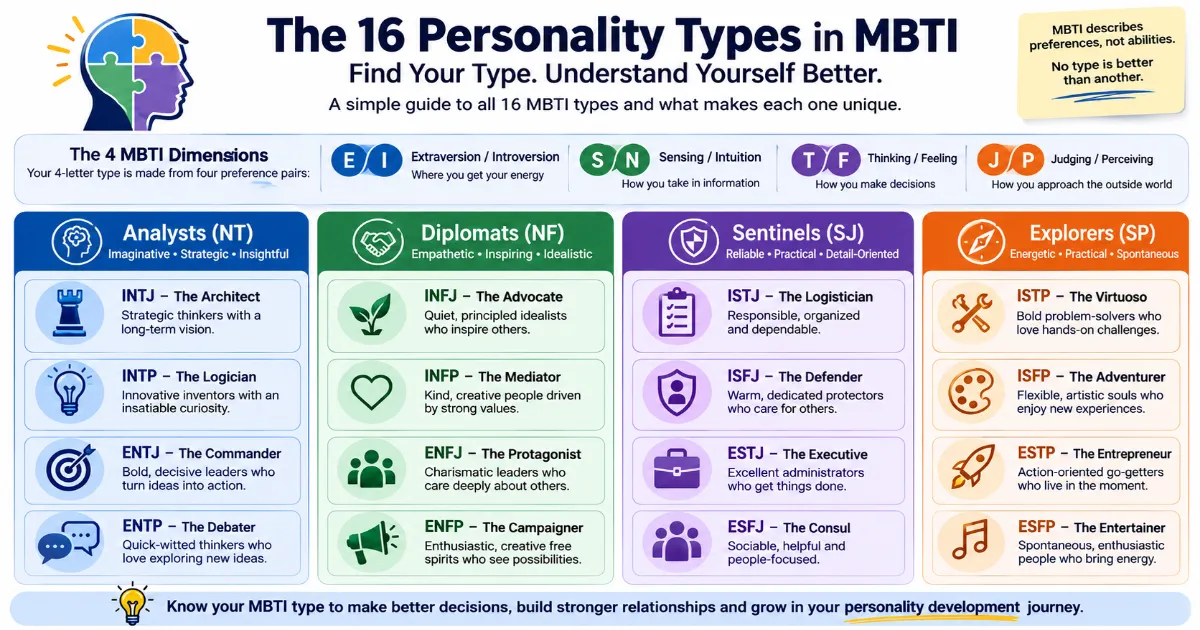
The 16 personality types in MBTI are combinations of four letter pairs, like INFJ or ESTP, that describe how a person directs their energy, takes in information, makes decisions, and approaches the outside world. If you only read one line of this article, that is the one to remember; everything below just unpacks it.
Now here is why that four-letter code is more slippery than most sites admit. Imagine a friend of yours, let us call her Naina, who took the MBTI test before a big career decision. Her result came back INFJ. She read the description and said, “This is scarily accurate.” Two years later, she took it again out of curiosity. This time she got ENFJ.
Same person. Different result. This happens more often than most personality quizzes admit.
That does not mean MBTI is useless. It means you should understand what it actually measures, and what it does not, before you build a career choice or a relationship decision around a four-letter code. This guide covers all 16 personality types MBTI offers, in plain language, with the honest parts most sites skip. It is part of our wider personality development coverage, so if this is your first stop, there is more to explore once you find your type.
Key Takeaways
- MBTI sorts personality into 16 types using four letter pairs, such as INFJ or ESTP.
- The four pairs are Extraversion or Introversion, Sensing or Intuition, Thinking or Feeling, and Judging or Perceiving.
- The 16 types group into four broader categories: Analysts, Diplomats, Sentinels, and Explorers.
- The APA Dictionary of Psychology describes MBTI as a personality assessment based on Jungian psychological types, and notes that researchers have raised concerns about its reliability, since people do not always receive the same type when they retest.
- MBTI still has real practical value as a self-reflection tool and a shared vocabulary for talking about personality, even with those limits.
Quick Answer: The 16 personality types in MBTI are combinations of four letter pairs that describe how a person directs their energy, takes in information, makes decisions, and approaches the outside world. Each combination, like INTJ or ESFP, points to a distinct pattern of thinking and behaving, though it is a starting point for self-reflection rather than a fixed scientific label.
What Is MBTI? A Quick History
MBTI stands for the Myers-Briggs Type Indicator. A mother and daughter team, Katharine Cook Briggs and Isabel Briggs Myers, built it in the 1940s. They based their framework on Carl Jung’s theory of personality classification, the Swiss psychiatrist who wrote about psychological types decades earlier.
Neither Katharine Cook Briggs nor Isabel Briggs Myers had formal training as psychologists, which is an important part of the MBTI’s history and later criticism. They were, in fact, curious observers of human behavior. Their interest became especially relevant during World War II, when large numbers of women were entering the industrial workforce for the first time and needed a practical way to identify the kind of wartime jobs suited to their strengths. That origin story matters, because it shapes both the tool’s strength- its intuitive, relatable language- and its weakness: a lack of the rigorous validation that formal psychometric tools usually go through. If you want the fuller backstory of how personality theory evolved before MBTI even existed, this journey from genes to Freud is a good next read.
What Do the MBTI Letters E, I, S, N, T, F, J, P Actually Mean?
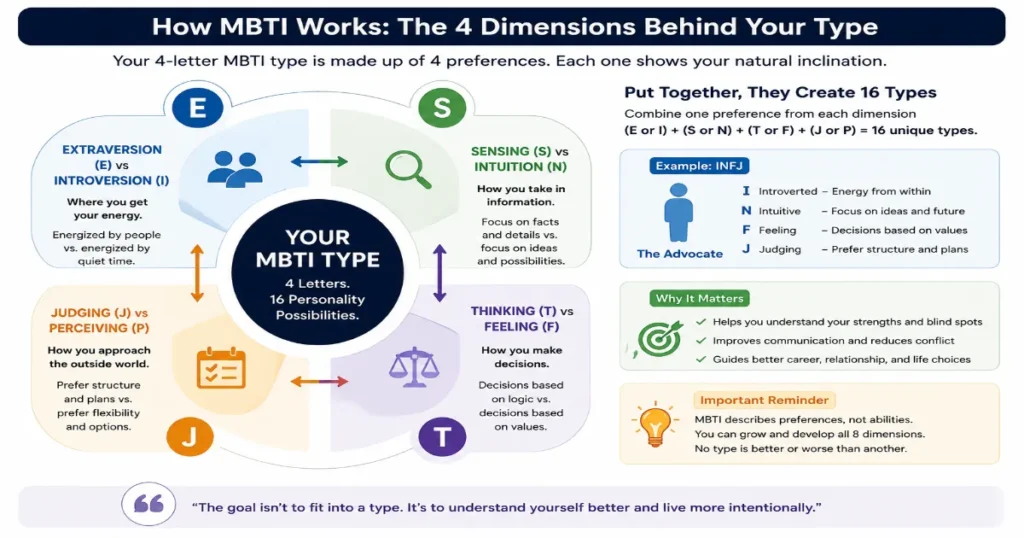
Every one of the 16 MBTI personality types is a four-letter code. Each letter comes from one of four pairs.
Extraversion vs. Introversion (E/I)
This pair is about where you direct your energy. Extraverts recharge by being around people and activity. Introverts recharge through quiet time and reflection. This is not the same as being shy or outgoing. A quiet extravert and a chatty introvert both exist.
Sensing vs. Intuition (S/N)
This pair is about how you take in information. Sensors trust facts, details, and direct experience. Intuitives trust patterns, possibilities, and the bigger picture. In a team meeting, the sensor asks “what exactly happened,” while the intuitive asks “what does this mean going forward?”
Thinking vs. Feeling (T/F)
This pair is about how you make decisions. Thinkers lean on logic and consistency. Feelers lean on values and the impact on people. Neither is more rational than the other. They are just optimizing for different things.
Judging vs. Perceiving (J/P)
This pair is about how you approach the outside world. Judging types like structure, plans, and closure. Perceiving types like flexibility and keeping options open. A J books the itinerary two months early. A P decides the night before.
4 MBTI Groups Explained
All 16 personality types MBTI covers cluster into four broader families. This makes the whole system easier to remember.
Analysts (NT): Rational and strategic
- INTJ, the Architect
- INTP, the Logician
- ENTJ, the Commander
- ENTP, the Debater
Diplomats (NF): Idealistic and people-focused
- INFJ, the Advocate
- INFP, the Mediator
- ENFJ, the Protagonist
- ENFP, the Campaigner
Sentinels (SJ): Practical and dependable
- ISTJ, the Logistician
- ISFJ, the Defender
- ESTJ, the Executive
- ESFJ, the Consul
Explorers (SP): Spontaneous and hands-on
- ISTP, the Virtuoso
- ISFP, the Adventurer
- ESTP, the Entrepreneur
- ESFP, the Entertainer
Full 16 Personality Types MBTI Chart
Here is the complete list in one place, so you do not need to scroll through four sections to compare types. This 16 MBTI personality types chart gives you a quick way to compare all four groups, their common nicknames, and the traits typically associated with each type.
| Type | Group | Nickname | Core Trait |
|---|---|---|---|
| INTJ | Analyst | Architect | Strategic planner |
| INTP | Analyst | Logician | Curious problem solver |
| ENTJ | Analyst | Commander | Decisive leader |
| ENTP | Analyst | Debater | Quick, sharp thinker |
| INFJ | Diplomat | Advocate | Idealistic and insightful |
| INFP | Diplomat | Mediator | Values-driven and gentle |
| ENFJ | Diplomat | Protagonist | Warm and persuasive |
| ENFP | Diplomat | Campaigner | Enthusiastic connector |
| ISTJ | Sentinel | Logistician | Reliable and thorough |
| ISFJ | Sentinel | Defender | Loyal and caring |
| ESTJ | Sentinel | Executive | Organized and firm |
| ESFJ | Sentinel | Consul | Sociable and supportive |
| ISTP | Explorer | Virtuoso | Practical and hands on |
| ISFP | Explorer | Adventurer | Gentle and artistic |
| ESTP | Explorer | Entrepreneur | Bold and energetic |
| ESFP | Explorer | Entertainer | Fun and spontaneous |
What Are the Rarest MBTI Types?
INFJ and ENTJ are often described as relatively uncommon in commonly cited MBTI samples, while types such as ISFJ and ESFP appear more frequently in the same data. Prevalence estimates vary by dataset, country, and sampling method, so treat any single ranking as a rough guide, not a hard fact.
If you tested as a rarer type, that does not make you special or broken. It just means fewer people around you may share your exact wiring, which can sometimes explain why certain conversations feel harder to find at work or at home.
Which MBTI Type Is Most Romantic?
This question comes up often, and most quiz sites turn it into a ranking. There is no scientifically established “most romantic” MBTI type. Online MBTI communities often associate NF types, such as INFP, ENFP, INFJ, and ENFJ, with romantic idealism, largely because emotional depth and values-driven thinking are core to that group. That is a description of common type stereotypes, though, not evidence that these types actually make better romantic partners.
But compatibility in real relationships depends far more on communication and shared values than on matching letters. Two ESTJs can build a great marriage. Two INFPs can struggle if neither one handles conflict directly. Treat this pairing question as a fun starting point for conversation, not a compatibility test.
Is MBTI Scientifically Accurate?
This is the part most personality sites avoid, because it is inconvenient for a quiz-heavy business model. Here is the honest picture.
The Myers and Briggs Foundation’s own research page acknowledges that critics question the tool’s test-retest reliability, meaning some people get a different result if they take it again months later, exactly what happened to Naina.
The APA Dictionary of Psychology notes that MBTI carries limited credibility among research psychologists, and some studies have found that around half of test takers receive a different type on a second attempt.
So should you throw the whole thing out? Not necessarily. Here is a fair way to think about it:
- Use MBTI as a conversation starter, not a verdict.
- Do not make a hiring decision, a relationship decision, or a life-altering career move based on four letters alone.
- Pair it with real self-reflection, feedback from people who know you well, and your own track record of what actually makes you happy.
That balance is really what separates a useful self-awareness tool from a party trick, and it is the honest way to think about 16 personality types MBTI results overall.
How Do I Find My MBTI Type?
You have two honest routes here.
Self-assessment. Read through the four letter pairs above and be brutally honest about which side you lean toward in most situations, not just how you wish you behaved.
A formal test. Several platforms offer free or paid versions of the assessment. Whichever you use, remember the reliability caveat above, and consider retaking it after a few months to see if your result holds steady. If you want to go deeper on self-understanding beyond a single test, reading about transactional analysis in personality development offers a completely different lens on why you react the way you do.
16 Personality Types MBTI in Everyday Indian Life
In a typical Indian household, you will often see all 16 personality types MBTI describes play out without anyone naming it. The parent who plans the entire wedding checklist eight months in advance is showing classic Judging behavior. The cousin who decides to book a Goa trip the night before is showing Perceiving. The colleague who stays quiet in meetings but sends a brilliant, well-thought-out email afterward is very likely leaning Introverted.
You do not need a test to notice these patterns. Once you know the four-letter framework, you start seeing it in your family WhatsApp group, your office standups, and your own decision-making.
MBTI vs. Enneagram: What Is the Difference?
MBTI focuses on how you think, decide, and interact with the world day to day. The Enneagram focuses on your core motivations and fears, the deeper “why” behind your behavior. Many people find value in using both together. MBTI tells you how you operate. Enneagram tells you why.
If you want another view of personality types, read the Enneagram personality types explained.
If you are exploring both frameworks, understanding how EQ vs. IQ shapes different personality frameworks is a useful next step, since neither MBTI nor Enneagram measures emotional intelligence directly, and that gap matters more than people realize.
Conclusion
The 16 personality types in MBTI will not tell you exactly who you are. No four-letter code can do that. What it can do is give you language to describe your patterns, and a starting point for real self-reflection. Use it the way Naina eventually did, as one data point among many, not the final word.
This connects closely to your wider personality development journey, and it works best alongside real emotional intelligence, since knowing your type means little without also understanding how you affect the people around you.
FAQs
1. What are the MBTI letters E, I, S, N, T, F, J, P?
They stand for Extraversion, Introversion, Sensing, Intuition, Thinking, Feeling, Judging, and Perceiving. Each letter represents one side of a preference pair, and your four letter type is built from one letter out of each pair.
2. What is the rarest MBTI type?
INFJ is commonly cited as one of the rarest types across various surveys, though exact rankings shift depending on the sample and country studied.
3. Which MBTI type is most romantic?
NF types, especially INFP and ENFP, are often described as the most romantic due to their idealism and emotional depth, though real compatibility depends on far more than type alone.
4. Is MBTI the same as the 16 Personalities test?
Not exactly. MBTI is the original framework created by Briggs and Myers. 16Personalities is a separate, popular online platform that uses its own model, called the NERIS Type Explorer, which blends Myers-Briggs style typing with elements of Big Five personality traits. That is why 16Personalities results sometimes read a little differently from a traditional MBTI report, even though both land on the same 16 four-letter type names. The Big Five component is generally considered more research-backed than the original MBTI framework alone, which is part of why 16Personalities markets itself as a slightly more grounded version of the same idea.
5. What are the 16 personality types MBTI in full?
The 16 personality types MBTI describes are INTJ, INTP, ENTJ, ENTP, INFJ, INFP, ENFJ, ENFP, ISTJ, ISFJ, ESTJ, ESFJ, ISTP, ISFP, ESTP, and ESFP. Each one is a unique combination of the four letter pairs covered earlier in this guide, and the full chart above breaks down what each type is generally like.
6. What does a 16 MBTI personality types chart actually show?
A 16 MBTI personality types chart typically lays out each type’s four-letter code, its broader group (Analyst, Diplomat, Sentinel, or Explorer), its common nickname, and a one-line summary of its core trait, exactly the format used in the chart earlier in this article. It is meant to be a quick reference, not a substitute for reading the fuller description of your own type.

Ayanshi is the founder of PersonaGuru.in, a blog focused on personality development, career, relationships, and mental well-being. With over 3 years of writing experience, she turns psychology and everyday experiences into practical, easy-to-understand advice for real life.