
Last updated on September 13th, 2026 at 10:15 am
Confidence building exercises are structured, repeatable practices, physical, mental, or behavioral, that retrain how you carry yourself, talk to yourself, and act under pressure, until confidence stops being a feeling you wait for and becomes something you can actually build. This guide gives you 10 of them, with exact steps, not vague advice.
I remember sitting in a waiting room before a big presentation, hands cold, stomach tight, telling myself the usual line, “just relax.” It never worked. What actually worked, years later, was something far less poetic: standing in a bathroom stall for two minutes with my shoulders back before walking in. That is the difference this article is built around. A tip tells you what to feel. An exercise tells you what to do.
Key Takeaways
- Confidence building exercises fall into three categories: physical, mental, and behavioral.
- Michigan State University Extension outlines confidence as one of Lerner’s 5 C’s of positive development, alongside competence, connection, character, and caring.
- The 3 C’s of self-esteem, commonly cited across self-esteem resources, are confidence, connection, and competence.
- Psychologist Albert Bandura’s research on self-efficacy shows that small, repeated successes build more lasting confidence than motivation or pep talks ever do.
- You will know an exercise is working when you can do the hard thing with the fear still present, not when the fear disappears.
Why Most “Confidence Tips” Do Not Actually Work
Search “how to be confident” and you get the same five words every time. Believe in yourself. Fake it till you make it. Stand tall. Smile more. None of it is wrong exactly. It just is not actionable.
Difference Between a Tip and an Exercise
A tip is advice. An exercise is a rep. If you already want general confidence-boosting tips, that guide covers the broader mindset side. This article is different on purpose. Everything below has a duration, a frequency, and a way to check if it is working, the same way a workout plan does.
What Are the 7 Types of Confidence?
There is no single official list here, different writers group confidence differently, but most practical breakdowns land on something close to this:
- Physical confidence, trust in your body and how it moves.
- Social confidence, ease in conversations and groups.
- Intellectual confidence, trust in your own thinking and decisions.
- Emotional confidence, the ability to sit with difficult feelings without falling apart.
- Professional confidence, belief in your competence at work.
- Moral confidence, staying aligned with your own values under pressure.
- Resilience confidence, trust that you can recover from setbacks.
Most people are strong in two or three of these and quietly avoid the rest. Knowing which ones you are avoiding is often more useful than any single tip.
Physical Confidence Building Exercises
Your body sends signals to your brain, not just the other way around. These three exercises use that link directly.
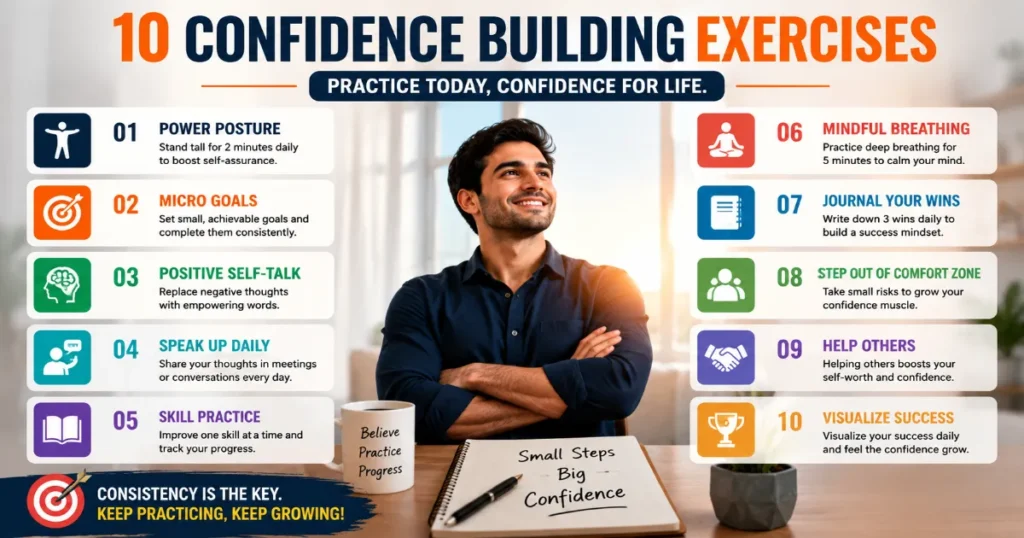
1. Power Posing, 2 Minutes Stand with your feet apart and hands on your hips, or arms raised in a V shape, for two full minutes before something stressful. Do this somewhere private. It feels strange the first time. That is fine.
2. Grounded Posture Practice Before a meeting or a difficult conversation, plant your feet flat, relax your shoulders down and back, and keep your chin level. Hold it for 30 seconds. Notice how different this feels from your usual slouch.
3. Slow, Deliberate Movement in a Room Practice walking into a room at half your normal speed, once a day, for a week. Rushed movement reads as nervous. Slow movement reads as calm, even when you do not feel calm yet.
Mental Confidence Building Exercises
These three work on the story running in your head, not just your posture.
4. Reframe Negative Self-Talk Catch the thought “I can’t do this” and rewrite it on paper as “I have not done this yet, and I can learn.” Do this once a day for two weeks. The goal is not positivity. The goal is accuracy.
5. The Success Journal Each night, write down one thing you did well that day, no matter how small. Not a gratitude list, a proof list. Over a month, this becomes hard evidence your brain cannot easily argue with.
6. The “I Am” Statement Drill Stand straight, close your eyes, and repeat a short, specific phrase like “I am prepared” or “I am capable” for one minute before something you are nervous about. Keep it specific to the situation, not generic.
Behavioral Confidence Building Exercises
Confidence is also a habit you act your way into, not just think your way into.
7. Celebrate Small Wins, Correctly When you finish something small, actually pause and acknowledge it out loud or in writing. Do not rush straight to the next task. The pause is what makes it register as a win.
8. Make One Independent Decision a Day Pick something small, what to eat, what to wear, which route to take, and decide it alone, without asking anyone for approval. Do this daily for two weeks. Small independent choices build the muscle for bigger ones.
9. The One Uncomfortable Conversation a Week Rule Pick one conversation each week that you have been avoiding, a piece of feedback, a boundary, a request, and have it. Nothing builds confidence faster than proof that discomfort is survivable.
10. The Two Minute Delay When self-doubt hits right before you act, wait two minutes instead of retreating. Most panic peaks and drops within that window. Acting on the other side of it, instead of before it, rewires how your brain predicts the next time.
What Are the 5 C’s of Confidence?
This one gets misquoted a lot. Confidence is not broken into 5 C’s on its own. It is one of Lerner’s 5 C’s of Positive Youth Development, alongside competence, connection, character, and caring, with contribution sometimes added as a sixth. In that model, confidence is defined as an internal sense of overall self-worth and self-efficacy, not a standalone trait you build in isolation.
What Are the 3 C’s of Self-Esteem?
The 3 C’s of self-esteem are confidence, connection, and competence. Confidence is believing in yourself. Competence is having the actual skills to back that belief. Connection is the relationships that remind you neither of the first two exist in a vacuum. Miss any one of the three and the other two feel shaky.
Confidence Building Exercises for the Workplace
Indian offices often reward quiet competence and quietly punish visible uncertainty, which makes workplace confidence its own specific skill. Try this instead of generic advice.
- Before a meeting where you need to speak up, write your one key point on a sticky note. Say it once, out loud, alone, before you walk in.
- If you tend to over-apologize in emails, remove the word “just” and “sorry” from your first draft, then read it again.
- Ask one question in every meeting for a week, even a small one. Visibility builds itself in small repeated moments, not one big speech.
If self-doubt at work is a recurring pattern rather than an occasional nerves problem, that deserves its own, deeper approach. For a broader look at confidence for career success, the strategies compound well with the exercises here.
Confidence Building Exercises for Students
Exam stress and interview nerves respond well to the same drills, adapted slightly.
- Before an oral exam or viva, do the grounded posture practice from earlier, right outside the room.
- Keep a success journal specifically for study wins, not just grades, effort counts too.
- Practice one small independent decision a day, since students often over-rely on friends or parents for choices they are fully capable of making alone.
What Causes a Lack of Confidence?
Usually it is not one big event. It is a slow buildup of a few patterns.
- Repeated criticism without any accompanying encouragement.
- Avoiding hard things long enough that your brain never gets proof you can handle them.
- Comparing your behind-the-scenes to someone else’s highlight reel, especially on social media.
- Low competence in an area you keep judging yourself against.
How Do You Know These Exercises Are Actually Working?
This is the part almost nobody tells you. You will not feel dramatically different after one week. What actually changes first is behavior, not feeling.
Track these instead of your mood:
| Sign | What It Looks Like |
|---|---|
| You do the hard thing anyway | The fear is present, but it does not stop you |
| Recovery time shrinks | A setback used to ruin your week, now it ruins an hour |
| Your posture holds under pressure | You stop shrinking in meetings, even nervous ones |
| You catch the negative thought faster | You notice “I can’t” before it takes over, not after |
According to Bandura’s research on self-efficacy, the strongest confidence comes from mastery experiences, actually doing the thing successfully, more than from encouragement or comparison to others. That is exactly why these exercises are built around repetition, not motivation.
Conclusion
Confidence building exercises will not remove your nerves. They will give you something to do with them. Pick two exercises from this list, not all ten, and repeat them for two weeks before judging whether they work. This connects closely to your wider confidence development journey, and it pairs well with building self-esteem and real emotional intelligence, since confidence without self-awareness tends to tip into overconfidence fast. If daily reminders help, a set of positive affirmations can pair well with the mental exercises above. If you are building this for a teenager rather than yourself, building confidence in teenagers needs a slightly different approach, worth reading separately.
FAQs
1. What are 5 ways to boost confidence?
Power posing, reframing negative self-talk, keeping a success journal, celebrating small wins properly, and having one uncomfortable conversation a week are five of the strongest starting points from this guide.
What is the biggest confidence booster?
Mastery experiences, actually succeeding at something difficult, consistently rank as the strongest driver of lasting confidence in psychological research, ahead of encouragement, comparison, or motivation.
What are the four pillars of self-confidence?
Different sources phrase this differently, but the most common version includes self-belief, competence, self-respect, and resilience, the ability to recover after setbacks.
What is the root cause of low confidence?
Most often it traces back to avoidance, not having enough real evidence, positive or negative, because the hard thing was never actually attempted. Confidence gaps tend to shrink once avoidance does.
What are confidence building exercises for adults?
Confidence building exercises for adults work the same way as the ones in this guide, physical, mental, and behavioral, but adults usually need to fit them around work, relationships, and less free time than students have. The most practical starting point for adults is picking two or three exercises, like the success journal, grounded posture practice, and the one uncomfortable conversation a week rule, and repeating them for two weeks before adding more.

Ayanshi is the founder of PersonaGuru.in, a blog focused on personality development, career, relationships, and mental well-being. With over 3 years of writing experience, she turns psychology and everyday experiences into practical, easy-to-understand advice for real life.