
Last updated on October 13th, 2026 at 08:27 am
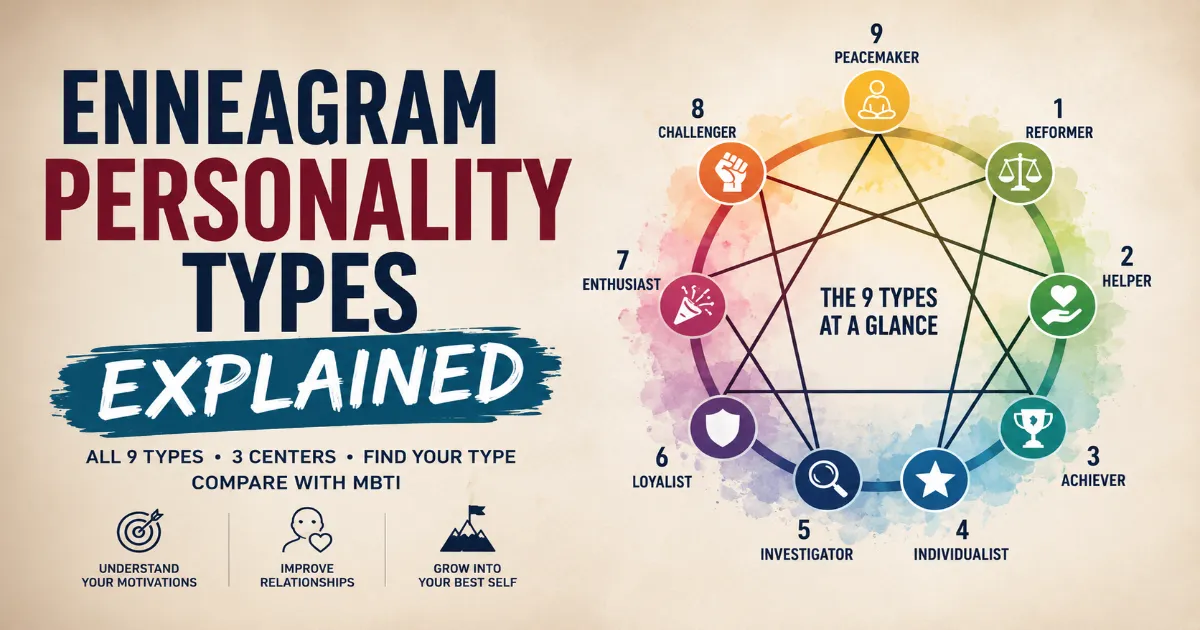
The Enneagram sorts personality into 9 core types. Each type is built around a core fear, a core desire, and a strategy for coping. It is not just about behavior. A quiz might tell you that you are organized or outgoing. These Enneagram personality types explained in plain words will tell you why. What are you actually afraid of underneath that behavior? What are you quietly chasing?
Imagine a workshop where a facilitator describes Type 6, the Loyalist, as someone who scans a room for what could go wrong before they even sit down. For someone who constantly plans for the worst case, that description can feel surprisingly familiar. That is the pull of this system. It does not just describe you. It explains you.
Key Takeaways
These Enneagram personality types explained here, in one place, without the usual filler:
- The Enneagram describes 9 personality types. Each one has a core fear and a core desire, not just a behavior pattern.
- The 9 types group into 3 centers of intelligence: Heart, Head, and Body.
- The modern framework traces back to Oscar Ichazo in the 1950s and Chilean psychiatrist Claudio Naranjo in the 1970s, according to Wikipedia’s documented history of the system.
- There is no verified population data on which Enneagram type is rarest, despite how often that question gets searched.
- MBTI focuses on how you think and act. The Enneagram focuses on why, your underlying motivation.
What Is the Enneagram? A Quick Origin Story
If you are asking what is Enneagram personality at its core, the answer starts with two names. The word Enneagram comes from Greek. It means nine and something written or drawn. The system’s modern form traces back to Oscar Ichazo. He was a Bolivian teacher who began developing it in the 1950s. Claudio Naranjo, a Chilean psychiatrist, studied under Ichazo in 1970. He then built his own version of the model, according to Wikipedia’s documented history of the Enneagram.
Naranjo blended Ichazo’s teaching with older ideas from George Gurdjieff’s Fourth Way tradition. Two of Naranjo’s students later adapted the system for Christian spiritual direction. That is part of why the Enneagram spread through therapy circles and spiritual retreats long before it reached online quizzes.
This history matters for one reason. Carl Jung’s theory of personality classification fed directly into academic psychology, and later into MBTI. The Enneagram’s modern history is closely tied to spiritual and philosophical teaching. Its use in personal development and some therapeutic settings came later, but it should not be treated as a clinically validated diagnostic system.
3 Centers of Intelligence
Before you look at individual types, know this. All 9 Enneagram types cluster into three broader centers. Each center is based on where a person’s core reaction lives.
Heart types, 2, 3, 4. These types process the world through feeling first. Their core struggle usually centers on image, connection, and how others see them.
Head types, 5, 6, 7. These types process the world through thinking first. Their core struggle usually centers on security and managing anxiety about the future.
Body types, 8, 9, 1. These types process the world through instinct first. Their core struggle usually centers on control, boundaries, and how they handle anger.
Knowing your center often narrows things down faster than guessing your exact number first.

All 9 Enneagram Personality Types Explained
Here is the full list in one place. These 9 Enneagram personality types cover the whole system. Read the core fear and desire columns closely. They matter more than the one line description.
| Type | Name | Core Fear | Core Desire |
|---|---|---|---|
| 1 | The Reformer | Being wrong or corrupt | To be good and right |
| 2 | The Helper | Being unwanted or unloved | To feel loved and needed |
| 3 | The Achiever | Being worthless without success | To feel valuable and admired |
| 4 | The Individualist | Having no identity or significance | To find their true, unique self |
| 5 | The Investigator | Being useless or overwhelmed | To be capable and self-sufficient |
| 6 | The Loyalist | Being without support or guidance | To feel secure and supported |
| 7 | The Enthusiast | Being trapped in pain or limitation | To stay happy and satisfied |
| 8 | The Challenger | Being controlled or vulnerable | To protect themselves and stay in control |
| 9 | The Peacemaker | Loss of connection or conflict | To maintain inner and outer peace |
A quick note on each, in plain language. These are the enneagram types explained one by one, not just listed in a table.
Type 1, The Reformer holds themselves and others to a high standard. They struggle to switch off the inner critic.
Type 2, The Helper gives generously. Sometimes they lose track of their own needs entirely.
Type 3, The Achiever adapts fast and performs well. They can confuse actual achievement with self-worth.
Type 4, The Individualist feels things deeply and craves authenticity. They sometimes compare themselves to everyone else.
Type 5, The Investigator needs space to think and recharge. Under stress, they can retreat too far into their own head.
Type 6, The Loyalist plans for what could go wrong. That is protective, until it tips into constant worry.
Type 7, The Enthusiast chases new experiences and keeps the mood light. Sometimes that is a way to avoid anything painful.
Type 8, The Challenger takes charge naturally and protects the people around them. Under pressure, they can come across as too blunt.
Type 9, The Peacemaker keeps the group calm and avoids conflict. Sometimes that means quietly going along with things they do not agree with.
What Is the Rarest Enneagram Type?
This gets searched constantly. Honestly, there is no reliable answer. The Enneagram Institute does not publish verified population percentages by type. Neither does any other major Enneagram body. You may see a number online, like “Type 4 is the rarest, only 4 percent of people.” That number is almost always an unsourced estimate, repeated from one blog to another until it sounds like fact.
Here is what is fair to say. Some types, particularly 4 and 8, come up less often in informal community surveys than types like 6 and 9. Treat that as a loose pattern, not a statistic.
How Do I Figure Out My Enneagram Type?
Once these Enneagram personality types explained above start to feel familiar, the next question is which one is actually yours. You have two real options here.
Self-reflection. Read the core fear and desire columns above slowly. Most people recognize themselves in the fear column faster than the desire column. Fears tend to be the quieter, more automatic driver.
A formal test. Several reputable Enneagram organizations offer paid or free assessments. Treat the result as a strong guess, not a verdict. Read the full type description before you accept it. Misidentifying your type in the first few minutes of a quiz is common, especially between types that share a center.
Here is a tip that helps more than people expect. Ask someone who knows you well which core fear sounds like you. We are often the last person to see our own patterns clearly.
Is Enneagram Better Than MBTI?
With these Enneagram personality types explained, the natural next question is how this compares to the other big personality system. Neither is better. They measure different things. MBTI sorts personality into 16 types based on how you think, decide, and interact with the world. The Enneagram sorts personality into 9 types based on why you do those things, your underlying fear and motivation.
Here is a simple way to hold both at once. MBTI might tell you that you are an INTJ who likes structure and independent thinking. The Enneagram might tell you that you are a Type 5. It might also tell you that your drive for independence comes from a fear of being overwhelmed by other people’s demands. One describes the pattern. The other tries to explain the root.
Many people use both together. They also pair these with other frameworks. Two good ones are transactional analysis in personality development and the Big Five personality traits. No need to pick just one system and drop the rest.
Can You Really Know Someone’s Enneagram Type From the Outside?
A lot of people search for Elon Musk’s Enneagram type, or Mark Zuckerberg’s, or a well known historical figure’s. That curiosity makes sense. But here is the honest answer. No, not reliably.
The Enneagram is built around internal motivation. It needs a core fear and desire that the person themselves has to recognize and confirm. You cannot accurately assign a type to someone based on public behavior or interviews. Confident public behavior could come from a Type 8’s natural directness, a Type 3’s drive to look successful, or a Type 7’s love of bold new ideas. From the outside, those can look identical.
Remember this the next time you see a confident post online claiming to know a celebrity’s type. It says more about the writer’s guess than the celebrity’s actual inner world.
Conclusion
These 9 Enneagram personality types explained here will not hand you a finished picture of who you are. What they can do is name a pattern you have been living inside, one you may never have named yourself. This connects closely to your wider personality development journey. It works best alongside real emotional intelligence and honest self-concept work. A type label means little without the self-awareness to actually use it.
FAQs
What do Enneagram wings mean?
A wing is the type on either side of your core number. It adds flavor to your core type. A Type 4 with a strong 3 wing, written as 4w3, behaves differently from a 4 with a strong 5 wing. Your core number stays the same. The wing just shapes how it shows up.
What are Enneagram numbers?
Enneagram numbers are simply the 1 through 9 labels for each of the nine core types. The number carries no ranking. Type 9 is not better or worse than Type 1. They are just different positions on the same circle.
Is the Enneagram scientifically validated?
It has less formal research behind it than tools like the Big Five. Its origins are spiritual and philosophical, not clinical. That does not make it useless. It is fair to treat it as a reflective tool, not a proven diagnostic instrument.
Can your Enneagram type change over time?
Most Enneagram teachers say your core type stays fixed for life. But how healthy or unhealthy you express that type can shift a lot with self-awareness, stress, and growth.

Ayanshi is the founder of PersonaGuru.in, a blog focused on personality development, career, relationships, and mental well-being. With over 3 years of writing experience, she turns psychology and everyday experiences into practical, easy-to-understand advice for real life.