
Last updated on September 25th, 2026 at 08:11 am
Career and workplace growth means building the skills, habits, and mindset that help you perform better, handle pressure well, and move forward in your job. It rests on four pillars: a clear career plan, goals backed by a growth mindset, steady resilience under stress, and daily habits that turn effort into visible output. Growth is rarely about one big change. It is the result of small, repeated choices made over months, not days.
Technical skills can get you a role. But communication, confidence, self-management, and adaptability often shape how well you perform and grow once you are in that role.
Most career advice focuses on certificates and technical training. This guide focuses on career and workplace growth from the personality development side: how you plan your goals, how you handle stress, how you speak up in a meeting, and how you recover after a bad quarter.
This guide is part of our complete personality development framework, focused specifically on the career and workplace side of that framework. It brings together four areas that support career and workplace growth: planning, mindset, resilience, and daily productivity. Each section links to a full article so you can go deep on the exact area you need right now.
Direct Answer
Career and workplace growth means building the skills, habits, and mindset that help you perform better, handle pressure well, and move forward in your job. It rests on four pillars: a clear career plan, goals backed by a growth mindset, steady resilience under stress, and daily habits that turn effort into visible output.
Growth is rarely about one big change. It is the result of small, repeated choices made over months, not days.
Key Takeaways
- Career and workplace growth depend on personality skills as much as technical skills, according to 2026 hiring data.
- A 2026 hiring manager survey found that soft skills and hard skills are now rated as equally valuable by most employers.
- Growth works best when you build four areas together: career planning, goal setting, stress management, and daily productivity.
- Small, specific goals tend to work better than big, vague ones.
- Direction should generally come before speed. Plan first, then move fast.
Why Does Career and Workplace Growth Depend on More Than Skill?
An Illustrative Example from an Indian Workplace
Consider a situation common in many Indian offices. Naina, a marketing executive in Bangalore, is good at her job. Her reports are accurate, her campaigns perform well, and her manager has no real complaints about her work. This is an illustrative scenario, not a documented case study, but it reflects a pattern many working professionals will recognise.
Yet in this scenario, two rounds of promotions pass her by. Both times, someone with a similar skill set moves ahead instead.
The colleague who gets promoted sets clear goals every quarter, shows assertiveness in the workplace by speaking up during reviews, stays calm during a product launch crisis, and manages time well without needing constant reminders.
Naina has the skill. She has not yet built the personality side of her career and workplace growth.
This pattern shows up across Indian workplaces, from IT firms in Pune to family businesses in Jaipur. Technical ability can open the door. Personal development often influences how far a person moves once inside.
What Do 2026 Workplace Reports Say About Career Growth?
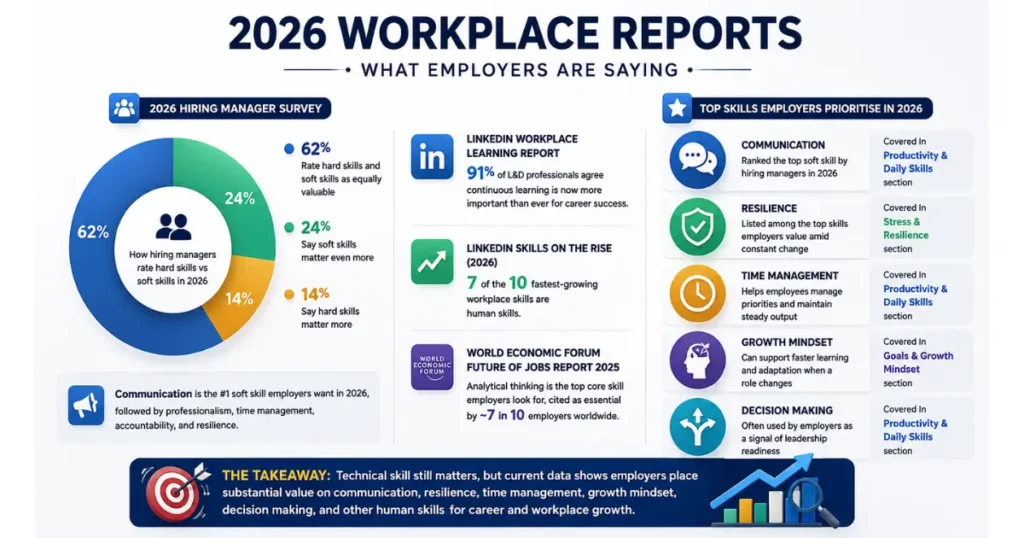
This is not just opinion. Recent workplace data backs it up.
A 2026 survey of 1,005 U.S. hiring managers found that 62% now rate hard skills and soft skills as equally valuable, while another 24% said soft skills matter even more. Communication topped the list of soft skills employers want in 2026, followed by professionalism, time management, accountability, and resilience.
LinkedIn’s own Workplace Learning Report found that 91% of learning and development professionals agree continuous learning is now more important than ever for career success. Separately, LinkedIn’s Skills on the Rise research for 2026 shows that seven of the ten fastest-growing workplace skills fall in the human skills category, alongside technical ones.
The World Economic Forum’s Future of Jobs Report also lists analytical thinking as the top core skill employers look for, cited as essential by roughly seven in ten employers worldwide.
Here is a quick summary of what employers are prioritising in 2026:
| Skill Area | Why It Matters | Covered In |
|---|---|---|
| Communication | Ranked the top soft skill by hiring managers in 2026 | Productivity & Daily Skills section |
| Resilience | Listed among the top skills employers value amid constant change | Stress & Resilience section |
| Time management | Helps employees manage priorities and maintain steady output | Productivity & Daily Skills section |
| Growth mindset | Can support faster learning and adaptation when a role changes | Goals & Growth Mindset section |
| Decision making | Often used by employers as a signal of leadership readiness | Productivity & Daily Skills section |
The takeaway is simple. Technical skill still matters, but current data suggests it rarely decides career and workplace growth on its own.
How Do You Build a Career Plan?
Most people work hard without a clear direction. They finish tasks, stay busy, and never step back to ask where all that effort is actually taking them.
A career plan fixes that. It gives your daily work a purpose.
A good plan starts with an honest look at where you stand.
- What are you actually good at, based on feedback, not assumptions?
- What kind of work do you enjoy enough to keep improving at it?
- What does your industry reward right now?
- What gap sits between where you are and where you want to be in two years?
Kabir, an engineer at a Hyderabad startup, used to switch teams every year, chasing whatever project looked exciting. After building a simple one-page career plan, he picked one skill area to specialise in and stuck with it for two years. That focus is what earned him his first team lead role.
Explore these articles to build your own plan:
- Self-career perception and how it shapes your growth
- How to improve self-career perception in an interview
- How to create a professional development plan
- 13 powerful personality development tips for professionals
- How to evaluate your personal development plan
- Personality development skills in the workplace for career success
- Personality development skills for career growth
- How to become a personality development trainer
- Setting personal development goals for work
- How to develop a strong personality at work
- Networking skills for career growth
- Effective communication skills for career growth
How Do You Prepare for Interviews and Career Moves?
A career plan only helps if you can also perform in the moments that decide your next move, like interviews and internal promotion conversations. Interview performance is not only about your resume. It is about how you present your personality, handle pressure questions, and communicate under evaluation.
Explore these articles to strengthen your interview readiness:
- How to improve your personality for job interviews
- Top interview skills in personality development
- Why communication skills matter in an interview
How Do You Set Goals That Actually Work?
Planning tells you where to go. Goals and mindset are what actually move you there. Without them, even a good plan stays on paper.
A growth mindset means you treat setbacks as information, not proof that you cannot improve. It is the difference between avoiding a hard project out of fear and taking it on because it will teach you something.
Kavya, a first-year analyst in Mumbai, wanted to get better at presenting to clients. Instead of a vague goal like “improve my communication,” she set a specific one. Be present in every team meeting for eight weeks, then ask for direct feedback each time.
By week six, her manager asked her to lead the client presentation.
Small, specific goals beat big, vague ones almost every time. This pattern shows up behind most career jumps worth noticing.
Explore these articles to strengthen your goals and mindset:
- How to build willpower
- 7 ways to become self-dependent
- 7 ways to do goal setting that work
- Good habits for personality development
- Benefits of daily reading for personal growth
- How to achieve your goals in 2026
- Building a positive mindset
- Why a growth mindset matters for success
- The role of deadlines in goal setting
- Top books on personality development
- How to stay focused on your goals
- Best personality development books for students
- How to build a strong personal brand
- How to say no to extra work
How Do You Handle Stress Without Burning Out?
Every job has hard weeks. Deadlines pile up, targets get missed, and managers get short with people. What separates people who grow in their careers from people who burn out is not the absence of stress. It is how they respond to it.
Resilience is a skill, not something you are simply born with. It is built through small habits: short breaks between tasks, naming what is actually bothering you instead of pushing it down, and having a plan for the worst day, not only the best one.
Aryan, a customer support lead in Delhi, used to lie awake most nights replaying difficult client calls. He started a ten-minute wind-down routine before bed and a habit of writing down one thing he handled well each day. Within a month, his sleep improved, and so did his patience on calls the next morning.
Explore these articles on stress and resilience:
- How to stop overthinking at night
- How embracing challenges contributes to personal growth
- 17 effective stress management techniques
- Quick ways to reduce stress levels immediately
- Developing resilience for personal growth
- Top coping strategies for stress
- How to handle stressful situations in the workplace
How Do You Turn Skills Into Daily Output?
Career planning and mindset set your direction. Productivity is where that direction actually shows up in your work. This is the practical layer: how you solve problems, manage your time, and make decisions under pressure.
Most people try to fix this layer first, and that is usually a mistake. A better time management system will not help someone who has no clear goals or who burns out every few weeks. Productivity works best once the first three pieces are already in place. Then it becomes a multiplier.
Explore these articles to sharpen your daily skills:
- Problem-solving skills for personality development
- How to improve your soft skills
- Time management for personality development
- 10 amazing tips to become smart
- 9 best ways to become creative
- 25 techniques to improve decision-making
A 30-Day Career Growth Starting Point
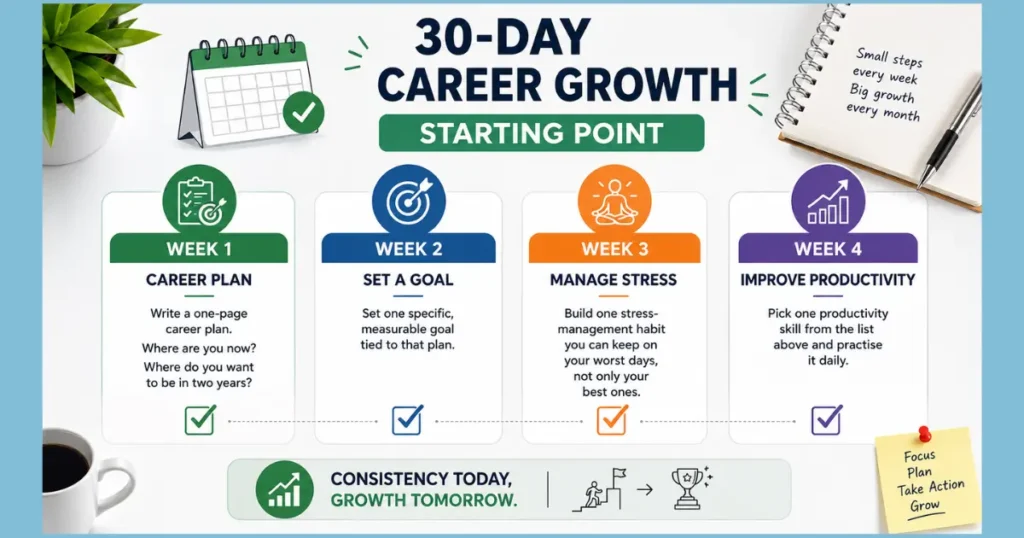
You do not need to work on all four areas at once. Pick one focus per week for a month.
- Week 1: Write a one-page career plan. Where are you now? Where do you want to be in two years?
- Week 2: Set one specific, measurable goal tied to that plan.
- Week 3: Build one stress-management habit you can keep on your worst days, not only your best ones.
- Week 4: Pick one productivity skill from the list above and practise it daily.
Small, sequenced steps like this build real momentum. Trying to fix everything in one week almost always fails.
Conclusion: Start Your Career and Workplace Growth Today
Career and workplace growth is not one big leap. It is the result of small, consistent choices across four areas: planning, mindset, resilience, and daily productivity. Naina’s story, Kabir’s, and Kavya’s all point to the same lesson. Technical skill opens a door. What you do with your personality, your focus, and your reactions to pressure decides how far you walk through it.
You do not need to fix everything this week. Pick one section from this guide- career planning, goal setting, stress management, or productivity- and start there. Explore the linked articles above for the exact skill you want to build next, and revisit this guide whenever you need the full picture again.
If you are only beginning this journey, start with our complete personality development guide first, then return here whenever a specific career and workplace growth topic comes up. Growth is a habit you build one week at a time.
FAQs
1. What is the difference between career growth and personal growth?
Career growth means progress in your job or profession, such as promotions, new responsibilities, or higher pay. Personal growth is the internal development of skills, mindset, and habits. Personal growth can support career growth by strengthening communication, self-management, adaptability, and confidence, though career progress also depends on experience, performance, and opportunity.
2. How do I set personal development goals for work?
Start with one specific, measurable goal tied to a real gap in your current role. Instead of “get better at communication,” try “speak up at least once in every team meeting for a month.” Review progress every two weeks and adjust as needed.
3. Can personality development really affect my salary or promotion?
It can play a role. 2026 hiring data shows employers now rate communication, adaptability, and resilience alongside technical skills when making promotion decisions, and soft skills carry equal or greater weight than hard skills in many roles. Actual outcomes still depend on your performance, role, and company.
4. How long does it take to see career growth from personal development?
There is no fixed timeline. Small shifts, sharper focus, and calmer reactions to stress tend to show up with consistent practice over a few weeks. Visible career outcomes, like a promotion or new responsibility, depend on performance, opportunity, experience, and how your workplace operates, so they can take anywhere from a few months to longer.
5. I feel stuck in my career. Where should I start?
Start with career planning, not productivity hacks. Get clear on where you want to go before you try to move faster. Direction without speed is slow. Speed without direction is wasted.
6. Is workplace stress a sign that I am in the wrong job?
Not always. Some stress is normal in any job, especially during growth phases. It becomes a bigger concern when it is constant, affects your sleep or health, or does not improve even after you try resilience-building habits. In that case, an honest conversation with your manager, or a serious look at a change, is worth having.

Ayanshi is the founder of PersonaGuru.in, a blog focused on personality development, career, relationships, and mental well-being. With over 3 years of writing experience, she turns psychology and everyday experiences into practical, easy-to-understand advice for real life.