
Last updated on September 13th, 2026 at 11:58 am
Most people think yoga is just stretching before bed or a way to touch your toes. That idea misses the bigger picture. The real role of yoga in personality development is not about flexibility at all. It is about building the kind of discipline, patience and self-control that shapes how you show up every single day.
If you have already read about meditation and personality growth, you know it works mainly on the mind. Yoga works differently. It trains your body, your breath and your behavior together, which is why ancient Indian texts never treated it as a relaxation technique. They treated it as a full system of character building.
In short: The role of yoga in personality development comes from three things working together, physical postures that build discipline, breath control that steadies emotions, and an ethical code called yamas and niyamas that shapes how you treat yourself and others. Unlike meditation, which mainly trains attention, yoga trains behavior first and the mind follows.
Key Takeaways
- Yoga shapes personality through four connected areas: physical, emotional, intellectual and social-spiritual growth.
- The yamas and niyamas, yoga’s ethical code, do more for personality than any pose does.
- Specific asanas build specific traits. Warrior pose builds confidence. Tree pose builds focus.
- Yoga and meditation both help personality, but they work through different paths. One trains the body and behavior. The other trains attention and awareness.
- A short, consistent 15-minute daily routine works better than an occasional 90-minute class.
What Does Yoga Actually Mean for Your Personality?
Yoga comes from the Sanskrit word “yuj,” which means to unite. It was never designed as exercise. It was designed to bring the body, breath, mind and behavior into one working system.
This matters for the role of yoga in personality development because your personality is not just your thoughts. It is also your habits, your reactions under pressure and your self-control. Yoga trains all three, not just the thinking part.
Sage Patanjali, who systemised yoga through the Yoga Sutras, built it as an eight-limbed path. Only two of those eight limbs involve postures or breathing. The rest deal directly with ethics, discipline and mental restraint. That single fact tells you yoga was built for character, not just for calm.
How Many People Actually Practice Yoga Today?
The numbers here are worth knowing, because they show the role of yoga in personality development is being studied and applied at a scale no article can ignore.
- More than 300 million people practice yoga regularly worldwide as of 2025, and participation grew by close to 64 percent between 2010 and 2021.
- Yoga is now practised in over 190 countries.
- India marked the 12th International Day of Yoga on 21 June 2026, with the Ministry of AYUSH confirming that over six lakh organisations registered to take part alongside the Prime Minister.
- The United Nations page on International Day of Yoga notes that yoga has been recognized as part of the UN’s global health and heritage agenda since 2014.
These numbers matter because they show yoga has moved past being a wellness trend. Governments, universities and workplaces are now building it into education and public health policy, which is a strong signal that the role of yoga in personality development goes far beyond flexibility.
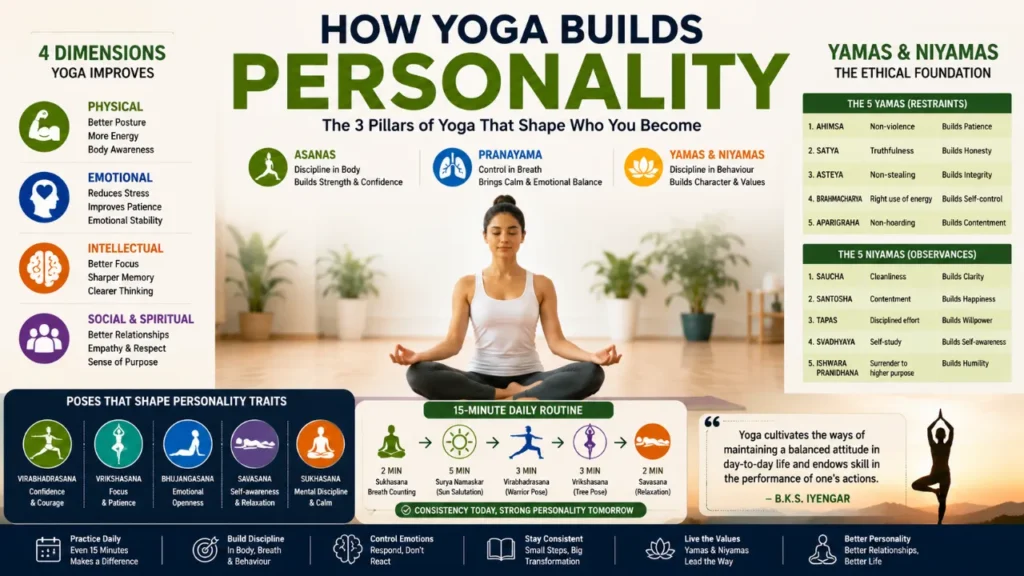
Four Dimensions Yoga Shapes
Every serious study on yoga and personality development points to the same four areas. Here is what each one actually looks like in daily life.
1. Physical Development
Regular practice improves posture, stamina and body awareness. A person who stands taller and moves with more control naturally comes across as more confident, even before they say a word. This is similar to how sports build discipline and resilience in students, except yoga does it without competition or a scoreboard.
2. Emotional Development
Pranayama, or breath control, directly affects your nervous system. Slow, controlled breathing lowers your stress response, which means you react less impulsively when someone annoys you or when a deadline suddenly moves up.
3. Intellectual Development
Concentration practices like Trataka or simple breath counting train your mind to stay on one task longer. Over weeks, this shows up as sharper focus and calmer decision making, especially under pressure.
4. Social and Spiritual Development
Yoga’s ethical code, the yamas and niyamas, shapes how you treat other people, an area most yoga-and-personality articles barely touch. That directly affects your social skills and your sense of purpose, in much the same way empathy grows through daily practice rather than one grand gesture.
What Are Yamas and Niyamas, and Why Do They Shape Personality?
Yamas and niyamas are yoga’s ethical code, ten principles that guide behavior and choices in daily life. They matter for personality because they turn abstract values like patience or honesty into something you practice on purpose, not something you hope you have.
Most guides mention them in a single line and move on. That undersells them. The yamas and niyamas are where the role of yoga in personality development is grounded, not just added on top.
The five yamas are restraints, things you choose not to do. The five niyamas are observances, things you actively practice. Together they form a working code of conduct, one that connects closely to how character building in personality development actually happens, through repeated small choices rather than one big decision.
| Yama or Niyama | Meaning | Personality Trait It Builds |
|---|---|---|
| Ahimsa | Non-violence, in action and speech | Patience, self-control |
| Satya | Truthfulness | Honesty, trustworthiness |
| Asteya | Non-stealing, including of time and credit | Integrity, respect for others |
| Brahmacharya | Right use of energy | Focus, self-discipline |
| Aparigraha | Non-hoarding, letting go | Contentment, reduced anxiety |
| Saucha | Cleanliness, of body and mind | Clarity, self-respect |
| Santosha | Contentment | Emotional stability |
| Tapas | Disciplined effort | Willpower, consistency |
| Svadhyaya | Self-study | Self-awareness |
| Ishvara Pranidhana | Surrender to a higher purpose | Humility, resilience |
This is the same value system explored in the article on personality development values, which looks at how core values shape long-term character. Yoga simply gives that value system a daily practice to live by.
Which Yoga Poses Build Which Personality Traits
Postures are not random. Each one places a specific demand on your body and mind, and that demand trains a specific trait over time. This is where yoga for discipline and self-control becomes practical rather than theoretical, since every pose is really a small, repeatable exercise in holding your ground.
- Warrior Pose (Virabhadrasana): Requires a strong, grounded stance. Builds confidence and courage.
- Tree Pose (Vrikshasana): Demands stillness and balance. Builds focus and patience.
- Bhujangasana (Cobra Pose): Opens the chest and requires you to hold a vulnerable position. Builds emotional openness.
- Savasana (Corpse Pose): Forces complete stillness at the end of practice. Builds self-awareness.
- Sukhasana with breath counting: A simple seated pose paired with counted breathing. Builds mental discipline.
None of these effects happen after one class. They build slowly, the same way structured training like NCC builds discipline through daily repetition, one drill at a time, not one lecture. Consistency is what turns a pose into a personality trait.
Is Yoga Different From Meditation for Personality Development?
This is a fair question, because the two often get grouped together.
Meditation works almost entirely on the mind. It sharpens self-awareness, improves emotional regulation and builds empathy, as covered in detail in the article on how meditation improves personality development. It is a mental practice.
Yoga works on the body, the breath and behavior first, and the mind follows. A student who cannot sit still for ten minutes of meditation can often start with 10 minutes of asana practice instead, because movement gives the mind something to anchor to before it learns to sit quietly.
Think of it this way. Meditation trains attention. Yoga trains discipline. Most personality experts agree the two work best together, not as substitutes for each other, and this is really where the role of yoga in personality development becomes clear against its better known cousin.
As B.K.S. Iyengar, one of the most respected yoga teachers of the last century, put it:
“Yoga cultivates the ways of maintaining a balanced attitude in day-to-day life and endows skill in the performance of one’s actions.”
That single line captures the difference well. Yoga is not about escaping daily life. It is about performing better within it.
A Real Example: How a Simple Routine Changed Kabir’s Mornings
Kabir, a second-year engineering student in Pune, used to skip breakfast, rush to class and lose his temper over small things by the afternoon. A friend suggested he try 15 minutes of yoga before checking his phone in the morning.
He started with just Surya Namaskar and five minutes of seated breathing. Within three weeks, he noticed he was reacting less to minor irritations, like a delayed bus or a group project teammate missing a deadline. His attendance improved too, simply because he was waking up on time to fit the practice in.
Nothing dramatic happened overnight. What changed was small and steady, and it shows exactly how the role of yoga in personality development usually plays out in real life, quietly, not overnight.
A Simple 15-Minute Daily Yoga Routine for Personality Development
You do not need an hour or a studio membership to start. This routine works especially well as yoga for students personality development, since it fits before college or school without needing any equipment. Here is a routine built around the traits covered above.
- 2 minutes: Sukhasana with slow breath counting, to settle the mind before you begin.
- 5 minutes: Surya Namaskar (Sun Salutation), for physical energy and body awareness.
- 3 minutes: Warrior Pose, held on each side, for confidence and grounding.
- 3 minutes: Tree Pose, for balance and focus.
- 2 minutes: Savasana, for stillness and self-awareness before you start your day.
Do this consistently for four weeks before judging whether it works. Most people quit at day five, right before the habit would have started to show results.
The Bottom Line
The role of yoga in personality development is not about becoming flexible enough for a headstand. It is about the quiet discipline that builds when you show up for your body and your breath every single day, even when you do not feel like it. That discipline spills into how you handle a difficult conversation, a missed deadline or a stressful exam.
Start small. Five minutes of breath work tomorrow morning will teach you more about your own personality than reading about it ever will.
FAQs
1. What is the role of yoga in personality development?
Yoga shapes personality through physical discipline, breath control that steadies emotions, and an ethical code called yamas and niyamas that guides behavior. Together, these build traits like confidence, patience, focus and self-control over consistent daily practice.
2. What are the five pillars of personality development?
Most frameworks group them as self-awareness, emotional intelligence, communication, discipline and adaptability. Yoga touches all five, but its strongest impact is on discipline and emotional intelligence.
3. What are the four types of yoga?
Karma Yoga (the path of action), Bhakti Yoga (the path of devotion), Jnana Yoga (the path of knowledge) and Raja Yoga (the path of meditation and mental control). Personality development draws mainly from Raja and Karma Yoga.
4. Can yoga alone replace meditation for personality growth?
Not entirely. Yoga builds the physical and behavioral foundation, while meditation sharpens attention and self-awareness. Combining short sessions of both gives better results than relying on just one.
5. Are there career opportunities in yoga related to personality development?
Yes. Certified yoga instructors, corporate wellness trainers and school-level yoga educators are increasingly in demand, especially as institutes add yoga to student development programs.

Ayanshi is the founder of PersonaGuru.in, a blog focused on personality development, career, relationships, and mental well-being. With over 3 years of writing experience, she turns psychology and everyday experiences into practical, easy-to-understand advice for real life.