
Last updated on September 13th, 2026 at 12:08 pm
Character building in personality development is the part most people skip because it does not show up in the first 30 seconds of a conversation the way confidence or communication skills do.
Rohan was the most polished person in his office. He spoke well in meetings, dressed sharply, and knew exactly how to win people over quickly. When a client project needed a lead, his manager picked Priya instead. Priya was quieter. She had never once missed a deadline, never once blamed a teammate for her own mistake, and never once said something in a meeting that she did not actually mean in private.
That decision confused Rohan for weeks. He assumed personality was the whole game. What he had not realized is that character-building in personality development is a separate process from polishing how you come across, and that it is usually the quieter one that earns long-term trust.
Personality Development vs Character Building: What Is Actually Different
This confusion between personality development vs character building is one of the most common mix-ups in self-improvement content, and it is worth clearing up early. Personality development focuses on how you come across. It covers communication, confidence, body language, and the outer skills that shape a first impression. Character building focuses on something quieter and slower to build: the values that guide your choices when nobody is watching or grading you on it.
This distinction becomes easier to see once you understand your own self-concept, since the values you believe define you shape which choices feel natural and which feel like a stretch. A person who sees themselves as someone who always follows through will feel real discomfort breaking even a small promise.
Both personality and character matter. Neither replaces the other. A person can have excellent personality skills and weak character, and a person can have strong character with an underdeveloped personality. Long-term trust, leadership, and respect come from combining the two.
| Aspect | Personality Development | Character Building |
|---|---|---|
| Focus | Outer behavior and presentation | Inner values and integrity |
| Core skills | Communication, confidence, body language | Honesty, responsibility, resilience, fairness |
| Visible when | In the first meeting | Under pressure or when unsupervised |
| Builds | First impressions | Long-term trust |
| Changes fastest through | Practice and feedback | Repeated decisions over time |
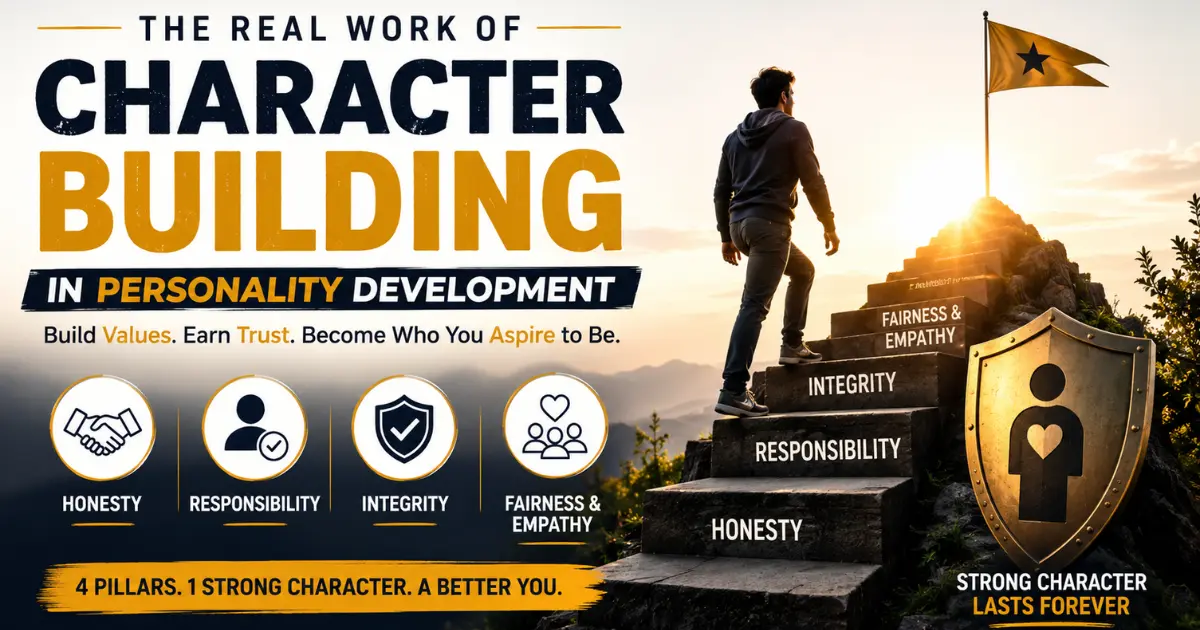
Four Pillars of Character Building in Personality Development
These four pillars are the core character building traits worth tracking, because character is not a single trait. It is a small set of habits that repeat until they become automatic.
1. Honesty
Honesty means your words match your actions, even in small moments. This includes admitting a mistake before someone else catches it, and not exaggerating a story to sound better in front of others.
2. Responsibility
Responsibility means owning the outcome of your choices, good or bad. A person with strong character does not look for someone else to blame when a plan fails. This is often where your locus of control plays a direct role, since a person who believes outcomes are largely within their control finds it far easier to accept responsibility than someone who assumes external circumstances decide everything.
3. Resilience and Integrity
Resilience under pressure is where character shows most clearly. Anyone can hold their values during an easy week. Character is what stays consistent during a hard one. Erikson’s stage theory describes a similar tension in early life, where a child either builds a sense of competence or falls into feelings of inferiority depending on how consistently they are encouraged to finish what they start.
4. Fairness and Empathy
Fairness means treating people consistently, not shifting your behavior based on what someone can do for you. Empathy means noticing how your decisions affect the people around you, not only yourself. Many of these standards form early, shaped heavily by the role your family plays in your upbringing, long before a child can put a name to concepts like fairness or integrity.
Why Character Building in Personality Development Actually Matters
Character strengths are not just a moral nice-to-have. Psychologists Christopher Peterson and Martin Seligman built a widely used classification of character strengths and virtues, arguing that traits like honesty, fairness, and perseverance function as measurable psychological strengths that predict wellbeing and life satisfaction, not just likability in the moment. Their framework, documented by the VIA Institute on Character, remains one of the most cited tools in positive psychology, and it treats character the same way this article does: as a set of trainable habits, not a fixed trait you either have or do not have.
Positive Psychology’s overview of character strengths adds a useful point here: strengths grow through deliberate practice in ordinary daily situations, not through occasional big gestures. This is exactly why character building in personality development rewards small, repeated choices over dramatic one-time efforts.
This matters because most personality advice promises fast, visible results. Character building rarely feels fast. It shows up months later, in the form of people trusting you with more, promoting you ahead of someone louder, or staying in your life longer.
A Closer Look: Rohan’s Turnaround
After the missed promotion, Rohan asked Priya directly what she did differently. Her answer was simple. She said she picked one rule for herself years ago: never say yes to something she did not plan to actually do. That single rule forced her to think before committing, follow through when she did commit, and admit early when she could not.
Rohan tried the same rule for three months. He said no more often, which felt uncomfortable at first. But every commitment he did make, he finished. By the next quarter, two colleagues asked to work directly under him, not because his personality had changed, but because his word had started to mean something concrete. Building small, repeatable good habits like this one is often what separates people who talk about character from people who actually build it.
How to Build Character Alongside Your Personality: A 5-Step Plan
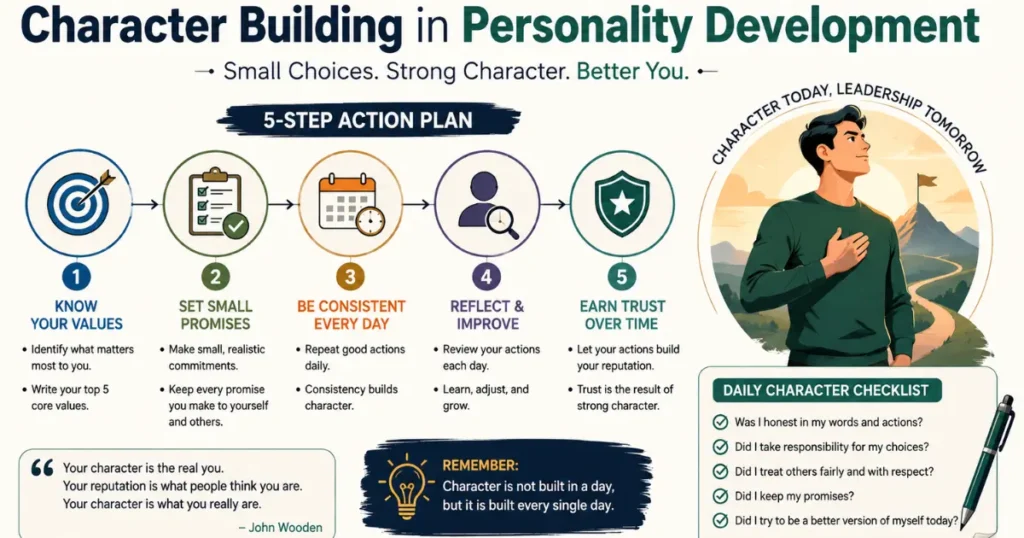
- Pick one value to work on first. Do not try to fix everything at once. Choose the pillar that is weakest for you right now, whether that is honesty, responsibility, resilience, or fairness.
- Set one rule tied to that value. Rohan’s rule was simple and specific. A vague goal like “be more honest” rarely changes behavior. A specific rule like “never agree to a deadline I have not checked against my calendar” does.
- Track it for thirty days. Keep a simple daily note of whether you kept the rule. Staying consistent here depends heavily on your ability to build willpower, especially during the weeks when keeping your word is genuinely inconvenient.
- Review your slips without excuses. When you break the rule, write down what happened without blaming the situation. This step alone builds the self-awareness that character growth depends on.
- Add a second pillar once the first feels automatic. Character habits stack. Trying to build all four pillars in one month usually leads to giving up on all four.
Character Building for Students:
If you’re studying personality development vs character building as part of your course, one thing examiners often look for is whether you understand the difference between the two.
Keep these points in mind:
- Personality development is about improving skills like communication, confidence, and the way you interact with others.
- Character building is about developing values such as honesty, responsibility, integrity, and empathy.
- Personality helps you make a good first impression, while character helps you earn lasting trust.
- The two are closely connected. A strong personality becomes more meaningful when it’s backed by good character.
- In exams, avoid writing that personality development vs character building are the same. Instead, explain how they work together to shape a person’s overall development.
Conclusion
Personality opens the door. Character decides whether people want you to stay in the room. Rohan’s story is common because most self-improvement advice stops at communication, confidence, and first impressions, and never touches the slower work of character building in personality development. Start with one rule, tied to one value, tracked honestly for thirty days. That single habit will do more for how people trust you than any amount of polish ever will.
If you are working on your own personality growth right now, start with our full Personality Development guide to see exactly where character building fits into the bigger picture.
FAQs
1. Is character building part of personality development?
Character building is a component of personality development in the broader sense, but the two focus on different things. Personality development shapes outer presentation, while character building shapes inner values.
2. Can character be developed at any age?
Yes. Character habits form through repeated decisions and daily practice, not through a fixed developmental stage, so adults can build stronger character through consistent effort at any age.
3. What is the fastest way to start building character?
Start with one specific, trackable rule tied to a single value, such as honesty or responsibility, rather than attempting to improve every trait at once.
4. Why do some people have strong personalities but weak character?
Personality skills like confidence and communication can be learned quickly through practice and feedback, while character habits take longer to build because they depend on repeated private decisions rather than visible performance.
5. Is character-building in personality development the same across cultures?
The core values like honesty and fairness stay similar, but how strongly they are emphasized and expressed varies by culture and upbringing.

Ayanshi is the founder of PersonaGuru.in, a blog focused on personality development, career, relationships, and mental well-being. With over 3 years of writing experience, she turns psychology and everyday experiences into practical, easy-to-understand advice for real life.