
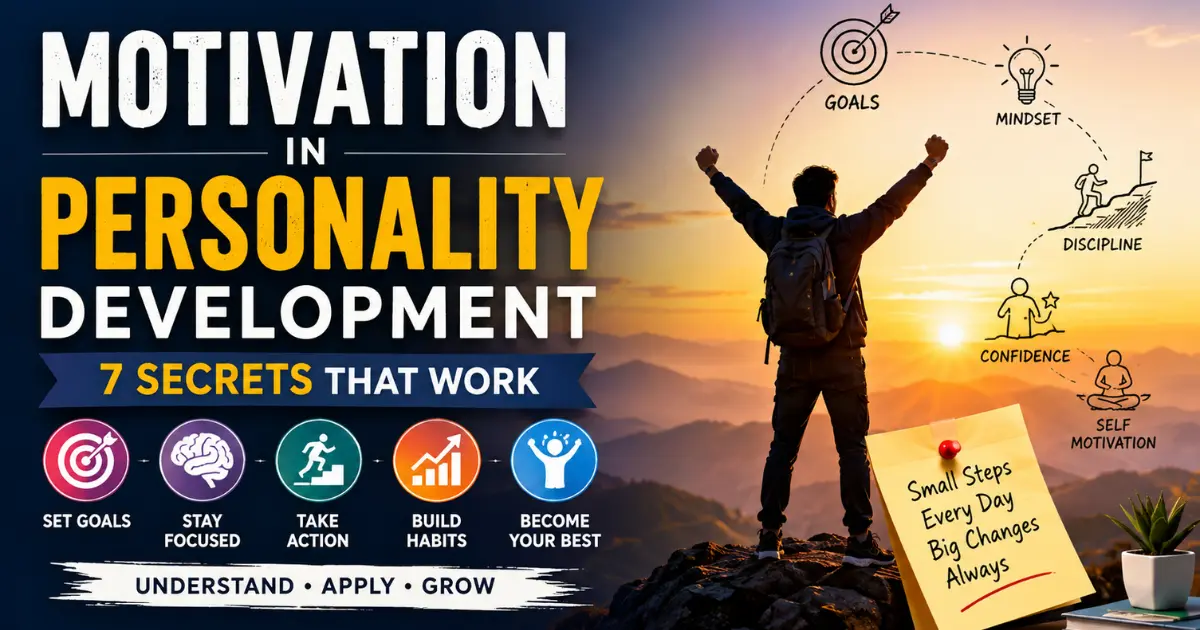
Priya set an alarm for 5 a.m. every day. For two weeks, she showed up. Then one tired Monday, she hit snooze. The whole routine fell apart within a month.
Ask her what happened. She will not blame her schedule. She will not blame her willpower. She will say her motivation ran out.
That one word explains a lot about human behaviour. Motivation in personality development is the inner push that decides whether you start a habit, stick with it, or quietly let it go. It shapes your confidence. It shapes how you handle failure. It shapes how far you are willing to grow.
This article explains what that drive actually means, the main types and theories behind it, the factors that raise or lower it, and simple ways to build it back when it disappears.
📘 Download Free Motivation Self-Check & Goal Tracker Worksheet (PDF)
Key Takeaways
- Motivation in personality development is the internal and external drive that pushes a person toward goals and consistent action.
- There are two broad types of motivation: intrinsic (from within) and extrinsic (from outside rewards).
- Theories like Self-Determination Theory, Herzberg’s Two-Factor Theory, and McClelland’s Theory of Needs explain motivation from different angles.
- Motivation depends on internal factors, external factors, and situational factors, not on willpower alone.
- Self-motivation is a skill you can build. Small, repeated habits work better than one big burst of inspiration.
What Is Motivation in Personality Development?
It means the internal and external forces that push a person to set goals, take action, and keep going when things get hard. It is the gap between wanting to change and actually changing.
Motivation is not the same as personality. The two work together. Personality is your pattern of thinking, feeling, and acting. Motivation is what moves that pattern forward. A disciplined person still needs motivation to sit down and finish a task. A confident person still needs motivation to walk into a room full of strangers.
Athlete Jim Ryun once said motivation is what gets you started, and habit is what keeps you going. That line explains why so many people start strong and fade fast. They lean on motivation alone. They never turn it into a routine.
Why Motivation Matters in Personality Development
Role of Motivation in Shaping Behaviour
Motivation in personality development shapes nearly every part of how a personality forms.
It decides whether you take the harder, more rewarding path or the easier one. It decides whether a setback becomes a lesson or a reason to quit. These small choices, repeated over months, become the traits people notice in a strong personality. Discipline. Resilience. Confidence.
Take two students preparing for the same exam, with the same textbook and the same coaching class. The one who stays motivated through months of preparation is usually the one who builds real self-discipline out of the process, not just better marks.
Significance of Self-Motivation
Self-motivation matters most once outside structure disappears. That means after school ends, after a course finishes, or after a deadline passes. Nobody is checking in anymore. Internal drive decides whether growth continues or stalls.
This gap shows up at a global scale too. Gallup’s State of the Global Workplace 2026 report found that only 20 percent of employees worldwide felt engaged in 2025. That is the lowest level since 2020. Gallup estimates this low engagement cost the global economy close to 10 trillion dollars in lost productivity. Behind low engagement sits a motivation problem almost every time: unclear goals, no recognition, or work that stopped feeling meaningful.
Types of Motivation in Personality Development
Psychologists split motivation in personality development into two broad types, based on where the drive comes from.
Intrinsic Motivation
Intrinsic motivation comes from within. You do something because it feels satisfying or meaningful on its own, not because of an outside reward.
Rohan, a software developer, builds small apps on weekends. Nobody asked him to. Nobody pays him for it. He does it because solving the problem feels good. That is intrinsic motivation.
Extrinsic Motivation
Extrinsic motivation comes from outside factors. Money, grades, praise, or the fear of punishment all count.
Ananya dislikes her morning gym sessions. She keeps going because her health insurance gives a discount for hitting a step count. The reward, not the workout, keeps her showing up. That is extrinsic motivation.
Neither type wins on its own. Intrinsic motivation tends to last longer. Extrinsic motivation is often what gets a habit started in the first place. Knowing which one is driving you is the first real step in understanding motivation in personality development.
7 Types of Motivation at a Glance
| Type | What Drives It | Example |
|---|---|---|
| Achievement | Desire to accomplish something meaningful | Finishing a certification course |
| Power | Desire to lead or influence others | Taking on a team lead role |
| Affiliation | Desire for connection and belonging | Joining a community group |
| Incentive | Reward-driven action | Working extra hours for a bonus |
| Fear | Avoiding a negative outcome | Studying to avoid failing an exam |
| Competence | Desire to master a skill | Practicing a language daily |
| Social | Wanting approval from others | Sharing progress updates to stay accountable |
Theories of Motivation in Personality Development
A few psychologists have tried to explain what actually drives motivation in personality development. Each theory looks at it from a different angle.
Maslow’s Hierarchy of Needs is the most well-known starting point. It argues that people move up from basic survival needs toward self-actualization, once each level below is reasonably met. We cover that theory in full detail in our guide on Maslow’s Hierarchy of Needs. Here, we will look at three theories that explain angles Maslow does not fully cover.
Self-Determination Theory (Deci and Ryan)
Psychologists Edward Deci and Richard Ryan proposed that motivation depends on three basic needs: competence, autonomy, and relatedness. According to Self-Determination Theory, people feel truly motivated when they feel capable, in control of their choices, and connected to others. When any of these three needs gets blocked, motivation drops, even if the rewards stay the same.
This explains why a well-paid job can still feel flat. If an employee has no say in decisions and no real connection with the team, salary alone rarely holds motivation for long.
Herzberg’s Two-Factor Theory
Frederick Herzberg split workplace motivation into two groups: hygiene factors and motivators. Hygiene factors, like salary and job security, do not create motivation by themselves. Their absence causes dissatisfaction, but their presence does not spark drive. Motivators, like recognition and meaningful work, are what actually push people to perform better.
This idea applies outside the office too. A comfortable routine will not motivate personal growth on its own. Growth usually needs a motivator, such as a clear goal or a visible sense of progress. Herzberg’s split is one of the clearest explanations for motivation in personality development in everyday life, not just at work.
McClelland’s Theory of Needs
David McClelland proposed that every person is driven by a mix of three needs: achievement, affiliation, and power. Most people lean toward one more than the others. Someone high in achievement motivation sets ambitious personal goals. Someone high in affiliation motivation is driven by relationships. Someone high in power motivation is driven by influence over outcomes.
Knowing which need drives you most can help you pick goals that actually stick, instead of chasing a goal built for someone else’s personality.
Factors Affecting Motivation in Personality Development
Motivation rarely comes from one source. It builds from internal, external, and situational factors working together.
| Factor Type | Examples | Effect on Motivation |
|---|---|---|
| Internal | Self-efficacy, personality traits, personal values | Belief in your own ability raises effort and persistence |
| External | Rewards, praise, social support, environment | A supportive environment makes effort easier to sustain |
| Situational | Clear goals, timely feedback, life challenges | Specific goals and honest feedback keep motivation on track |
- Internal factors include self-efficacy, meaning how much you believe in your own ability, along with personality traits like conscientiousness and resilience. A person who believes they can improve is far more likely to keep trying after a setback.
2. External factors include the people and surroundings around you. Family encouragement, a supportive friend group, and a workplace that notices effort all make motivation easier to sustain. A chaotic or unsupportive environment does the opposite.
3. Situational factors include the exact conditions of a task, such as how clear the goal is and how fast feedback arrives. A vague goal like “get better at my job” rarely holds motivation. A specific goal like “finish one online course by month-end” does.
5 Key Principles of Motivation
- Motivation follows clarity. A vague goal produces vague effort. A specific, written goal produces focused effort.
- Small wins build momentum. Motivation grows from proof of progress, not from willpower alone.
- Feedback keeps motivation alive. Without knowing if effort is working, motivation fades faster.
- Motivation is not constant. It naturally rises and falls. Habits and systems carry you through the low points.
- Internal motivation lasts longer than external motivation. Rewards can start a habit. Purpose is usually what sustains it.
Self-discipline plays a similar role here. Once motivation dips, discipline is what keeps the routine alive. Our guide on the role of self-discipline in personality development breaks this down step by step.
How Attitude and Motivation Work Together
Attitude and motivation feed each other constantly. A hopeful, solution-focused attitude makes it easier to stay motivated after a setback. A negative attitude often kills motivation the moment something small goes wrong.
This works both ways. Staying motivated and seeing real progress also improves attitude over time. Our guide on attitude in personality development explains how attitude forms and how to strengthen it.
How to Build Self-Motivation: 7 Practical Tips
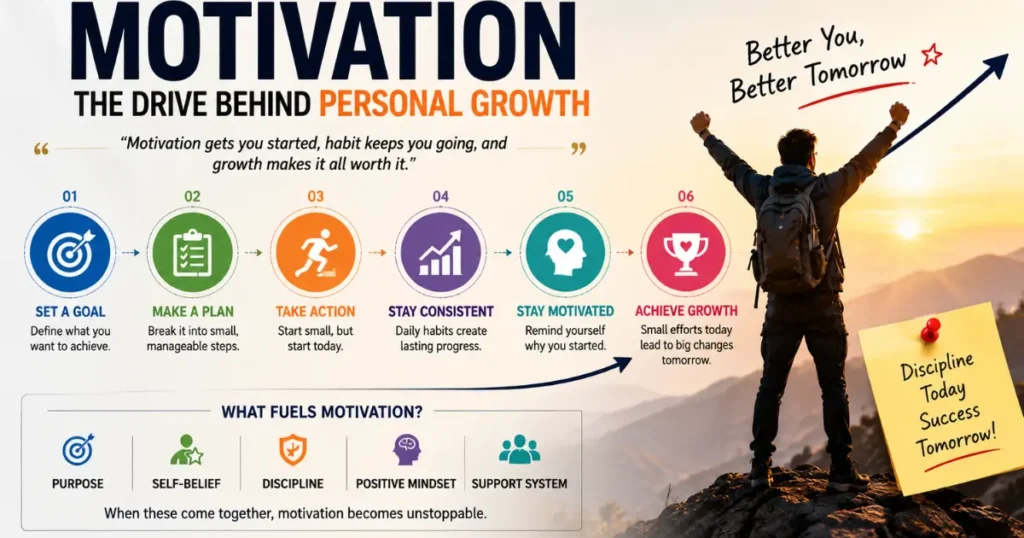
Motivation in personality development is not something you either have or do not have. It is a skill you build through consistent habits.
- Set one specific goal at a time. Trying to fix everything at once usually leads to burnout within a week.
- Break the goal into small, visible steps. “Read more” is hard to act on. “Read 10 pages before bed” is not.
- Track progress somewhere visible. A simple checklist or journal works well. Seeing progress on paper keeps motivation alive.
- Reward consistency, not just results. Celebrate showing up for seven days straight, not only the outcome.
- Find one accountability partner. Telling one person about your goal makes it harder to give up quietly.
- Revisit your reason often. Write down why the goal matters. Read it again whenever motivation dips.
- Build willpower alongside motivation. Motivation gets you started. Willpower carries you through the days it goes missing. Our guide on how to build willpower has science-backed steps for strengthening that muscle.
Here is a real example. Kabir, a college student, wanted to improve his public speaking. Instead of aiming for “become a confident speaker,” he committed to speaking up once in every class discussion for a month. That one small, specific target did more for his confidence than any big resolution had.
What Causes Low Motivation, and How Do You Fix It?
Low motivation usually has a specific cause. It is not a personality flaw. Common causes include unclear goals, exhaustion, fear of failure, and no visible progress.
The fix almost always starts with shrinking the goal. When motivation disappears, the task in front of you is usually too big or too vague. Cutting it down to something small enough to finish today is often enough to restart momentum. If low motivation keeps circling back to the same worries at night, our guide on how to stop overthinking at night can help break that cycle too.
Motivation Tips for Students in India
For Indian students preparing for board exams or competitive exams, motivation dips hardest during long preparation phases with no immediate reward in sight. A few things help.
Break the syllabus into weekly, trackable targets instead of thinking about the whole exam at once. Study with a friend or a small group, since social accountability keeps motivation steadier than studying alone. Revisit your reason for wanting the result, whether that is a college seat, a career goal, or making your family proud, on the days motivation is at its lowest.
Motivation during exam preparation is rarely about willpower alone. It is about designing a routine that does not depend on feeling motivated every single day. This connects directly to how you see your own career path. Our guide on self-career perception in personality development covers that link in more depth.
Conclusion
Motivation in personality development is not a fixed trait some people are born with. It comes from clear goals, self-belief, supportive surroundings, and small, repeated habits.
The types and theories in this guide explain why motivation rises and falls. The factors and principles give you something practical to work with on the days it disappears completely.
Start small. Pick one goal. Track it somewhere you can see it. Motivation to keep going usually follows the action. It rarely comes before it.
FAQs
1. What are the 5 pillars of motivation?
The 5 pillars of motivation are commonly listed as purpose, self-belief, clear goals, social support, and consistent action. Together, they explain why some people sustain motivation for years while others burn out in weeks.
2. What are the 5 C’s of motivation?
The 5 C’s of motivation are typically clarity, commitment, confidence, consistency, and celebration. Each one plays a role, from knowing exactly what you want (clarity) to acknowledging your own progress (celebration).
3. What are the 7 rules of motivation?
The 7 rules of motivation generally include setting clear goals, breaking them into small steps, tracking progress, celebrating small wins, staying around supportive people, staying consistent, and revisiting your reason regularly.
4. What are the five principles of motivation?
The five principles of motivation covered in this guide are clarity, momentum through small wins, regular feedback, accepting that motivation naturally fluctuates, and building on internal motivation for long-term consistency.
5. What is motivation in personality development in one line?
Motivation in personality development is the internal and external drive that pushes a person to set goals, take consistent action, and keep growing, even when the process gets hard.

Ayanshi is the founder of PersonaGuru.in, a blog focused on personality development, career, relationships, and mental well-being. With over 3 years of writing experience, she turns psychology and everyday experiences into practical, easy-to-understand advice for real life.