
Last updated on August 10th, 2026 at 09:34 am
The role of self-discipline in personality development becomes clear the day someone finally keeps a promise to themselves. Priya used to hit snooze five times every morning. She missed deadlines. She promised herself a new routine every Monday and dropped it by Wednesday. Then a mentor gave her one small rule. Wake up, drink water, write down three tasks. Nothing else. No big plan, just that one habit, every single day.
Six months later, Priya was not a different person on the outside. But something inside her had shifted. She kept promises to herself now. Small ones, but real ones. That shift is what self-discipline actually does.
Quick Answer: Self-discipline shapes personality by training a person to choose long-term goals over short-term comfort, again and again, until that choice becomes automatic. It builds resilience, focus, and emotional control, and research shows it predicts success better than raw talent or IQ.
Key Takeaways
- Self-discipline is a trainable skill, not a fixed personality trait.
- Research from the University of Pennsylvania found self-discipline predicted academic performance better than IQ.
- A large PNAS study linked childhood self-control to better health, wealth, and safety outcomes decades later.
- Self-discipline strengthens emotional intelligence, relationships, and financial habits.
- Small daily habits build self-discipline faster than big, dramatic resolutions.
.jpg "The Role of Self-Discipline in Personality Development") |
| The Role of Self-Discipline in Personality Development |
What Is Self-Discipline in Personality Development?
The role of self-discipline in personality development starts with a simple idea: personality forms through repeated choices. Self-discipline is the ability to control impulses, emotions, and actions in order to reach a goal that matters more than the moment. It is not about being hard on yourself. It is about choosing your future self over your present comfort.
Personality forms through repeated choices. Genetics set a starting point, but self-discipline is what shapes the rest. Psychologist Angela Duckworth and Martin Seligman studied this directly at the University of Pennsylvania. Their research on self-discipline and willpower found that self-discipline predicted eighth graders’ grades, attendance, and test scores better than their IQ scores did.
That single finding changed how psychologists think about success. Talent opens a door. Self-discipline is what walks through it, every day, even on the days that feel hard.
7 Ways Self-Discipline Shapes Your Personality
1. Builds Resilience
Every setback tests a person’s ability to keep going. Self-discipline is what makes someone show up again after a bad result instead of quitting. This same pattern shows up clearly in athletes, where the role of sports in personality development is built almost entirely on this kind of repeated recovery from loss.
2. Sharpens Focus
A disciplined mind resists distraction better. It is easier to finish one task fully before jumping to the next. Over time, this habit trains the brain to concentrate for longer stretches, which improves both work quality and confidence.
3. Strengthens Willpower
Self-discipline and willpower feed each other. Every time a person resists a small temptation, saying no to one extra scroll on the phone, the next act of self-control gets a little easier. Anyone wanting to go deeper into this can look at practical techniques for building real willpower, since the two skills overlap almost completely.
4. Builds Reliability
People trust those who follow through. Someone who keeps small promises, showing up on time, finishing what they start, earns trust that lasts. This reliability is one of the clearest, most visible signs of self-discipline and character building working together.
5. Develops Leadership
Leaders are rarely the loudest people in the room. They are usually the most consistent. Self-discipline gives a person the steadiness to take responsibility during a crisis instead of freezing. This links closely with what actually drives people to lead and stay motivated, since discipline without motivation tends to burn out fast.
6. Improves Emotional Intelligence
Discipline is not only about tasks. It also governs reactions. A disciplined person can pause before reacting in anger, which is the exact skill behind managing aggression versus healthy assertiveness. That pause, just two or three seconds, is often the difference between a regretted reaction and a measured response.
7. Forms Lasting Habits
Habits are self-discipline on autopilot. Once a behavior repeats enough times, the brain stops treating it as effort. This is exactly how consistent character building actually works over months and years, not through one big decision, but through hundreds of small repeated ones.
What Does the Research Actually Say?
Most articles on this topic list benefits without any real data behind them. Here is what the actual studies found about self-control and success.
| Study | What It Found |
|---|---|
| Duckworth & Seligman, University of Pennsylvania (2005) | Self-discipline predicted final grades and test scores more accurately than IQ, accounting for more than twice the variance |
| Moffitt et al., Dunedin Study, published in PNAS | Children with stronger self-control at age 3 to 11 had better health, more savings, and fewer credit problems by age 32, independent of IQ and family background |
| Tangney et al., George Mason University (via APA) | Higher self-control scores in students correlated with higher GPA, higher self-esteem, and less binge eating and alcohol misuse |
None of these studies measured talent. They measured the ability to keep a promise to yourself, over and over.
Self-Discipline and Character: A Real Example
Arjun ran a small tailoring shop. Every evening, no matter how tired he was, he balanced his accounts before locking up. It took fifteen minutes. He did it for eleven years straight.
One day, a supplier tried to inflate a bill by a small amount, hoping it would slip through unnoticed. Arjun caught it in under a minute. Not because he was clever. Because fifteen minutes of daily discipline had made him someone who always knew exactly where he stood.
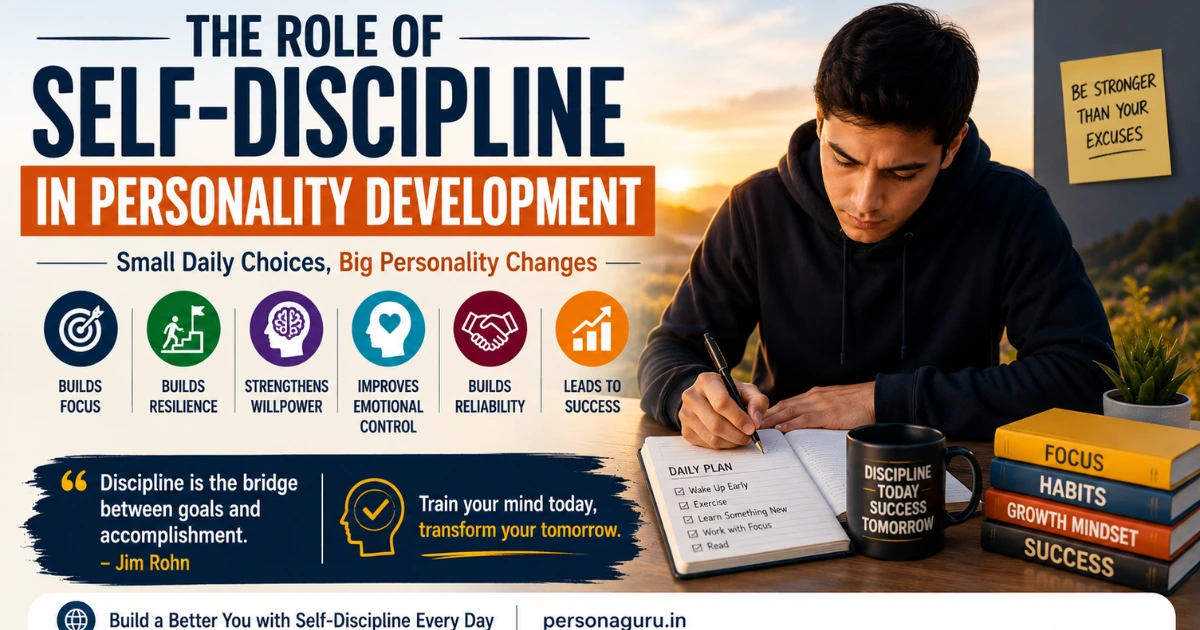
As the entrepreneur and motivational speaker Jim Rohn put it, “Discipline is the bridge between goals and accomplishment.” Arjun’s bridge was built one evening at a time.
How to Build Self-Discipline: 6 Practical Steps
Knowing how to build self-discipline matters more than knowing why it matters. Here is where to actually start.
- Start absurdly small. One task, one habit, done daily beats a big plan done twice.
- Set a fixed time. Discipline sticks better when it is tied to a clock, not a mood.
- Remove friction. Keep temptations out of easy reach and useful tools in easy reach.
- Track it visibly. A simple checklist on paper works better than a memory-based promise.
- Expect to slip. Missing one day is normal. Missing two in a row is the real risk to guard against.
- Reward the process, not just the result. Acknowledge the effort of showing up, separate from the outcome.
Conclusion
Priya still hits snooze sometimes. But she still writes her three tasks, most days, even on the mornings that go wrong. That is what self-discipline in personality development really looks like. Not perfection, just enough consistency to keep becoming someone a little steadier than yesterday.
For a wider look at how every part of character connects, read the complete personality development guide.
Frequently Asked Questions
1. What is the role of self-discipline in personality development?
Self-discipline trains a person to choose long-term goals over short-term comfort. Over time, this repeated choice builds resilience, focus, reliability, and emotional control, all of which shape a stable, mature personality.
2. What is the difference between self-discipline and willpower?
Willpower is the short-term mental effort used to resist a specific temptation. Self-discipline is the longer-term habit and system built from repeated acts of willpower, which is why it feels easier over time.
3. Can adults build self-discipline, or is it only formed in childhood?
Adults can absolutely build self-discipline at any age. While childhood self-control has a strong influence, research shows the brain’s habit-forming systems stay flexible well into adulthood.
4. How does self-discipline improve emotional intelligence?
Self-discipline creates a pause between a trigger and a reaction. That pause allows a person to choose a measured response instead of an impulsive one, which is a core part of emotional intelligence.
5. Does self-discipline really affect financial success?
Yes. Multiple studies, including the Dunedin longitudinal study published in PNAS, link stronger self-control to better savings behaviour, fewer credit problems, and stronger long-term financial stability.
6. What is the easiest way to start building self-discipline today?
Pick one small, specific habit, tied to a fixed time of day, and repeat it daily for two weeks before adding anything else. Small and consistent beats big and occasional.

Ayanshi is the founder of PersonaGuru.in, a blog focused on personality development, career, relationships, and mental well-being. With over 3 years of writing experience, she turns psychology and everyday experiences into practical, easy-to-understand advice for real life.