
Last updated on September 28th, 2026 at 06:35 am
Most people think willpower is something you either have or you do not have. You either wake up early or you hit snooze five times. You either resist the extra samosa, or you finish the whole plate and feel guilty later.
But that idea is wrong. Willpower is not a fixed trait. It is a skill. And like any skill, learning how to build willpower starts with understanding how it actually works, not just trying harder. This willpower guide is part of our broader Personality Development series, where self-control is one of the core building blocks of a strong personality.
This guide breaks down what modern research actually says about willpower, why it fades during the day, and ten practical ways to strengthen it starting today.
Key Takeaways
- Willpower and self-control work more like a muscle than a fixed personality trait.
- Recent research questions the old idea that willpower is a limited resource that runs out.
- Small environment changes often work better than pure mental effort when you want to build willpower.
- Sleep, blood sugar, and stress directly affect how much self-control you have on a given day.
- Willpower exercises like the two-minute rule and if-then planning build real, lasting discipline.
What Is Willpower and Why Does It Matter
Willpower is your ability to control impulses, delay gratification, and stick to a decision even when a part of you wants to quit. Psychologists also call this self-control. Understanding this definition is the first real step in how to build willpower that actually lasts, instead of relying on short bursts of motivation.
It matters because almost every major life goal, whether it is finishing a degree, saving money, or improving health, depends on doing the harder thing today so tomorrow gets easier. A well-known long-term study from Dunedin, New Zealand followed over a thousand children into adulthood and found that childhood self-control predicted adult health, wealth, and even how well people avoided addiction, regardless of intelligence or family backgroundA well-known long-term study from Dunedin, New Zealand, tracked by James Clear’s breakdown of the willpower research, followed over a thousand children into adulthood and found that childhood self-control predicted adult health, wealth, and even how well people avoided addiction, regardless of intelligence or family background.
Willpower vs Self-Control vs Discipline vs Motivation
People use these four words as if they mean the same thing. They do not.
| Term | What It Actually Means | Example |
|---|---|---|
| Willpower | The mental effort used in a single moment to resist temptation | Not checking your phone during a meeting |
| Self-Control | The broader, ongoing ability to regulate emotions and impulses | Staying calm during an argument |
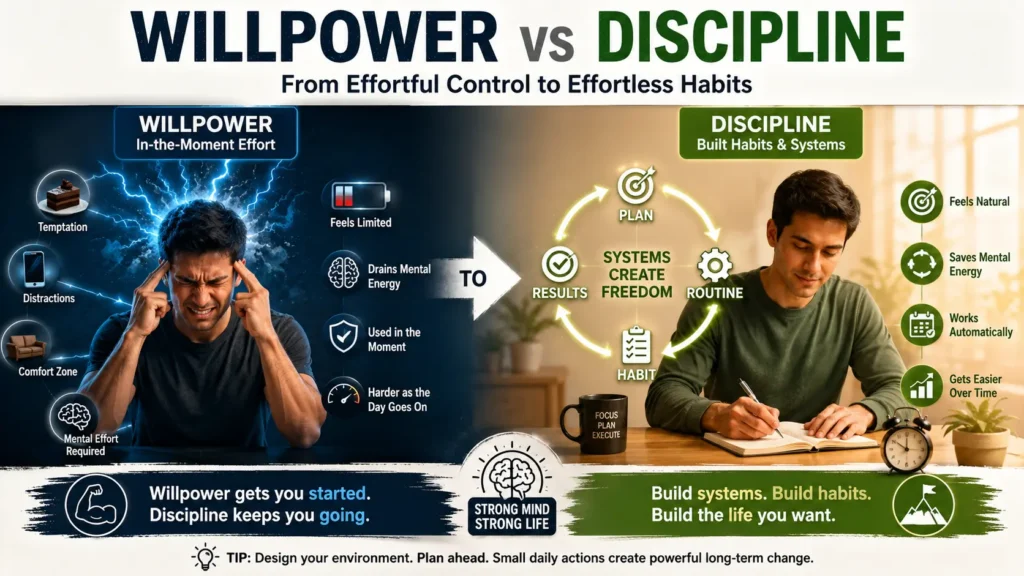
| Discipline | A trained habit or routine that removes the need for willpower | Waking up at 6 AM daily without a struggle |
| Motivation | The desire or reason behind an action | Wanting to lose weight before a wedding |
Here is the important part: discipline is what you build once your willpower has already done its job a few hundred times. Motivation gets you started. Discipline keeps you going without needing willpower every single time. We cover this connection in more depth in our article on the role of self-discipline in personality development, if you want to go further into building lasting discipline.
Is Willpower Genetic or Learned
Some people are born with a calmer temperament, which does make early self-control slightly easier. But most researchers agree that when it comes to how to build willpower, genetics only sets a starting point — habits, environment, and practice shape where you actually end up.
Why Willpower Fades: The Science Explained
If you have ever eaten healthy all day and then binged on chips at 11 PM, you already know willpower fades. Here is why.
Ego Depletion Theory
In the 1990s, psychologist Roy Baumeister proposed that willpower works like a muscle with a limited daily supply. Every time you resist a temptation, you use up a bit of this supply, and eventually you run out. This idea was called ego depletion, and it became one of the most cited theories in psychology.
Mindset Debate: Is Willpower Really Limited
Here is something most willpower articles do not tell you. In 2016, a large registered replication study across 24 labs tested the ego depletion effect and found almost no evidence that willpower actually runs out the way Baumeister described.
Around the same time, Stanford researchers Veronika Job and Carol Dweck found something interesting. People who believed willpower was unlimited did not experience the same fatigue as people who believed it was limited. You can read James Clear’s full breakdown of this willpower research on his dedicated willpower guide, where he explains why environment design often beats raw self-control.
This does not mean willpower is infinite. It means the story you tell yourself about your own limits matters more than most people realize.
What Drains Willpower Daily
Even if willpower is not a fixed tank, these factors do make self-control harder in the moment:
- Poor or irregular sleep
- Chronic stress
- Low blood sugar
- Making too many small decisions back to back
- Emotional exhaustion
According to the American Psychological Association’s 2025 Stress in America report, a large share of adults say daily stress is affecting their ability to focus and make sound decisions, and stress tied to information overload and technology has risen compared to the previous year. This lines up with why willpower often feels weaker during high-stress periods.
Signs of Strong Willpower vs Low Willpower
Before working on your willpower, it helps to know where you currently stand.
Signs You Have Strong Willpower
- You can delay a reward without constant internal struggle
- You recover quickly after a setback instead of spiraling
- You follow through on plans even when motivation is low
- You rarely need external pressure to complete tasks
Symptoms and Signs of Weak Willpower
- Frequently starting tasks and abandoning them halfway
- Feeling controlled by cravings, notifications, or impulses
- Making the same resolution repeatedly without lasting change
- Blaming lack of time instead of recognizing avoidance patterns
These patterns often overlap with self-sabotaging behavior. If this sounds familiar, our detailed guide on self-sabotage meaning, causes, and solutions is a useful companion read.
How to Build Willpower: 10 Science-Backed Ways
1. Change Your Environment, Not Just Your Mindset
Fighting temptation through pure mental force is exhausting. It is far easier to remove the temptation altogether. Keep junk food out of the house. Put your phone in another room while working. This single shift is often the fastest way to build willpower, because it removes the need for constant decision-making.
Real example: Aryan, a 28-year-old software engineer, kept failing his “no phone after 10 PM” goal until he started leaving his phone charging in the kitchen overnight instead of his bedroom. The goal succeeded not because his willpower increased, but because the environment made the wrong choice harder to access.
2. Use the Two-Minute Rule to Start Small
Pick the task you are avoiding and commit to doing it for just two minutes. Once you start, momentum usually carries you forward. This works because starting, not finishing, is the hardest part for most people.
3. Try Temptation Bundling
Pair something you enjoy with something you need to do. Only listen to your favorite podcast while exercising. Only watch your favorite show while doing household chores. This makes the harder task feel less like a burden. These simple habits show how to build willpower in daily life. Small actions practiced consistently create lasting self-control.
4. Practice If-Then Planning
Decide in advance what you will do when temptation hits. For example: “If I feel like skipping my workout, then I will do just 10 minutes instead of zero.” This removes the need for in-the-moment decision-making, which is when willpower usually fails.
5. Protect Your Sleep
A tired brain struggles to regulate impulses. Aim for 7 to 8 hours of consistent sleep. Even one night of poor sleep measurably reduces self-control the next day.
6. Stabilize Your Blood Sugar and Energy
Sudden drops in blood sugar increase cravings and reduce focus. Choose complex carbohydrates, protein, and regular meals instead of relying on sugar spikes to get through the day.
7. Use Breathing and Meditation to Reset Self-Control
Slowing your breathing to around four to six breaths per minute activates the part of your brain responsible for self-control and reduces stress in real time. Even short daily meditation practice has been shown to strengthen attention and impulse control over just a few weeks.
8. Reduce Daily Decision Fatigue
Every small decision, like what to wear or what to eat, uses up a bit of mental energy. Simplify routine choices so your energy is available for decisions that actually matter.
9. Reward Small Wins
Do not wait for the final result to celebrate progress. Small, consistent rewards along the way keep motivation alive and make the process feel less like punishment.
10. Forgive Setbacks and Restart Fast
One missed workout or one bad day does not erase your progress. People who successfully build willpower over the long term are not people who never fail. They are people who restart quickly instead of spiraling into guilt.
Willpower Exercises You Can Practice Daily
Think of these as a gym routine for your self-control. Practicing these small willpower exercises consistently is often more effective than any single big effort to build willpower overnight:
- Skip one small comfort each day on purpose, like an extra episode or a second snack
- Complete one small task immediately instead of delaying it, such as making your bed
- Sit with a craving for five minutes before acting on it
- Practice saying no to one minor request that does not serve your priorities
- Track one habit daily using a simple checklist or journal
If you want to know how to build willpower, start with one small exercise every day. Consistency always beats perfection.
Download Your Free Willpower Self-Check Worksheet
Reading about willpower is easy. Practicing it daily is where real change happens. To make that easier, we have created a free two-page Willpower Self-Check Worksheet you can download and print.
Inside, you will find:
- A self-check list to spot your current signs of strong or weak willpower
- An If-Then Plan template to prepare for real temptations before they happen
- A 7-Day Willpower Tracker to build one habit at a time
- Weekly reflection questions to keep you honest and consistent
Download the Willpower Self-Check Worksheet (PDF)
Fill it in once a week. It takes five minutes and keeps your progress visible, which is one of the simplest ways to build willpower that actually lasts.
How to Build Willpower for Students and Exam Preparation
Indian students preparing for board exams or competitive exams like UPSC, JEE, or NEET often equate willpower with studying for endless hours. This usually backfires and leads to burnout.
A more sustainable approach is combining if-then planning with the two-minute rule. Instead of “I will study for 6 hours,” try “If it is 6 PM, then I open my books and study for just 25 minutes.” Once started, most students continue well past the initial 25 minutes, because starting was the actual barrier, not the studying itself.
Short, distraction-free study blocks of 25 to 45 minutes, followed by a five-minute break, also work better than long, unstructured study sessions, since sustained focus itself depends on the same limited attention resources as willpower.
A few more tips that make a real difference during exam preparation:
- Study with a friend online or offline, even in silence. This is called body doubling. Simply having another person present, studying their own subject, makes it harder to give in to distraction. Many UPSC and NEET aspirants use silent study-with-me sessions on video call for exactly this reason.
- Keep your phone in a separate room, not just on silent. Silent mode still lets the phone tempt you visually. Physical distance removes the temptation completely, which is far easier than resisting it moment to moment.
- Revise using active recall instead of rereading. Close the book and try to write down what you remember before checking. This feels harder than passive reading, which is exactly why it strengthens both memory and mental discipline at the same time.
- Use a “worry list” before you sit down to study. Write down anything on your mind- exam stress, pending tasks, family matters- on a piece of paper first. This clears mental clutter so your willpower is not divided between studying and quietly worrying in the background.
- Set a fixed start time, not just a fixed target. Most students plan how many hours they will study, but few plan exactly when they will start. A fixed start time, like 5 PM sharp every day, builds the habit faster than an open-ended goal ever will.
- Do your hardest subject first, not last. Willpower is usually highest earlier in a study session. Save the subject you enjoy most for later, when your focus naturally starts to dip.
What to Do If You Feel You Have No Willpower Left
If you feel like you have completely run out of willpower, the problem is rarely a personal flaw. It is usually one of these:
- You are sleep-deprived or physically exhausted
- You are trying to change too many habits at once
- Your environment is working against your goal
- You are relying on motivation instead of a system
Start by fixing just one of these factors instead of trying to overhaul your entire life at once. If low motivation persists for weeks and affects daily functioning, it is worth speaking with a mental health professional, since ongoing low motivation can sometimes be linked to underlying stress or emotional exhaustion rather than a simple lack of discipline. If you find yourself constantly overthinking every decision before acting, our guide on how to stop overthinking at night can help you break that cycle too.
Final Thoughts
Building willpower is not about becoming a different, more disciplined person overnight. It is about designing your days so that good choices require less effort and bad choices require more. Start with one small change today, and let that be your real answer to how to build willpower that sticks. Your future self will thank you for it.
If you want to understand the deeper personality traits that support strong self-control, read our complete guide on the 12 key aspects of personality development, or explore how your attitude shapes long-term personality growth. You can also learn to spot distorted thinking patterns that quietly sabotage self-control, and see how emotional intelligence works alongside willpower to help you make better daily decisions. For long-term habit building, our piece on good habits for personality development is a useful next read. This ties into the broader career and workplace growth framework — planning, mindset, resilience, and daily habits together.
FAQs
1. Can willpower be taught?
Yes. Research consistently shows that willpower behaves like a trainable skill rather than a fixed trait, especially when practiced through small, repeatable exercises.
2. Is willpower more mental or physical?
It is both. It begins as a mental process in the prefrontal cortex, but physical factors like sleep, blood sugar, and stress directly affect how much willpower you have available.
3. What causes loss of willpower?
Poor sleep, chronic stress, decision fatigue, and an environment full of easy temptations are the biggest daily drains on willpower.
4. Do people with ADHD have low willpower?
People with ADHD often struggle more with impulse control due to differences in brain regulation, not a lack of character. Structured systems and environment design tend to help more than relying on willpower alone.
5. How to increase willpower in 30 days?
Pick one habit, apply the two-minute rule daily, track it visibly, and adjust your environment to remove friction. Thirty days of small, consistent action builds far more lasting willpower than one intense burst of motivation.

Ayanshi is the founder of PersonaGuru.in, a blog focused on personality development, career, relationships, and mental well-being. With over 3 years of writing experience, she turns psychology and everyday experiences into practical, easy-to-understand advice for real life.