

Last updated on September 13th, 2026 at 12:06 pm
Naina walked into her first job interview with a firm handshake, a warm smile, and a simple please and thank you at the right moments. She did not have the most polished resume in the room. Yet she got the offer. The interviewer later told her that her manners spoke louder than her marks.
This is not a rare story. It shows how good manners and etiquette in personality development work in real life. They decide how people see you before they even know what you can do.
Good manners and etiquette in personality development are the small daily behaviours- respect, politeness, self-control, and social awareness- that shape how a person is perceived and how far that person goes in life. This guide breaks down what good manners and etiquette in personality development actually mean, why they matter, and how to build them step by step.
Key Takeaways
- Good manners and etiquette in personality development are learned habits, not traits you are born with.
- A person forms a first impression of you in a matter of seconds, and manners are one of the biggest factors in that judgement.
- Manners and etiquette are related but not the same thing.
- Etiquette has different types: social, table, professional, and digital.
- Simple daily habits, not grand gestures, build strong etiquette over time.
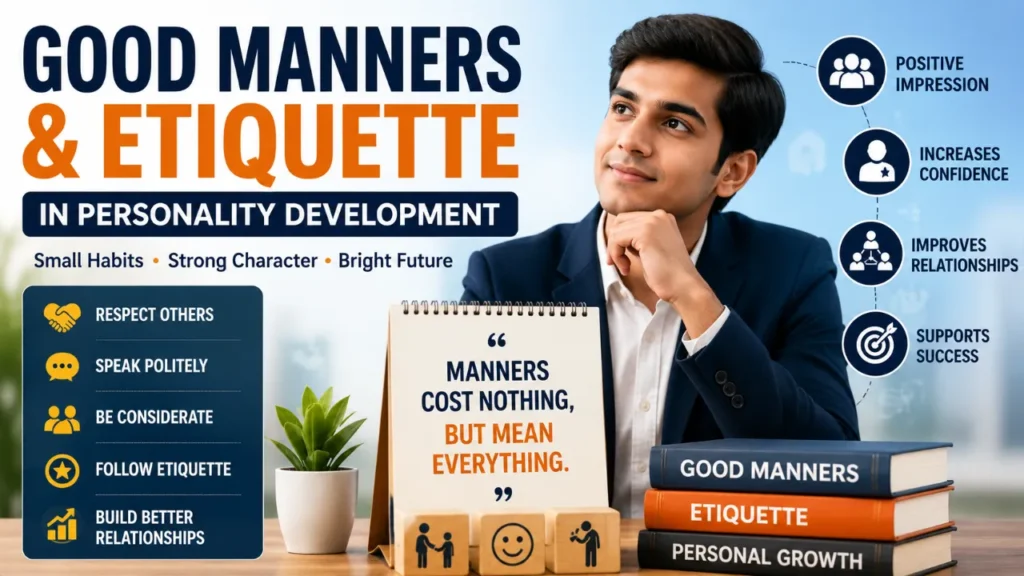
What Are Good Manners and Etiquette in Personality Development?
Good manners are the basic behaviours that show respect and consideration for other people. Saying please, listening without interrupting, and holding a door open are all good manners.
Etiquette is slightly different. Etiquette is the accepted code of conduct in a specific setting, such as a classroom, a workplace, or a formal dinner. Etiquette often changes with culture and context, while manners stay largely the same everywhere.
In personality development, good manners and etiquette work together. Manners build the foundation of respect. Etiquette teaches a person how to apply that respect correctly in different situations, whether it is a school assembly, a job interview, or a family function. This is exactly why good manners and etiquette in personality development are taught as a single, connected skill rather than two separate topics.
Difference Between Manners and Etiquette
People often use these two words as if they mean the same thing, but there is a clear line between them.
| Aspect | Manners | Etiquette |
|---|---|---|
| Meaning | General behaviour that shows respect | Specific rules of conduct for a setting |
| Nature | Universal, taught early in life | Varies by culture, region, and occasion |
| Example | Saying thank you | Knowing which fork to use at a formal dinner |
| Focus | Attitude towards others | Correct action in a given situation |
Manners come from the heart. Etiquette comes from knowledge of the setting. A person can have good manners without knowing formal etiquette, but strong personality development needs both working side by side, which is the whole idea behind good manners and etiquette in personality development.
How Good Manners Contribute to Personality Development
Personality development is not only about confidence or communication skills. It is also about how a person treats others and handles social situations. This is where the connection between the role of communication in personality development becomes clear, since polite speech and active listening are communication skills at their core.
Good manners contribute to personality development in the following ways.
- They build trust quickly. People open up faster to someone who is polite and respectful.
- They improve communication. Listening without interrupting and speaking politely make conversations smoother.
- They strengthen emotional intelligence. Manners require reading the room and adjusting behaviour accordingly.
- They create leadership presence. Leaders who are courteous inspire more loyalty than those who are rude, even if both are equally skilled.
- They reduce conflict. Polite behaviour defuses tension before it turns into an argument.
“Manners are a sensitive awareness of the feelings of others,” wrote etiquette authority Emily Post, and this idea still holds true in classrooms, offices, and homes today.
Golden Rule and Core Principles of Etiquette
Every etiquette expert agrees on one thing. There is a simple rule underneath all the complicated dinner table and boardroom advice.
Golden Rule of Manners
The golden rule of manners is simple: treat others the way you want to be treated. If you want people to listen when you speak, listen when they speak. If you want respect, give respect first. This single rule sits at the centre of good manners and etiquette in personality development.
Three Main Principles of Etiquette
Most etiquette systems, whether social, professional, or digital, are built on three core principles.
- Respect – acknowledging the value and feelings of the other person.
- Consideration – thinking about how your actions affect people around you.
- Honesty – being truthful and sincere, not just polite on the surface.
The 3 R’s of Etiquette
A simple way to remember good etiquette is through the 3 R’s.
- Respect for yourself and others.
- Responsiveness to the needs and feelings of people around you.
- Responsibility for your own words and actions.
Kabir, a college student preparing for group discussions, uses this exact framework. He respects other speakers, responds to their points instead of ignoring them, and takes responsibility when he interrupts by mistake. His trainers noticed the change within weeks, and it also lifted his self-esteem in social settings, since confident body language and etiquette tend to grow together.
10 Good Manners Everyone Should Practise
These ten manners form the base of good manners and etiquette in personality development at home, school, and work.
- Say please, thank you, and sorry. These three words carry more weight than most people realise.
- Listen without interrupting. Let the other person finish before you respond.
- Respect elders and authority. A polite tone with teachers, parents, and seniors goes a long way.
- Keep your surroundings clean. Cleanliness reflects self-respect and consideration for shared spaces.
- Use polite language. Avoid harsh words even during disagreements.
- Be punctual. Arriving on time shows you value other people’s time.
- Share and cooperate. Team spirit builds long-term relationships.
- Maintain eye contact. It signals confidence and honesty during conversations.
- Apologise sincerely when wrong. Owning a mistake builds trust faster than avoiding it.
- Be kind and helpful. Small acts of kindness leave a lasting impression.
Aryan, a school student in Pune, practised the first three points for a month before his annual day speech. His teacher told him his stage presence had improved, but what she really noticed was how calmly he thanked the judges and audience, both winners and losers, after the results. Stories like this show why teachers keep repeating the same lesson in every value education class: good manners and etiquette in personality development cannot be memorised; they have to be practised.
Types of Etiquette in Personality Development
Etiquette is not one single set of rules. It changes depending on where you are and who you are with, which is another reason good manners and etiquette in personality development are taught through real examples rather than a single list.
Social Etiquette
Social etiquette governs everyday interactions with family, friends, and strangers. Greeting people, respecting personal space, and using polite language fall under this category.
Table or Dining Etiquette
Table etiquette includes using utensils correctly, not talking with a full mouth, and waiting for everyone to be served before eating. Kavya learned this the hard way at a formal family dinner, when she realised she was the only one who had started eating before the elders sat down.
Professional Etiquette
Professional etiquette applies at the workplace. It includes punctuality, respectful emails, active listening in meetings, and appropriate dress. According to CNBC’s coverage of LinkedIn’s 2025 workplace skills report, people-focused, human-centred skills- the same qualities behind good manners and etiquette- now rank among the top skills employers look for, since they are harder to fake or automate. This is also why building strong interview skills always includes a section on professional etiquette.
Digital Etiquette
Digital etiquette is a newer addition, shaped by online communication. It includes responding to messages politely, avoiding all capital letters in emails, and respecting other people’s time in video calls.
Rule of 12 and ABCs of Etiquette Explained
Two lesser-known frameworks help simplify etiquette even further.
The rule of 12 in etiquette suggests paying attention to the first twelve words you speak, the first twelve steps you take, and the first twelve inches around your face, including expression, eye contact, and grooming. This idea comes from professional etiquette training and is often used to prepare people for interviews and public speaking.
The ABCs of etiquette stand for Appearance, Behaviour, and Communication. Together, these three areas cover almost everything a person needs to manage a strong first impression, and they map neatly onto the wider idea of good manners and etiquette in personality development.
5 Basic Etiquettes Every Student Should Know
For school and college students, five basic etiquettes matter most.
- Greet teachers and classmates with respect.
- Raise your hand before speaking in class.
- Keep your phone away during conversations and lessons.
- Wait for your turn in queues and discussions.
- Say sorry immediately if you make a mistake.
Students who build these five habits early rarely need a refresher course later, because good manners and etiquette in personality development, once formed at a young age, tend to stay for life. This pattern also connects closely with motivation in personality development, since disciplined students usually stay more consistent with both habits.
Why Good Manners Are Important for Students
In Indian schools, moral science and value education classes often ask students to write ten lines on good manners. This is not a random exercise. Manners shape how a student is perceived by teachers, peers, and later by employers.
Research consistently shows how fast first impressions form. A recent survey on first impression statistics found that decent manners were named among the top three factors people notice when meeting someone new, right after a genuine smile.
Benefits of Good Manners
- Better relationships with teachers, classmates, and family.
- Stronger first impressions during interviews and interactions.
- Improved emotional intelligence and self-control.
- Higher classroom participation and confidence.
- Long-term career growth, since employers value professionalism as much as skill, a pattern also visible in how self-career perception shapes success.
How to Practise Good Manners and Etiquette Daily
Reading about good manners and etiquette in personality development is easy. Practising them daily is where real personality development happens.
- Start each morning with a simple greeting to family members.
- Practise active listening in one conversation every day without checking your phone.
- Keep a small notebook and write down one moment you handled politely, even under pressure.
- Role-play tricky situations, like receiving criticism or disagreeing with someone, before they actually happen.
- Ask a trusted friend or teacher for honest feedback on your body language and tone.
These habits, repeated over weeks, quietly reshape personality far more than any single lesson can.
Conclusion
Good manners and etiquette in personality development are not old-fashioned rules. They are practical tools that shape trust, confidence, and long-term success. Small habits- a genuine thank you, patient listening, punctuality- build a personality that people remember for the right reasons.
Start with one habit this week. Practise it daily. If you want the full framework behind these habits, our complete guide to personality development connects every trait covered here into one structured path. Personality development, at its core, is built exactly this way: one polite, consistent action at a time, and good manners and etiquette in personality development are where that journey begins.
FAQs
1. Who is considered a famous authority on etiquette?
Emily Post is widely regarded as one of the most influential authorities on modern etiquette. Her work continues to guide etiquette education worldwide, including through the Emily Post Institute.
2. What is the first requirement of good etiquette?
The first requirement of good etiquette is respect for others. Every rule of etiquette, from table manners to professional conduct, is built on this single foundation.
3. What are basic manners?
Basic manners include saying please and thank you, listening without interrupting, respecting elders, being punctual, and apologising when wrong.
4. Are good manners really important in today’s world?
Yes. Even with rapid changes in technology and communication, people still judge character through behaviour. Good manners and etiquette in personality development remain one of the fastest ways to build trust and respect.

Ayanshi is the founder of PersonaGuru.in, a blog focused on personality development, career, relationships, and mental well-being. With over 3 years of writing experience, she turns psychology and everyday experiences into practical, easy-to-understand advice for real life.