

Last updated on September 13th, 2026 at 12:11 pm
You walk into a meeting with a great idea. You know the subject well. But somehow, the moment you start speaking, people lose interest, or worse, they misunderstand you completely. If this sounds familiar, the problem is rarely your idea. It is usually how you communicate it.
This is exactly where the role of communication in personality development becomes clear. Communication is not just about talking. It is the process of sharing your thoughts, feelings, and ideas through speaking, listening, writing, and body language, in a way that others can understand and trust. Personality development is the process of growing your confidence, character, and behavior over time. Put the two together, and communication becomes the tool that carries your inner growth out into the world, where people can actually see it.
I have watched this play out with my own readers over the years. A shy college student who could barely make eye contact during a mock interview started speaking with real confidence after three months of daily conversation practice. Nothing about her personality type changed. Her communication did, and that changed how the world responded to her.
This guide breaks down exactly how communication shapes personality, backed by research, real examples, and steps you can start using today.
Key Takeaways
- Communication is not one skill. It is a mix of verbal, nonverbal, written, and listening abilities that together shape how confident and influential your personality feels to others.
- Strong communicators tend to build self-confidence, emotional intelligence, and trust faster than people who struggle to express themselves.
- The 7 C’s of communication (clear, concise, concrete, correct, coherent, complete, courteous) offer a practical framework for personality growth.
- Small daily habits, like active listening and better body language, create visible changes in personality within weeks.
- Employers now rank communication among the top soft skills they hire for, right alongside technical ability.
What Is the Role of Communication in Personality Development?
Communication is the bridge between who you are on the inside and how people experience you on the outside. Personality development is the ongoing process of shaping your character, confidence, and behavior. Communication is the tool that carries that inner growth into the world.
When you express your thoughts clearly and listen with genuine attention, people see you as confident, trustworthy, and emotionally intelligent. When communication is weak, even a thoughtful and capable person can come across as unsure or distant.
In short, communication does not just describe your personality. It actively builds it, one conversation at a time. This is the core reason the role of communication in personality development matters so much, both in personal life and at work.
How Different Types of Communication Shape Your Personality
Every conversation you have uses more than one channel at once. Verbal words carry your message. Nonverbal cues like posture, tone, and eye contact carry your confidence. Written communication reflects your clarity of thought, and active listening shows your respect for others.
Body language alone can shape how confident you appear before you say a single word. Small habits like standing tall and keeping an open posture are covered in detail in our guide on body language in personality development, along with practical steps in 11 ways to have more confident body language.
Each of these types leaves its own mark on your personality. A person with strong verbal skills but poor eye contact often gets read as nervous. A person who listens well but rarely speaks up can come across as passive, even if they are simply thoughtful.
We have covered each type in full detail, including examples and improvement tips, in our guide on communication skills, their types, and importance. Here, the focus stays on how these types translate directly into personality traits.
7 Ways Communication Skills Build a Strong Personality
The infographic below summarizes the seven key ways communication shapes personality and personal growth.
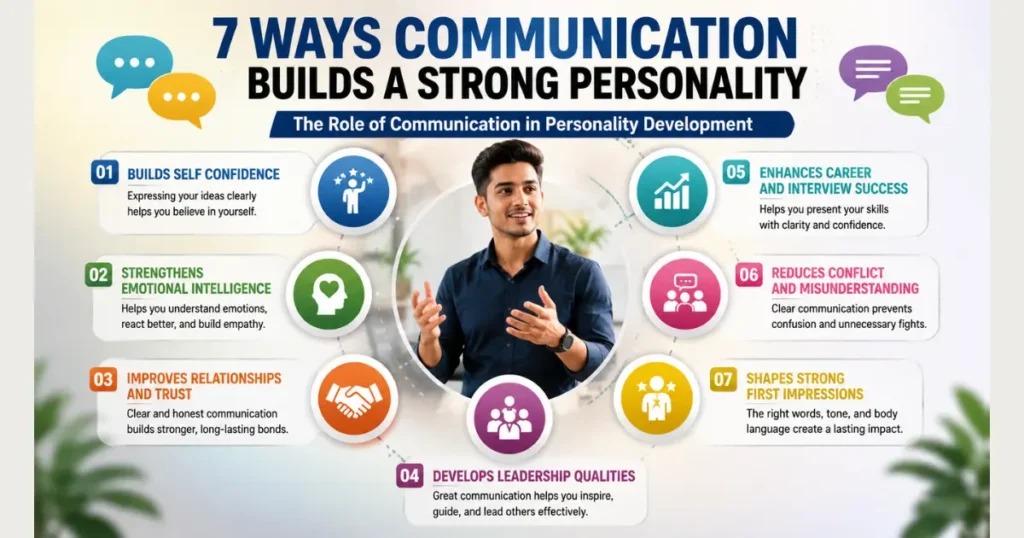
1. Builds Self-Confidence and Self-Esteem
Every time you express an idea clearly and someone understands you, it reinforces a small sense of achievement. Over time, these small wins stack up into genuine self-confidence.
Ramesh, a marketing executive I once worked with through a personality development workshop, avoided speaking in team meetings for over a year. Once he started practicing structured, short responses instead of long, unclear ones, his confidence visibly shifted within a single quarter. His personality did not change. His communication did, and confidence followed.
If low confidence is holding you back in conversations, our guides on how to boost self-confidence with expert tips and how to build self-esteem walk through the exact steps to build it from the ground up.
2. Strengthens Emotional Intelligence
Good communicators read tone, body language, and unspoken emotions, not just words. This awareness is a core part of emotional intelligence, which shapes how you manage your own reactions and respond to others with empathy.
People with high emotional intelligence rarely react impulsively. They pause, interpret the full message, and respond in a way that keeps the relationship intact.
3. Improves Relationships and Trust
Clear, honest communication removes the guesswork from relationships. When people know exactly where they stand with you, trust builds faster.
Psychologist Carl Rogers, known for his work on genuine human connection, once noted that real communication happens only when people feel heard without judgment. That single idea, being heard without judgment, is often the difference between a shallow acquaintance and a deep, lasting relationship.
4. Develops Leadership Qualities
Leaders are rarely the loudest people in the room. They are usually the clearest. The ability to explain a vision simply, listen to team concerns, and give direct feedback is what separates a manager from a true leader.
This is one of the clearest examples of the role of communication in personality development at work. Our detailed guides on how personality development can enhance leadership quality and 13 leadership qualities of a good leader go deeper into building this skill step by step.
Personality development programs across corporate India consistently list communication as the number one trait employers look for in future leaders.
5. Enhances Career and Interview Success
Recruiters do not just hire skills on paper. They hire how you present those skills. A candidate who can explain their experience with clarity and confidence often beats a more qualified candidate who cannot articulate their value.
If you want a focused breakdown of this, our guide on interview skills in personality development covers exactly how to prepare for that moment.
Recent workforce data backs this up. According to a 2026 industry report on soft skills, 93% of employers now confirm that soft skills like communication are essential to their hiring decisions, often weighed as heavily as technical qualifications.
6. Reduces Conflict and Misunderstanding
Most conflicts do not start from disagreement. They start from miscommunication. A vague message, a missed tone, or an assumption left unchecked can turn a small issue into a lasting rift.
People with strong communication skills tend to clarify before reacting. That one habit alone prevents a large share of everyday conflict, at home and at work.
7. Shapes First Impressions
Research consistently shows that people form an impression of you within the first few seconds of interaction, long before you finish a sentence. Your tone, posture, and word choice do most of that work.
A calm, clear opening line can shape how an entire conversation, or even a relationship, unfolds from that point forward.
7 C’s of Communication and Personality Development
Business communication experts have long used the 7 C’s framework to judge message quality. Applied to the role of communication in personality development, each C becomes a personal habit, not just a writing rule.
| The 7 C | What It Means | Personality Development Application |
|---|---|---|
| Clear | Message has one obvious meaning | Reduces confusion, builds trust |
| Concise | No unnecessary words | Signals confidence and respect for others’ time |
| Concrete | Backed by facts or examples | Makes you sound credible and prepared |
| Correct | Free from factual or grammatical errors | Builds professional credibility |
| Coherent | Logically connected ideas | Reflects a clear, organized mind |
| Complete | Includes all necessary information | Prevents follow-up confusion |
| Courteous | Respectful and considerate in tone | Builds warmth and likability |
Practicing even three of these consistently, clear, concise, and courteous, will noticeably change how people respond to you within a few weeks.
How to Improve Communication for Better Personality Development
- Practice active listening. Put away distractions, maintain eye contact, and resist the urge to plan your reply while the other person is still speaking.
- Work on your body language. Stand tall, uncross your arms, and match your facial expressions to your words. Nonverbal cues often speak louder than the words themselves.
- Build vocabulary through reading. Reading widely, even fifteen minutes a day, gives you the words you need to express complex thoughts simply.
- Practice speaking out loud. Record yourself explaining a topic for two minutes. Play it back. You will notice filler words and unclear points almost immediately.
- Ask for honest feedback. A mentor, colleague, or friend can point out blind spots you cannot see in yourself.
- Start small. Speak up once in every meeting, even briefly. Confidence in communication builds through repetition, not overnight effort.
Try the two-minute recording exercise for one full week. Most people are surprised at how much clearer their speech becomes by day seven.
Role of Communication in Personality Development for Students
For students, communication is often the first personality skill tested in real life, during class discussions, group projects, and campus interviews.
Students who practice public speaking, group discussions, and structured writing early tend to carry that confidence directly into placement interviews and early career roles. A student who can explain a concept clearly in class is quietly building the same skill that will later help them lead a team meeting.
According to the World Economic Forum’s Future of Jobs Report, communication remains one of the core skills employers expect from every graduate entering the workforce, regardless of their technical field.
If you are a student looking to build this early, small daily habits like reading aloud, joining a debate club, or simply asking one question in every class can start the shift.
Conclusion
The role of communication in personality development is not a small piece of the puzzle. It is often the piece that makes every other trait visible to the world. You can be confident, empathetic, and capable, but without clear communication, none of that reaches the people around you.
For a complete roadmap of every skill covered in this guide and more, explore our full personality development guide.
Start with one habit from this guide today. Practice active listening in your next conversation, or record yourself speaking for two minutes. Small, consistent changes in how you communicate will reshape how the world sees your personality, often faster than you expect.
Which of these seven ways do you think has shaped your own personality the most? Think about it during your next conversation, and notice the difference it makes.
FAQs
1. What is the role of communication in personality development?
Communication acts as the bridge that carries your inner confidence, values, and emotional intelligence into how others perceive you. It shapes trust, first impressions, and relationships, making it one of the most important building blocks of personality.
2. What are the main roles of communication in personality development?
The main roles include building self-confidence, strengthening emotional intelligence, improving relationships, developing leadership qualities, supporting career growth, reducing conflict, and shaping first impressions.
3. Explain the role of communication in personality development in simple words.
In simple words, how you speak, listen, and express yourself directly affects how confident, trustworthy, and likable people find you. Better communication almost always leads to a stronger, more influential personality over time.
4. Why is communication important in personality development for students?
For students, communication shapes academic performance, interview success, and early career confidence. It is often the first personality skill that gets tested outside the home, in classrooms, group projects, and placement interviews.
5. Can personality development happen without improving communication?
Personality development is possible in areas like self-awareness or emotional control without touching communication directly. However, real, visible growth that others can see and respond to almost always requires stronger communication skills.

Ayanshi is the founder of PersonaGuru.in, a blog focused on personality development, career, relationships, and mental well-being. With over 3 years of writing experience, she turns psychology and everyday experiences into practical, easy-to-understand advice for real life.