
Last updated on September 13th, 2026 at 12:06 pm
Kabir was asked to submit a report after his college personality development workshop. He had plenty to say about the three-day session, but when he sat down to write, the words came out jumbled. His teacher returned the draft with one comment: organise your thoughts first, then write.
That single piece of feedback changed how Kabir approached every report after that. It also taught him something bigger. Report writing skills in personality development are not just an academic requirement. They are a direct reflection of how clearly a person thinks.
This guide explains what report writing skills in personality development actually mean, why they matter, and how you can build them step by step, along with a ready sample structure if you need to write a report on a personality development topic.
Key Takeaways
- Report writing skills in personality development combine clarity of thought with structured communication.
- A report is only as strong as the thinking behind it, not just the vocabulary used.
- The 5 C’s- clear, concise, correct, complete, and courteous- cover almost every quality a good report needs.
- Reports come in different types, and knowing which one to use matters as much as writing it well.
- Practising with a simple outline before writing solves most common report writing mistakes.
What Are Report Writing Skills in Personality Development?
Report writing is the ability to organise facts, observations, or findings into a structured document that another person can read and understand quickly. It is one of the clearest ways written communication shows up in daily life, at school, in college, and later at work.
In personality development, report writing skills go beyond grammar and formatting. They train a person to think logically, stay objective, and present ideas without confusion. This connects closely with the role of communication in personality development, since both skills depend on organising your thoughts before you speak or write.
A well-written report tells the reader three things quickly: what happened, why it matters, and what should happen next.
Importance of Report Writing Skills in Everyday Life
The importance of report writing skills goes well beyond passing an exam or submitting an assignment.
- They build clarity of thought. You cannot write a clear report about a confused idea. Writing forces you to organise your thinking first.
- They strengthen discipline. Following a structure- introduction, body, and conclusion- builds the same discipline that shows up in other areas of personality.
- They improve objectivity. A good report separates facts from opinions, which trains emotional control and balanced judgement.
- They boost professional credibility. According to the National Association of Colleges and Employers’ Job Outlook 2025 survey, written communication ranks among the top three skills employers look for in new hires, right alongside problem-solving and teamwork.
- They save time for everyone. A well-structured report gets read and understood faster, which reflects respect for the reader’s time.
As the writer William Zinsser once put it, “writing is thinking on paper.” A report is simply that thinking made visible and shared with someone else.
Benefits of Report Writing
- Sharper analytical thinking.
- Stronger academic and career performance.
- Better first impressions with teachers, professors, and managers.
- Improved ability to explain complex ideas simply.
- Higher confidence during presentations and interviews, a skill also covered in top interview skills in personality development.
7 Key Elements of Good Report Writing
Every strong report, whether it is two pages or twenty, is built from the same core elements of report writing.
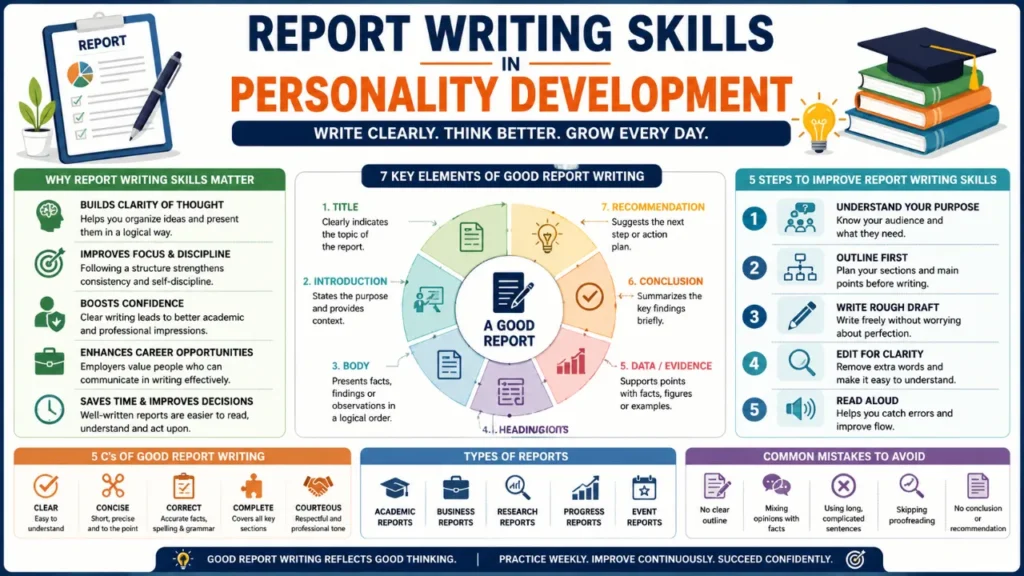
- Title – tells the reader exactly what the report covers.
- Introduction – states the purpose and context in two or three lines.
- Body – presents facts, findings, or observations in a logical order.
- Headings – break the report into scannable sections.
- Data or evidence – supports every major claim with a fact or example.
- Conclusion – summarises the key finding without introducing new information.
- Recommendation – suggests a clear next step, when relevant.
Missing even one of these elements is usually why a report feels incomplete, even if the writing itself is grammatically correct.
5 Steps to Improve Your Report Writing Skills
How to improve report writing skills does not require a writing course. It requires consistent practice with the right method.
- Understand your purpose. Before writing a single word, ask who will read this and what they need to know.
- Build an outline first. List your sections and main points before drafting a single paragraph.
- Write a rough draft quickly. Do not edit while writing. Get the ideas down first.
- Edit for clarity, not decoration. Cut unnecessary words. Replace vague phrases with specific ones.
- Read it aloud once. If a sentence sounds confusing when spoken, it will read as confusing too.
Naina, a second-year student, used to spend hours staring at a blank page before every report. Once she started writing a rough outline first, her drafting time dropped from three hours to under one.
5 Qualities and Rules of Good Report Writing
A good report is judged less by fancy vocabulary and more by whether it respects the reader’s time and attention.
| Quality | What It Means |
|---|---|
| Clarity | Every sentence has one clear meaning |
| Accuracy | Facts and figures are verified before writing |
| Objectivity | Opinions are kept separate from facts |
| Structure | Information flows in a logical order |
| Brevity | Every sentence earns its place in the report |
5 C’s of Good Report Writing
A simple way to remember report writing quality is through the 5 C’s.
- Clear – easy to understand on the first read.
- Concise – no unnecessary words or repetition.
- Correct – accurate facts, spelling, and grammar.
- Complete – covers every section the reader needs.
- Courteous – maintains a respectful, professional tone.
Types of Reports You Should Know
Reports are not one size fits all. Knowing which type to use is part of the skill itself.
- Academic reports – written for school or college assignments, usually following a fixed format.
- Business reports – used at work to share findings, updates, or recommendations.
- Research reports – present data and analysis from a study or survey.
- Progress reports – track work completed against a plan or deadline.
- Event reports – summarise what happened at a workshop, seminar, or program.
Most reports, regardless of type, follow the same three basic parts: an introduction, a body, and a conclusion.
How Report Writing Skills Build Broader Personality Traits
Report writing rarely stays confined to paper. The habits it builds tend to show up elsewhere in a person’s personality.
Someone who writes structured reports often becomes a more structured speaker too. The same logical flow that organises a report also organises a conversation, a presentation, or an answer during an interview. This is one reason motivation in personality development and consistent writing practice tend to reinforce each other. Small, repeated wins in one area build confidence to try harder things in another.
Aryan, who struggled with public speaking, noticed his confidence improve once he got comfortable writing structured reports for his internship. Organising his thoughts on paper first made it easier to organise them out loud later.
How to Write a Report on Personality Development
Many students search for this exact task: a report on personality development workshop, seminar, or program they attended. Here is a simple structure to follow.
Sample Structure for a Personality Development Workshop Report
- Title: Report on [Workshop Name], organised by [institution or department].
- Introduction: Mention the date, venue, and purpose of the workshop in two lines.
- Objective: State what the workshop aimed to achieve, such as improving communication or confidence.
- Body: Describe the key sessions, activities, or speakers in the order they happened.
- Learning outcome: Explain what participants gained, using specific examples where possible.
- Conclusion: Summarise the overall impact of the workshop in two or three lines.
Kavya used this exact structure for her college’s personality development seminar report and finished it in under thirty minutes, compared to the two hours it usually took her before she had a template to follow.
Mini Sample Report
Here is a short example you can adapt for your own workshop or seminar report.
Report on Personality Development Workshop
A two day personality development workshop was organised by the college’s training cell on 14 and 15 January. The session focused on communication skills, body language, and confidence building.
The first day covered verbal and non verbal communication, with practical exercises on tone, eye contact, and posture. The trainer used role play activities so participants could practise real conversations instead of just listening to theory.
The second day focused on group discussions and mock interviews. Each participant received individual feedback, which most students found more useful than the group sessions.
Overall, the workshop helped participants become more aware of their communication gaps. Many students reported feeling noticeably more confident during the closing group activity compared to the opening session.
Recommendation: Future workshops should include a short follow up session after two weeks to check whether participants are applying what they learned.
Report Writing vs Essay Writing
Students often confuse the two formats. Here is a quick side-by-side comparison.
| Aspect | Report | Essay |
|---|---|---|
| Structure | Uses headings and sections | Flows as continuous paragraphs |
| Focus | Facts, findings, and data | Personal opinion and argument |
| Tone | Objective and neutral | Can be persuasive or reflective |
| Purpose | Informs a decision or records an event | Explores or argues an idea |
| Length | Often shorter and more scannable | Usually longer, uninterrupted prose |
Common Mistakes in Report Writing
- Starting to write without a clear outline.
- Mixing opinions with facts.
- Using long, complicated sentences instead of short, clear ones.
- Skipping the proofreading step entirely.
- Forgetting to include a conclusion or recommendation.
- Writing everything in one long paragraph instead of using headings.
Most of these mistakes disappear once you commit to planning before writing, which is exactly why a simple outline habit matters so much.
Why Report Writing Skills Matter for Students
In Indian schools and colleges, report writing appears constantly, from science project reports to internship summaries to personality development workshop write-ups. Building this skill early pays off well beyond the classroom.
Research from workplace communication studies suggests employees now spend close to 19 hours a week on writing-related tasks, according to a recent analysis of workplace communication statistics. Students who build strong report writing skills in personality development early are simply better prepared for how much of professional life depends on writing well, a pattern also visible in how self-career perception shapes long-term success.
Conclusion
Report writing skills in personality development are not a dry academic requirement. They train the mind to think clearly, communicate honestly, and respect the reader’s time. Every structured report you write is also a small exercise in structured thinking.
Start with one habit this week. Outline before you write. That single change, repeated often enough, builds both a better report and a more organised personality. To connect this skill with the wider picture, our complete guide to personality development ties every trait covered here into one structured path.
The best way to improve report writing is to write one report every week. Consistent practice builds both writing ability and personality.
Download the free Report Writing Skills Self-Check Worksheet to practise the 5 C’s checklist, a fill-in-the-blank report template, and a 7-day practice plan.
FAQs
1. What is the most important thing in report writing?
Clarity is the most important quality in report writing. A report that is accurate but confusing fails at its basic purpose, which is helping the reader understand something quickly.
2. What are five personal skills report writing helps build?
Report writing helps build clarity of thought, discipline, objectivity, time management, and confident communication.
3. Can report writing really improve personality development?
Yes. Report writing trains structured thinking and disciplined communication, both of which are core parts of personality development, not separate from it.
4. How is a report different from an essay?
A report is structured with headings and focuses on facts and findings, while an essay flows as continuous prose and often includes more personal argument or opinion.

Ayanshi is the founder of PersonaGuru.in, a blog focused on personality development, career, relationships, and mental well-being. With over 3 years of writing experience, she turns psychology and everyday experiences into practical, easy-to-understand advice for real life.