
Last updated on October 18th, 2026 at 06:58 am
Personality development is the lifelong process of improving how you think, feel, behave, and connect with others. It covers six areas: emotional, social, intellectual, moral, professional, and physical growth. You cannot change your basic temperament. You can build habits, self-awareness, and skills that change how people experience you.
Rohan was the smartest person in his team. Everyone knew it. His manager knew it too. But when a promotion opened up, it went to a colleague who knew half of what Rohan knew.
Rohan asked his manager why. The answer stayed with him. “You have the knowledge. He has the presence.”
That one sentence explains why personality development matters more than most people realize. Skills get you noticed. Personality decides what happens after that.
This guide breaks down what personality development actually means, its types, why it matters right now, and exactly how to work on it. No jargon. No vague advice. Just a clear map you can follow.
Key Takeaways
- Personality development is a lifelong process, not a one-time fix. It never really stops.
- It includes several connected areas: emotional, social, intellectual, moral, professional, and physical development.
- Research from Harvard’s Study of Adult Development shows that relationship quality and emotional stability predict long-term well-being better than income or intelligence.
- The World Economic Forum’s Future of Jobs Report 2025 places analytical thinking, resilience, and leadership among the top skills employers want, ahead of many technical skills.
- You do not need a personality transplant. Small, repeated habits change how people experience you within weeks.
What Is Personality Development?
Personality development is the process of building and refining how you think, feel, behave, and connect with others over time.
It is not about becoming a different person. It is about becoming a clearer version of the one you already are.
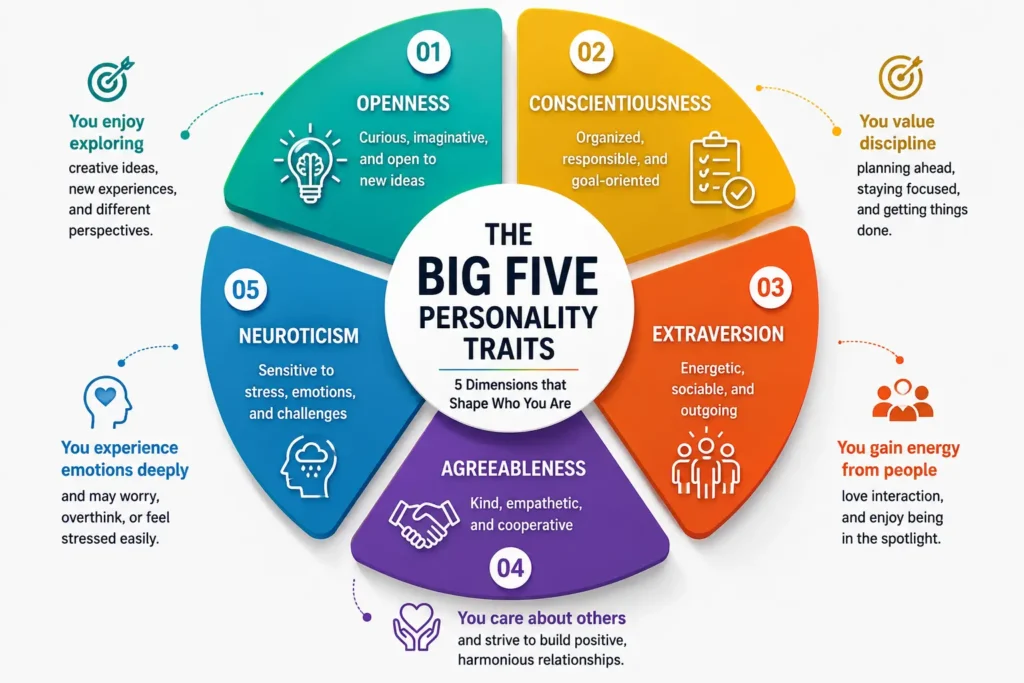
Psychologists describe personality using five broad traits that stay fairly stable across situations, known together as the Big Five.
| Trait | What It Means |
|---|---|
| Openness | Curiosity, creativity, and willingness to try new ideas |
| Conscientiousness | Discipline, organisation, and follow-through |
| Extraversion | Sociability and energy drawn from other people |
| Agreeableness | Kindness, empathy, and ease of cooperation |
| Neuroticism | Emotional stability versus sensitivity to stress |
Other models, like MBTI and the Enneagram, sort people into types instead of traits.
Personality development works on top of these traits. You cannot fully rewrite your baseline temperament, but you can build the skills, habits, and self-awareness that sit above it.
Think of it like this. Your personality traits are the soil. Personality development is what you choose to grow in it.
Types of Personality Development
Personality development is not just one skill. It covers six connected areas, and most people are stronger in some than others.
- Emotional development: Managing your reactions, handling stress, and staying steady under pressure.
- Social development: Building relationships, reading social cues, and communicating with different kinds of people.
- Intellectual development: Curiosity, critical thinking, and the habit of continuous learning.
- Moral development: Values, integrity, and doing the right thing when no one is watching.
- Professional development: Workplace behaviour, leadership, and career-related skills like negotiation and presentation— see our full career and workplace growth guide.
- Physical development: Posture, grooming, and body language, the visible layer that reflects everything above it.
Real growth usually needs work across more than one of these areas. Someone can be intellectually sharp and still struggle socially, or emotionally strong and still need professional polish.
Why Personality Development Matters in 2026
A few years ago, personality development was seen as something you needed only for interviews or public speaking. That thinking is outdated now.
Here is why it matters more today than it did a decade ago.
Soft skills now outrank many technical skills. According to the World Economic Forum’s Future of Jobs Report 2025, employers rank analytical thinking, resilience, flexibility, leadership, and social influence among the most important skills for the next five years, often above narrow technical ability. Machines can process data. They still cannot read a room, calm down an angry client, or lead a team through uncertainty.
Relationships shape long-term health, not just happiness. The Harvard Study of Adult Development, the longest-running study on adult life, has tracked hundreds of people for over 80 years. Its clearest finding is that the quality of a person’s relationships predicts long-term health and happiness more accurately than wealth, fame, or even genetics. Personality development, communication, empathy, and emotional regulation are what build those relationships in the first place.
Remote and hybrid work reward presence over proximity. When you are not in the same room every day, how you communicate becomes your entire impression. Tone, clarity, and confidence in a five-minute call now carry the weight that a whole day in the office used to carry.
As author and psychologist Daniel Goleman once put it, “In a very real sense we have two minds, one that thinks and one that feels.” Personality development is what teaches these two minds to work together instead of against each other.
What Shapes Your Personality?
Personality is not built from one single source. It comes from a mix of factors working together.
| Factor | What It Means | Can You Change It? |
|---|---|---|
| Genetics and temperament | Natural tendencies you are born with, like being more reserved or more outgoing | Mostly fixed, but you can manage its expression |
| Childhood environment | Parenting style, early relationships, and emotional safety at home | Cannot be changed, but its effects can be understood and worked through |
| Culture and upbringing | Values, language, and social norms absorbed while growing up | Partially, through exposure and conscious reflection |
| Life experiences | Setbacks, achievements, relationships, and turning points | Ongoing, and often the biggest driver of change |
| Conscious effort | Habits, learning, feedback, and self-reflection you choose to build | Fully within your control |
The first two rows explain where you started. The last three explain where you can still go. Personality development focuses almost entirely on those last three.
Personality vs Character vs Behaviour: What Is the Difference?
People use these three words as if they mean the same thing. They do not.
| Term | What It Actually Means | Example |
|---|---|---|
| Personality | Your overall pattern of thinking, feeling, and behaving, fairly stable over time | Being naturally outgoing and talkative |
| Character | Your moral compass, honesty, integrity, and values | Returning extra change a shopkeeper gave you by mistake |
| Behaviour | What you actually do in a specific moment, which can shift with the situation | Staying quiet in one meeting despite being an outgoing person |
A person can have a strong personality and weak character, or a quiet personality and strong character. Personality development aims to strengthen all three together, not just the loudest one.
Core Theories and Tools of Personality Development
You do not need a psychology degree to use these tools. Each one below is a practical lens, not just theory.
Self-Awareness and the Johari Window
You cannot fix what you cannot see. The Johari Window is a simple framework that maps what you know about yourself against what others know about you, revealing blind spots most people never notice on their own.
Priya, a marketing executive, once asked her closest colleagues for honest feedback. Three of them mentioned the same thing: she interrupted people mid-sentence when excited. She had no idea. Within a month of noticing it, her one-on-one meetings became noticeably smoother.
For the full framework, exercises, and a downloadable worksheet, read our complete guide to the Johari Window in personality development.
To build this habit, read how to improve self-awareness.
Want to see how others see you? Take the likable person test.
Locus of Control: Who Is Driving Your Life?
Some people believe their choices shape their outcomes. Others believe outcomes are mostly luck or circumstance. Psychologists call this your locus of control, and it is one of the strongest predictors of resilience.
People with a stronger internal locus of control tend to recover from setbacks faster, simply because they look for what they can do next instead of who or what to blame.
Read the full breakdown, including the healthy middle ground between the two extremes, in our guide on Locus of Control in personality development.
SWOT Analysis for Personal Growth
Businesses use SWOT analysis to plan strategy. The same four boxes, strengths, weaknesses, opportunities, and threats, work just as well when pointed at yourself instead of a company.
It forces you to name your strengths honestly instead of guessing, and to spot outside opportunities you might otherwise miss.
See our step-by-step guide on running a personal SWOT analysis.
Social Intelligence: Reading the Room
Social intelligence is the skill of understanding people and situations quickly enough to respond well, not just correctly. It is different from being book-smart. You can know every fact in the room and still misread the tension in it.
Learn the four pillars of this skill in our guide to social intelligence in personality development.
Good listening is part of this skill. See how to practice active listening.
Group Discussions: Practice Ground for Real Life
Group discussions are not just a college placement round. They are one of the fastest ways to practice thinking on your feet, listening under pressure, and speaking up without dominating.
Karan used to freeze in every group round during his campus placements. He knew the answers. He just never found the right moment to jump in. After a few weeks of practice, he stopped waiting for silence and started entering with one clear point at a time. He cleared his next three interviews.
Our full guide covers the exact process: group discussions in personality development.
Voice Modulation: How You Say It Matters
Two people can say the same sentence. One sounds confident. The other sounds bored or nervous. The difference is rarely the words. It is pace, pitch, and pause.
Voice modulation is trainable, and it is one of the fastest personality upgrades available because you can practice it alone, in your own room, with your own phone recording you.
Explore practical exercises in our guide to voice modulation for confident speaking.
Emotional Intelligence and Aggression vs Assertiveness
Emotional intelligence is your ability to notice emotions in yourself and others and respond rather than react. One of its most practical applications is knowing the line between aggression and assertiveness.
Aggression attacks the other person. Assertiveness defends your own position without attacking anyone. Most people who get labeled “too aggressive” are actually just being assertive for the first time in their life, and it feels unfamiliar to people around them.
Read the full comparison of aggression vs assertiveness.
Go deeper with the factors affecting assertiveness and how to speak up in meetings.
Negotiation Skills for Everyday Life
Negotiation is not just for salary discussions. You negotiate with your landlord, your partner, your child, and your own procrastination almost every week.
Good negotiators do not win by being the loudest voice in the room. They win by preparing better than the other side and listening for what the other person actually needs.
See seven practical, real-world techniques in our guide on how to improve your negotiation skills.
Childhood Experiences and Adult Personality
A lot of adult behavior makes more sense once you trace it back to childhood. The child who was praised only for achievements often grows into an adult who struggles to rest without guilt. The child who was never allowed to express anger often grows into an adult who avoids all conflict, even the healthy kind.
Understanding this connection is not about blaming your past. It is about finally understanding your present.
Read more about how childhood experiences shape personality development.
Meditation and Mental Clarity
You cannot build a calm, confident personality on top of a constantly reactive mind. Meditation is one of the few tools that works directly on that reactivity, not just the behavior sitting on top of it.
It does not need to be an hour of silence on a mountain. Ten focused minutes a day change how you respond to a stressful email by evening.
Learn a simple, realistic routine for how meditation improves personality development.
Goal Setting and Self-Dependence
Personality development without direction turns into a hobby. Goal setting gives it a destination. Self-dependence gives you the discipline to walk there without needing someone else to push you every single day.
Both are trainable habits, not personality traits you either have or do not.
Read our practical frameworks for goal setting for success and becoming self-dependent.
If you keep putting tasks off, read how to stop procrastinating.
How to Start Your Personality Development Journey
You do not need to work on all of this at once. Pick one area, build one habit, and let it compound.
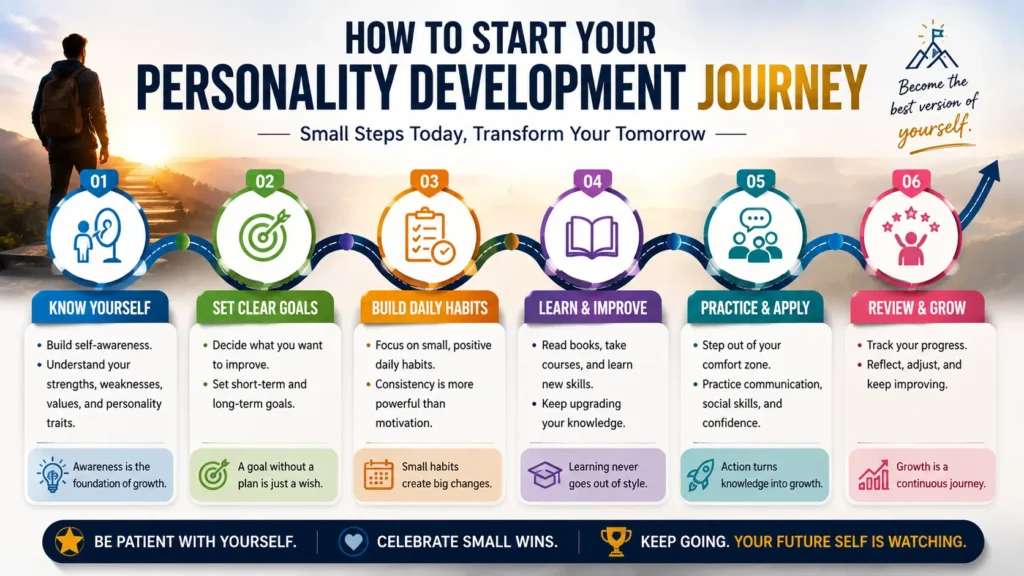
- Ask for one honest piece of feedback this week. Not general feedback. One specific thing you do that you might not notice.
- Record yourself speaking for two minutes. Most people are surprised by their own filler words and pace once they hear it back.
- Name one thing you can control in a situation that frustrated you recently. This trains your locus of control without needing a course or a book.
- Sit in silence for five minutes, once a day, for a week. No phone. Just notice what your mind does when it is not distracted.
- Say one honest “no” this week, to a request you would normally accept out of habit. Notice how it feels to be assertive instead of agreeable. Need help with the wording? See how to say no to extra work.
- Write down one goal with a deadline, even a small one. Direction beats motivation almost every time. Want it written down? Use our personal development plan template.
Small, consistent steps like these build real change. Big, one-time efforts rarely do.
Personality Development for Students vs Working Professionals
The core ideas stay the same. Where you apply them changes.
| Area | Students | Working Professionals |
|---|---|---|
| Communication | Class participation, group projects, campus interviews | Client calls, team meetings, cross-department coordination |
| Confidence | Speaking up in a lecture hall or seminar | Presenting ideas to senior leadership |
| Emotional intelligence | Handling peer pressure and comparison | Managing office politics and difficult feedback |
| Goal setting | Academic targets, skill-building for placements | Career milestones, promotions, skill upgrades |
If you are a student, our dedicated guide on personality development for students goes deeper into age-specific strategies.
Common Mistakes People Make
- Copying someone else’s personality instead of refining their own. What works for a confident extrovert may not work for a thoughtful introvert, and it does not need to.
- Treating it as a one-week fix before an interview. Real change needs weeks of repetition, not one weekend of effort.
- Focusing only on how they look, not how they think. Grooming and body language matter, but they sit on top of confidence and clarity, not instead of them.
- Ignoring emotional patterns from childhood. Skipping this step often means fixing the surface while the root cause stays untouched.
- Waiting to feel ready before starting. Confidence usually follows action. It rarely arrives first.
How Long Does Personality Development Take?
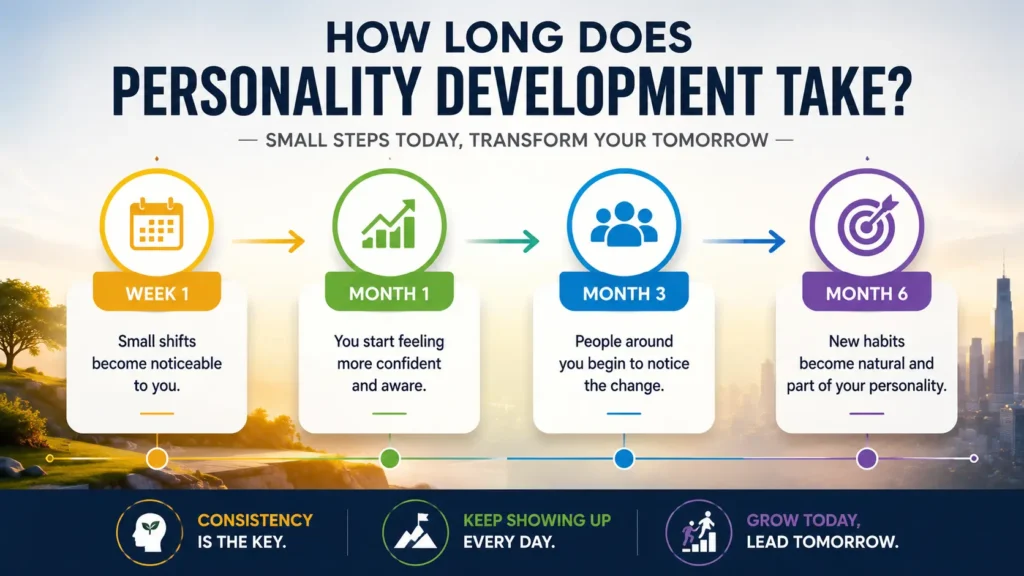
There is no single number, because personality development never fully stops. That said, most people notice visible change within a specific timeline when they stay consistent:
- 2 to 4 weeks: Small shifts become noticeable to you, like catching yourself before interrupting someone.
- 2 to 3 months: People around you start noticing the change, often before you fully believe it yourself.
- 6 months and beyond: New habits stop feeling like effort and start feeling like who you are.
The honest answer is that it takes as long as you stay consistent, and it keeps evolving as your life circumstances change.
Final Thoughts
Rohan’s story from the start of this guide did not end with him quitting his job. He asked his manager for specific feedback, started practicing how he communicated in meetings, and worked on staying calm under pressure instead of getting defensive. Eight months later, he got the next promotion that opened up.
Nothing about his knowledge changed. His presence did.
That is what personality development really offers. Not a new personality. A clearer, steadier version of the one you already have.
Not sure where to begin? Start with the roadmap table above and improve one skill every week.
FAQs
1. Can personality really change?
Yes. Core traits stay fairly stable, but how you express them, your habits, communication style, and emotional responses can change significantly through conscious effort and practice.
2. What is the best age to start personality development?
There is no fixed age. Children benefit from early habit-building, students benefit from structured practice like group discussions, and adults benefit from targeted work on communication and emotional intelligence. The best age to start is now, whatever age that happens to be.
3. Is personality development only about confidence?
No. Confidence is one visible outcome, not the whole goal. Personality development also covers self-awareness, emotional regulation, communication, and how you handle relationships and setbacks.
4. Can introverts have a strong personality?
Yes. A strong personality is not the same as being loud or outgoing. Many of the most effective leaders and communicators are introverts who lead through clarity, preparation, and calm presence rather than volume.

Ayanshi is the founder of PersonaGuru.in, a blog focused on personality development, career, relationships, and mental well-being. With over 3 years of writing experience, she turns psychology and everyday experiences into practical, easy-to-understand advice for real life.