

Last updated on September 25th, 2026 at 10:14 am
If you are looking for practical ways to improve your negotiation skills, you are not alone. Most of us were never taught how to negotiate. We picked up habits by accident, some good, some not so good.
John F. Kennedy once said, “Let us never negotiate out of fear. But let us never fear to negotiate.” That line still describes how most people feel about negotiation today. We treat it like a fight to survive, not a skill to build.
But negotiation is not only for boardrooms. It happens when you ask your manager for extra time on a deadline. It happens when you and your partner decide whose parents to visit at this festival. It happens when your child asks for ten more minutes of screen time and somehow wins.
Negotiation skills are a core part of personality development. They mix communication, emotional control, and self-worth. A person with strong negotiation skills knows their value. They can express it without anger or apology.
This article covers 7 practical ways to improve your negotiation skills, the personality traits behind good negotiation, and real examples you can use today.
This is part of a bigger picture — read our complete Personality Development to understand how self-awareness, communication, and confidence all connect.
Key Takeaways
- Negotiation skills are not about winning. They are about reaching a deal both sides can accept.
- Emotional intelligence matters more than aggression in negotiation.
- More than half of people never negotiate their first salary. Most of them regret it later.
- Preparation and listening matter more than clever tricks.
- You can practice negotiation skills in small, daily moments before you need them in a big one.
- A free negotiation prep worksheet is included at the end of this article.
What Are Negotiation Skills?
Negotiation skills help you reach an agreement when your needs and someone else’s needs do not match right away.
That sounds formal. But the skill itself is simple. State what you need. Understand what the other person needs. Find a middle path where both sides feel okay.
It Is Not About Winning
Many people avoid negotiation. They picture it as a fight. One side wins, the other side loses.
But research from the Harvard Program on Negotiation found something different. Conscientiousness, not dominance, predicts strong negotiation outcomes. Careful preparation beats aggression almost every time.
Once you drop the “fight” mindset, negotiation feels much less scary.
Why Negotiation Skills Matter in Personality Development
Negotiation skills in personality development go beyond getting a better deal. They shape how confident you feel in daily life.
Every time you negotiate well, you practice three things at once. You practice stating your needs clearly. You practice staying calm under pressure. And you practice respecting another person’s point of view while holding on to your own.
Over time, this builds a steadier, more assertive personality. People with strong negotiation skills are usually better at setting boundaries, handling conflict, and asking for what they deserve, whether that is at work, at home, or with friends.
This is why personality development experts often list negotiation as a core soft skill, right alongside communication and emotional intelligence.
Types of Negotiation Skills
Before you improve your negotiation skills, know what they actually include. Here is a simple breakdown.
| Skill | What It Looks Like |
|---|---|
| Active listening | Repeating back what the other person said |
| Emotional intelligence | Staying calm when things get tense |
| Clear communication | One direct sentence, not five vague ones |
| Persuasion | Backing your ask with a reason, not just a demand |
| Patience | Sitting with silence instead of rushing to fill it |
| Problem-solving | Offering a new idea when the first one fails |
Research by psychologist Maw Der Foo and team studied emotional intelligence in negotiation. They found emotionally intelligent negotiators created better outcomes for both sides, not just for themselves. The person who listens best usually gets the most out of the room. If you want to build this skill further, read about the different types of emotional intelligence and how to improve them.
Qualities of a Good Negotiator
Good negotiators are not always the loudest people in the room. In fact, some of the best negotiators are quiet, careful listeners. A few qualities show up again and again in people who negotiate well:
- Self-awareness. They know their own triggers and stay calm when pushed.
- Curiosity. They ask more questions than they answer.
- Flexibility. They can change their approach mid-conversation if something is not working.
- Patience. They do not rush to close the deal at any cost.
- Preparation. They walk in knowing their numbers, their limits, and their goals.
None of these qualities requires a dominant or extroverted personality. That is good news, because it means negotiation skills can be learned by anyone, regardless of natural temperament.
5 Steps of the Negotiation Process
Most successful negotiations, big or small, follow a similar pattern. Knowing these steps in advance makes any conversation feel less overwhelming.
- Prepare. Decide your goal and your walk-away point before the conversation starts.
- Open. Start with rapport, not numbers. Ask a question before making a statement.
- Explore. Listen for the other side’s real interests, not just their stated position.
- Bargain. Trade concessions slowly. Give something only when you get something in return.
- Close. Confirm the agreement clearly, in writing if possible, so both sides remember the same terms.
Skipping the first step, preparation, is the most common reason negotiations go badly. Skipping the last step, closing clearly, is the most common reason agreements fall apart later.
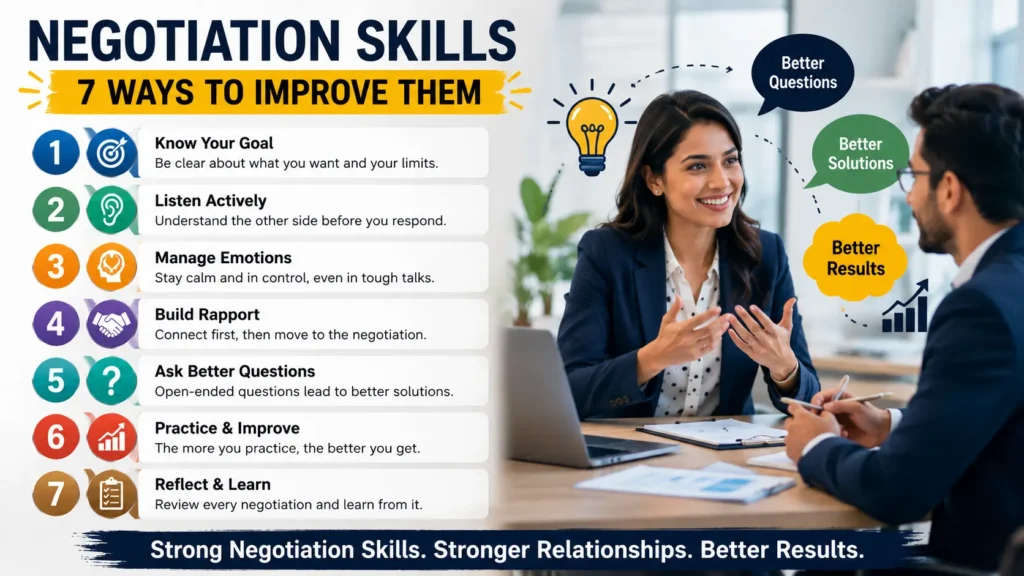
7 Ways to Improve Your Negotiation Skills
1. Know Your Goal First
Before any negotiation, decide on two things. What outcome would make you happy? And the point where you are willing to walk away.
Without a walk-away point, you negotiate from fear, not clarity. You end up agreeing to terms you regret later.
Real example: Rohan, a marketing executive in Pune, wanted a raise. He decided on his minimum acceptable hike before the meeting. When his manager offered less, he calmly said, “Let us revisit this in three months.” He did not panic or accept on the spot. Three months later, he got the number he wanted.
Why this works: A clear goal removes emotion from the decision. You are comparing an offer to a number you already chose, not reacting on the spot. This is closely tied to what makes a person assertive in the first place, since a clear goal is easier to hold onto with confidence.
2. Listen More, Talk Less
Strong negotiators talk less than you think. Every sentence the other person says gives you a clue about what they truly want. That is often different from what they first ask for.
William Ury, co-founder of the Harvard Negotiation Project, said it best: “Creativity is our biggest resource in negotiation.” Creativity comes from information. Information comes from listening.
Tip: Ask one open question before you make your first offer. Try, “What matters most to you here?” It often changes the whole conversation.
Real example: During a vendor contract renewal, Sneha, a procurement manager in Bengaluru, stopped pitching her price for the first ten minutes. Instead, she asked the vendor what was driving their cost increase. She learned it was a raw material shortage, not greed. That single insight helped her offer a longer contract instead of a higher price, which solved both sides’ real problem.
3. Control Your Emotions
Anxious or angry negotiators give in too early. Or they react badly and damage the deal.
Before a hard conversation, pause. Name what you feel. Nervous, annoyed, defensive, whatever it is. Naming an emotion weakens its grip on you.
Real example: Meera’s landlord in Mumbai raised her rent without warning. Instead of reacting in anger, she paused and said, “Help me understand the reason behind this increase.” That one calm line got her a smaller hike than was first proposed.
Why this works: A calm tone signals confidence, not weakness. It also keeps the other person from getting defensive in return.
4. Build Rapport First
People give better terms to people they trust. Spend the first few minutes on real connection, not tactics.
This does not mean fake friendliness. It means listening to the other side’s situation before you share yours.
Real example: Before asking for a raise, Arjun, a software engineer in Hyderabad, asked his manager about the team’s biggest challenges that quarter. Only after that did he bring up his own numbers. His manager felt heard first, and the conversation stayed cooperative instead of defensive.
5. Ask Open Questions
Closed questions get a yes or no. Open questions get you the reason behind the yes or no. That reason is where the real negotiation room lives.
Try asking:
- “What would make this easier for you?”
- “What is your biggest constraint here?”
- “How did you arrive at this number?”
These questions move the talk from fixed positions to real interests, and they often surface options neither side had considered before.
6. Practice Often
Negotiation is a physical skill, not just a mental one. You cannot read your way into confidence. You have to say the words out loud.
Start small. Negotiate the price at a local market. Ask a friend to role-play a salary talk with you. Every small win builds the muscle for bigger ones.
Real example: A 2025 Resume Genius survey found that only 45 percent of full-time workers negotiate their starting salary, yet 78 percent of those who negotiate get a better offer. The gap between those numbers comes from practice and confidence, not raw skill.
7. Reflect After Every Talk
After any negotiation, win or lose, take five minutes. Write down what worked and what did not. Where did you give in too fast? Which question changed the mood?
This habit turns every negotiation, even the small ones, into a lesson for the next one.
Free Download: Negotiation Prep Worksheet
Reading these tips is a good start, but writing your answers down before a real negotiation makes them stick.
Use this free one-page worksheet to prepare your goal, your walk-away point, and the questions you will ask before your next salary talk, rent discussion, or family decision.
Download the Negotiation Prep Worksheet (PDF)
Negotiation Skills Examples in Daily Life
At the Workplace
- Negotiating a deadline by offering a phased delivery, instead of a flat “no.”
- Asking a colleague to swap shifts by offering something back, not just a favour.
- Discussing a raise using specific achievements, not a general request for “more.”
- Setting workload boundaries professionally—for practical strategies on handling heavy workloads without damaging workplace relationships, see our guide on How to Say No to Extra Work.
Negotiation is just one part of a bigger picture. If you want to build overall workplace presence and leadership authority, our guide on Career & Workplace Growth is a useful next read.
In Personal Relationships
- Deciding house chores with a partner by discussing preferences, not assuming roles.
- Setting a family budget by listing shared priorities first, then dividing spending.
- Resolving a fight with a friend by asking what outcome they actually want.
For Students
- Negotiating an assignment extension by proposing a specific new date, not an open-ended delay.
- Asking parents for a later curfew by offering a compromise, like a check-in call.
- Splitting group project work fairly by discussing each member’s strengths first.
Common Mistakes That Hurt Your Negotiation Skills
- Talking too much early. You give away information before you learn what the other side needs.
- Treating the first offer as final. Most first offers have room built in.
- Rushing to fill the silence. A pause after an offer often works in your favour.
- Making it personal. Disagreeing with an idea is not the same as disliking the person.
- Skipping preparation. Walking in without a clear goal is the top reason negotiations fail.
Final Thoughts
Negotiation skills are not something you are born with. They are closer to a language you get better at with use. These 7 ways to improve your negotiation skills work because they focus on preparation and calm, not clever tricks.
Pick one situation this week- a price, a deadline, a plan with a friend- and treat it as practice, not a test. Use just one tip from this list: know your goal, listen more, or pause before you react, and notice the difference it makes.
Which of these seven tips will you try first? Download the free negotiation prep worksheet below, fill it in before your next important conversation, and see how much more confident you feel walking in prepared.
If you want to understand yourself better before your next big conversation, start with understanding your blind spots through the Johari Window, or read about how your locus of control shapes the way you handle setbacks.
FAQs on Negotiation Skills
1. Is negotiation a soft skill?
Yes, negotiation is a soft skill. It sits alongside communication and emotional intelligence because it depends on how well you read people and manage a conversation, not on technical or subject knowledge. Most employers list it as a top interpersonal skill for leadership roles.
2. Can negotiation skills be learned?
Yes, negotiation skills can absolutely be learned. While some personality traits, like conscientiousness, give certain people a natural edge, research consistently shows that structured practice, role-play, and honest reflection after each conversation improve negotiation outcomes for almost anyone, regardless of where they started.
3. What are good negotiation skills for a job interview?
The most useful negotiation skills for a job interview are active listening, clearly stating your value with specific examples, staying comfortable with silence after making a request, and asking thoughtful questions about the employer’s priorities before you discuss salary numbers.
4. How does personality affect negotiation?
Personality shapes your negotiation style rather than your final success. Agreeable people may need to prepare firmer boundaries in advance so they do not concede too quickly. In contrast, highly assertive people often get better results by slowing down and practising patience and active listening.
5. Are negotiation skills in personality development an important topic to learn?
Yes, negotiation skills in personality development are considered an important topic because negotiation touches nearly every part of daily life, from relationships to career growth, and improving them builds confidence, assertiveness, and better communication overall.

Ayanshi is the founder of PersonaGuru.in, a blog focused on personality development, career, relationships, and mental well-being. With over 3 years of writing experience, she turns psychology and everyday experiences into practical, easy-to-understand advice for real life.