

Last updated on September 13th, 2026 at 12:25 pm
Rohan used to sit quietly in every group discussion round during his college placements. He knew the answers. He just could not find the right moment to speak.
By his fourth mock session, something changed. He stopped waiting for a perfect gap and started jumping in with one clear point at a time. Three weeks later, he cleared his first real group discussion round.
That shift, from silent to confident, is not luck. It is exactly what group discussion in personality development is about. A group discussion is not just a hiring filter or a college exercise. It is one of the fastest ways to build real personality traits like confidence, listening, and leadership, all at once.
This guide covers what a group discussion actually is, how group discussion in personality development works, the process, the rules, real examples, and simple ways to get better at it starting this week.
This is part of a bigger picture — read our complete Personality Development Guide to understand how self-awareness, communication, and confidence all connect.
Key Takeaways
- A group discussion tests how you think, speak, and listen in front of others, not just what you know.
- Communication skills are the top skill employers look for in new hires, according to recent hiring research.
- Group discussion in personality development strengthens five core traits: confidence, listening, leadership, emotional intelligence, and decision-making.
- There are four common types of group discussion, and each one tests a slightly different skill.
- Most successful group discussions follow five clear steps, from topic introduction to conclusion.
- Small, consistent practice, even 10 minutes a day, changes how you perform far more than one big prep session.
What Is a Group Discussion?
A group discussion, often shortened to GD, is a structured conversation where a small group of people shares views on one topic. Understanding this basic setup is the first step toward group discussion in personality development. It is commonly used in college admissions, job interviews, and team meetings.
Unlike a debate, nobody is assigned a side to defend. Everyone brings their own perspective, and the goal is to build a shared understanding, not to win an argument.
In simple words, a group discussion checks how well you think on your feet and how well you work with other people while doing it.
What Is the Purpose of a Group Discussion?
The purpose of a group discussion goes beyond checking your knowledge of a topic. Recruiters and teachers use it to observe your natural behavior in a group setting, something a one-on-one interview cannot always show. This lines up with what NACE’s Job Outlook 2025 survey found more broadly: that employers increasingly hire for demonstrated skills over degrees or resumes alone.
How Group Discussion Helps in Personality Development
This is where group discussion in personality development becomes more than a placement exercise. Every round quietly trains five traits at once.
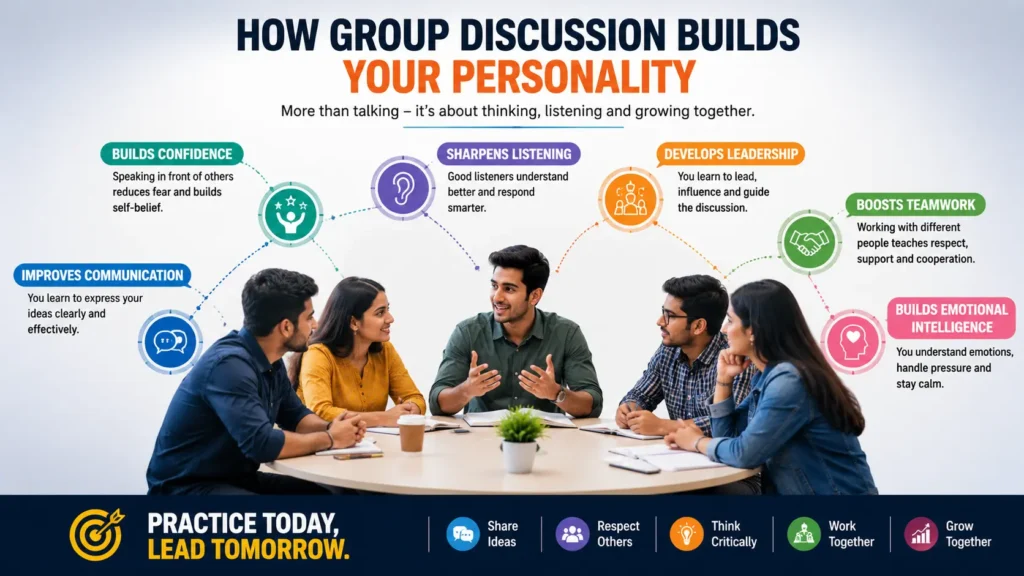
Self-Awareness
You notice your own patterns fast in a group discussion. Do you interrupt people? Do you freeze under pressure? A GD holds up a mirror in real time.
Emotional Intelligence
Reading the room, sensing when someone feels talked over, and adjusting your tone accordingly- all of this is emotional intelligence in action. Working on your emotional intelligence directly improves how you come across in a group discussion.
Confidence and Assertiveness
Speaking up in a group of strangers is uncomfortable at first. Every time you do it anyway, you build assertiveness without even trying to.
Decision-Making Under Pressure
A group discussion rarely gives you time to overthink. You learn to form an opinion quickly, defend it calmly, and adjust it when someone makes a fair point.
Types of Group Discussion
Most group discussions fall into four broad types, and each one plays a slightly different role in group discussion in personality development.
- Topic-based GD: a general subject like education, technology, or current affairs.
- Case-study GD: a real or hypothetical business situation the group must analyze and solve.
- Abstract GD: an open-ended phrase or idea, meant to test creative thinking.
- Structured GD: the moderator sets clear rules, like a fixed speaking order or time limit for each person.
Knowing the type in advance changes how you prepare. A case-study GD rewards logical structure, while an abstract GD rewards original thinking.
What Are the Different Roles in a Group Discussion?
Every group discussion naturally develops a few informal roles, even without anyone assigning them. Recognizing your natural role is a useful early step in group discussion in personality development.
| Role | What They Do |
|---|---|
| Initiator | Opens the discussion and sets the tone |
| Contributor | Adds relevant points and builds on others’ ideas |
| Summarizer | Pulls scattered points into a clear conclusion |
| Moderator | Keeps the group on topic and manages time |
| Silent Observer | Listens carefully, speaks only when it adds real value |
You do not need to fight for the initiator role every time. Evaluators often rate a strong summarizer just as highly as a strong initiator.
Characteristics of a Successful Group Discussion
A group discussion works well when a few things are true at once, and these same traits carry directly into group discussion in personality development.
- Every member gets a fair chance to speak.
- Points build on each other instead of repeating.
- Disagreements stay respectful, not personal.
- The group reaches some form of conclusion, even a partial one.
- Body language stays open, with eye contact and active listening.
The Process of Group Discussion: 5 Steps
Most structured group discussions follow the same five-step process. Learning this process is one of the most practical parts of group discussion in personality development.
- Topic introduction. The moderator announces the topic and gives the group a minute or two to think.
- Opening statements. One or two members open the discussion with their initial take.
- Open discussion. The group exchanges views, questions, and counterpoints.
- Building consensus. The group tries to find common ground or a shared direction.
- Conclusion. A summarizer wraps up the key points discussed.
Real-Life Examples of Group Discussion
These short stories show group discussion in personality development playing out in real settings, not just in theory.
Priya’s college admission GD. Priya was applying for a management program. Her group was given the topic “Should social media be regulated by the government?” She noticed the room splitting into two loud camps early on. Instead of picking a side immediately, she waited, then offered a middle point that pulled in ideas from both sides. The panel later told her that balancing the discussion, not winning it, was what stood out.
Arjun’s job interview GD. Arjun, applying for a sales role, was placed in a case-study GD about a company losing market share. Two candidates dominated the first five minutes. Arjun waited for a pause, then said, “Before we go further, can we agree on what is actually causing the drop, price or product?” That one question reset the entire discussion and got him noticed. A group discussion round like this is often the first of several interview skills that get tested on the same day, so what Arjun did here carried into the rest of his interview too.
A corporate team discussion. At a mid-sized firm, a product team was stuck deciding between two feature ideas. The quietest person in the room, who rarely spoke first, waited until both sides had made their case, then pointed out a customer complaint pattern nobody had mentioned. The team changed direction because of that one observation.
Rules of a Successful Group Discussion
Keep these rules in mind before your next group discussion. Following them consistently is what turns a single GD into a real group discussion in personality development progress.
- Do not interrupt someone mid-sentence.
- Listen actively, even when you disagree.
- Support your points with facts or examples, not just opinions.
- Respect other viewpoints, even the ones you plan to counter.
- Stay on topic, and gently bring the group back if it drifts.
- Maintain steady eye contact with the group, not just the moderator.
How Group Discussions Are Evaluated
This evaluation table is one of the clearest ways to see group discussion in personality development in action. Evaluators are not simply counting how much you speak. They are scoring specific traits.
| Skill | Why It Matters |
|---|---|
| Communication | Clear, structured ideas are easier to follow and remember |
| Leadership | Guiding the discussion without dominating it |
| Listening | Responding to what was actually said, not a rehearsed point |
| Confidence | Speaking without visible fear, even when challenged |
| Teamwork | Building on others’ points instead of only pushing your own |
| Critical Thinking | Logical, well-reasoned arguments over loud opinions |
A 2025 hiring skills report found that strong verbal communication was the single most valued skill among employers, ahead of even technical ability for many roles. A group discussion is often the first place that the skill gets tested directly.
Skills Required for a Group Discussion
These are the core skills that most group discussions in personality development programs try to build.
- Clear and confident verbal communication
- Active listening
- Quick, logical thinking
- Calm body language under pressure
- The ability to disagree without sounding dismissive
Common Mistakes to Avoid in a Group Discussion
Avoiding these mistakes matters just as much as following the rules if you want real group discussion in personality development.
- Talking too much, too early, without letting others in.
- Staying completely silent out of nervousness.
- Repeating a point someone already made, just in different words.
- Getting visibly frustrated when interrupted.
- Avoiding eye contact with the wider group.
How to Improve Your GD Skills
Small, steady practice beats last-minute cramming every time, and it compounds fast when your goal is genuine group discussion in personality development.
- Read one news article a day and form a one-line opinion on it.
- Practice speaking for two minutes on a random topic, out loud, alone.
- Record yourself once a week and watch it back.
- Join or start a small mock GD group with friends.
- Watch how strong public speakers structure their points, then borrow the structure, not the words.
Group Discussion Topics for Personality Development
Practicing on real topics is where group discussion in personality development actually happens, not just in theory.
Topics for Students
- Should exams be replaced with continuous assessment?
- Is social media doing more harm than good for teenagers?
- Should college attendance be optional?
Topics for Working Professionals
- Is remote work more productive than office work?
- Should companies pay for employee mental health support?
- Is artificial intelligence a threat to entry-level jobs?
7-Day Group Discussion Practice Challenge
You do not need weeks of preparation. This short challenge is a fast, practical entry point into group discussion in personality development. Try this instead.
| Day | Task |
|---|---|
| Day 1 | Read the newspaper and pick one story to discuss |
| Day 2 | Speak on that topic for two minutes, out loud |
| Day 3 | Record yourself giving the same two-minute point |
| Day 4 | Practice a mock GD with two or three friends |
| Day 5 | Watch one short talk and note how the speaker opens |
| Day 6 | Join or organize one real mock GD session |
| Day 7 | Watch your Day 3 recording again and note one change |
Group Discussion vs Debate: What Is the Difference?
People often confuse the two, but they test different things, and only one of them is centered on group discussion in personality development rather than winning an argument.
| Group Discussion | Debate | |
|---|---|---|
| Goal | Reach a shared understanding | Win an argument |
| Sides | No fixed side | Assigned for or against |
| Tone | Collaborative | Competitive |
| Evaluated on | Listening, teamwork, clarity | Persuasion, rebuttal strength |
Free Group Discussion Practice Workbook
This workbook is designed to turn everything above into daily group discussion in personality development practice. Reading tips are one thing. Practicing with structure is what actually changes your performance.
Download our free Group Discussion Practice Workbook. It includes 25 ready-to-use GD topics, a self-evaluation sheet, a mock GD scorecard, and a simple weekly improvement tracker, all in one printable PDF.
Download the free Group Discussion Practice Workbook (PDF)
Final Thoughts
Group discussion in personality development is not just an interview hurdle to survive. It is genuine practice for real life, where you learn to speak up, listen properly, and think clearly under pressure.
Start small. Pick one topic today, speak on it out loud for two minutes, and notice how much easier it feels the second time.
FAQs
1. What is a group discussion?
At its core, group discussion in personality development starts with this definition. A group discussion is a structured conversation where a group of people shares their views on a given topic, usually evaluated by a moderator or panel.
2. What are the 5 steps of a group discussion?
These five steps form the backbone of group discussion in personality development practice: topic introduction, opening statements, open discussion, building consensus, and a conclusion.
3. What is the conclusion of a group discussion?
The conclusion is a summary that pulls together the key points raised by the group, usually delivered by one member near the end of the session.
4. What are the four types of group discussion?
Each type tests a different side of group discussion in personality development: topic-based, case-study, abstract, and structured group discussions.
5. How does group discussion help in the personality development of children?
It teaches children to speak up, listen to others, and handle disagreement calmly, skills that quietly shape confidence and communication habits well into adulthood.
6. How does group discussion build the core pillars of personality development?
A group discussion touches several pillars at once, including communication, confidence, emotional intelligence, and decision-making, since all of them get tested in real time during a single conversation.

Ayanshi is the founder of PersonaGuru.in, a blog focused on personality development, career, relationships, and mental well-being. With over 3 years of writing experience, she turns psychology and everyday experiences into practical, easy-to-understand advice for real life.