

Last updated on September 13th, 2026 at 12:01 pm
Have you ever met someone who just gets you, without you saying much at all? That is empathy at work. It is not a trait you either have or do not have. It is something you can build, step by step, and the role of empathy in personality development is bigger than most people realise.
Most articles online explain what empathy means and stop there. This one goes further. You will find seven practical ways to build it, a real example of how it changes the way people lead and connect, how long the change actually takes, and the warning signs when empathy is missing.
Key Takeaways
- Empathy shapes self-awareness, emotional control, and how much people trust you.
- You can build it through daily habits like active listening and perspective taking, not just traits you are born with.
- Low empathy shows up as specific, recognisable patterns, not just being rude.
- Empathy and sympathy are not the same thing, and mixing them up can hurt your relationships.
- Recent workplace research shows this trait has a measurable impact on trust, retention, and even revenue.
What Is the Role of Empathy in Personality Development?
In short, it improves self-awareness, emotional control, and the ability to connect with others. People who practice it regularly build stronger trust, resolve conflicts faster, and come across as more mature and dependable. It works quietly in the background of almost every interaction you have.
How Empathy Becomes Part of a Strong Personality
Empathy does not sit in one corner of your personality. It touches how you listen, how you argue, how you lead, and how you recover from disagreements.
When you practice it often, three things start to shift.
You get better at noticing your own emotions, because understanding others makes you more aware of yourself too. You react less and respond more, since pausing to consider someone else’s view naturally slows down your own temper. And you build relationships that last, because people remember how safe they felt around you, long after they forget what you actually said.
Experts often place this trait alongside self-awareness and emotional regulation as one of the three pillars of emotional intelligence.
7 Simple Ways to Develop Empathy
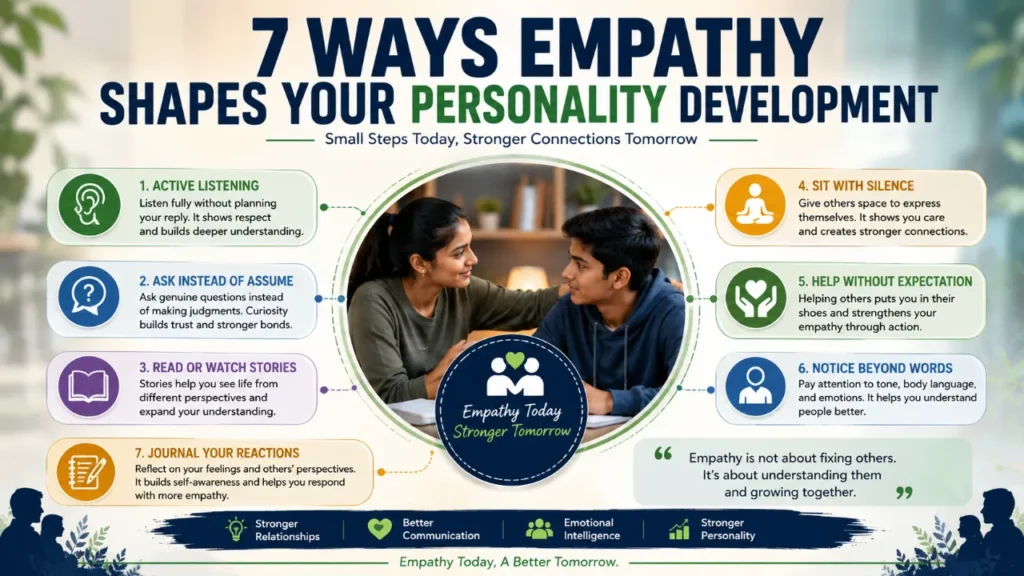
You do not need therapy sessions or personality workshops to build this trait. Small, repeated habits work better than big gestures. Here are seven that actually hold up in daily life.
1. Practice Active Listening Without Planning Your Reply
Most people listen just long enough to form their next sentence. Try the opposite. When someone talks, put your phone down, stop rehearsing your response, and just take in what they are saying. Repeat back what you heard in your own words before you respond. Our guide on the role of communication in personality development covers listening habits in more detail.
2. Ask Instead of Assume
When a colleague seems distracted, or a friend cancels plans last minute, it is easy to assume the worst. Ask a simple, direct question instead. “Is everything okay?” opens a door that assumptions close.
3. Read Fiction or Watch Stories From Lives Unlike Yours
Research in psychology has repeatedly linked reading fiction to stronger perspective taking, because a good story forces you to sit inside someone else’s head for a few hundred pages. Documentaries and films work too. The goal is exposure to lives, choices, and struggles that are not your own.
4. Sit With Someone’s Silence Instead of Rushing to Fix It
When someone is upset, the instinct is to jump in with advice or solutions. Sometimes people just need to be heard. Try staying quiet for a few extra seconds after they finish talking. That small pause often invites them to share more.
5. Volunteer or Help Without Being Asked
This trait grows faster through action than through thinking about it. Helping a neighbour carry groceries, mentoring a junior at work, or spending an hour at a local shelter puts you directly in contact with situations outside your usual bubble.
6. Pay Attention to Tone and Body Language, Not Just Words
A huge part of what people communicate has nothing to do with the words they choose. A flat tone, crossed arms, or a forced smile often say more than the sentence itself. Training yourself to notice these cues builds a sharper, more attentive read on people.
7. Journal Your Reactions to Difficult Conversations
After a tense conversation, write down what you felt and, separately, what you think the other person might have felt. This habit forces you to step outside your own reaction and consider theirs.
How Long Does It Take to Build Empathy
There is no fixed timeline, but most people notice a real shift in four to eight weeks of consistent practice, not months of theory.
The first two weeks are usually the hardest. You will catch yourself interrupting or assuming, often after the fact rather than before. That awareness itself is progress, even when it feels like failure in the moment.
By week three or four, the pause before reacting starts to feel automatic rather than forced. People around you tend to notice this shift before you do. A friend might say you seem calmer, or a colleague might open up more than usual in a conversation.
By weeks six to eight, most of the seven habits above stop feeling like a checklist and start feeling like how you naturally respond. The pace depends entirely on how often you practice, not on how much you read about it. Journaling reactions, as covered above, tends to speed this timeline up because it forces regular reflection instead of occasional effort.
A Real Example: How Empathy Changed the Way Kavya Led Her Team
Kavya, a project manager at a mid-sized firm in Pune, used to run her team meetings the same way most new managers do. Fast, direct, and focused only on deadlines. Her team hit targets, but people started requesting transfers within a year.
A mentor suggested something simple. Before every status update, Kavya began asking one team member how their week actually went, and then stayed quiet long enough to get a real answer instead of a polite one.
Within a few months, something shifted. Her team started flagging problems earlier instead of hiding them until the deadline. One member later told her that meetings finally felt like a conversation, not an inspection. Kavya had not changed her targets or her deadlines. She had simply started listening, and her personality as a leader changed along with it. Her own motivation to keep improving grew too, once she saw the results.
What Happens When Empathy Is Missing From a Personality
Low empathy does not always look like cruelty. Often it looks like distraction, impatience, or an inability to read a room. Here are the patterns to watch for.
| Sign of Low Empathy | How It Shows Up |
|---|---|
| Interrupting often | Cutting people off before they finish a thought |
| Dismissing feelings | Responding with “just get over it” type reactions |
| One-sided conversations | Talking mostly about their own experiences |
| Missing social cues | Not noticing when someone is upset or withdrawn |
| Quick to judge | Assuming motives instead of asking questions |
| Discomfort with emotion | Changing the subject when things get emotional |
Some of these overlap with poor conflict habits too. Our article on aggression vs assertiveness breaks down how interrupting and dismissiveness often connect to bigger communication patterns.
None of these signs mean a person cannot change. This trait, like any other, responds to practice. The seven habits above work just as well for someone rebuilding it as for someone strengthening it further.
Empathy vs Sympathy: What Is the Difference
These two words get mixed up constantly, and the difference actually matters here.
| Empathy | Sympathy |
|---|---|
| You feel with someone | You feel for someone |
| Involves stepping into their perspective | Involves observing from the outside |
| Builds deep, equal connection | Can create distance or pity |
| Example: “I understand why this hurts; I have felt something similar” | Example: “I am sorry that happened to you” |
Sympathy is not wrong. It is a natural first reaction. But personalities that grow through empathy tend to build stronger, longer-lasting relationships than those that stop at sympathy. It also closely relates to how family shapes early personality traits, since children usually first learn the difference between the two at home.
Why This Matters More Than Ever
This is not just a personal virtue anymore. Recent research backs its practical impact.
Businessolver’s 2026 State of Workplace Empathy study found that employees who see their workplace as unempathetic report far higher toxicity and more mental health struggles, and organizations that fail to build this trait risk billions of dollars in avoidable turnover costs each year.
The impact goes beyond the workplace too. A large-scale international survey by Zurich and YouGov covering more than 11,000 consumers found that a majority of respondents say they would avoid companies that show a lack of it.
Whether at home, at work, or in friendships, the pattern is the same. It is no longer treated as optional. It is treated as a core part of a personality people trust.
Final Thoughts
The role of empathy in personality development is not a one-time lesson. It is a habit you keep returning to, in small moments, with people who are easy to understand and people who are not. Start with just one of the seven habits above this week. Notice how a single extra pause in a conversation changes how people respond to you. That one small shift is usually where real personality growth begins.
FAQs
1. What are the 7 keys of empathy?
Most frameworks describe them as active listening, perspective taking, emotional awareness, nonjudgment, genuine curiosity, patience, and the willingness to act on what you understand about the other person.
2. What is empathy in 10 points?
In short, empathy involves listening fully, noticing emotions, asking rather than assuming, staying nonjudgmental, understanding perspectives, managing your own reactions, offering support, respecting boundaries, following up later, and practicing consistently rather than occasionally.
3. What are the 7 elements of empathy?
These typically include emotional recognition, perspective taking, active listening, nonjudgmental attitude, patience, genuine curiosity, and compassionate action.
4. What role does empathy play in personality development?
The role of empathy in personality development is to strengthen self-awareness, improve emotional control, and build the kind of trust that makes relationships and leadership more effective. It is one of the clearest, most trainable paths to a stronger, more mature personality.
5. Is empathy the same as being a pushover?
No. Empathy means understanding someone’s feelings, not automatically agreeing with everything they want. You can hold a boundary and still be empathetic about how it lands.

Ayanshi is the founder of PersonaGuru.in, a blog focused on personality development, career, relationships, and mental well-being. With over 3 years of writing experience, she turns psychology and everyday experiences into practical, easy-to-understand advice for real life.