
Last updated on September 13th, 2026 at 12:24 pm
Social intelligence in personality development is the ability to read people, understand social situations, and respond in a way that builds trust instead of tension. It sounds simple, but it shapes almost everything about how others experience you.
Think about the last time you walked into a room and instantly felt the mood. Maybe your team was stressed before a deadline, or a friend was upset but trying to hide it. You picked up on that without anyone saying a word. That is social intelligence at work.
Psychologist Edward Thorndike first named this ability in 1920. He called it the skill to understand and manage people wisely. A century later, it is still one of the most underrated parts of personality development, even though it decides how well you lead, connect, and grow in almost every area of life.
This guide breaks down what social intelligence really means, its four key elements, clear signs of high and low social intelligence, and simple ways to build it starting today.
This is part of a bigger picture — read our complete Personality Development Guide to understand how self-awareness, communication, and confidence all connect.
Key Takeaways
- Social intelligence in personality development is not the same as being an extrovert. Quiet people can have very high social skills.
- It is different from emotional intelligence, though the two work closely together.
- Edward Thorndike introduced the concept in 1920, long before emotional intelligence became popular.
- Active listening, situational awareness, impression management, and empathy make up its four core elements.
- Social intelligence can be learned and improved at any age through daily practice, not just personality.
What Is Social Intelligence in Personality Development?
Social intelligence in personality development refers to your capacity to understand social situations and manage relationships in a way that feels natural to others, not forced.
It is not about being the loudest person in the room. It is about noticing what a situation needs, then responding to it well. A socially intelligent person can walk into a tense meeting, sense the mood, and know exactly when to speak and when to stay quiet.
Edward Thorndike’s Original Theory of Social Intelligence (1920)
Edward Thorndike, an American psychologist, first used the term “social intelligence” in 1920. He described it as the ability to understand and manage men and women, boys and girls, and to act wisely in human relationships.
Thorndike separated intelligence into three types:
- Abstract Intelligence, the ability to work with ideas and language;
- Mechanical Intelligence, the ability to work with tools and objects;
- Social Intelligence is the ability to work with people. This was one of the earliest signs that psychologists saw people skills as a distinct form of intelligence, not just a personality trait.
Daniel Goleman’s Modern View on Social Intelligence
Decades later, psychologist Daniel Goleman expanded on this idea in his book Social Intelligence: The New Science of Human Relationships. Goleman connected social intelligence directly to emotional intelligence.
As Goleman put it, “Empathy and social skills are social intelligence, the interpersonal part of emotional intelligence.” In other words, social intelligence is what happens when you take your emotional awareness and actually use it with other people.
Social Intelligence vs Emotional Intelligence:
These two terms get mixed up often, but they are not the same thing. Emotional intelligence is about understanding and managing your own emotions. Social intelligence is about understanding and managing situations with other people.
| Emotional Intelligence (EQ) | Social Intelligence (SQ) |
|---|---|
| Focuses on your own emotions | Focuses on other people and situations |
| Helps you stay calm under pressure | Helps you read a room correctly |
| Builds self-awareness | Builds relationship awareness |
| Example: noticing you feel anxious before a meeting | Example: noticing your team feels anxious before a meeting |
The two skills overlap, and you need both. High emotional intelligence usually makes social intelligence easier to build because you cannot read other people well if you cannot first read yourself. If you want to strengthen the emotional side of this pair, this breakdown of the different types of emotional intelligence and how to improve them is a useful next step.
4 Key Elements of Social Intelligence
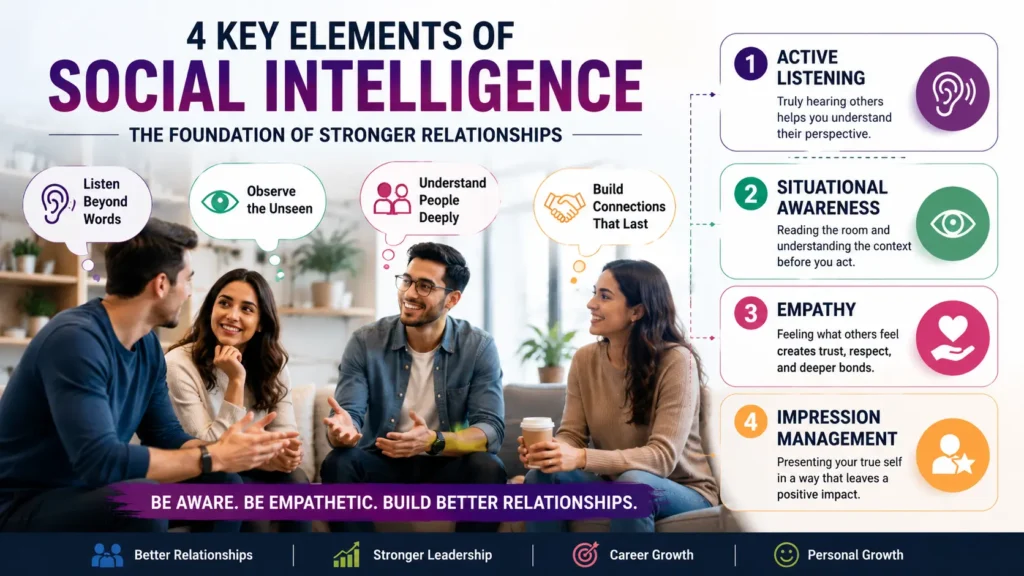
To fully incorporate social intelligence in personality development, you must realize that it is not one single skill. It is made up of four smaller skills that work together:
1. Active Listening
This means listening to understand, not just listening to reply. It includes noticing tone, pace, and pauses, not just words.
2. Situational Awareness
This is your ability to read the unspoken rules of a room. A joke that works at a birthday party will not work at a funeral. Socially intelligent people sense this instantly.
3. Impression Management
This is how you present yourself so people form an accurate, positive picture of who you are. It is not about faking a personality. It is about being consistent and clear.
4. Empathy
This is the ability to sense what someone else is feeling, even when they have not said it directly. Empathy is the emotional engine behind the other three elements.
Signs of High Social Intelligence
When an individual successfully integrates social intelligence in personality development, a few common habits and signs of high social intelligence start showing up in their daily life:
- They remember small details about people and bring them up later.
- They adjust their tone depending on who they are speaking to.
- They notice when someone is uncomfortable, even in a group setting.
- They ask more questions than they answer in a new conversation.
- They rarely dominate a conversation, even when they know the most.
Signs of Low Social Intelligence
On the other hand, low social intelligence often shows up in patterns that quietly damage relationships.
- Talking over people without noticing.
- Missing obvious social cues, like a room going quiet after a comment.
- Struggling to read sarcasm or humour correctly.
- Repeating the same conversational approach with everyone, regardless of context.
- Feeling confused about why people pull away after a conversation.
None of these signs are permanent traits. They are patterns, and patterns can change with practice.
Why Social Intelligence Matters in Personality Development
Social intelligence shapes how far your personality actually takes you. You can be brilliant at your job, but if you cannot read a room, your ideas often get lost.
This is not a small trend either. According to research covered by the McKinsey Global Institute on the future of work, demand for social and emotional skills is projected to rise sharply in both Europe and the United States by 2030, as automation takes over more technical tasks. The more machines handle routine work, the more human connection becomes the differentiator.
Impact on Leadership and Career Growth
Leaders with high social intelligence build teams that trust them. They notice burnout before it becomes resignation. They read tension in a meeting before it becomes conflict. This is why social intelligence is often listed alongside communication as one of the most important workplace skills, right next to building an overall strong personality at work.
Impact on Relationships and Conflict Resolution
In personal relationships, social intelligence is what helps you sense when your partner needs space instead of advice, or when a friend needs a joke instead of a lecture. It is the quiet skill behind most healthy, long-lasting relationships.
How to Improve Your Social Intelligence (Step-by-Step)
If you are trying to figure out how to improve social intelligence, the process relies on small, everyday behavioral choices rather than changing your whole core personality.
1. Practice Active Listening Daily
Put your phone away during conversations. Repeat back what the other person said before you respond. This alone changes how people experience talking to you.
Real example: Priya, a team lead in Chennai, noticed her one-on-ones felt rushed. She started repeating her team member’s last sentence before replying. Within a month, two team members told her they finally felt heard at work. If you want a structured way to build this habit, this action plan to improve communication skills in the workplace is a good place to start.
2. Read the Room Before You React
Before you speak in a group, pause and notice the mood. Is the room tense, relaxed, or distracted? Match your response to what is actually happening, not what you planned to say.
Real example: Karan walked into a family dinner ready to share good news about a promotion. He noticed his sister looked upset and paused. He asked her how she was doing first. That small pause built more trust than the announcement would have.
3. Ask More, Assume Less
Instead of guessing why someone acted a certain way, ask them directly. “I noticed you went quiet in that meeting. Is everything okay?” opens a door that assumptions close.
4. Work on Your Body Language
Eye contact, open posture, and a calm tone say more than your words do. Crossed arms and a flat tone can undo an otherwise kind sentence.
Real example: Neha, a customer support executive in Bangalore, kept getting complaints about sounding cold on calls, even though her scripts were polite. A coach pointed out that her tone dropped flat under pressure. She practiced varying her tone during stressful calls, and her customer satisfaction scores improved within weeks. If you want to understand how your physical cues affect others, reading about the detailed role of body language in personality development can help you match your posture to your intent.
5. Reflect After Every Social Interaction
After a meeting or a difficult conversation, ask yourself what you noticed about the other person’s mood. This habit trains your brain to pick up on social cues automatically over time.
Real-Life Examples of Social Intelligence
At the Workplace
- A manager who notices an employee has gone quiet in meetings and checks in privately, instead of calling them out publicly.
- A colleague who reads a client’s hesitation on a call and slows down, instead of pushing for a quick yes.
- A new hire who watches team dynamics for a week before offering strong opinions.
In Friendships and Family
- Sensing a friend needs to vent, not receive advice, and simply listening.
- Noticing a parent is stressed and offering to help with a task, instead of asking for something in return.
- Reading a partner’s silence correctly as tiredness, not anger, and giving them space.
A recent Forbes report on workplace skills found that a large majority of companies now say human capabilities like social and emotional skills matter as much as technical skills. Social intelligence sits right at the center of that shift.
Final Thoughts
Social intelligence in personality development is not about becoming someone else in every room. It is about noticing more, assuming less, and responding to people the way the moment actually needs.
Start with one habit this week. Put your phone away during one conversation a day, or pause before you speak in your next group setting. Small, consistent practice is what actually builds this skill over time.
If you want to keep building your personality in this direction, read more about understanding your blind spots through the Johari Window, which pairs closely with social intelligence and self-awareness.
FAQs on Social Intelligence in Personality Development
1. What is an example of social intelligence?
A common example is noticing a colleague seems distracted in a meeting and following up privately afterward, instead of ignoring it. This small act of reading a social cue and responding well is social intelligence in action.
2. Is social intelligence genetic or learned?
Social intelligence has some natural basis, but research shows it is mostly learned through exposure, feedback, and practice. Children develop early signs of it, but adults can meaningfully improve it through conscious effort at any age.
3. What is Edward Thorndike’s theory of social intelligence?
Thorndike proposed in 1920 that intelligence has three forms: abstract, mechanical, and social. Social intelligence, in his theory, is the specific ability to understand and manage people wisely in everyday human interaction.
4. What is the difference between social intelligence and emotional intelligence?
Emotional intelligence is about recognising and managing your own emotions. Social intelligence is about applying that awareness to real interactions, reading other people, situations, and social cues accurately, and responding appropriately.
5. Can social intelligence be improved?
Yes. Social intelligence improves with active listening, deliberate observation of social cues, and regular reflection after conversations. Like any skill, it strengthens with consistent, intentional practice over time.

Ayanshi is the founder of PersonaGuru.in, a blog focused on personality development, career, relationships, and mental well-being. With over 3 years of writing experience, she turns psychology and everyday experiences into practical, easy-to-understand advice for real life.