
Last updated on September 13th, 2026 at 12:23 pm
A reader named Rohan wrote to us last month. He said something that stuck with us. “I know what I want to say in interviews. I just sound boring saying it.”
That is not a confidence problem. It is a voice problem. And it has a fix.
Voice modulation exercises are simple daily practices that train your pitch, tone, pace, and volume. They stop your voice from sounding flat. They help you sound like a person who means what they are saying, not someone reading it off a card.
This guide gives you the exercises we shared with Rohan. It also explains why they work and why voice modulation in personality development matters as much as it does.
Key Takeaways
- Voice modulation exercises work by changing your pitch, tone, pace, and volume so your speech does not sound flat.
- A short daily practice, done for two to three weeks, makes a real difference. You do not need months.
- Psychologist Albert Mehrabian’s research showed that tone carries far more emotional weight than words alone, at least when feelings are involved.
- Interviewers form a sense of your confidence within seconds of hearing you speak. Often before your answer even makes sense to them.
- This is a trainable skill. Actors and broadcasters were not born with it. They practiced it.
What Is Voice Modulation?
Voice modulation is the natural rise and fall in your voice while you speak.
Picture two people reading the same sentence. One reads it like a train announcement. Flat. No life in it. The other reads it like they are telling you something that actually matters. Same words. Same sentence. One puts you to sleep. The other makes you lean in.
That difference is voice modulation, and it is exactly what voice modulation exercises are built to train.
Why Voice Modulation Exercises Actually Work
Here is something most people get wrong about their own voice. They think it is fixed. Like eye colour.
It is not. Your voice is a set of muscles and habits. Muscles respond to practice. Habits change with repetition.
Psychologist Albert Mehrabian studied how people read emotion in conversation. His research found that when someone is expressing a feeling, listeners lean far more on tone of voice than on the actual words. Words alone carried a surprisingly small share of the emotional message in his studies. It is worth noting that Mehrabian himself said this applies to emotional, attitude-based talk. It does not apply to someone reading out a train timetable (Yale Office of Career Development).
That nuance matters. But the core idea holds up in daily life. Say “I am fine” in a flat voice. Now say it warmly. Two completely different messages. Same two words.
Toastmasters International, the global public speaking organisation, makes a similar point in its own breakdown of why vocal variety matters. Speakers who vary their volume, pitch, pace, and pauses hold an audience’s attention far better than speakers who use a flat, uniform tone, since variety is what signals which words in a sentence actually matter.
If nerves are part of the problem for you, and they are for most people, our guide on how to overcome the fear of public speaking is worth reading alongside this one. A shaky voice is often fear talking, not a lack of skill.
Separate research on how people judge voices found that listeners decide whether a speaker sounds trustworthy almost instantly, purely from the sound of their voice, before they have even processed what was said.
That is not a small thing. That is the first ten seconds of every interview you will ever sit for, and exactly why voice modulation tips matter more than most people realise.
How Voice Modulation Shapes Personality Development
Personality development is not just about what you think or how you dress. It is also about how you sound when you speak, since your voice is often the first thing people register about you.
A trained, expressive voice supports personality growth in a few concrete ways.
- It builds real confidence, not performative confidence. When you know your voice will not shake or flatten under pressure, you walk into a room differently.
- It shapes how people read your leadership. A calm, controlled voice signals composure. A rushed, flat one signals nerves, even when the person speaking is not actually nervous.
- It improves first impressions. Before anyone judges your ideas, they register your tone. A warm, varied voice invites people in. A flat one makes them tune out. Voice works alongside body language in personality development here. Your posture and expressions say one thing, your voice confirms or contradicts it, and people notice the mismatch even when they cannot name it.
- It strengthens emotional intelligence. Reading your own tone and adjusting it to the moment is a form of self-awareness. It also helps you notice tone in others.
- It carries into every relationship, not just interviews. A partner, a friend, a colleague. They all respond to how you say things, not only what you say.
None of this happens overnight. But it compounds the same way any personality development habit does. A little, practiced often, through the same voice modulation exercises you will find below.
Elements You Are Actually Adjusting
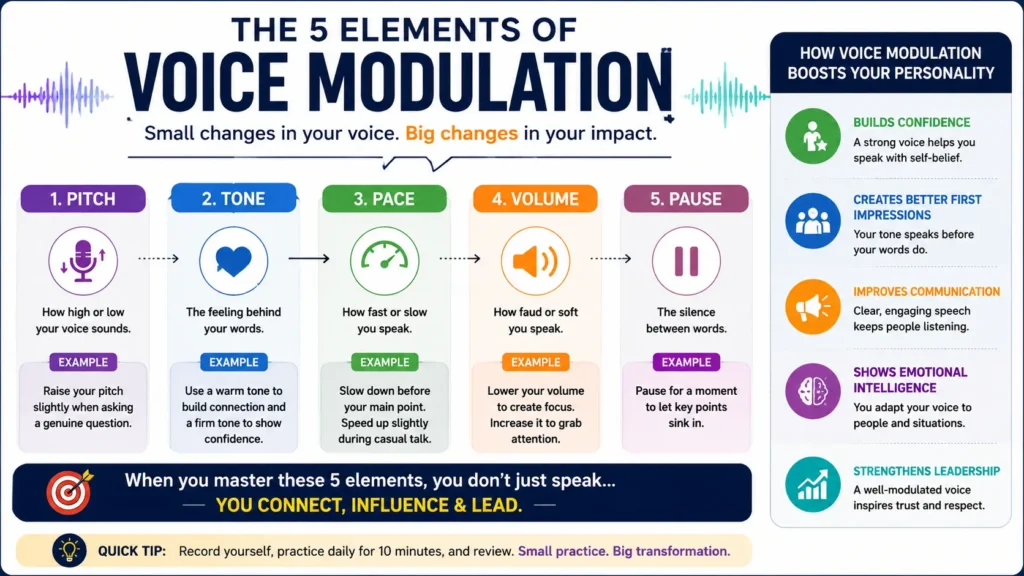
| Element | What It Means | Everyday Example |
|---|---|---|
| Pitch | How high or low your voice sounds | Raising the pitch slightly when you ask a genuine question |
| Tone | The feeling behind your words | A warm tone when comforting a friend, a firm one when setting a boundary |
| Pace | How fast or slow you talk | Slowing down right before your main point |
| Volume | How loud or soft you speak | Dropping your volume to pull people in during a serious moment |
| Pause | The silence between words | Stopping for a beat after saying something important |
You use all five already, just not on purpose. These exercises put you in control of them.
5 Voice Modulation Exercises to Practice Daily
Ten minutes a day. That is the commitment. Here is what to do with those ten minutes.
1. The Pitch Ladder
Say one sentence out loud. Start low. Repeat the same sentence, going slightly higher each time, until you reach a naturally higher pitch.
Try this line: “I am ready for this opportunity.”
Say it low and serious first. Then say it higher, like you actually mean it. Notice how different the same six words can sound.
2. Pop, Drop, and Pause
This one comes from public speaking coaches, and it works because it is so specific.
Pick the one word in a sentence that matters most, and pop it, meaning raise your volume or pitch slightly on that word. Then drop your tone when you get to something serious or reflective. Then pause, for a full second or two, right before or after your key point.
Try it on this line: “The most important thing I learned from that project was patience.”
Pop on “most important.” Drop on “patience.” Pause right before you say it.
3. Record Yourself and Actually Listen
Ask yourself, “Tell me about yourself,” and answer it out loud for sixty seconds. Record it on your phone.
Then play it back.
Most people wince the first time. That is normal. Priya, one of our readers who tried this before a campus interview, told us she did not realise how often she said “um” until she heard it played back three times in a row. By the fourth recording, it was almost gone.
4. Breathe From Your Stomach, Not Your Chest
A shaky voice usually comes from shallow breathing, not nerves alone.
Sit up straight. Put one hand on your stomach. Breathe in slowly through your nose so your stomach rises, not your shoulders. Speak a full sentence as you breathe out.
Do this for three minutes before any interview or presentation. It genuinely calms the shake in your voice.
5. Read the Same Line Three Different Ways
Pick any sentence. A line from a book. Even a text message you got this morning.
Read it once like you are thrilled. Read it again like you are calm and serious. Read it a third time like you are explaining it to a five-year-old.
This shows you a range in your voice that you already have. You just do not use it in daily conversation.
How to Improve Voice Modulation for Interviews
Interviews are where a flat voice costs you the most. You could have the best answer in the room and still sound forgettable.
The same voice modulation exercises above work especially well here, with a few interview-specific adjustments.
- Slow down on your achievements. Rushing through the one thing you are proudest of makes it sound like you do not think it matters either.
- Keep a steady pace for routine questions. Save your energy shifts for the moments that count.
- Take one breath before you answer. Not a big dramatic pause. Just one breath. It stops the voice shake that comes from launching straight into an answer under pressure.
- Practice your “Tell me about yourself” answer out loud, not silently in your head. Silent rehearsal trains nothing except your thoughts.
- Imagine you are talking to a friend, not a panel. Voices soften the moment the imagined listener changes.
For a deeper look at the mindset side of this, our piece on how to be confident in public speaking covers the psychology behind why nerves show up in the voice first. And once your voice is steady, pairing it with 11 ways to have more confident body language rounds out the full picture interviewers actually respond to. Our broader guide on interview skills in personality development covers what to do with the rest of the conversation once your voice is working for you.
Common Situations Where Voice Modulation Matters
Voice modulation is not something you only need on a stage. It shows up everywhere.
- Job interviews — where a flat voice can make even a strong answer sound unconvincing
- Public speaking — where vocal variety is what keeps an audience listening, especially for students building these skills early
- Sales conversations — where tone often decides trust faster than the pitch itself
- Teaching and training — where a monotone voice loses a room within minutes
- Meetings — where your tone signals whether you actually believe what you are proposing
- Everyday conversation — where a flat “I’m fine” can be read as disinterest, even when you mean it warmly
Mistakes That Undo All This Practice
- Overdoing it. Changing your pitch on every single word sounds forced, not confident.
- Speeding up when nervous. Nerves push pace up and volume down, which is the opposite of what sounds confident.
- Skipping pauses. Rushing to fill silence usually communicates less confidence than a well-placed pause would.
- Practicing only in your head. This is a physical skill. It needs your actual voice, out loud, not your imagination.
- Thinking louder means being more confident. Tone and pace do more work than volume ever will.
How Long Before You Notice a Difference?
Most people notice a real shift within two to three weeks of daily practice with these voice modulation exercises.
You are not building a new voice. You are breaking a flat, one-note habit and replacing it with one that has natural variation in it. That takes repetition, not talent.
Final Thought
You use your voice every day. Almost nobody trains it.
Rohan practiced the Pitch Ladder and the Pop-Drop-Pause exercise for two weeks before his next interview. He did not change what he said. He changed how it landed. He got the offer.
Start with one of these voice modulation exercises today. Not all five. Just one. The goal is not a new voice. It is the clearest, most confident version of the one you already have, and one more building block in your voice modulation in personality development journey.
“Want to build a stronger personality overall? Check out our complete guide to personality development for the full roadmap.”
FAQs
1. What are the main elements of voice modulation?
Pitch, tone, pace, and volume, with pauses often counted as a fifth. Together, they decide whether your voice sounds engaging or flat.
2. Can voice modulation actually be learned?
Yes. It is a trained skill, not something you are born with. Broadcasters and actors built theirs through repeated practice. So can you.
3. Can introverts improve their voice modulation too?
Yes, and often faster than expected. Voice modulation is not about being loud or extroverted. It is about intentional variation, which works just as well in a quiet, measured speaking style as it does in an energetic one.
4. Does voice modulation actually increase confidence, or just the appearance of it?
Both, over time. Sounding more controlled under pressure genuinely reduces the physical signs of nervousness, like a shaky voice, which in turn makes you feel steadier the next time you speak.
5. Is voice modulation useful in online meetings?
Yes, arguably more than in person. Video calls strip away a lot of body language, so your voice carries more of the message. A flat tone on a video call reads as disengagement even faster than it does in a room.
6. Does this only matter for public speaking?
No. It shapes job interviews, everyday conversations, and even a simple phone call. A flat voice can make you sound disengaged even when you genuinely care about what you are saying.
7. How is voice modulation different from accent?
Accent is about pronunciation and regional speech patterns. Voice modulation is about the expressiveness of your delivery. You can have any accent and still sound flat, or any accent and sound genuinely engaging.

Ayanshi is the founder of PersonaGuru.in, a blog focused on personality development, career, relationships, and mental well-being. With over 3 years of writing experience, she turns psychology and everyday experiences into practical, easy-to-understand advice for real life.