
Last updated on September 29th, 2026 at 06:40 am
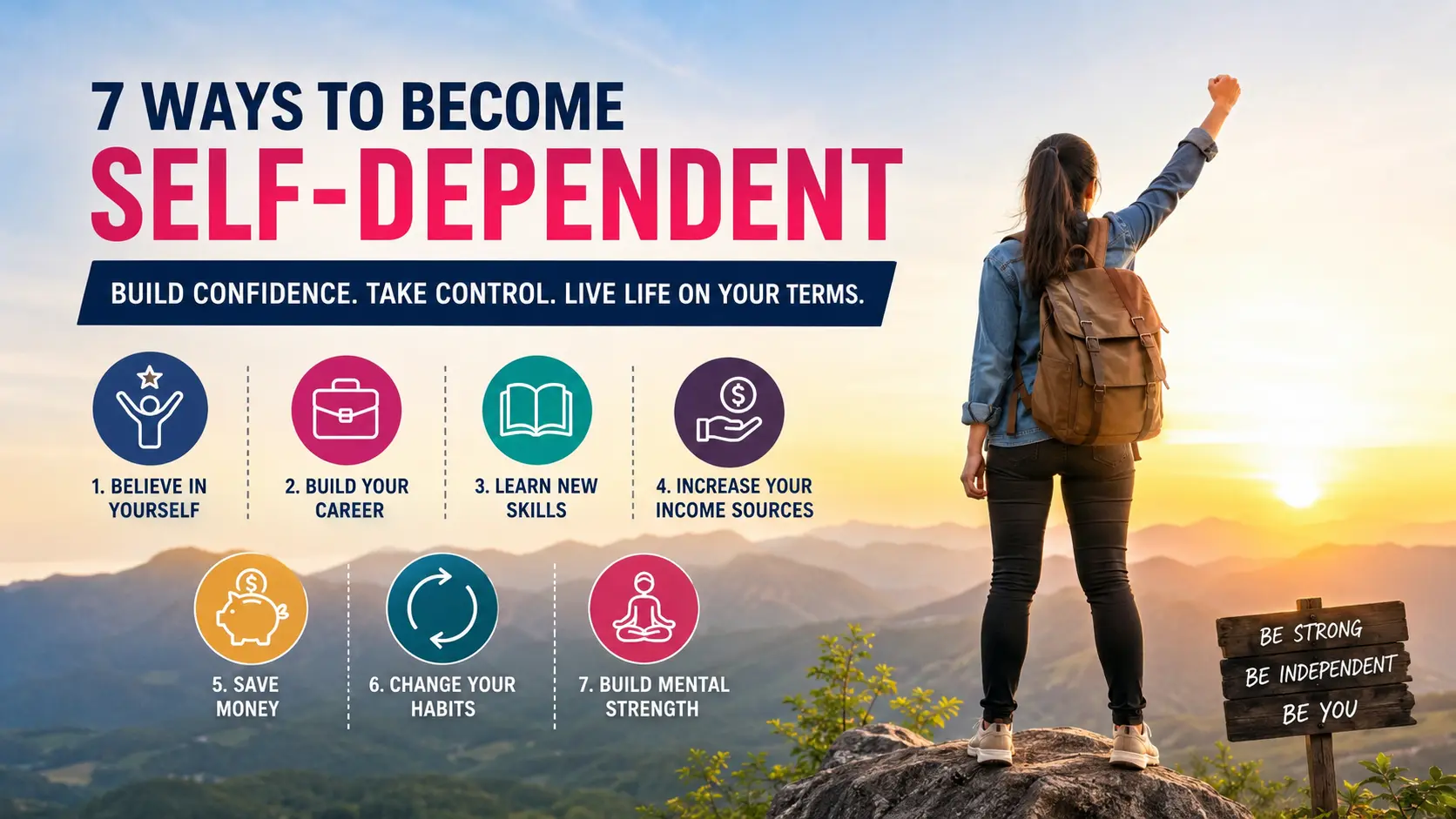
How to become self-dependent starts with seven habits. Build real confidence. Keep a steady career. Learn new skills. Create more than one income source. Save money. Fix your habits. Grow mental strength. None of this means cutting people off. It means you can run your own life.
Remember when someone else made every decision for you? What to eat. What to study. Where to go. That was childhood. It felt safe. Then one day it stops. Now you handle things yourself. Rent. Career. Money. Mistakes. And if you struggle, people talk. They call you useless. They say you cannot do anything.
Ignore the noise. But take the hint. It is time to build your own strength.
So where do you start? Right here. This guide gives you seven clear steps.
Let me be clear about one thing first. Learning how to become self-dependent does not mean shutting everyone out. It means you make your own decisions and handle your own life. It is a skill, not a wall. You can still ask for help. We will come back to this later.
This guide is part of our Personality Development series. Self-awareness, communication, and confidence all connect there.

What Does Self-Dependent Mean?
Being self-dependent means you run your own life. You pay your own bills. You make your own decisions. You do not wait for anyone’s approval to move forward.
This is different from being closed off. Self-dependence is about capability. It is not about proving that you never need anyone.
Benefits of Being Self-Dependent
- You are seen as a person with a strong personality.
- You stay confident and motivated from within.
- You can make important decisions on your own.
- You become an inspiration for others.
- You can take responsibility for yourself and others.
- Your value increases in front of people.
Why Is It Important to Be Self-Dependent?
- It leads to personal growth.
- You live life on your own terms.
- You can guide people who are struggling.
- You live with more peace and less panic.
How to Become Self-Dependent: 7 Ways That Work
1. Have Confidence in Yourself
Confidence is not fixed. You build it through action. Each time you make a decision on your own and it works, you get proof that you can handle things. Start small. Plan your own day. Handle a minor conflict yourself. Then build from there. For a step-by-step approach, see our guide on how to boost your self-confidence.
2. Build Your Career the Right Way
Your career is one of the fastest paths to self-dependence. It makes everything else on this list possible. If you are wondering how to become self-dependent in a practical way, start here. So give it real attention. Set one clear goal for the next year. Not just “do well at work.” Our guide on career and workplace growth covers planning, goals, and daily habits in more depth.
3. Learn New Skills
Competition keeps rising. To keep up, you need to learn new skills from time to time. Pick skills that help your career grow. New skills bring new opportunities.
Do not stop at skills tied to your job title. Learn basic budgeting, negotiation, or public speaking too. These help you handle everyday life on your own.
4. Increase Your Income Sources
Never depend on only one income source. Something can always go wrong. So once your main income is stable, save some of it. Then invest that money into a second source.
You can learn skills the market wants outside your main field. This can lead to a part-time job or a small business.
Start small. Do not put a lot of money into a second source at once. Over time, you can build four or five sources. If one stops, money still comes in from the others. That gives you time to think clearly.
5. Save Money
Aim to save enough to cover your essential expenses for 3 to 6 months. This is the standard guideline for an emergency fund, according to BetterInvesting’s personal finance guide. Aim closer to 6 months if your income is irregular or if others depend on you.
You cannot know what is coming. A sudden job loss. A medical bill. An emergency at home. Without savings, you may have to lean on other people.
Take Kabir, a 27-year-old designer in Pune. His contract ended without warning. He had four months of expenses saved. So he took six weeks to find the right role. He did not have to grab the first offer. His savings did not just protect his money. They protected his choices.
6. Change Your Habits
Bad habits can ruin a life. Some people end up depending on others because of them. Whatever a person becomes, successful or not, mostly comes down to habits. See our guide on good habits for personality development for a practical start. And read our guide on how to build willpower to make them stick.
So look closely at your own habits. Which ones move you forward? Which ones quietly hold you back?
7. Make Yourself Mentally Strong
Stay around good people. Learn from your mistakes. If something is bothering you, share it with someone you trust. Stay away from people who put you down. Meditate for at least 15 minutes every day.
Do not compare yourself to others. Do not underestimate yourself. Keep one clear plan and one clear goal in front of you. That keeps you steady. You work toward something instead of just reacting to life.
Self-Dependence vs. Hyper-Independence
There is a healthy kind of self-dependence. And there is hyper-independence. Many people avoid asking for help because it feels weak. But there is a limit.
Clinical psychologist Annie Tanasugarn explores this in Psychology Today. She asks whether hyper-independence is a trauma response, where extreme self-reliance starts as self-protection. Over time, refusing all help can leave a person tired and alone.
In simple words, self-dependence is healthy. Refusing help from everyone, always, out of fear or pride, is not. Knowing how to become self-dependent also means knowing where to stop.
Signs you may have gone too far:
- You feel guilty asking for help, even for small things.
- You take on more than you can handle to avoid depending on someone.
- You find it hard to open up, even when you are struggling.
- You quietly assume others will let you down.
If this sounds like you, do not swing back to depending on everyone. Just leave room for support. Emotional intelligence helps here. It shows you the difference between “I can handle this” and “I am refusing help out of fear.”
A Common Mistake While Building Self-Dependence
The biggest mistake is trying to do it all overnight.
People feel motivated for a few days. Then they try to fix their career, savings, habits, and mindset at once. It usually ends in burnout within weeks.
Here is a better way. Pick one area from the 7 steps above. Work on it for a month. Then move to the next. Also protect your time with clear boundaries. Our guide on how to say no to extra work shows how to do it without guilt.
Conclusion
So, how to become self-dependent? Believe in yourself. Build your career. Create more than one income source. Save 3 to 6 months of expenses. Learn skills the market needs. Fix your habits. Build mental strength.
And remember where healthy self-dependence ends. You can stand on your own and still let good people stand beside you. Now you know how to become self-dependent without cutting off the people who care about you.
Nobody gets this right overnight. Pick one step today. That is enough to begin. This connects to the wider career and workplace growth framework of planning, mindset, resilience, and daily habits.
FAQs
1. How to be self-dependent emotionally?
Start by accepting your feelings. Build self-awareness. Set clear boundaries. Keep a support network, but learn to steady yourself first. Treat challenges as chances to grow.
2. Is self-dependence good?
Yes. It builds personal growth, resilience, and a real sense of control over your life. Just do not let it turn into hyper-independence, where you refuse all help out of fear.
3. What are some modern examples of self-reliance?
Entrepreneurs building startups, freelancers running their own careers, and people learning new skills online. Budgeting and investing through a simple app, instead of leaving it to family, is another everyday example.
4. How can a woman become financially independent?
Budget, save, and invest wisely. Build skills that the market pays for. Create more than one income stream. Set clear money goals and build an emergency fund. Keep learning about personal finance.
5. How long does it take to become self-dependent?
There is no fixed timeline. Financial self-dependence can take a couple of years of steady saving and skill-building. Emotional self-dependence is an ongoing practice, not a finish line. Aim for steady progress across the 7 areas, not a deadline.

Ayanshi is the founder of PersonaGuru.in, a blog focused on personality development, career, relationships, and mental well-being. With over 3 years of writing experience, she turns psychology and everyday experiences into practical, easy-to-understand advice for real life.