
Last updated on July 21st, 2026 at 09:54 am
You already know the SWOT framework from business classes or office meetings. Strengths, weaknesses, opportunities, threats. Four boxes, one grid.
What most people do not realize is that the same tool works just as well when you point it at yourself instead of a company. A SWOT analysis in personality development is simply this framework turned inward, used to map your own strengths, gaps, and growth paths.
In this guide, you will learn exactly how to do a personal SWOT analysis, see real examples, and get a simple worksheet you can fill in today.
📥 Download the free Personal SWOT Analysis Worksheet (PDF) — follow along as you read.
Key Takeaways
- A SWOT analysis in personality development maps your strengths, weaknesses, opportunities, and threats to guide real decisions, not just list adjectives.
- Strengths and weaknesses are internal. Opportunities and threats are external.
- A personal SWOT analysis only works when tied to a specific goal, such as a promotion or a career switch.
- Research on self-awareness shows most people overestimate how clearly they see themselves, which is exactly why a written SWOT analysis helps.
- A short worksheet and 10 honest minutes are often enough to get real clarity.
What Is SWOT Analysis in Personality Development?
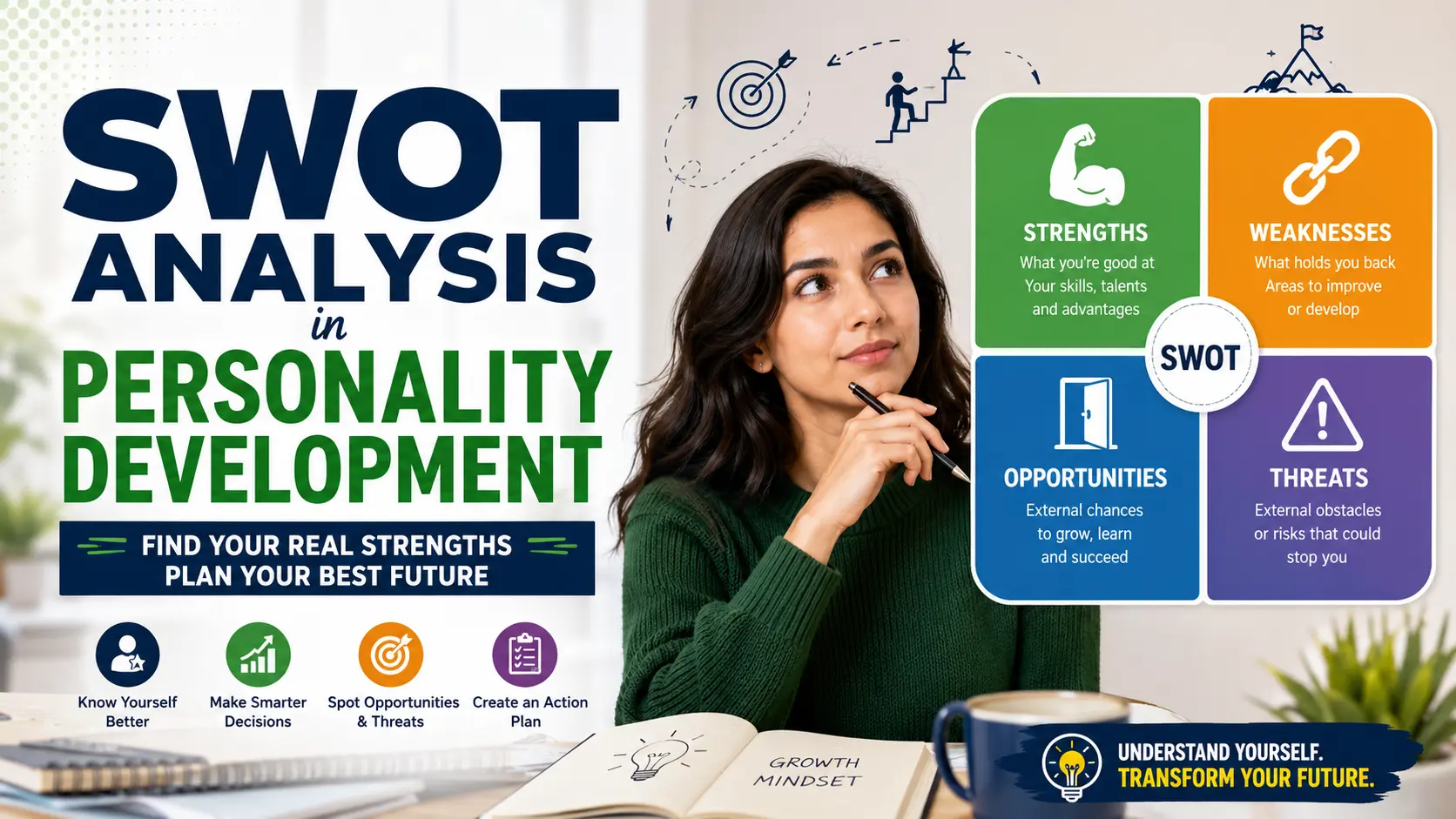
SWOT analysis in personality development is the practice of using the classic business framework, Strengths, Weaknesses, Opportunities, and Threats, to evaluate yourself instead of a company. It gives you a simple, structured way to see where you stand and where you can grow.
Businesses have used SWOT analysis for decades to plan strategy. The same logic applies to a person. Your strengths and weaknesses live inside you. Your opportunities and threats come from the world around you, your industry, your relationships, and your circumstances.
As the line often attributed to management thinker Peter Drucker goes, “what gets measured gets managed.” A personal SWOT analysis is one of the simplest ways to actually measure yourself instead of guessing.
Why a Personal SWOT Analysis Matters for Growth
Most people believe they know themselves well. Research says otherwise. In a nearly five-year study of thousands of people, organizational psychologist Tasha Eurich found that although 95 percent of people believe they are self-aware, only 10 to 15 percent actually meet the criteria for true self-awareness.
That gap is exactly where a SWOT analysis in personality development helps. It forces you to put your beliefs about yourself on paper, next to real evidence, instead of relying on gut feeling alone.
Without this kind of structure, most self-reflection turns into vague statements like “I am a hard worker” or “I need to improve my confidence.” A SWOT analysis pushes you past that, into specifics you can actually act on.
Four Components of SWOT Analysis in Personality Development
Here is what goes into each of the four boxes.
Strengths (Internal, Positive)
These are things you are already good at. Ask yourself:
- What do people regularly compliment you on?
- Which tasks feel easy for you but hard for others?
- What skills, certifications, or experiences give you an edge?
Weaknesses (Internal, Negative)
These are internal habits or gaps holding you back. Ask yourself:
- What feedback do you hear more than once from different people?
- Which tasks do you avoid or procrastinate on?
- What skill gaps show up again and again in your work or relationships?
Opportunities (External, Positive)
These are outside factors you could use to your advantage. Ask yourself:
- What is changing in your industry or field right now?
- Which courses, mentors, or communities could help you grow faster?
- Where is there less competition than you expected?
Threats (External, Negative)
These are outside obstacles working against you. Ask yourself:
- What is your biggest competition for the role or goal you want?
- What market or economic shifts could affect your plans?
- What personal circumstances could slow you down?
How to Do a Personal SWOT Analysis (Step by Step)
Here is a simple five-step process to build your own SWOT analysis in personality development.
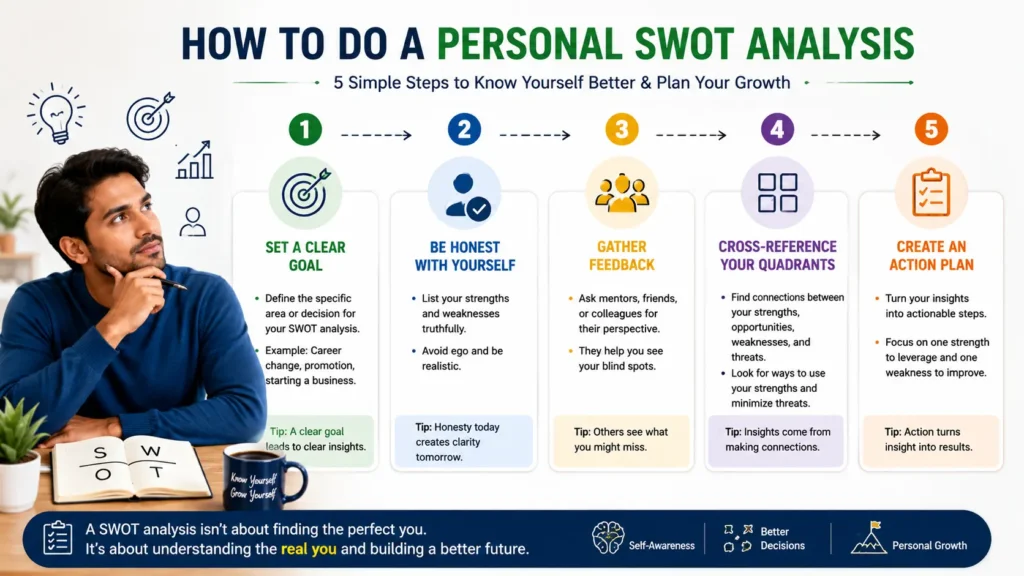
- Set a clear goal first. Do not write a SWOT analysis “in general.” Tie it to a specific question, such as “Should I ask for a promotion?” or “Am I ready to switch careers?”
- Be radically honest. Do not censor your weaknesses to protect your ego. This exercise only works if you are truthful with yourself.
- Ask people who know you well. A mentor, colleague, or close friend often sees blind spots you cannot see on your own.
- Cross-reference your quadrants. Ask how a specific strength could help you grab a specific opportunity or defend against a specific threat.
- Turn it into an action plan. A SWOT analysis without next steps is just a list. Pick one strength to use this month and one weakness to work on.
📥 Ready to try it yourself? Grab the free Personal SWOT Analysis Worksheet (PDF) and fill in your own four quadrants as you go.
Personal SWOT Analysis Example
Here is a short example to show how this looks in practice.
Case: A marketing professional considering a shift into UX design
- Strengths: Five years of experience reading user behavior data, a self-taught working knowledge of design tools, a track record of improving website conversions
- Weaknesses: No formal design certification yet, limited hands-on portfolio work, still building confidence in presenting design decisions
- Opportunities: Rising demand for professionals who understand both data and design, several respected online design courses, and a growing local UX community to network with
- Threats: Strong competition from candidates with formal design degrees, a slower hiring market in some tech companies this year
From here, the action plan is clear. Use the existing data skills as a differentiator, enroll in one design course to close the certification gap, and start building two or three portfolio pieces within three months.
SWOT Analysis vs SMART Goals: What Is the Difference?
These two frameworks often get used together, but they do different jobs.
| Aspect | SWOT Analysis | SMART Goals |
|---|---|---|
| Purpose | Understand where you currently stand | Define a specific target to work toward |
| Structure | Four categories: strengths, weaknesses, opportunities, threats | Five criteria: specific, measurable, achievable, relevant, time-bound |
| When to use it | Before you decide on a direction | After you have decided on a direction |
| Simple example | Realizing you have strong writing skills but weak public speaking skills | Setting a goal to complete one public speaking course in 90 days |
In short, a SWOT analysis tells you where you are. A SMART goal tells you exactly where you are going next. The two work best when used one after the other.
Common Mistakes to Avoid in a Personal SWOT Analysis
Watch out for these traps.
- Writing it too generally. A SWOT analysis without a clear goal turns into a vague personality quiz instead of a useful tool.
- Listing feelings instead of evidence. “I am a good communicator” means little. “I led three client presentations last quarter” means a lot more.
- Skipping the external factors. Many people fill in strengths and weaknesses but rush through opportunities and threats, which are just as important.
- Never turning it into action. A SWOT analysis that stays on paper without a next step rarely changes anything.
A Note From the Writer
While researching this topic for PersonaGuru, I noticed something in reader comments again and again. People love listing their weaknesses. They rarely sit with their strengths long enough to actually use them. If you take one thing from this guide, let it be this. Spend as much time on your strengths column as you do on your weaknesses column. Most people already know what is wrong with them. Far fewer know what is actually working in their favor.
A Few Practical Tips
- Do it on paper, not just in your head. Writing forces specifics in a way that thinking alone does not.
- Revisit it every six months. Your strengths and circumstances change, and so should your SWOT analysis.
- Pair it with one honest conversation. Ask a mentor or close friend, “What is one thing I do not see about myself?” The answer is often the missing piece.
- Keep it to one page. If your SWOT analysis needs more than four short lists, you are overthinking it.
If you want to dig deeper into how self-perception shapes career decisions, our guide on self-career perception looks at this exact pattern in more detail. You can also pair this exercise with the Johari Window, another simple framework for spotting the blind spots a SWOT analysis alone might miss.
Final Thought
A SWOT analysis in personality development will not hand you a finished version of yourself. What it gives you is a clearer starting point, written down instead of guessed at. Give it one honest hour with a pen and paper, and you will likely see yourself a little more clearly than you did before.
📥 Grab your free Personal SWOT Analysis Worksheet (PDF) and start your own analysis today.
Want to build a stronger personality overall? Check out our complete guide to personality development for the full roadmap.
Sources referenced: Tasha Eurich, “What Self-Awareness Really Is (and How to Cultivate It),” Harvard Business Review
FAQs on SWOT Analysis in Personality Development
1. What are the four types of SWOT analysis?
The four components are Strengths, Weaknesses, Opportunities, and Threats. Strengths and weaknesses are internal factors within your control. Opportunities and threats are external factors shaped by your environment, industry, or circumstances.
2. What are the five steps of SWOT analysis?
The five steps are setting a clear goal, being honest about your strengths and weaknesses, gathering outside feedback, cross-referencing your quadrants against each other, and turning the findings into a concrete action plan.
3. What is an example of a personal SWOT analysis?
A common example is someone considering a career change who lists their transferable skills as strengths, their missing certifications as weaknesses, growing demand in the new field as an opportunity, and strong competition from formally trained candidates as a threat.
4. What is the difference between a SWOT analysis and a SMART goal?
A SWOT analysis helps you understand where you currently stand. A SMART goal defines a specific, measurable target to move toward once you already know your starting point. Most people use SWOT first and SMART goals second.
5. What are the disadvantages of SWOT analysis?
A SWOT analysis can become too general without a clear goal attached to it. It can also be skewed by personal bias, since people often rate their own strengths and weaknesses inaccurately without outside feedback.

Ayanshi is the founder of PersonaGuru.in, a blog focused on personality development, career, relationships, and mental well-being. With over 3 years of writing experience, she turns psychology and everyday experiences into practical, easy-to-understand advice for real life.