
Last updated on October 23rd, 2026 at 07:20 am
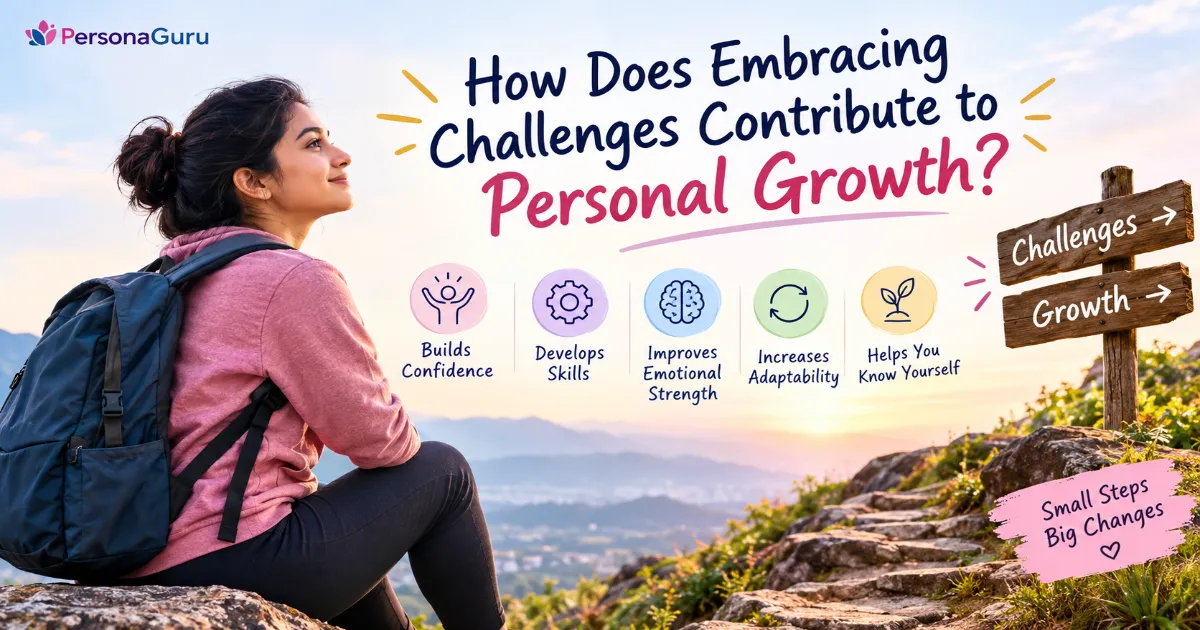
Embracing challenges contributes to personal growth because every hard task gives you proof that you can learn, adapt, and cope. You build skills, confidence, and emotional strength along the way. It works best when the challenge is big enough to stretch you, but not so big that it overwhelms you.
Embracing challenges for personal growth does not mean chasing stress. It means choosing difficult things on purpose, in small doses, and learning from the result. This guide explains how it works, what you gain, six practical ways to start, and a 30-day plan. It is one part of personality development, so read that guide too for the bigger picture.
Key Takeaways
- Embracing challenges for personal growth works because success on hard tasks builds real belief in yourself.
- Choose challenges that stretch you a little. Avoid ones that crush you.
- A failed attempt is useful information. Review it and try again with a changed plan.
- Start small. One hard thing each week is enough.
- Some challenges are too heavy to face alone. Asking for help is also part of growth.
 |
| How does Embracing Challenges Contribute to Personal Growth |
What Does It Mean to Embrace a Challenge?
To embrace a challenge means you move toward a difficult task instead of avoiding it. You accept that it may feel uncomfortable, and you decide to try anyway.
It does not mean you enjoy pain or take reckless risks. A student who decides to speak once in class is embracing a challenge. So is a clerk who asks to lead a small project. So is an adult who starts learning English after years of avoiding it.
Challenges come in two types.
| Type | Examples | What you can do |
|---|---|---|
| Chosen | Learning a skill, public speaking, a fitness goal | Set the size and the timeline yourself |
| Unchosen | Exam failure, job loss, a difficult boss | You cannot pick the event, but you can pick your response and ask for support |
This guide to embracing challenges for personal growth covers both, but it focuses on chosen challenges, because those are the ones you can use to grow on purpose.
How Does Embracing Challenges Contribute to Personal Growth?
Here are five clear ways a challenge helps you grow.
1. It Builds Real Self-Belief
Confidence does not come from positive thinking alone. It comes from doing something hard and seeing that you managed it.
Psychologist Albert Bandura called this belief self-efficacy. A summary on Simply Psychology describes mastery experiences, meaning real success on a task, as the strongest source of self-efficacy. It also notes that repeated failures tend to weaken it.
This is why size matters. A challenge that you can partly handle builds belief. A challenge that is far too big can damage it. For more on this, read our guide on self-confidence development.
2. It Builds Skills Faster Than Reading About Them
You can read ten articles on communication and still freeze in a meeting. A challenge forces you to use the skill with real people and real stakes.
Leading a small project teaches delegation. Handling a rude customer teaches patience. Giving a presentation teaches structure. The learning stays because you needed it.
3. It Trains Your Emotional Control
Challenges bring up fear, frustration, and doubt. Each time you feel these and still continue, you practice handling them.
Over time, nervousness becomes less scary because you have felt it many times and survived. Read how this connects to developing resilience for personal growth, and try these stress management techniques when the pressure rises.
4. It Makes You Adaptable
Plans change. Jobs change. Technology changes. A person who has faced unfamiliar situations before finds the next one less shocking.
Each new challenge is practice at starting from zero. That skill helps in every career and every stage of life.
5. It Shows You Who You Are
You learn what you are good at and where you need help. You also understand other people better. After you struggle with something yourself, you are more patient with others who struggle with it.
Why Mindset Decides What You Learn
Two people can face the same challenge and take away different lessons. One thinks, “I am not good at this.” The other thinks, “I am not good at this yet.”
Researchers tested this idea at a large scale. A national experiment published in Nature gave students a short online program, under one hour, that taught them that intellectual abilities can be developed. According to the Harvard Kennedy School summary of the study, it improved grades among lower-achieving students. It also found that the effect depended on school context, especially whether peers supported the message.
So beliefs about ability matter, but they work best with a supportive environment. Do not just tell yourself to think positive. Surround yourself with people who also try hard things. Read more about this in our guide on how to adopt a growth mindset and about a positive mindset for personality development.
The Right Size of Challenge
Not every challenge helps you grow. Embracing challenges for personal growth works only when the size is right. This is a practical rule of thumb, not a scientific model.
| Level | What it feels like | Result |
|---|---|---|
| Too easy | Boring, no effort needed | Little growth |
| Stretch | Slightly nervous, but you can still think clearly | Best for learning |
| Too big | Panic, freezing, wanting to quit at once | Stress and avoidance |
A simple test: if you feel a little nervous but can still plan your next step, the challenge is probably the right size. If you cannot think at all, break the task into a smaller one.
A Common Example
A first-year student is afraid to speak in class. She decides to take on a challenge.
In week one, she asks one short question. In week two, she answers one question. In week three, she shares her view in a group discussion. In week four, she gives a two-minute talk.
Her voice may still shake in week four. But she now knows she can do it. That belief spreads to interviews, group projects, and later to her first job. This is how embracing challenges for personal growth works in real life. Small steps add up.
6 Practical Ways to Embrace Challenges
These six habits make embracing challenges for personal growth easier to do every week.
1. Set Stretch Goals With a Date
Pick a goal that is slightly beyond your current level, and give it a deadline. If you want to get fit, aim for three workouts a week for a month. Then raise the target. Read our guides on goal setting and the role of deadlines in goal setting.
2. Learn One New Skill
Choose a language, an instrument, a cooking method, or a software tool. Give it 20 minutes a day. The first weeks are awkward. That awkward stage is where learning happens.
3. Do One Slightly Scary Thing Each Week
Speak in a meeting. Ask a stranger a question. Apply for a role that feels one level too high. Keep the step small enough to finish, but big enough to feel.
4. Treat Failure as Feedback
When something fails, do not decide that you are the problem. Ask three questions. Was the goal too big? Was my plan weak? Did I lack a skill? Then change one thing and try again. For a full guide, read how to overcome fear of failure.
5. Ask for Honest Feedback
Choose one or two people you trust. Ask, “What should I improve?” Listen without defending yourself. Then act on one point.
6. Track Small Wins
Keep a notebook. Write what you tried and what happened. On hard days, read the earlier pages. They show proof that you have handled difficult things before.
5 Self-Improvement Challenges You Can Try
Use these ideas for embracing challenges for personal growth in daily life.
| Challenge | What it builds | Starter version |
|---|---|---|
| 30-day fitness challenge | Discipline and energy | 15 minutes of exercise daily |
| One book a month | Critical thinking and focus | 15 pages a day. See the benefits of daily reading |
| Digital detox | Focus and calm | One phone-free hour every day. See how to stay focused on your goals |
| Public speaking challenge | Communication and confidence | Speak for two minutes to a small group. Read how to overcome fear of public speaking |
| Learn a skill | Patience and adaptability | 20 minutes of practice, six days a week |
You can also combine several into one month. See how to transform your personality in 30 days for a longer plan.
What If the Challenge Does Not Go Well?
Sometimes it will not. You will miss the target, forget your lines, or quit in week two. That is normal.
Do not judge the whole experience by one result. Look at what you learned, and what you will do differently. A failed attempt that you review teaches more than an easy win that you do not think about.
When a Challenge Is Too Much
Be honest about this part. Not every hard situation is a growth opportunity. Long-term stress, grief, or health problems can hurt you instead of helping you.
Growth does not mean you must handle everything alone. If you feel hopeless, cannot sleep for weeks, or cannot function at work or school, speak with a doctor or a qualified counselor. This article is general information and not medical advice.
A 30 Day Plan
Use this plan for embracing challenges for personal growth over one month.
| Week | Focus | Action |
|---|---|---|
| 1 | Choose | Pick one challenge and write the exact target and date |
| 2 | Start small | Do the starter version every day. Track it in a notebook |
| 3 | Stretch | Increase the difficulty by about 10 to 20 percent |
| 4 | Review | Ask for feedback. Write what you learned and pick the next challenge |
Common Mistakes to Avoid
Avoid these mistakes when embracing challenges for personal growth.
- Starting too big. A giant goal leads to quitting. Start with a small one.
- Taking on five challenges at once. Pick one.
- Comparing yourself with others. Compare with your own past.
- Ignoring rest. Tired people learn less.
- Skipping the review. The learning happens when you look back.
Conclusion
Embracing challenges for personal growth is not about being fearless. It is about moving forward while you are still a little afraid. Each small success builds belief, skill, and calm.
Start this week. Choose one challenge from the list, make it small, and give it a date. Then write down what you learned.
To see how this fits with other skills, read about good habits for personality development and the 12 key aspects of personality development.
FAQs
How does embracing challenges contribute to personal growth? It builds skills, confidence, and emotional strength by giving you real proof that you can handle difficult tasks. The challenge must be big enough to stretch you, but not so big that it overwhelms you.
Why is it important to embrace challenges? Challenges help you learn faster, adapt to change, and understand your own strengths. Without them, growth slows because you only repeat what you already know.
How can I start embracing challenges for personal growth? Pick one small task that makes you slightly nervous, give it a date, and review the result. Start with one challenge a week, not five.
How can I challenge myself every day? Pick one small task that makes you slightly nervous, such as asking a question, learning 10 new words, or exercising for 15 minutes. Keep it small and repeat it daily.
What if I fail at a challenge? Treat it as feedback. Ask whether the goal was too big, the plan was weak, or you lacked a skill. Then change one thing and try again.
Are all challenges good for personal growth? No. Challenges that are too large or that cause long term distress can harm you. Choose a size that stretches you, and ask for help if stress becomes too heavy.

Ayanshi is the founder of PersonaGuru.in, a blog focused on personality development, career, relationships, and mental well-being. With over 3 years of writing experience, she turns psychology and everyday experiences into practical, easy-to-understand advice for real life.