
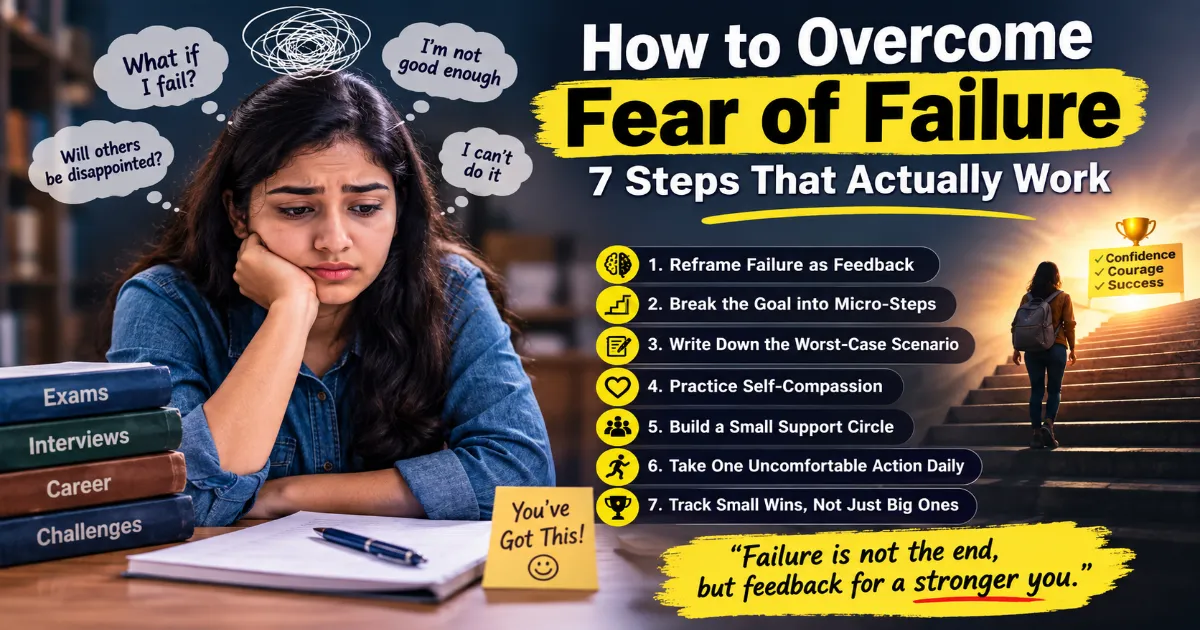
Naina sat outside the exam hall an hour early. Her revision was done. Her notes were done. But one thought kept looping in her head: what if I fail?
That question can freeze even the most prepared person. It has a name: fear of failure. It shows up before exams, before interviews, before you hit submit on something you care about. If you have felt it too, you are not overreacting. You are human.
This article covers where fear of failure comes from, how to spot it in yourself, and how to overcome fear of failure with seven steps that actually work.
Key Takeaways
- Fear of failure usually starts with childhood criticism, past setbacks, or marks-based pressure at home.
- Common signs include overthinking, procrastination, avoiding new challenges, and harsh self-talk over small mistakes.
- Reframing failure as feedback and breaking your goal into small, low-stakes steps is one of the most useful ways to loosen its grip.
- Students facing fear of failure in exams need practice under real-time pressure, not just more revision.
- You do not think your way out of it. You act your way out, one small step at a time.
In short: Fear of failure is the anxious pull that stops you from trying, trying again, or taking a healthy risk. You can work through it by treating failure as feedback, shrinking your goal into small steps, being kind to yourself after mistakes, and taking one uncomfortable action daily until courage outweighs the fear.
What Causes Fear of Failure? (The Root Cause)
This fear rarely appears overnight. It builds up over years, one experience at a time.
Childhood Criticism and Perfectionism
Praise only for results, rarely for effort, teaches a dangerous rule early: my worth equals my score. Over time, this hardens into perfectionism, where anything short of flawless feels like failure, not a normal part of learning.
Past Failures That Left a Mark
A humiliating moment in class. A rejected application. A relationship that ended badly. One sharp memory can attach itself to an entire category of effort. The brain then avoids that category just to dodge the pain again.
Marks-Based Family Pressure
In many Indian homes, approval gets tied to percentage or rank. A child who scores 85% instead of 95% can feel like they let the family down, not just missed a target. For many Indian students, this kind of comparison culture is a significant, and often under-discussed, contributor to fear of failure.
Signs You Might Have Fear of Failure (Self-Check)
It does not always look like fear. Often it looks like laziness, indecision, or perfectionism. That is exactly why it stays hidden for years.
| Sign | What It Actually Looks Like |
|---|---|
| Chronic procrastination | Delaying a task to dodge a possible bad result, not from laziness |
| Overpreparing, never starting | Endless research or revision that never becomes action |
| Avoiding new challenges | Sticking only to what you already know you are good at |
| Harsh self-talk after mistakes | Calling yourself “stupid” or “useless” over one small error |
| Constant reassurance-seeking | Repeatedly asking others if your work is good enough |
| Physical symptoms before big moments | Racing heart, upset stomach, or sleeplessness before exams or interviews |
If several of these sound familiar, this fear may be playing a bigger role in your decisions than you realised. Building your everyday self-confidence is one of the fastest ways to weaken this pattern at its root.
How to Overcome Fear of Failure: 7 Practical Steps
Kabir, a final-year engineering student, had a placement interview in two days. He had the skills. He had the marks. But every time he opened his laptop to prepare, he shut it again within minutes, telling himself he would “start properly tomorrow.” That loop is fear of failure in action. Here is how to overcome fear of failure, in the exact order that moved Kabir past it.
Step 1: Reframe Failure as Feedback, Not Identity
A rejected interview is not proof you are not good enough. It is one data point telling you what to adjust next. Separate what happened from who you are.
Step 2: Break the Goal into Micro-Steps
“Prepare for the interview” feels huge, so the brain avoids it. “Review five common questions today” feels doable, so the brain accepts it. Smaller steps lower the stakes of each attempt.
Step 3: Write Down the Worst-Case Scenario
Most of this fear lives in imagination, not reality. Write down what would actually happen if you failed. Usually, the honest answer is: uncomfortable, but survivable.
Step 4: Practice Self-Compassion Over Self-Criticism
Talk to yourself the way you would talk to a close friend who just messed up. The American Psychological Association has written about why self-compassion helps people recover from mistakes faster than harsh self-criticism does, since it supports recovery rather than prolonging it.
Step 5: Build a Small Support Circle
Tell one trusted person what you are attempting. It grows in isolation and shrinks the moment someone else knows what you are trying to do.
Step 6: Take One Uncomfortable Action Daily
Send the email. Ask the question in class. Submit the application before it feels ready. Confidence follows action. It rarely arrives first.
Step 7: Track Small Wins, Not Just Big Ones
Keep a simple list of things you attempted this week, whatever the outcome. Over time, this list becomes proof that trying is safe. That proof is one of the more reliable antidotes to fear of failure.
How to Overcome Fear of Failure as a Student
Student life adds its own layer to fear of failure: boards, entrance exams, and constant comparison with classmates.
Before Board and Competitive Exams
Practice under exam-like time pressure at least twice a week, not just untimed revision. This builds tolerance for the anxiety you will feel on the actual day, so it feels familiar instead of overwhelming. A short breathing routine before the paper starts can also help you feel calmer as you begin.
Handling Comparison with Toppers or Siblings
Constant comparison to a topper or an older sibling can quietly turn every exam into a verdict on your worth. Keep a private log of your own progress instead: marks, mock scores, weak topics improved, so your benchmark becomes your past self, not someone else’s result.
How to Overcome Fear of Failure at Work and in Career
This fear does not end once you finish studying. It just changes shape.
Before Interviews
Mock interviews, even imperfect ones, reduce it far more than silent preparation does. They let you practise recovering from an awkward answer instead of just avoiding the possibility of one. If interview nerves are a recurring problem, our guide on improving your self-career perception before an interview breaks this down step by step, and our broader piece on self-career perception explains why this mindset shift matters in the first place.
When Starting a New Business or Side Project
Fear of failure shapes major decisions well beyond the workplace. The Global Entrepreneurship Monitor 2024/2025 report from the University of Glasgow, co-authored by researchers including Professor Sreevas Sahasranamam, found that among people worldwide who saw a good opportunity to start a business, the share who held back purely because they feared failure rose from 42% in 2019 to 47% in 2024. The finding is specific to entrepreneurial decisions rather than fear of failure in general, but it shows how much this one emotion can shape whether a good idea ever gets tested.
Starting small changes this equation. A pilot version, one paying customer, one quick test, lets you learn fast without risking everything on a single outcome.
How to Help Someone Else Dealing with Fear of Failure
If someone you care about is struggling with it, resist saying “just don’t worry about it.” It rarely helps and can feel dismissive. Instead:
- Ask about their effort and process, not just the final result.
- Share a genuine story of your own failure and what you learned from it.
- Avoid comparing them to siblings, friends, or classmates, even with good intentions.
- Point them toward one small next step, not the whole overwhelming task.
- Be someone they can tell about an attempt without fear of judgment.
Sometimes the most useSometimes the most useful thing you can say to someone dealing with it is simply: it’s okay, try anyway, I’m not going anywhere. That single sentence often teaches someone how to overcome fear of failure faster than any advice does.ul thing you can say to someone dealing with it is simply: it’s okay, try anyway, I’m not going anywhere.
Michael Jordan once reflected on the many shots he missed and games he lost over his career, using those failures as part of the reason he kept succeeding.
Building a Long-Term Relationship With Failure
Overcoming fear of failure is not a one-time fix. It works more like a habit, built the same way willpower is built: through small, consistent practice rather than one big burst of motivation. Your locus of control, how much you believe your own effort shapes outcomes, plays a direct role here too. People who believe their actions matter tend to recover from failure faster than people who feel results are purely down to luck.
If self-doubt after a setback tends to spiral into avoiding effort altogether, it is worth reading about self-sabotage as well, since the two patterns often travel together.
The American Psychological Association notes that resilience is not a fixed trait but a set of skills that can be learned and strengthened over time. Treating one bad result as one bad result, rather than a verdict on your ability, is often the real turning point in overcoming fear of failure.
Conclusion
Learning how to overcome fear of failure is not about waiting for the fear to disappear. It is about acting alongside it, one small, honest step at a time, until the fear carries less weight than your effort does. Start with one step from this guide today. That single step is usually enough to break the freeze.
FAQ
What is the root cause of fear of failure?
It usually comes from childhood experiences where approval felt conditional on results, combined with one or more sharp past failures that left a lasting emotional mark.
How can I stop being scared of failure quickly?
You cannot erase fear of failure instantly. But you can shrink it fast by picking one small, low-stakes step and doing it today instead of waiting to feel ready.
Can you actually train your brain to not feel fear?
You cannot remove fear completely, and you should not try to. What you can train is your response to it, so fear becomes a signal to prepare rather than a reason to freeze. Repeated, gradual exposure to small risks builds this tolerance over time, a principle used widely in modern exposure-based anxiety treatment.
Is fear of failure the same as fear of success?
No. It is anxiety about not meeting a standard. Fear of success is discomfort with the visibility or expectations that follow doing well. The two can overlap, but they are not the same.
Does fear of failure affect students more than working professionals?
It affects both, just in different forms. Students usually feel it around marks and exams. Professionals usually feel it around promotions, career changes, or public mistakes at work. The underlying avoidance pattern is the same either way.
How do I help my child if they seem afraid of failing?
Praise their effort and strategy more than the final score, and normalise talking about your own mistakes at home. Children pick up their emotional cues about failure directly from how the adults around them react to it.

Ayanshi is the founder of PersonaGuru.in, a blog focused on personality development, career, relationships, and mental well-being. With over 3 years of writing experience, she turns psychology and everyday experiences into practical, easy-to-understand advice for real life.