
Last updated on September 13th, 2026 at 11:53 am
You just got promoted. Your manager praised your work in front of the whole team. And yet, somewhere in your head, a small voice whispers, “They made a mistake. It’s only a matter of time before everyone finds out you don’t actually deserve this.”
If that voice sounds familiar, you are not broken, and you are not alone. This feeling has a name: imposter syndrome. It shows up in top students, first-time managers, artists, doctors, and even Oscar winners, often right at the moments when your career and workplace growth should feel exciting instead of anxiety-inducing.
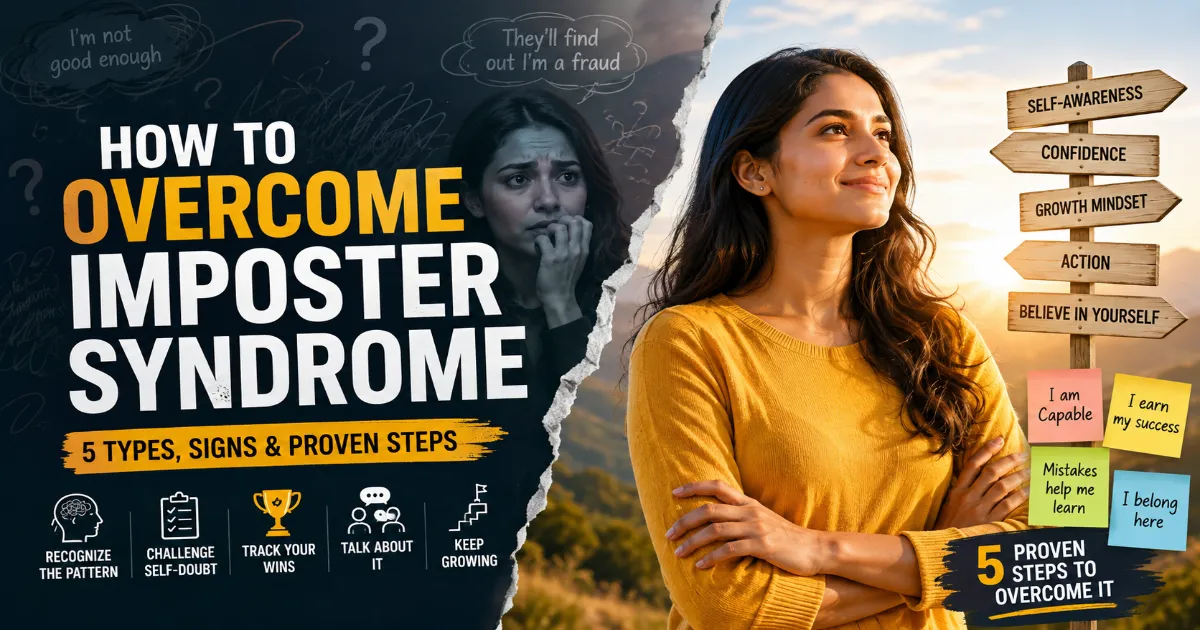
The good news? How to overcome imposter syndrome is no longer a mystery. Psychologists have studied it since the 1970s, and there are clear, practical steps that actually work. This guide walks you through what it is, why it happens, the five types, and exactly how to overcome imposter syndrome for good.
Quick Answer
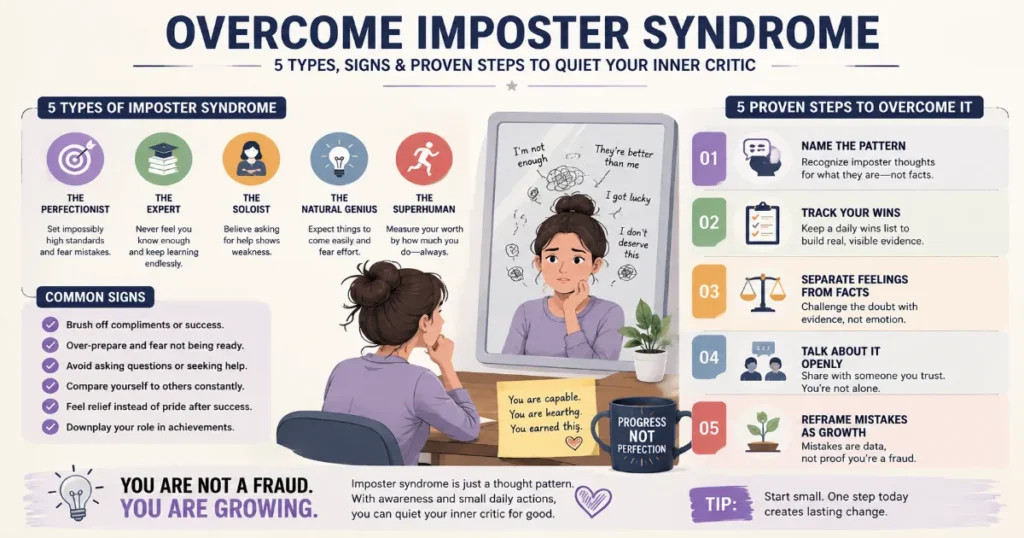
If you are wondering how to overcome imposter syndrome, the short version is this: name the pattern, separate feelings from facts, track your real wins, talk about it openly, and reframe mistakes as growth instead of proof you are a fraud. Imposter syndrome is the persistent feeling that you don’t deserve your success, even when there’s clear proof you earned it.
Key Takeaways
- Imposter syndrome affects an estimated 7 in 10 people at some point in their career, not just a few “unlucky” ones.
- There are 5 distinct types: the Perfectionist, the Expert, the Soloist, the Natural Genius, and the Superhuman.
- It is not a mental illness. It’s a thinking pattern, and thinking patterns can be changed with practice.
- Keeping a simple “wins list” is one of the fastest, most practical ways to learn how to overcome imposter syndrome.
- High achievers feel it more, not less, because their standards for themselves are so high.
What Is Imposter Syndrome?
The simplest imposter syndrome meaning is this: it’s the nagging belief that your success is due to luck, timing, or other people being fooled, and not your actual skill. It’s also called imposter phenomenon in academic research, and it’s one of the more common blind spots covered under personality development as a whole.
Psychologists Pauline Clance and Suzanne Imes first described this pattern back in 1978. They noticed it repeatedly in high-achieving women who couldn’t accept that their success came from real ability. Since then, research from the American Psychological Association has shown the pattern is far more widespread, cutting across gender, industry, and background.
Here’s the twist: feeling this way once in a while is actually normal, even healthy. A small dose of self-doubt can keep you humble and push you to prepare well. The problem starts when that doubt becomes constant, and it stops you from applying for the promotion, sharing your idea, or accepting a compliment.
Meera, a 26-year-old software developer in Pune, put it simply during a team stand-up: “I built this feature myself, but I still feel like someone’s going to ask me to prove I actually know how to code.” That single sentence sums up what millions of people quietly feel every day.
Do I Have Imposter Syndrome? (Signs to Watch For)
Not sure if what you are feeling is imposter syndrome or just normal work stress? Here are the most common signs of imposter syndrome to watch for:
- You brush off compliments with “I got lucky” or “It wasn’t a big deal.”
- You over-prepare for tasks you’re already qualified to do.
- You avoid asking questions because you’re scared people will realize you don’t know everything.
- You compare your behind-the-scenes struggles to everyone else’s highlight reel.
- You feel a rush of relief, not pride, when a project goes well, because you “got away with it.”
- You struggle to say “I did that” and instead say “we got lucky” even when the work was mostly yours.
If three or more of these sound like you, you’re likely dealing with imposter syndrome, not a genuine skill gap.
What Can Be Mistaken for Imposter Syndrome?
Imposter syndrome often overlaps with, but isn’t the same as, a few other things:
| Condition | How It’s Different |
|---|---|
| Low self-esteem | Low self-esteem is a general negative view of yourself in all areas of life. Imposter syndrome is specific to achievements and competence. |
| Anxiety | Anxiety is a broader stress response. Imposter syndrome is one possible trigger for anxious thoughts, not the same condition. |
| Perfectionism | Perfectionism is about setting impossibly high standards. It often feeds imposter syndrome but isn’t identical to it. |
| Genuine skill gap | Sometimes you really don’t know something yet, and that’s fine. Imposter syndrome is doubting skills you already have proof of. |
Getting this distinction right matters. If it’s a genuine skill gap, the fix is learning. If it’s imposter syndrome, the fix is changing how you talk to yourself, because the skill was already there.
What Triggers Imposter Syndrome?
Imposter syndrome rarely appears out of nowhere. It’s usually set off by specific situations, and many of the same factors affecting self-esteem also fuel this pattern:
- Starting a new job or being promoted into a bigger role
- Being the only person from your background, gender, or age group in the room
- Comparing yourself to others on social media or LinkedIn
- Growing up with parents who praised results but rarely effort
- Working in highly competitive fields like tech, medicine, or academia
- A single piece of harsh feedback that overshadows years of good work
Who Is Most Prone to Imposter Syndrome?
Recent workplace research highlighted by Asana’s 2026 report on impostor syndrome at work found that younger leaders report it far more often, with close to half of leaders aged 24 to 44 saying they frequently feel like a fraud, compared to less than a quarter of leaders aged 55 and above. This is worth remembering if you’re stepping into a leadership role for the first time, since the feeling tends to spike right when your responsibilities grow.
Interestingly, intelligence doesn’t protect you from it. If anything, high-IQ individuals and high achievers often feel it more, because their internal bar for “good enough” keeps rising every time they succeed. Students in competitive courses, first-generation professionals, and people switching careers also report it heavily, simply because they’re constantly operating without a built-in sense of “I’ve done this before.”
5 Types of Imposter Syndrome
Psychologist Dr. Valerie Young studied thousands of high achievers and found the pattern usually shows up as one of five distinct types. Knowing your type makes it much easier to fix, because each one needs a slightly different approach.
1. The Perfectionist
You set impossibly high standards, and even 99% correct feels like failure. A single typo in an otherwise flawless report can ruin your whole day.
Fix: Set a “good enough” bar before you start a task, not after. Decide in advance what “done well” looks like, so 90% doesn’t feel like a loss.
2. The Expert
You feel you can never know enough, so you keep collecting certificates and courses instead of applying what you already know. You avoid raising your hand in meetings because you’re “still learning.”
Fix: Make a list of things you already know that you didn’t know a year ago. That list is proof you’re growing, not proof you’re behind.
3. The Soloist
You believe asking for help is a sign of weakness, so you take everything on yourself and quietly struggle.
Fix: Ask for one small piece of help this week, on purpose. Notice that nobody thinks less of you. That single experience rewires the fear faster than any pep talk.
4. The Natural Genius
You expect skills to come easily, and if something takes real effort, you assume you’re simply not cut out for it.
Fix: Pick up something completely new, like a sport or a language, purely to relearn what it feels like to be a beginner and improve slowly. It rebuilds your tolerance for struggle.
5. The Superhuman
You measure your worth by how much you can juggle, so you keep saying yes until you burn out.
Fix: Rohan, a marketing manager in Bengaluru, realized he was a classic Superhuman when he hadn’t taken a weekend off in four months. He started blocking “no meeting” time on his calendar like a real appointment, and treated it as non-negotiable. Within a month, his focus and output actually improved.
What Are the “Three C’s” of Imposter Syndrome?
You may come across the phrase “three C’s of imposter syndrome” while researching this topic, and it’s worth a quick clarification: there isn’t one single, universally agreed definition. Different experts use it differently.
- Authors Lisa and Richard Orbé-Austin describe their three C’s as Clarify, Choose, and Create, a step-by-step framework from their book on overcoming imposter syndrome at work.
- Some therapists frame it as Criticism, Comparison, and Compensation, the three habits that keep the cycle going.
- Others use Context, Characteristics, and Coping, as a way to understand where imposter feelings come from and how to manage them.
Rather than picking one “correct” version, the useful takeaway is this: whichever framework you use, they all point to the same three-step process: recognize the pattern, understand what’s fuelling it, and build a coping strategy that’s specific to you.
How to Overcome Imposter Syndrome: Step-by-Step
This is the part that actually changes things. Small, repeated actions work better than one big mindset shift, and they pair well with the steps in our guide to building self-esteem, since the two patterns feed each other.
1. Name It Out Loud
Say the words “this is imposter syndrome” the next time the feeling hits. Naming a pattern takes away a surprising amount of its power, because you stop treating the thought as fact and start treating it as a familiar visitor.
2. Keep a Wins File
Open a note on your phone and add one small win every single day, no matter how minor. On hard days, scroll through it. This is one of the fastest, most practical fixes, because it replaces vague self-doubt with specific evidence.
3. Separate Feelings From Facts
Feeling like a fraud is not the same as being one. When the thought comes, ask yourself: “What is the actual evidence for and against this?” Nine times out of ten, the evidence doesn’t support the fear.
4. Talk to Someone You Trust
Share the feeling with a mentor, senior colleague, or friend. You will almost always hear some version of “I feel that too.” That shared relief is powerful, and it’s backed by research too: studies estimate that roughly seven in ten people experience impostor feelings at some point in their lives, so the odds are good that the person you tell already understands exactly what you mean.
5. Reframe Mistakes as Data, Not Verdicts
A mistake doesn’t prove you’re a fraud. It proves you’re doing something hard enough to occasionally get wrong. Treat it as information for next time, not a final judgment on your worth.
How to Snap Out of Imposter Syndrome Quickly
When the feeling hits right before a big meeting or presentation, you don’t have time for deep reflection. Try this instead:
- Take three slow breaths and name the feeling silently: “This is imposter syndrome, not truth.”
- Recall one specific past success related to the task ahead, in detail.
- Remind yourself: you were invited or chosen for a reason, and that reason still exists.
This quick version won’t fix the long-term pattern, but it will get you through the next ten minutes with a steadier head.
60-Second Self-Check: Do You Have Imposter Syndrome?
Answer yes or no to these four questions:
- Do you regularly credit your success to luck rather than skill?
- Do you feel anxious right after receiving praise, expecting to be “found out”?
- Do you avoid opportunities you’re qualified for because you don’t feel “ready enough”?
- Do you downplay your role when a team project succeeds?
Score: 3-4 “yes” answers = Strong imposter syndrome pattern, worth actively working on. 1-2 “yes” answers = Mild, situational imposter syndrome. 0 “yes” answers = You have a healthy, realistic view of your abilities.
Imposter Syndrome in Specific Situations
At Work or In a New Job
Imposter syndrome at work is one of the most common versions of this feeling. New roles bring a natural learning curve, but it tricks you into believing you should already know everything on day one. Give yourself the same 90-day grace period you’d give any new hire, and pair it with our guide on confidence strategies for career success for a fuller picture of building workplace confidence.
In College or Grad School
Surrounded by other high achievers, it’s easy to assume everyone else understands the material better than you do. In reality, most of your classmates are silently thinking the exact same thing. This is closely tied to how you see your own career perception and self-worth, which shapes how confident you feel long after graduation too.
As a High-Achieving Woman
Research consistently shows imposter syndrome hits women particularly hard in male-dominated fields, often tied to being one of the few people in the room who look like them. Building a support network of peers facing the same environment makes a measurable difference.
In a Relationship
Imposter syndrome isn’t limited to careers. Some people feel like a “fraud” in relationships too, quietly wondering if they deserve their partner’s love. The same core fix applies: separate the anxious feeling from the actual evidence of how your partner treats you.
Is Imposter Syndrome Curable?
Imposter syndrome is not classified as a medical condition, so there’s no “cure” in the clinical sense. But it is absolutely treatable and manageable. Most people who actively practice the steps above see a real, noticeable drop in intensity within a few months.
Think of it less like a disease you cure once, and more like a habit you keep in check, the same way you’d manage stress or a short temper. It rarely disappears completely, but it stops running the show.
Famous People Who’ve Felt Like Imposters
You’re in good company. Actress Emma Watson has openly spoken about feeling like a fraud despite her success, admitting the more people praised her work, the more she feared being exposed. Even after writing eleven acclaimed books, Maya Angelou once admitted she still quietly feared people would eventually realize she hadn’t truly earned her success. Astronaut and former NASA chief scientist Ellen Ochoa has spoken about grappling with the same doubts early in her scientific career.
If some of the most accomplished people in the world still wrestle with this feeling, it’s clear proof that imposter syndrome has nothing to do with your actual ability.
Conclusion
Learning how to overcome imposter syndrome ultimately comes down to one shift: trusting evidence over emotion. You are allowed to feel unsure sometimes. What matters is that you don’t let that feeling make your decisions for you.
Start small. Pick one step from this guide, whether it’s naming the pattern, starting a wins file, or having one honest conversation, and try it this week. That inner voice telling you that you don’t belong has been wrong before, and it’s wrong now too. The more you practice how to overcome imposter syndrome in small, daily ways, the quieter that voice gets.
If self-doubt has been holding you back beyond just this one feeling, our guide on self-confidence development breaks down the deeper roots of confidence and how to rebuild it step by step. And if this shows up mostly at your job, how to stop self-doubt at work covers workplace-specific strategies that pair well with everything above.

Ayanshi is the founder of PersonaGuru.in, a blog focused on personality development, career, relationships, and mental well-being. With over 3 years of writing experience, she turns psychology and everyday experiences into practical, easy-to-understand advice for real life.