
Last updated on September 13th, 2026 at 11:51 am
Aryan had just been promoted to team lead at his IT firm in Pune. On day one, he tried to manage a five-year veteran the same way he managed a fresh graduate. Both felt frustrated within a week. His manager pulled him aside and said something he never forgot. Good leadership is not one style repeated on everyone. It is the right style for the right person at the right moment. Reading real situational leadership theory examples like this one is often the fastest way to actually understand the model.
That single idea is the heart of situational leadership theory. Below, you will find real situational leadership theory examples drawn from Indian offices, colleges, sports teams, and even family businesses, so you can actually picture how each style works before you try it yourself.
Key Takeaways
- Situational leadership means changing your style based on a person’s skill and confidence, not applying one fixed approach to everyone.
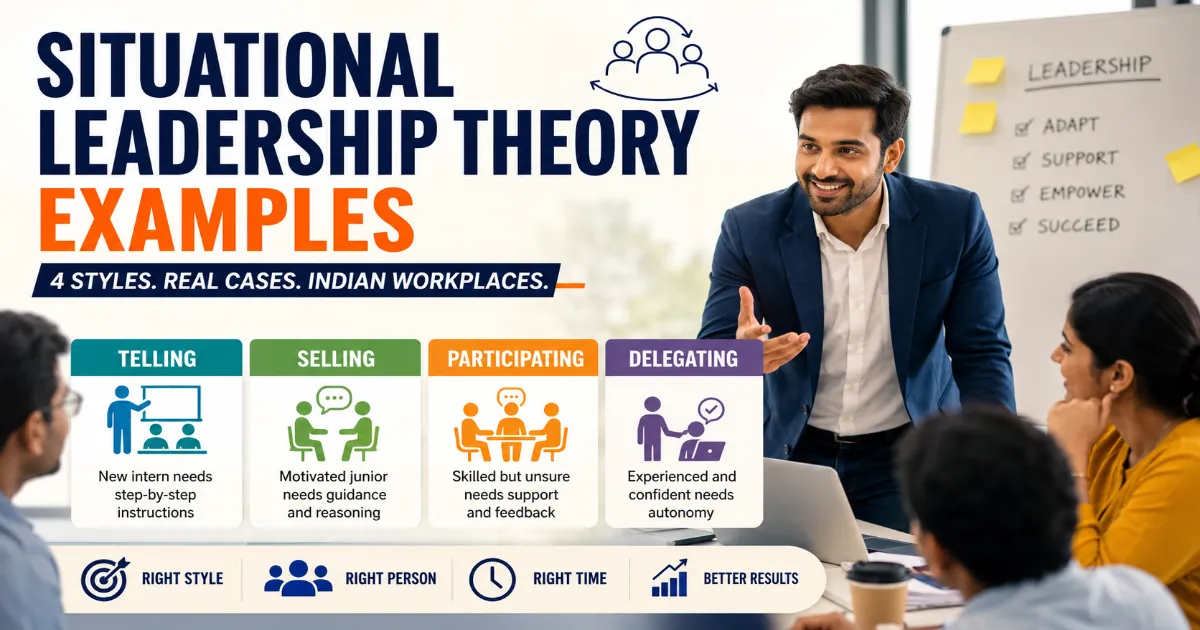
- There are four core styles: Telling, Selling, Participating, and Delegating.
- The right style depends mainly on the person’s competence and commitment for that specific task, not on their personality overall.
- A leader’s style is meant to change as the same person grows, not stay fixed forever.
- Gallup research links manager quality directly to team engagement, which is why situational skill matters beyond theory.
What Is Situational Leadership Theory? (Quick Answer)
Situational leadership theory says that no single leadership style works for every person or every task. A leader studies how skilled and how confident someone is, then picks between four styles: Telling, Selling, Participating, or Delegating. As the person grows more capable, the leader gradually steps back and hands over more control.
The model was first published by Paul Hersey and Ken Blanchard in 1969 as the “Life Cycle Theory of Leadership” while both were teaching at Ohio University. In the mid-1970s, it was renamed Situational Leadership, and it remains one of the most widely taught leadership frameworks in management courses today. If you want the fundamentals first, our complete guide to leadership covers the meaning, objectives, and traits that sit behind every leadership model, including this one.
4 Situational Leadership Styles, With Real Examples
Each style pairs a level of direction with a level of support. Here is what that actually looks like on the ground, not just on a slide. The situational leadership theory examples below are drawn from real workplaces, not textbook scenarios. If you are curious how this framework compares to other models, our breakdown of the types of leadership styles is worth reading alongside this one.
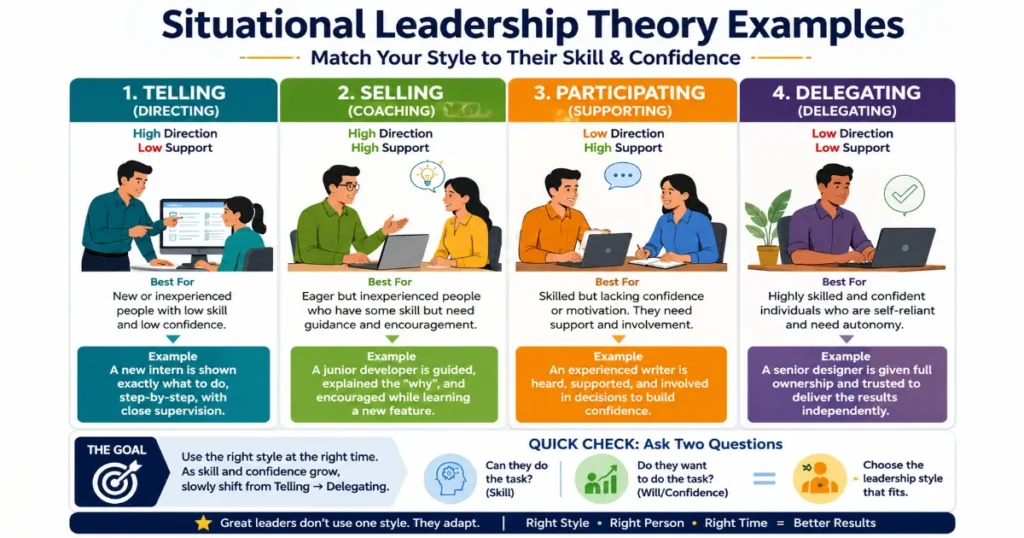
1. Telling (Directing): High Direction, Low Support
This style suits someone who is new to a task and needs clear, step-by-step instructions. There is little back and forth here. The leader decides, explains exactly what to do, and checks the work closely.
Example: Kavya joined a Mumbai marketing agency straight out of college. On her first project, her manager did not ask for her opinion on strategy. He gave her a checklist, showed her exactly how to format the client report, and reviewed her draft line by line. She had zero prior experience, so structure mattered more than freedom.
2. Selling (Coaching): High Direction, High Support
Here, the person still needs guidance, but they also bring energy and curiosity. The leader keeps giving direction, while also explaining the reasoning and inviting questions.
Example: Naina, a junior developer, was asked to build a small feature for a college placement portal. Her team lead did not hand her a finished specification and walk away. He explained the logic behind each decision, answered her questions patiently, and let her attempt parts of the code herself before reviewing it together.
3. Participating (Supporting): Low Direction, High Support
This style fits someone who already has the skill but lacks confidence. The leader stops giving instructions and instead listens, encourages, and shares the decision-making.
Example: Kabir had written strong content for two years, but felt unsure about handling a large pharmaceutical client for the first time. His manager did not tell him what to write. Instead, she sat with him, talked through his worries, and let him make the final call on tone and structure. He needed reassurance, not direction, which is a gap our guide on self-confidence development explores in more detail.
4. Delegating: Low Direction, Low Support
This is reserved for people who are both skilled and self-driven. The leader steps back almost completely and trusts the outcome.
Example: After four years at the same design studio, Aryan’s colleague Meher was given full ownership of the annual client showcase. Nobody checked her drafts weekly. Nobody sat in her creative meetings. She already had the technical skill, understood the client’s expectations, and had a track record of delivering without close supervision. Giving her detailed instructions at this point would have added control without adding any real value, so her manager stepped back and let her run the project.
Situational Leadership Theory Examples in the Workplace
Indian workplaces rarely fit neatly into one style for an entire team. A single manager often uses all four styles in the same week, sometimes in the same day.
| Employee Type | Skill Level | Confidence Level | Style Used |
|---|---|---|---|
| New hire, first job | Low | Low to medium | Telling |
| Eager but inexperienced | Low to medium | High | Selling |
| Skilled but nervous | High | Low to medium | Participating |
| Experienced and independent | High | High | Delegating |
A family-run textile business in Surat shows this well. The founder trains a new floor supervisor with the Telling style. Once that supervisor learns the ropes but hesitates on pricing decisions, the founder shifts to Participating, sitting beside them during client calls instead of dictating terms.
Example: New employee in customer support
Priya joined a Bengaluru fintech startup’s support team with no prior call-centre experience. Her supervisor started with Telling, sitting beside her and providing exact scripts for common complaints. Within six weeks, Priya was handling standard queries confidently but still checked in often for reassurance. Her supervisor shifted to Selling, walking her through trickier cases together instead of simply issuing scripts.
Example: Experienced employee given a new responsibility
Rohan had managed the same product line for three years and knew it inside out. When he was asked to lead a brand-new category launch, his manager did not treat him like a beginner. Because Rohan already had strong project skills, she used Participating at first, discussing the launch plan with him as a partner rather than an instructor. Once he delivered the first milestone on time, she moved fully into Delegating and let him run the rest of the launch independently.
Situational Leadership Theory Examples in Real Life
Situational leadership is not limited to offices. It shows up anywhere one person guides another toward a goal.
- Sports coaching: A cricket coach uses Telling with an under-14 player learning a new grip, then shifts to Delegating once that same player is ready to choose their own shot selection in a match. If you want to see how coaching styles shape personal growth further, our guide on the role of sports in personality development breaks this down in more depth.
- Parenting: A parent gives strict, detailed instructions to a six-year-old crossing the road, but gradually shifts to Delegating by the time that child is sixteen and driving independently.
- College group projects: A final-year student leading a group project tells a first-year junior exactly what data to collect, but simply checks in occasionally with a senior batchmate who already knows the process.
- Teacher and student: A school teacher walks a struggling student through each step of solving an equation, but with a student who already grasps the concept, she simply poses a harder problem and steps back, trusting them to work through it on their own.
Hersey and Blanchard’s Situational Leadership Theory Examples: Where It Came From
Paul Hersey and Ken Blanchard did not build this model in a boardroom. They built it while teaching organisational behaviour together at Ohio University in the late 1960s. Their original model focused on matching a leader’s behaviour to the development and readiness level of the person being led, rather than sticking to a single fixed style. That single shift in thinking is still the foundation every “situational leadership theory examples” search is really trying to understand.
If you want to go deeper into the academic background of this model, the EBSCO Research Starters overview of situational leadership theory documents its development through the 1970s in more academic detail.
How to Identify Which Style You Actually Need
Most people overcomplicate this. It comes down to two honest questions about the person in front of you. Almost every one of the situational leadership theory examples shared above traces back to these two questions. Reading these signals well is itself a form of emotional intelligence, which is why leaders who are naturally attuned to others tend to switch styles more smoothly.
Question 1: Can they do the task? This is skill.
Question 2: Do they want to do the task? This is will.
| Skill | Will / Confidence | Best Style | What the Leader Does |
|---|---|---|---|
| Low | Low | Telling | Gives clear instructions and close guidance |
| Low | High | Selling | Explains, coaches, and encourages |
| High | Low | Participating | Supports and involves the person in decisions |
| High | High | Delegating | Gives ownership and steps back |
As Ken Blanchard himself is often quoted as saying, none of us is as smart as all of us, a reminder that leadership works best when it adapts to the person, not the other way round.
Why This Actually Matters (Not Just Theory)
This is not an academic exercise. Gallup’s widely cited manager research puts the figure at around 70 percent of the difference in how engaged a team feels coming down to the manager alone. A leader who keeps using Telling on someone ready for Delegating will drain that person’s motivation, even if their intentions are good. You can explore Gallup’s ongoing workplace research if you want to read more on this.
Advantages and Disadvantages of Situational Leadership
Like any model, the situational leadership theory examples in this article also come with real trade-offs worth knowing before you apply the approach.
Advantages
- Adapts naturally as team members grow
- Reduces micromanagement once trust is built
- Works across industries, from IT to teaching to sports
Disadvantages
- Requires the leader to read people accurately, which takes practice
- Can feel inconsistent if not explained to the team
- Difficult to apply well under constant time pressure
A Few Practical Tips Before You Try This
- Do not assume skill level. Ask a new team member directly what they have handled before.
- Revisit your assessment every few months. A person’s readiness changes.
- Explain your style shift out loud. Saying “I am stepping back because I trust this now” prevents confusion.
- Watch for over-Telling. It is the most common trap for new managers, and it kills initiative fastest.
For a deeper look at how leadership style connects to your own personality and workplace presence, our career and workplace growth guide covers this alongside other professional skills. If you want a step-by-step path for growing into these styles over time, our guide on the process of leadership development is a natural next read.
Conclusion
There is no single correct way to lead every person you manage. The situational leadership theory examples in this article show the same core idea again and again: a new employee needs direction, a nervous but skilled employee needs support, and an experienced employee needs space. Watch the person in front of you, not a fixed playbook, and adjust your style as they grow.
Frequently Asked Questions
1. What is an example of situational leadership?
A manager giving detailed step-by-step instructions to a brand-new employee, then gradually stepping back to full delegation once that same employee becomes skilled and confident, is a classic example of situational leadership in action.
2. What are the four styles of situational leadership?
The four styles are Telling (high direction, low support), Selling (high direction, high support), Participating (low direction, high support), and Delegating (low direction, low support).
3. What are situational leadership theory examples in the workplace?
Common workplace examples include a new hire receiving close guidance during onboarding, a junior employee being coached through their first big task, and an experienced team member being trusted with full ownership of a project.
4. How do you choose the right situational leadership style?
Assess the person’s competence for the specific task and their commitment or confidence in doing it. Low competence generally calls for more direction, while high competence and commitment call for more delegation.
5. Who introduced situational leadership theory?
Paul Hersey and Ken Blanchard introduced it in 1969 while teaching at Ohio University, originally naming it the Life Cycle Theory of Leadership.
6. What are the key principles of situational leadership?
The core principle is that leadership style should match the follower’s competence and commitment for a given task, and that this match should be reassessed regularly as the person develops.

Ayanshi is the founder of PersonaGuru.in, a blog focused on personality development, career, relationships, and mental well-being. With over 3 years of writing experience, she turns psychology and everyday experiences into practical, easy-to-understand advice for real life.