
Last updated on September 18th, 2026 at 08:05 am
Learning how to create a professional development plan is one of the smartest moves you can make in today’s competitive job market. A Professional Development Plan (PDP) is essential for your career growth. A LinkedIn survey shows that 94% of employees would stay longer at a company that invests in their development.
Whether you are starting your career, seeking a promotion, or changing industries, a clear PDP can help you achieve your goals.
As Zig Ziglar said, “You don’t have to be great to start, but you have to start to be great.”
With the right tools and strategies, creating an effective PDP is easier than ever. This guide will help you build a personalized Professional Development Plan for your career journey.
A well-structured professional development plan offers numerous benefits:
- Career Growth and Advancement: A clear PDP allows you to track your progress and identify areas for improvement.
- Increased Job Satisfaction: A PDP supports this too, since employees who see a clear path for growth tend to stay longer at a company.
- Personal Fulfillment: A PDP ensures that your professional goals align with your personal values, making your work more engaging and fulfilling.
- Confidence Boost: With clear goals in your PDP, you will feel more confident in your ability to meet milestones and overcome challenges.
This is one piece of a bigger picture. If you want the full framework behind career growth, communication, and daily habits, our complete guide to career and workplace growth is the place to start before you come back here to build the plan itself.
On top of this, 2026 hiring data adds a practical reason to build one now. A recent survey of hiring managers found that 62% now rate hard and soft skills as equally valuable when making decisions, and communication ranked as the single most-wanted soft skill for 2026, according to the survey covered by HR Dive. A PDP gives you a structured way to build exactly these skills instead of hoping they develop on their own.
What Are the 5 P’s of Professional Development?
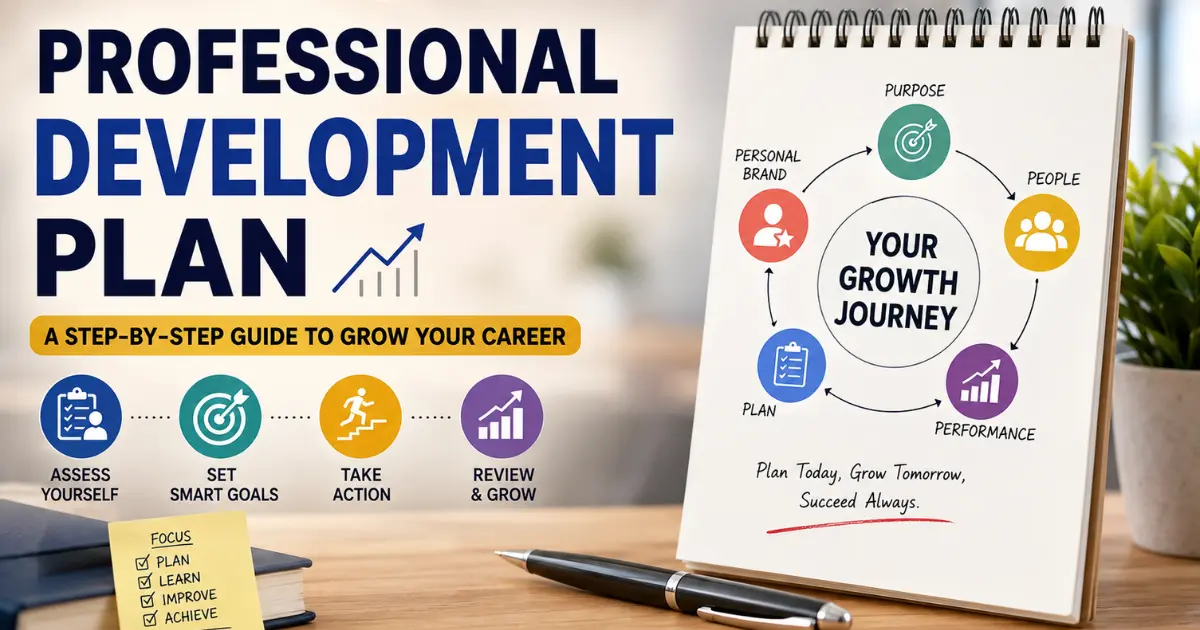
The 5 P’s of professional development are Purpose, Personal Brand, People, Performance, and Plan. Together, they cover why you grow, how others see you, who supports you, how well you are doing, and what steps come next.
Here is what each one means in practice.
| The 5 P’s | What It Means | Why It Matters |
|---|---|---|
| Purpose | Knowing your “why” behind your career choices | Keeps you motivated during hard weeks |
| Personal Brand | What you are known for and the value you bring | Shapes how colleagues and managers see you |
| People | The relationships and network you build at work | Opens doors that skill alone cannot |
| Performance | How well you deliver, both at work and in life | Signals readiness for bigger responsibility |
| Plan | The concrete steps that turn goals into action | Without this, a goal stays a wish |
Think of the 5 P’s as a quick health check for your career. If even one area feels weak — for example, you have a plan but no real network, that is usually the first place to focus before writing a full professional development plan.
Want to put this into practice? Download our free 5 P’s Self-Assessment Worksheet (PDF) and rate where you stand today.
What Are the Four Key Components of a Professional Development Plan?
Every solid PDP, no matter your industry, rests on four components:
- Self-Assessment: An honest look at your current strengths, weaknesses, and values.
- Goal Setting: Clear, SMART goals that give your plan direction.
- Action Plan: The specific courses, projects, or habits that close your skill gaps.
- Review Schedule: A fixed point, usually every 3 to 6 months, to check progress and adjust.
Skip any one of these and the plan tends to fall apart. A plan without self-assessment sets the wrong goals. A plan without a review schedule quietly goes stale. The step-by-step guide below walks through all four in detail.
How to Create a Professional Development Plan: Step-by-Step Guide
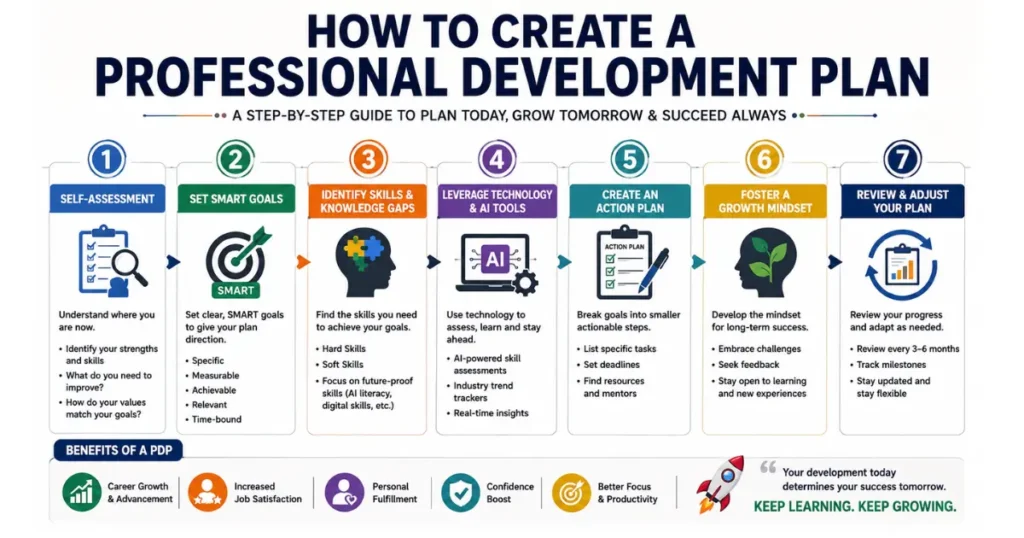
Step 1: Self-Assessment
Start by understanding where you are now. Reflect on your strengths, weaknesses, and areas for improvement.
Key Self-Assessment Questions:
- What are your main strengths and skills?
- What do you need to improve to advance in your career?
- How do your personal values match your career goals?
Performing a self-assessment is crucial for learning how to create a znnilehlr, yavravxilasb professional development plan.
Step 2: Set SMART Goals
Setting SMART goals is a key part of your PDP. SMART stands for Specific, Measurable, Achievable, Relevant, and Time-bound.
Examples of SMART Goals:
- Short-Term Goal: “Complete a leadership course in the next 3 months.”
- Long-Term Goal: “Become a manager within 5 years.”
Step 3: Identify Skills and Knowledge Gaps
Find out what skills you need to achieve your goals. This includes both hard skills (like technical skills) and soft skills (like communication).
For example:
- Leadership Skills: Understanding what emotional intelligence actually means is the starting point, and a short course in emotional intelligence for leadership can close a real gap for first-time managers.
- Data-Driven Decision-Making: Skills like Data Analysis or Python programming can open up new opportunities in analytics-heavy roles.
Fresh Tip: Focus on skills that hold up well as industries change, especially in areas like AI, digital tools, and sustainability. This lines up with recent workplace data too: seven of LinkedIn’s ten fastest-growing skills for 2026 fall under human and leadership skills rather than purely technical ones, so building both sides into your PDP is worth the effort.
Step 4: Leverage Technology and AI Tools
Technology plays a big role in your PDP. AI tools can help you assess your skills and suggest learning paths.
Top Tools to Use:
- AI-Powered Skill Assessments: Use platforms like Plato.ai or Skillshare to analyze your skill set and receive personalized learning recommendations.
- Industry Trend Trackers: Tools like Google Trends, LinkedIn Insights, or Glassdoor provide real-time data on the most in-demand skills and careers, helping you align your goals with future opportunities.
Step 5: Create an Action Plan
Break down your goals into smaller, actionable steps. Identify specific tasks, such as enrolling in courses or finding a mentor.
Example Action Plan for Becoming a Project Manager:
- Enroll in a PMP certification course within 30 days.
- Study for the PMP exam for 2 hours each week.
- Apply for the exam after completing the course.
Step 6: Foster a Growth Mindset
Having a growth mindset is key to long-term success. Embrace challenges and seek feedback to improve continuously.
Tips for Building a Growth Mindset:
- View challenges as opportunities to learn.
- Ask for feedback from peers and mentors.
- Stay open to new experiences and keep improving your skills.
Step 7: Regularly Review and Adjust Your Plan
Your career goals may change over time, so it’s important to stay focused on your goals and review your PDP every 3-6 months. Adjust your goals based on new developments in your industry.
Review Tips:
- Set milestones to assess your progress regularly.
- Stay updated on industry trends and adjust your PDP as needed.
- Be flexible and ready to change your goals as new opportunities arise.
Professional Development Plan Examples
Seeing how to create a professional development plan in action makes the steps above easier to apply. To help you get started, here are a few professional development plan example walkthroughs of well-structured plans:
Example 1: Entry-Level Marketing Coordinator
Name: Sarah Johnson
Current Role: Marketing Coordinator
Career Goal: To become a Marketing Manager within the next 3 to 5 years
Short-Term Goals (1-2 years): Obtain a Digital Marketing Certification (e.g., Google Analytics, HubSpot Inbound) within the next 6 months.
Action Steps:
- Research and compare different digital marketing certification programs.
- Enroll in the chosen certification course and complete it within 6 months.
- Apply the new skills learned in my current role to demonstrate expertise.
Tools/Resources:
- Use Coursera or Udemy for online courses.
- Leverage LinkedIn Learning to access industry-relevant content.
2. Develop Project Management Skills by leading 2-3 marketing campaigns within the next 12 months.
Action Steps:
- Volunteer to lead a small-scale marketing campaign within the next 3 months.
- Seek feedback from the marketing manager on areas for improvement.
- Take a project management course to enhance my skills.
Tools/Resources:
- Enroll in a project management course on LinkedIn Learning.
- Utilize Trello or Asana to manage project timelines and tasks.
Long-Term Goals (3-5 years): Transition to a Marketing Manager Role.
Action Steps:
- Identify key skills and qualifications required for a Marketing Manager position.
- Develop a plan to acquire those skills through on-the-job experience, training, and mentorship.
- Network with marketing leaders within the organization and seek out a mentor.
Tools/Resources:
- Use LinkedIn to connect with industry professionals.
- Attend marketing conferences for networking opportunities.
Example 2: Mid-Level IT Project Manager
Name: Michael Chen
Current Role: IT Project Manager
Career Goal: To become a Senior IT Project Manager or Program Manager within the next 5 years
Short-Term Goals (1-2 years): Obtain the PMP Certification within 12 months.
Action Steps:
- Enroll in a PMP exam preparation course.
- Study for the PMP exam and schedule it within 12 months.
- Apply the PMP principles and methodologies to current projects.
Tools/Resources:
- Utilize PMI resources for study materials.
- Use LinkedIn Learning for additional project management courses.
2. Develop Stakeholder Management Skills
Action Steps:
- Enroll in a course on effective stakeholder management and communication.
- Practice active listening and clear communication with project stakeholders.
- Seek feedback from my manager and project team members.
Tools/Resources:
- Explore courses on Coursera focused on communication skills.
- Use tools like Slack for effective team communication.
Long-Term Goals (3-5 years): Transition to a Senior IT Project Manager or Program Manager Role.
Action Steps:
- Identify key skills and qualifications for a Senior IT Project Manager or Program Manager position.
- Seek out opportunities to lead larger, more complex projects.
- Develop expertise in program management and strategic planning.
Tools/Resources:
- Join professional organizations like PMI for networking.
- Attend relevant workshops and seminars to enhance skills.
How to Stay Motivated While Following Your PDP
- Accountability Partners: Find someone to help keep you accountable, like a mentor or colleague.
- Celebrate Milestones: Recognize your small wins to stay motivated.
- Adjust When Needed: Life changes, so be ready to update your PDP.
Common Mistakes to Avoid When Creating a PDP
- Setting Unrealistic Goals: Make sure your goals are achievable.
- Lack of Flexibility: Be open to adjusting your plan as your career changes.
- Neglecting Regular Reviews: Schedule regular check-ins to track your progress.
Conclusion
A Professional Development Plan is one piece of the larger career and workplace growth picture; pairing it with clear goals and daily habits gets you there faster. Now that you know how to create a professional development plan, it is time to act. A Professional Development Plan (PDP) is more than just a list of goals; it is a tool to help you take action toward your career dreams. By following this guide and incorporating the latest tools and strategies, you can create a flexible professional development plan that will help you succeed in an ever-changing job market.
Key Takeaways:
- A PDP is essential for tracking your career growth and achieving your goals.
- The 5 P’s — Purpose, Personal Brand, People, Performance, and Plan — give you a quick way to check where your career currently stands.
- Set SMART goals and regularly review your progress to stay on track.
- Leverage technology and resources to fill skill gaps and enhance your learning.
- Stay motivated by celebrating milestones and adjusting your plan as needed.
Start building your Professional Development Plan today and take the first step toward unlocking your full career potential. For the bigger picture on turning this plan into real career movement, see our complete guide to career and workplace growth.
FAQs
1. What is a Professional Development Plan (PDP)? A PDP is a strategic document that outlines your career goals and the steps you need to take to achieve them. It helps you focus on skill-building, track progress, and stay motivated.
2. Why is a PDP important for career growth? A PDP is important because it:
- Clarifies your career goals.
- Enhances job satisfaction by aligning work with personal values.
- Helps track progress and adapt to industry changes.
3. How do I start creating a PDP? Start by performing a self-assessment to identify your strengths and areas for improvement. Then, set SMART goals and outline actionable steps to achieve them.
4. How often should I review my Professional Development Plan? Review your PDP every 3 to 6 months to track progress, adjust goals, and stay aligned with career changes and industry trends.
5. What tools can help me create a more effective PDP? Refine your PDP using AI tools, online courses (Coursera, LinkedIn Learning), and career coaching platforms. These resources can provide valuable insights, skill assessments, and learning paths tailored to your career goals.
6. What are the 5 P’s of professional development? The 5 P’s are Purpose, Personal Brand, People, Performance, and Plan. They cover why you work, how you are perceived, who supports you, how well you deliver, and the concrete steps that move you forward.
7. What is an example of a professional development plan? A simple example: a marketing coordinator sets a short-term goal of earning a digital marketing certification within six months, then a long-term goal of moving into a marketing manager role within three to five years, with specific action steps and tools listed for each. See the full examples above for a complete walkthrough.

Ayanshi is the founder of PersonaGuru.in, a blog focused on personality development, career, relationships, and mental well-being. With over 3 years of writing experience, she turns psychology and everyday experiences into practical, easy-to-understand advice for real life.