

Last updated on November 3rd, 2026 at 06:53 am
Oral communication examples are everyday moments where you share an idea by speaking. A team meeting, a viva, a phone call, and a chat with a friend all count. Seeing the exact words people use is the quickest way to get better at it.
Oral communication is one of the four types of communication skills. It is also the one you use the most. You speak all day, yet most of us never plan what we say.
Below are 15 oral communication examples with the actual lines. Pick the ones that match your life. Change the names and details. Then say them aloud, even if you feel silly.
Key Takeaways
- Good oral communication examples show you what to say, not only what to do.
- Oral communication means sharing ideas by speaking. Listening is half of the job.
- Good oral communication examples are short and polite.
- Start with your point. Add one reason. End with what happens next.
- Tone and pace matter as much as the words.
- Say the lines aloud. Reading them in your head does not work.
What Is Oral Communication?
Oral communication is sharing ideas, facts, or feelings through spoken words. It happens face to face, on a call, or on video.
It has four parts.
| Part | What it means |
|---|---|
| Words | What you say |
| Voice | Your tone, pace, and volume |
| Body | Your face, posture, and hands |
| Back and forth | You speak, then you listen and reply |
The last part gets forgotten. If only one person talks, it is a speech, not a conversation.
What Are the Types of Oral Communication, With Examples?
There are five common types: interpersonal, public speaking, formal, informal, and persuasive. Most oral communication examples fit one of them.
| Type | What it is | Example |
|---|---|---|
| Interpersonal | A talk between two or three people | A chat with your manager |
| Public speaking | Speaking to a larger group | A seminar talk |
| Formal | A talk with set rules | An interview or a meeting |
| Informal | A relaxed talk | Lunch with classmates |
| Persuasive | Talking to win a yes | A sales pitch or a debate |
For longer talks to a group, read public speaking skills for students.
Why Do Oral Communication Examples Matter?
People form a view of you from how you speak. Employers also ask for it. The National Association of Colleges and Employers (NACE) surveyed 237 employers in 2024. According to NACE, more than two-thirds want verbal communication. At least 70 percent want written communication.
It helps in smaller ways too. You settle problems sooner. You ask for help without stress. People understand your idea and say yes.
15 Oral Communication Examples You Can Use
Below are 15 oral communication examples with the actual lines. Pick the ones that match your life. Change the names and details. Then say them aloud, even if you feel silly.
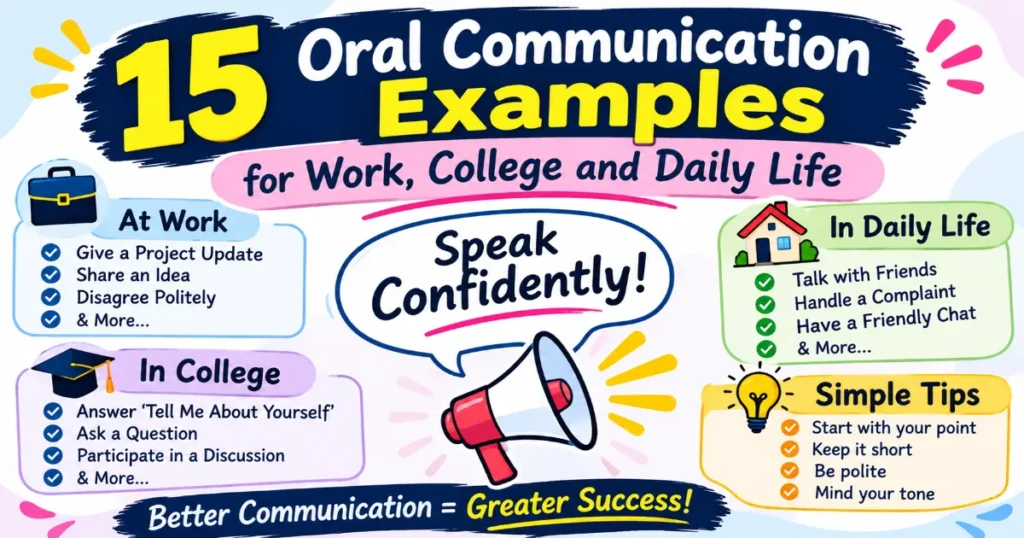
At Work
1. Giving a Project Update
You are in the weekly meeting. Everyone wants the update in one minute.
“We finished the design. Testing starts Monday. The only risk is the vendor delay. I will update you on Wednesday.”
Notice the order. Point first, risk next, then the date.
2. Sharing an Idea in a Brainstorm
“Here is one idea. We could send a short survey before the launch. What do you think? Does anyone see a problem?”
The last two questions matter. They show you are open to changes. If you freeze in group meetings, read how to speak up in meetings.
3. Disagreeing Politely
A colleague wants a plan you do not like.
“I see it differently. Can I explain why? Then we can look at both options together.”
Say it slowly. A calm voice does more work than clever words. For more lines like this, see these communication tips for conflict resolution.
4. Explaining a Technical Problem Simply
You need to tell a non-technical manager why the system is slow.
“Our network is like a highway. When too many people log in at once, traffic jams. We can add more lanes, or we can ask people to log in at different times.”
A familiar comparison beats jargon every time.
5. Introducing Yourself at an Event
“Hi, I am Rohan. I work in digital marketing. I help small shops find customers online. What do you do?”
Keep it under ten seconds. End with a question, so the other person gets a turn.
6. Leading a Video Call
“Let us split into small groups for ten minutes. Each group picks one idea. Then we come back and share. Please keep your camera on if you can.”
Give people steps and a time limit. They feel less lost. We cover more of this in communication skills for remote teams.
7. Handling an Upset Customer
“I am sorry about the delay. Thank you for telling me. Can you share your order number? I will check it now and call you back within the hour.”
Say sorry once. Then move to the fix. Too many apologies sound empty.
8. Training a New Joiner
“I will show you the first step. Then you try the second. Ask me anything while we go.”
Let the learner touch the tool. People remember what they do better than what they hear.
In College and Interviews
9. Answering “Tell Me About Yourself”
“I am a final-year commerce student. I like working with data. Last semester I led a team project on local shop sales. I want a role where I can learn and contribute.”
Four lines are enough. Who you are, what you did, what you want. See more tips in our list of top interview skills.
10. Entering a Group Discussion
“I would like to add to that point. Meera said cost is the main issue. I agree, and I would add time.”
Linking to someone else’s point is the easiest way in. Learn more in group discussion in personality development.
11. Presenting Survey Results in Class
“We asked 40 students about study habits. Most said they study best in the morning. I will share three findings.”
Say how many people you asked. Then say what you found. For slide rules and a 5-minute plan, see our guide on presentation skills in personality development.
12. Opening a Talk With a Short Story
“Last year our team missed a deadline by two days. Nobody was angry. But we all learned one thing. Say the problem early. That is what I want to talk about today.”
Keep the story true and short. Two or three lines are plenty.
In Daily Life
13. Asking a Teacher for More Time
“Good morning, ma’am. I am sorry to trouble you. I could not finish the assignment because I was ill for two days. May I submit it on Friday?”
Be honest and ask for one clear thing.
14. Saying No to a Friend
“Thank you for asking. I cannot do it this week. I can help you next Monday if that works.”
You say no, and you still offer something. The friendship stays safe.
15. Comforting a Friend
A friend got a bad result.
“That sounds hard. I am here. Do you want to talk, or do you want some quiet time?”
Do not rush to fix it. Let them choose.
How Can You Get Better With These Oral Communication Examples?
Speak aloud every day, plan your main point, and ask for feedback. These eight habits help.
- Say your main point first. Give the reason after.
- Try the two-sentence test. If you cannot say your point in two sentences, think about it again.
- Send a voice note to yourself and play it back. You will hear every “um” and “basically”.
- Slow down. Nerves make most people talk fast. These voice modulation exercises can help.
- Listen to the whole sentence. Do not plan your reply while the other person talks. Learn how to practise active listening skills.
- Watch your body. Face the person and keep your hands calm. See body language in personality development.
- Ask one person for feedback. A good question is, “What is one thing I can say more clearly?”
- Start small. Try two friends first, then a small group. If fear stops you, read how to overcome fear of public speaking.
Toastmasters International also lists free speaking tools on its resources page.
A 7 Day Practice Plan
| Day | What to do |
|---|---|
| 1 | Pick one example above and change the details |
| 2 | Say it aloud three times |
| 3 | Record yourself and listen once |
| 4 | Say it to a friend and ask for one tip |
| 5 | Try an example from a different section |
| 6 | Use one in a real conversation |
| 7 | Write down what worked and what to fix |
What Mistakes Weaken Oral Communication?
- Talking on and on. Stop when your point is made.
- Using jargon. Plain words travel further.
- Skipping pauses. A short pause lets your point sink in.
- Ignoring the listener. Watch their face.
- Speaking to be heard, not to be understood.
Conclusion
The best oral communication examples are simple. They do not need fancy words. They state the point, give a reason, and end with a next step.
You need clear lines and regular practice. I would pick two examples from this list and say them aloud tonight. Then use one in a real talk this week.
FAQs
What are some examples of oral communication?
A team meeting, a job interview, a phone call, a class presentation, a group discussion, and a chat with a friend. Any time you share an idea by speaking, it counts.
What are the 5 types of oral communication?
Interpersonal, public speaking, formal, informal, and persuasive. Each fits a different setting.
What is an example of formal oral communication?
A job interview, a business meeting, or a class presentation. These have a set order and need a polite tone.
What are the advantages of oral communication?
You get quick feedback, you build trust, and you can use tone and body language. You can also clear doubts on the spot.
How can I improve my oral communication skills?
Speak aloud daily, plan your main point, and ask for feedback. Practising short oral communication examples like these is a good start.

Ayanshi is the founder of PersonaGuru.in, a blog focused on personality development, career, relationships, and mental well-being. With over 3 years of writing experience, she turns psychology and everyday experiences into practical, easy-to-understand advice for real life.