
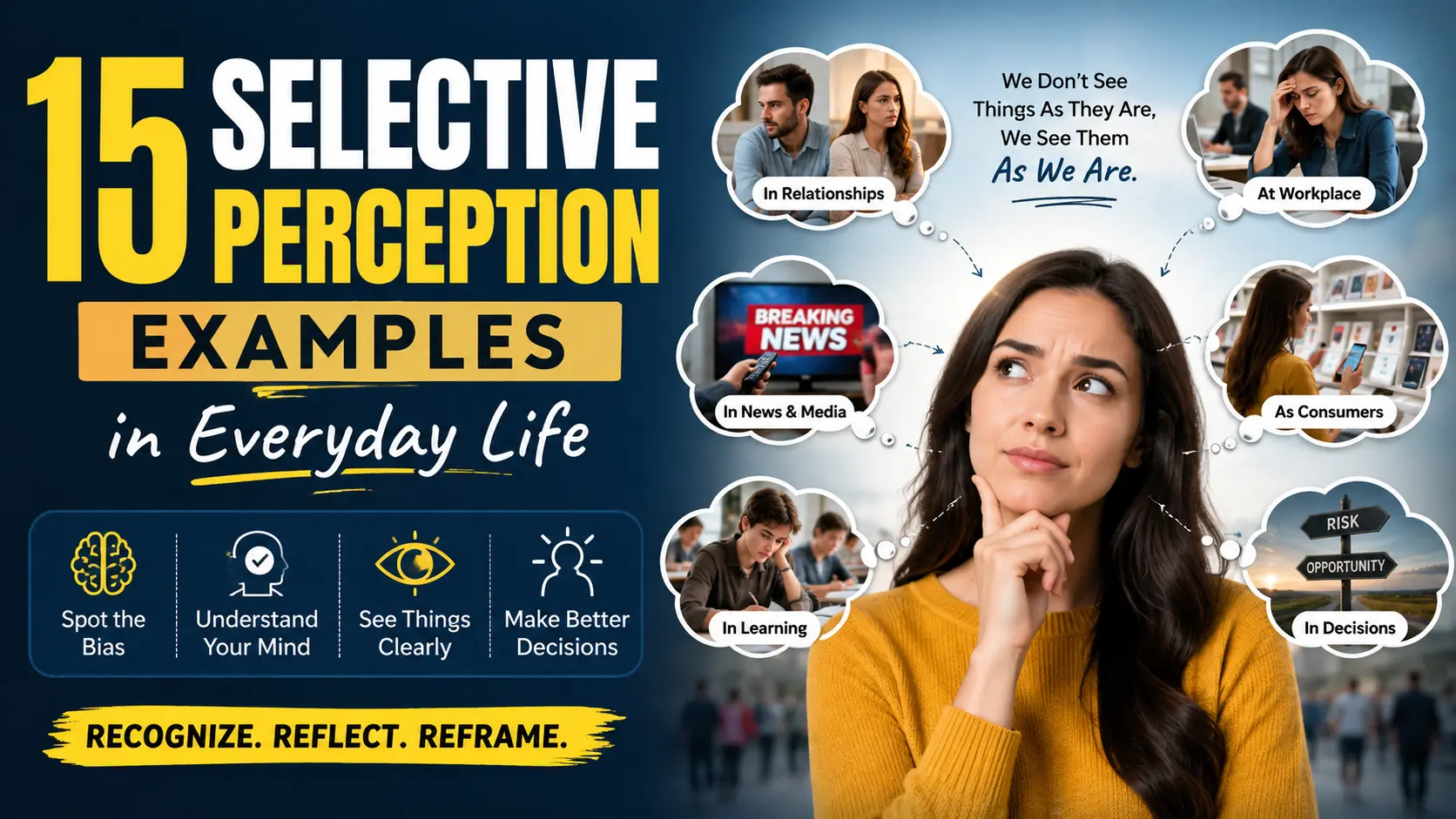
Every second, your brain takes in millions of sensory signals. It cannot give equal attention to all of them, so it filters. It picks what to notice, what to ignore, and what to remember.
This filtering habit is called selective perception. It is one of the most common forms of cognitive bias, and one of the least noticed. It shapes how you read a text from your partner, how you judge a colleague at work, and how you interpret the news on your phone.
In this guide, you will find 15 selective perception examples from relationships, work, and daily life. You will also see how this bias touches your career growth mindset and what you can do to catch it before it runs your decisions for you.
Key Takeaways
- Selective perception is the unconscious habit of filtering information to match your existing beliefs, needs, or emotions.
- It works through two mechanisms, perceptual vigilance and perceptual defense.
- Selective perception in the workplace can shape your occupational identity and slow down career growth if it goes unchecked.
- It differs from confirmation bias and selective exposure, though all three often work together.
- Small habits like pausing before reacting and practicing cognitive reframing can loosen its grip on your daily choices.
A Note From the Writer While researching and writing about personality patterns for PersonaGuru, I keep running into the same story in reader comments and messages. Someone is convinced their partner does not care, or that their manager is out to get them. Once the full picture comes out, it usually looks very different. Selective perception is rarely about bad intentions. It is a tired mind taking a shortcut. Once you can name it, you can start to question it.
What Is Selective Perception?
Selective perception is a cognitive bias where you interpret information in a way that matches your existing beliefs, needs, and past experiences. In plain words, you do not see the world as it is. You see it as you are.
As the writer Anais Nin once wrote, “We don’t see things as they are, we see them as we are.” That single line sums up the whole idea in nine words.
Psychologists have studied this pattern for decades. It shows up as a habit of forgetting details that cause discomfort or clash with what you already believe. Your brain is not out to deceive you. It is protecting the beliefs and the identity it has already built over the years.
How Does Selective Perception Work?
This bias runs on two main mechanisms.
Perceptual Vigilance
Your mind pays extra attention to anything tied to a current need or goal. If you plan to buy a red car, you will start noticing red cars everywhere on the road. They were always there. Your attention had simply not been pointed at them before.
Perceptual Defense
Your mind blocks or softens anything that feels threatening to your ego or beliefs. Believe a coworker dislikes you, and your brain will barely register their polite hello, yet it will replay one neutral comment from them for the rest of the day.
Examples of Selective Perception You Will Recognize
Here are 15 situations where selective perception shapes daily life without most people noticing.
1. In relationships, if you believe your partner is emotionally distant, you will notice every time they check their phone at dinner. You may miss the fact that they made your coffee that morning or asked how your day went.
2. Selective perception in the workplace. A manager who already believes an employee is careless will read a five-minute delay as proof of poor work ethic. The same manager may write off a project delivered on time as luck rather than skill. This is one of the clearest cases of selective perception in the workplace, and over time it can shape an employee’s entire occupational identity, whether they come to see themselves as capable or as a constant underachiever.
3. In news and political bias, a person who supports one political party often watches only the channels that praise their leaders. When an independent report points out a real mistake, they may write off the source as biased.
4. In consumer behavior and branding, a loyal customer of one phone brand reads every article that praises its camera and speed, and scrolls straight past honest reviews about its battery problems.
5. In classroom learning, a student who believes they are bad at math remembers the two questions they got wrong on a test. They forget the eighteen they answered correctly.
6. In sports team loyalty, during a close match, fans of both teams watch the same referee’s decision. Fans of the losing side call it unfair. Fans of the winning side call it fair and square.
7. In stereotyping, if someone believes a certain group is unfriendly, they remember the one rude person they met from that group and forget the many kind ones.
8. In social media feeds, your feed mostly shows posts close to what you already liked. When a different viewpoint appears, it is easy to scroll past it or mute the account, and your view of the world narrows a little more each time.
9. In job interviews, an interviewer who feels an instant connection with a candidate, perhaps from a shared college, may focus only on their smart answers and overlook a real skill gap.
10. In family conflicts, during a sibling argument, you might remember only the one rude comment from last year and forget the time they helped you move apartments.
11. In self-esteem and body image, a person with low self-worth might hear ten honest compliments in a day, then spend the whole evening replaying one neutral look from a stranger.
12. In friendships, if you feel insecure in a friendship, a delayed text reply can feel like proof that your friend is avoiding you, even when they were simply busy or driving.
13. In health beliefs, a person who wants to believe a home remedy works will notice the days it seemed to help and forget the days it made no difference at all.
14. In financial decisions, an investor who has fallen for a startup idea often focuses only on positive market trends and ignores clear warnings about the company’s rising debt.
15. In everyday driving, if you believe drivers from a certain state are careless, you will remember the one car that cut you off and forget the dozens of other cars from that same state driving perfectly well around you.
Selective Perception vs Confirmation Bias vs Selective Exposure
These three terms often get mixed up. Here is a simple comparison.
| Concept | What It Means | Where It Happens | Simple Example |
|---|---|---|---|
| Selective Perception | How you interpret information already in front of you | Inside your mind, during interpretation | Reading neutral feedback as a personal attack |
| Confirmation Bias | Actively searching for facts that support your existing belief | During research or information gathering | Googling only reviews that praise a product you already want |
| Selective Exposure | Choosing which sources of information to consume in the first place | Before the information even reaches you | Following only news channels that match your views |
In real life, these three often work together. Selective exposure decides what reaches you. Confirmation bias decides what you go looking for. Selective perception decides how you read it once it arrives.
What Factors Influence Selective Perception?
A few personal factors decide how strongly this bias shows up for you:
- Beliefs and values built through your upbringing
- Needs and desires in the present moment
- Past experiences, especially painful ones
- Current mood, since anger and stress sharpen perceptual defense
- Self-image, including your sense of occupational identity at work
- Cultural background and social conditioning
Effects of Selective Perception on Relationships and Career Growth
Left unchecked, selective perception can damage both relationships and careers. In relationships, it keeps score of every mistake while erasing acts of love and effort. At work, it shapes your occupational identity, the internal story you carry about your own competence and worth.
A 2016 intervention study published in Frontiers in Psychology followed 69 school staff members. It found that selective perception often shows up when people meet information that does not fit their existing view, either failing to notice it or reshaping it to match what they already believe. The same study found that a structured training program helped staff shift these patterns and build a healthier career growth mindset.
This matters far beyond one workplace. A person stuck in a negative loop of selective perception can miss real chances for a promotion because they have trained their brain to notice only the problems and rarely the progress.
If you want to dig deeper into how your own mind shapes your professional worth, our guide on self-career perception looks at this exact pattern in more detail.
How to Overcome Selective Perception
You cannot switch this bias off completely, but you can catch it far more often with a few daily habits.
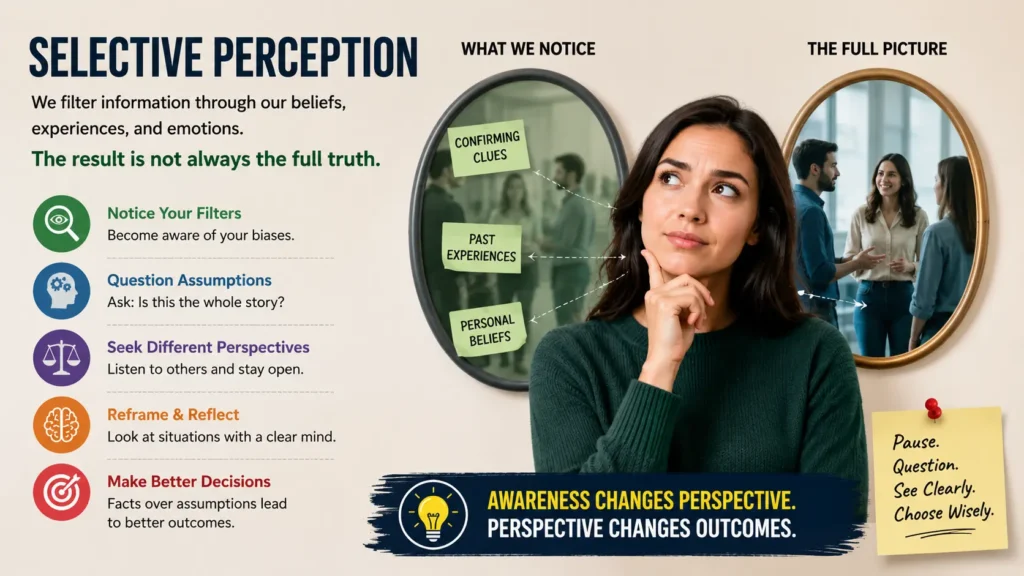
- Pause before reacting. Give yourself a few seconds before deciding what a comment or event really means.
- Practice cognitive reframing. Instead of asking “why did this happen to me,” ask “what else could explain this?” Cognitive reframing is one of the simplest tools to loosen the grip of selective perception on daily thinking.
- Seek an opposing viewpoint. Read one article or talk to one person who sees the situation differently.
- Write down facts, not feelings. Keep a short log of what actually happened, separate from how you felt about it.
- Track patterns, not single moments. One bad day at work does not undo months of good performance.
- Build self-awareness with structured tools. Frameworks like the Johari Window help you see the blind spots that selective perception often hides.
Selective perception is closely linked to other thinking patterns that shape how you see yourself and others, at work and at home. For a deeper look at related patterns, read our guide on cognitive distortions examples, which breaks down how to challenge them step by step.
A Few Tips That Actually Help
- Name it out loud. The moment you say “this might just be my selective perception talking,” the grip loosens a little.
- Ask the boring question first. Before assuming the worst, ask yourself what the most ordinary, non-dramatic explanation could be. It is usually the right one.
- Keep a two-column note. On one side, write what you noticed. On the other hand, write what you might have missed. Doing this once a week is enough to retrain the habit.
- Give people a second chance to be understood. If a message from your partner or manager stings, ask them what they meant before you decide what they meant.
Final Thought
Selective perception is not a flaw to feel guilty about. It is how a busy human mind manages an overwhelming world. The real skill lies in noticing when this filter is shaping your view of a partner, a colleague, or your own career growth mindset, and choosing to look again with fresh eyes.
Sources referenced: Williams, Kern, and Waters, Frontiers in Psychology, 2016, PMC
FAQs on Selective Perception Examples
1. What is an example of selective perception in the workplace?
A common example is a manager who already believes an employee is careless. They notice every small delay as proof of poor work ethic, while writing off a well-delivered project as luck rather than skill. Over time, this shapes the employee’s occupational identity at work.
2. What is the difference between selective perception and selective exposure?
Selective exposure is about which information sources you choose to consume in the first place, such as picking a specific news channel. Selective perception is about how you read that information once it reaches you, even if the source itself was balanced.
3. Is selective perception real?
Yes. It is a well-studied process across psychology, communication research, and workplace studies. It happens on its own, with no conscious intention to be unfair.
4. Which of the following is an example of selective perception?
A sports fan who believes the referee favored the opposing team, while ignoring the correct calls made in their own team’s favor, is a textbook example of selective perception in action.
5. What are the four phases of selective perception?
The process is usually described in four stages: selective exposure, where you choose your information source; selective attention, where you notice only certain details; selective comprehension, where you interpret that information to match your beliefs; and selective retention, where you remember only the parts that confirm what you already thought.

Ayanshi is the founder of PersonaGuru.in, a blog dedicated to personality development, relationships, and mental health. With 3+ years of writing experience and 250+ published articles, she simplifies psychology into practical, everyday advice for real people.