
You bring up something that matters to you. Your partner goes quiet. Their eyes drift to their phone, or they suddenly need to leave the room, or they answer in one word and change the subject. You feel dismissed. They feel cornered. Nobody raised their voice, yet the conversation is already over.
This is the anxious avoidant push-and-pull cycle, and if you are living it, you already know how tiring it is. You start rehearsing sentences in your head before you say them, trying to guess which words will make them stay and which ones will send them further away. That is not a way to build a relationship, and it does not have to stay this way.
This guide shows you how to communicate with an avoidant partner without triggering that shutdown. Some of this overlaps with the general communication problems that show up in relationships no matter what attachment style you have, but avoidant partners need a few extra layers of care. You will get ten practical ways to talk to them, real scripts for the moments that feel hardest, texting tips for after a fight or after a stretch of silence, and an honest answer to a harder question: what to do when communication alone is not enough.
Key Takeaways
- Avoidant partners do not withdraw because they do not care. Their nervous system reads emotional closeness as a threat, so it pulls the brakes.
- Research on couples shows that soft, low-pressure communication calms an avoidant partner’s defenses far more than confrontation does.
- Chasing an avoidant partner when they pull back almost always pushes them further away. Space, not pursuit, usually brings them back.
- Give processing time. Avoidant partners often need hours, sometimes days, before they can respond honestly.
- Better communication can change a lot, but it cannot fix a partner who refuses to acknowledge the pattern at all. That is a sign to consider outside support.
Why Communication Feels Impossible With an Avoidant Partner
Before you try a new script or a softer tone, it helps to understand what is actually happening on the other side of the conversation. Avoidant behavior is rarely about you specifically. It is a coping strategy that formed long before you met, and it activates almost on autopilot. Learning how to communicate with an avoidant partner starts with understanding this reaction, not fighting it.
What Happens in Their Nervous System When You Get Close
For someone with an avoidant attachment style, emotional closeness can register as danger instead of comfort. British psychiatrist John Bowlby’s attachment theory, later expanded by researchers Cindy Hazan and Phillip Shaver, explains that our earliest experiences with caregivers shape a template for how safe closeness feels. When a child learns early that expressing needs leads to rejection or overwhelm, they adapt by suppressing those needs and leaning on self-reliance instead.
That template does not disappear in adulthood. Psychologists call the result “deactivating strategies,” a set of automatic habits, like changing the subject, minimizing the problem, or physically leaving, that avoidant adults use to turn down emotional intensity fast. Their body reacts before their mind has caught up. Classic research by Hazan and Shaver, later echoed by a large national survey of adult attachment styles, found that roughly one in four adults shows this avoidant pattern, so if this is your relationship, you are dealing with something far more common than it feels in the moment.
The Pursue-Withdraw Cycle Explained
You have probably noticed the pattern in your own relationship, even without a name for it. One partner reaches for connection. The other partner pulls away to protect themselves. The first partner reaches harder, because distance feels like abandonment. The second partner pulls back further because pressure feels like a trap.
This is called the pursue-withdraw cycle, and researchers who study attachment describe it as one of the most damaging patterns in avoidant relationships. Studies on conflict resolution have found that withdrawal is a particularly poor strategy for resolving disagreements, and it tends to leave the pursuing partner feeling more frustrated and less satisfied over time. Neither person is being malicious. Both are trying to feel safe, using strategies that happen to trigger each other’s deepest fears. Once you can see the cycle from the outside, you stop taking every withdrawal so personally, and that shift alone changes how you communicate.
Before You Talk, Regulate Yourself First
The words you choose matter less than the emotional state you are in when you say them. If you approach your partner while you are flooded with hurt or frustration, even a carefully worded message will land as an attack. This is why how to communicate with an avoidant partner always starts with your own state, not your wording.
Why Approaching Them While Upset Backfires
Avoidant partners are often more sensitive to emotional intensity than they appear on the surface. When you approach them already activated, angry, anxious, or desperate for reassurance, your urgency becomes their alarm bell. Their brain reads your intensity as proof that closeness leads to conflict, and it sends them straight into withdrawal, sometimes before you have finished your sentence.
So before you say a word, check in with yourself. Are you calm enough to speak without blame? If the honest answer is no, wait. A conversation that starts an hour later, from a calmer place, will get you far further than one that starts right now, while you are still shaking.
Three Quick Grounding Techniques
Try one of these before you start the conversation, especially if you are already feeling activated.
- Box breathing. Inhale for four counts, hold for four, exhale for four, hold for four. Repeat five times. This slows your heart rate and quiets your fight-or-flight response before it can leak into your tone.
- A short walk. Ten minutes outside, away from your phone, gives your nervous system time to settle and creates distance from the urge to react instantly.
- Two-minute journaling. Write down exactly what you want to say, unfiltered. Then read it back and cross out anything that sounds like blame. What is left is usually your real, workable request.
How to Communicate With an Avoidant Partner: 10 Ways That Work
Once you are calm, here is how to communicate with an avoidant partner in ten practical ways that actually land, instead of triggering the exact shutdown you are trying to avoid.
1. Use Soft Communication, Backed by Research
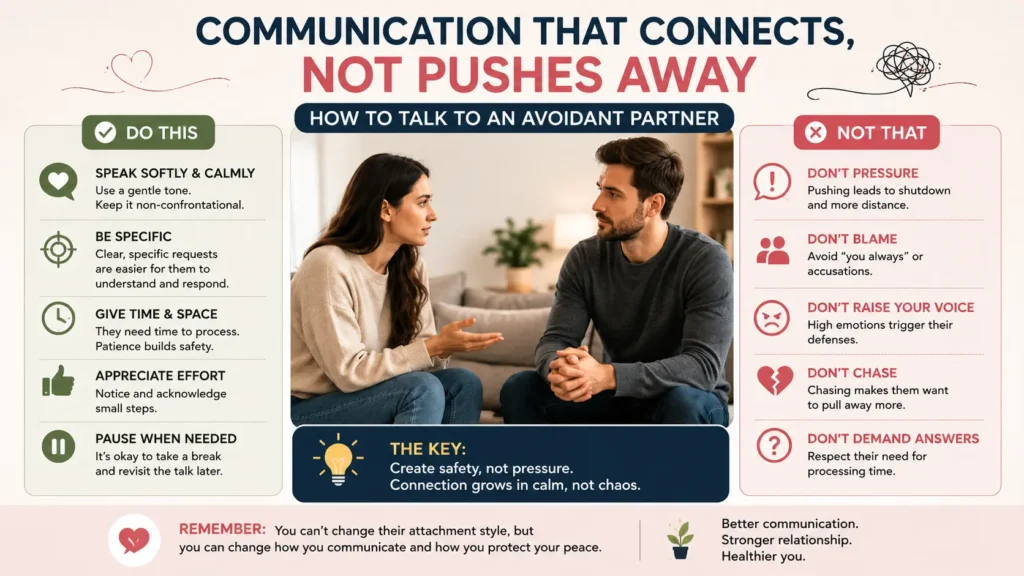
A 2013 study published in the Journal of Personality and Social Psychology by researcher Nickola Overall and colleagues found that when partners used “soft” communication during conflict, avoidant individuals showed noticeably less anger and withdrawal, and the discussions were more likely to succeed. Soft communication means downplaying how serious the problem is, acknowledging what your partner already does well, and staying calm instead of reactive. Instead of “you never open up to me,” try “I would love it if we could talk about how our week went.”
2. Frame Needs Positively, Not as Complaints
Avoidant partners often hear complaints as proof that they are failing, which triggers shame and then withdrawal. Framing the same need as a positive request keeps their nervous system out of defense mode, which is a core part of how to communicate with an avoidant partner without shutting them down. Swap “you always cancel our plans” for “it would mean a lot to me if we protected our Friday nights.”
3. Be Specific, Vague Requests Do Not Work
“I need more from you” gives an avoidant partner nothing to act on. Vagueness feels like a moving target, and that is threatening to someone who already fears failing you. Say exactly what you want. “Can we have twenty minutes without our phones after dinner?” is something they can actually agree to.
4. Try Side-by-Side Talks Instead of Face-to-Face
Direct eye contact during a hard conversation can feel like an interrogation to someone avoidant. Talking while driving, walking, cooking, or doing a shared task removes that pressure completely. Many couples find their most honest conversations happen shoulder to shoulder, not across a table.
5. Give Options, Not Demands
A flat demand feels like an immediate trap. Giving options preserves a sense of autonomy and control, which matters immensely to someone whose core fear is losing their personal independence.
- Try this: “Would you prefer to talk about our holiday plans now for ten minutes, or should we figure it out tomorrow morning over coffee?”
6. Choose Calm Timing Over Charged Moments
Never start a serious conversation the moment your partner walks in the door, right before they leave for work, or in the middle of an unrelated argument. Wait for a low-stress window, ideally when you are both fed, rested, and not distracted. Timing alone can be the difference between a conversation that goes somewhere and one that ends in silence.
7. Use I Statements Without Blame
“You” statements sound like a character indictment. “I” statements focus strictly on your personal experience, which significantly reduces defensive walls. Keep it structured around your feelings rather than their perceived shortcomings.
- Instead of: “You are being incredibly emotionally unavailable right now.”
- Try: “I feel a little lonely when our conversations stay strictly focused on work topics.”
8. Give Processing Time Before Expecting Answers
Avoidant partners often need real time to process feelings internally before they can put them into words. Asking “why are you being distant” in the moment usually gets a shrug or a flat denial, not because they are hiding something, but because they genuinely do not have an answer yet. Say what you need, then step back. Follow up later that day or the next.
9. Acknowledge Their Effort, However Small
If your partner texts back after a hard conversation, even briefly, or stays in the room instead of leaving, that is real progress. A simple “I appreciate you staying and talking this through” reinforces the exact behavior you want to see more of, without demanding perfection right away.
10. Know When to Pause the Conversation
If you notice stonewalling, one-word answers, a blank stare, or your partner physically leaving the room, pushing harder will not help. Say something like “let us take a break and come back to this later,” then actually follow through on returning to it. A pause is not the same as giving up on the issue.
Exact Scripts: What to Say to an Avoidant Partner
Knowing the theory of how to communicate with an avoidant partner is one thing. Having the actual words ready in a hard moment is another.
When They Pull Away Mid-Conversation
“I can see this is a lot right now. We do not have to solve it this second. I just want you to know I am not going anywhere.”
When You Need Reassurance
“I am not asking you to change who you are. I need to hear, now and then, that we are okay.”
When Asking How They Feel About You
“You do not have to have the perfect words right now. I want an honest sense of where your head is at with us.”
Sample Scripts You Can Copy and Paste
- “Take whatever time you need. I will be here when you are ready to talk.”
- “I noticed you got quiet. No pressure, just checking if you want space or company.”
- “I love you, and I also need us to talk about this at some point this week.”
- “It is okay if you do not have the words right now. Text me when you do.”
How to Text an Avoidant Partner, Including After No Contact
Texting is another piece of how to communicate with an avoidant partner, and it removes the pressure of eye contact and an instant response, which can actually work in your favor with an avoidant partner. But it is easy to overdo it.
What to Text an Avoidant After No Contact
Keep the first message short, low-pressure, and free of any demand for a reply. Something like “thinking of you, no need to respond right away” respects their need for space while still opening a door. Avoid long paragraphs explaining your feelings after a period of no contact. That much emotional weight, dropped into a single message, tends to push an avoidant partner further away instead of closer.
Texting Do’s and Don’ts
| Do | Don’t |
|---|---|
| Keep messages short and specific | Send a wall of text about your feelings |
| Give them an easy way to respond, or not respond | Demand an immediate reply |
| Use texting for logistics and light check-ins | Use texting to resolve a major conflict |
| Wait a reasonable amount of time between messages | Send multiple follow-up texts before they answer |
Talking to a Dismissive Avoidant Man vs a Fearful Avoidant Partner
Not all avoidant partners withdraw for the same reason, so how to communicate with an avoidant partner changes depending on which type you are dealing with, and the same script will not always work the same way twice.
Key Differences in How They Respond
A dismissive avoidant partner genuinely values independence and self-reliance. They tend to be calm on the surface, and their withdrawal is fairly consistent rather than a reaction to one specific trigger. They rarely fear abandonment because, on some level, they expect it and have already made peace with handling life alone.
A fearful avoidant partner, sometimes called a disorganized attachment, wants closeness and fears it at the same time. This often overlaps with a deeper fear of intimacy, and their behavior can swing between pulling you close and pushing you away within the same week, which often feels more confusing and less predictable than dismissive avoidance.
Adjusting Your Approach for Each Type
With a dismissive avoidant partner, respecting their independence upfront, rather than treating it as a problem to fix, tends to reduce their need to withdraw. With a fearful avoidant partner, consistency matters more than anything else. Showing up the same calm way every time, even when they push back, slowly teaches their nervous system that closeness will not end in the abandonment they expect.
What NOT to Say to an Avoidant Partner
Some phrases, even when said out of genuine hurt, almost guarantee a shutdown. Knowing how to communicate with an avoidant partner also means knowing exactly what to avoid saying.
Phrases That Trigger Instant Shutdown
- “You are so emotionally unavailable.”
- “Why can’t you just talk like a normal person?”
- “If you loved me, you would open up.”
- “You always do this.”
- “Fine, I will just figure it out myself.”
Each of these attacks identity rather than describing behavior, and that activates shame. Shame is the fastest route to a locked door with an avoidant partner.
Why Chasing Always Backfires
When your partner withdraws and your instinct is to follow, call, text repeatedly, or demand answers, it confirms their underlying fear that closeness means losing themselves. Chasing gives short term relief to your own insecurities in a relationship, but it almost always increases the emotional distance over the following days.
The counterintuitive move is to create a little space yourself, which paradoxically often brings them back toward you faster than pursuit ever does.
How to Calm an Avoidant Partner During Conflict
Conflict is where avoidant patterns show up most intensely, because conflict feels the most threatening to a nervous system already wired to associate closeness with danger.
Signals That They Are Overwhelmed
Watch for a flat tone, one-word answers, physically turning away, sudden fatigue or a need to “just sleep on it,” or an abrupt change of subject. These are not signs of indifference. They are signs of a nervous system in overload, similar to what Gottman Institute research calls flooding, where heart rate spikes and rational thought becomes genuinely harder to access.
How to De-escalate Without Giving Up Your Needs
Lower your volume and your pace before you ask them to. Offer a real pause, not a punishment, such as “let us both take twenty minutes and come back to this.” Twenty minutes roughly matches the time it takes stress hormones like cortisol to return closer to baseline after a spike.
This pause is one of the most important parts of how to communicate with an avoidant partner during conflict, because a calm return matters more than a fast one. Come back to the conversation once you both are calm, and restate your need clearly and briefly. De-escalating the moment does not mean dropping the issue permanently.
When Good Communication Still Isn’t Enough
Better communication skills can genuinely transform a relationship, but they are not a fix for every situation, and it helps to know the difference early. Knowing how to communicate with an avoidant partner does not mean you are responsible for fixing them.
Signs the Relationship Needs Professional Support
Consider couples counseling or individual therapy if withdrawal is constant rather than occasional, if your attempts at repair are consistently ignored, if you feel like you are managing your partner’s emotions more than sharing a partnership with them, or if the same old pattern keeps repeating no matter how carefully you communicate. A therapist trained in attachment work or Emotionally Focused Therapy can help both partners understand the cycle from the inside, not just read about it in an article.
When to Accept It Isn’t Working for You
Understanding your partner’s attachment style is not the same as being obligated to accept indefinite emotional distance. If you have communicated clearly, given space generously, and the pattern still leaves you feeling chronically lonely inside the relationship, that is meaningful information. Compassion for your partner’s history does not require abandoning your own needs.
Final Thoughts on How to Communicate With an Avoidant Partner
Learning how to communicate with an avoidant partner is not about finding the one perfect sentence that magically opens them up. It is about lowering the pressure enough, again and again, that their nervous system stops treating you as a threat.
Start with one strategy from this guide. Regulate yourself before the conversation, choose calm timing, and use one soft, specific script instead of a vague complaint. Notice what shifts. Build from there.
Their withdrawal was never a measure of your worth. It is a pattern shaped long before you, and with patience, consistency, and the right words, it can soften.
FAQs
Here are quick, direct answers to the questions people ask most often about how to communicate with an avoidant partner.
1. What to say to an avoidant when they pull away?
Keep it short and low pressure. Something like “I am here when you are ready, take your time” acknowledges their need for space without escalating the moment or demanding an immediate response.
2. How to manage an avoidant partner?
Focus on managing your own reactions rather than trying to manage their emotions for them. Give processing time, avoid chasing when they withdraw, and use soft, specific requests instead of criticism when raising a concern.
3. How to make an avoidant feel safe in a relationship?
Consistency, predictability, and respect for their independence build safety over time. Avoid sudden emotional intensity or ultimatums, and notice and appreciate small steps toward openness instead of expecting rapid change.
4. How to ask an avoidant how they feel about you?
Ask directly but gently, and remove pressure for an instant answer. Something like “no rush on this, but I would love to know where your head is at with us” invites honesty without triggering defensiveness.
5. How to deal with an avoidant attachment partner long-term?
Long-term success usually depends on both partners doing individual work, not just adjusting communication style. Many couples benefit from attachment-focused therapy alongside the daily practices in this guide, so the pattern shifts at the root instead of only on the surface.

Ayanshi is the founder of PersonaGuru.in, a blog focused on personality development, career, relationships, and mental well-being. With over 3 years of writing experience, she turns psychology and everyday experiences into practical, easy-to-understand advice for real life.