
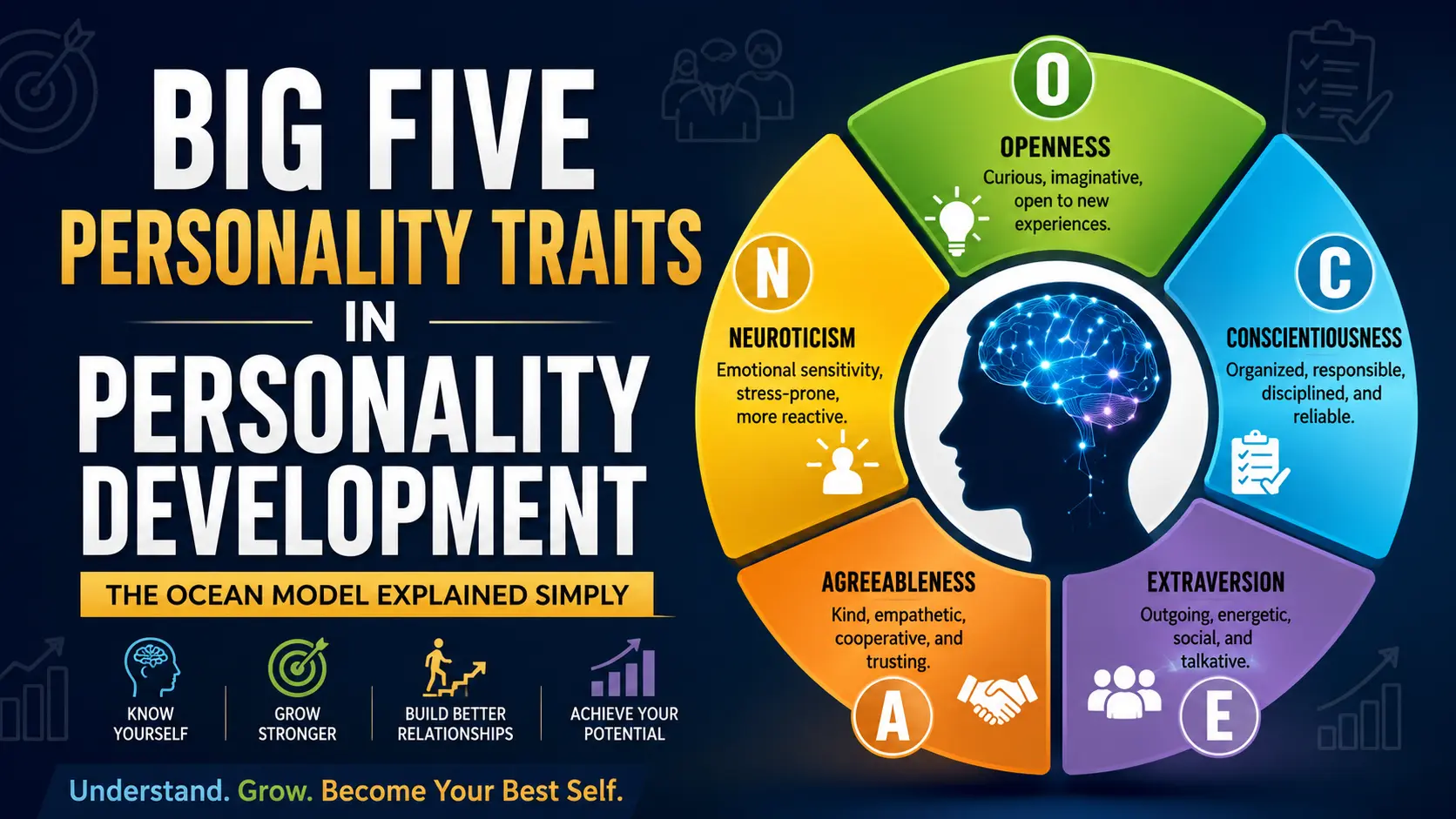
Five traits. One simple idea. Your personality is not one fixed type.
That is the core message behind the Big Five model. Psychologists built it over decades of research. Today it is the most trusted framework in personality science.
This guide covers Big Five Personality Traits in Personality Development in plain words. You will learn what each trait means, whether traits can change, and how to actually use this model in your own life.
Key Takeaways
- Big Five Personality Traits in Personality Development cover five core dimensions: Openness, Conscientiousness, Extraversion, Agreeableness, and Neuroticism, remembered by the acronym OCEAN.
- A major study of over 132,000 adults found conscientiousness and agreeableness genuinely rise with age.
- The Big Five model has stronger scientific backing than MBTI, though both remain popular for different reasons.
- Knowing your own trait profile helps you set goals that fit your natural style instead of fighting it.
- No trait is “good” or “bad.” Each one carries strengths and trade-offs depending on the situation.
What Are the Big Five Personality Traits in Personality Development?
Psychologists spent decades studying how people describe personality in everyday language. This process is called the lexical hypothesis. Researchers analyzed thousands of words people use to describe each other.
Five clear patterns kept showing up. Those patterns became the Big Five model.
Big Five Personality Traits in Personality Development are also called the Five Factor Model, or FFM. You will often see them written as the acronym OCEAN:
- Openness to Experience
- Conscientiousness
- Extraversion
- Agreeableness
- Neuroticism
Each trait sits on a spectrum. Nobody is purely one extreme. Most people fall somewhere in the middle, leaning slightly one way or the other.
Where Did the Big Five Model Come From?
The idea did not appear overnight. British psychologist William McDougall first proposed five personality factors back in the 1930s.
Later, researchers Costa and McCrae refined the model using large-scale factor analysis. Their work in the 1980s and 1990s gave the Big Five its current shape.
Unlike older type-based theories, this model does not sort people into fixed boxes. It measures degree, not category. That single difference is why it has held up so well under scientific testing.
Five Core Dimensions Explained
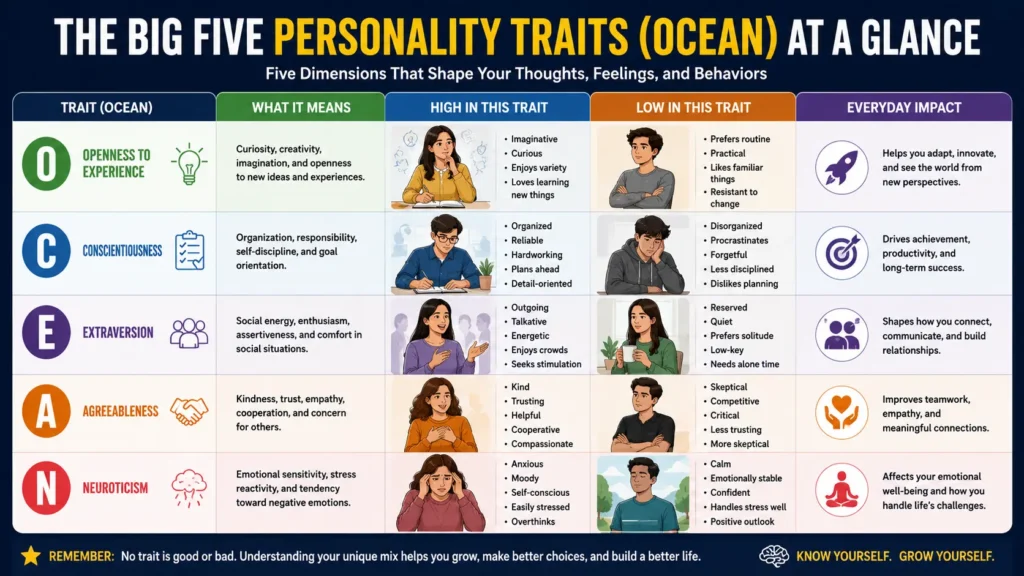
Let’s break down each trait in the Big Five Personality Traits in Personality Development.
1. Openness to Experience
This trait measures curiosity and imagination.
People high in openness enjoy new ideas, art, and unfamiliar experiences. People low in openness prefer routine and practical thinking.
High scorers tend to be:
- Curious and imaginative
- Drawn to art and abstract ideas
- Comfortable with change
Low scorers tend to be:
- Practical and traditional
- More comfortable with routine
- Focused on concrete facts over theories
2. Conscientiousness
This trait measures self-control and organization.
People high in conscientiousness plan ahead. They finish what they start. People low in this trait tend to be more spontaneous, sometimes at the cost of follow-through.
High scorers tend to be:
- Organized and disciplined
- Reliable and goal-focused
- Careful with detail
Low scorers tend to be:
- Spontaneous and flexible
- Prone to procrastination
- Less concerned with structure
3. Extraversion
This trait measures social energy.
People high in extraversion feel energized around others. People low in this trait, often called introverts, recharge through quiet time alone.
High scorers tend to be:
- Outgoing and talkative
- Comfortable in groups
- Energized by social interaction
Low scorers tend to be:
- Reserved and quiet
- Selective about socializing
- Drained by too much stimulation
4. Agreeableness
This trait measures warmth and cooperation.
People high in agreeableness are trusting and kind. People low in this trait tend to be more skeptical and competitive.
High scorers tend to be:
- Empathetic and helpful
- Trusting of others
- Focused on harmony
Low scorers tend to be:
- Competitive and direct
- More skeptical of others’ motives
- Comfortable with conflict
5. Neuroticism
This trait measures emotional stability.
People high in neuroticism experience stress and worry more intensely. People low in this trait stay calmer under pressure.
High scorers tend to be:
- Prone to worry and mood swings
- Sensitive to stress
- Emotionally reactive
Low scorers tend to be:
- Calm under pressure
- Emotionally steady
- Less easily rattled
If you want to understand how emotional steadiness connects to broader wellbeing, our guide on emotional intelligence explains how managing emotions works alongside your natural trait profile, not instead of it.
How to Identify Your Own Big Five Traits
You do not need a lab to get a rough sense of your profile. Most validated Big Five tests use short questionnaires with 40 to 120 items, rating how much you agree with statements like “I see myself as someone who is talkative” or “I see myself as someone who worries a lot.”
What Is the Most Reliable Big Five Test?
The most widely used research versions are the NEO-PI-R and the shorter Big Five Inventory (BFI). Free online versions exist too, though they vary in quality. Look for a test that gives you a score on all five dimensions separately, not a single overall type.
How to Interpret Your Big Five Score
Your result usually comes as a percentile on each trait. A high conscientiousness score does not mean you are a “good” person. It means you likely plan and follow through more than average. Read each score as a tendency, not a label.
Can Your Big Five Traits Change Over Time?
This is one of the most searched questions about the model, and the honest answer might surprise you.
For a long time, psychologists assumed personality was mostly fixed by adulthood. Newer research says otherwise.
A well-known study tracked 132,515 adults between ages 21 and 60. It found that conscientiousness kept rising through the age ranges studied, with the sharpest jump happening in a person’s 20s. Agreeableness also increased steadily, often peaking during the years people spend raising a family or managing a career.
As lead researcher Sanjay Srivastava put it in his findings:
“Conscientiousness grows as people mature and become better at managing their jobs and relationships.”
Do Personality Traits Mature With Age?
Largely, yes. Researchers call this the maturity principle. Conscientiousness, agreeableness, and emotional stability tend to rise through early and middle adulthood. Openness often dips slightly in later life.
This matters for Big Five Personality Traits in Personality Development because it means your profile is not a life sentence. Life experiences, career demands, and relationships genuinely reshape your trait scores over time.
If building stronger conscientiousness is a personal goal, our guide on self-discipline in personality development offers practical steps that align with what this research shows.
Big Five vs MBTI: Which Is Better?
This comparison comes up constantly, so let’s settle it clearly.
| Factor | Big Five Model | MBTI |
|---|---|---|
| Structure | Five continuous spectrums | 16 fixed categories |
| Scientific support | Strong, backed by decades of factor analysis | Weak, low test-retest reliability |
| Used in research | Yes, the standard in academic psychology | Rarely used in serious research |
| Used in workplaces | Common in hiring and team-building tools | Common in casual team workshops |
| Main criticism | Less intuitive, harder to remember | Oversimplifies people into fixed boxes |
The Big Five model wins on scientific grounding. MBTI wins on simplicity and popularity. Neither replaces the other completely, but if you want a data-backed answer to who you are, the Big Five model is the stronger choice.
Criticisms of the Big Five Model
No personality model is beyond criticism, and Big Five Personality Traits in Personality Development is no exception.
Is the Big Five Model Scientifically Valid?
Mostly, yes. It holds up better than most personality frameworks under repeated testing. But it is not perfect.
What Is a Common Criticism of the Big Five Approach?
The most frequent criticism is that five broad traits cannot capture the full complexity of a human being. Critics argue the model describes behavior well but explains the underlying cause of that behavior poorly. It tells you what a trait looks like, not always why it exists.
Some researchers, as described in Simply Psychology’s overview of the Big Five model, also point out that the five factors were derived mainly from English-language data, which raises questions about how cleanly they translate across every culture.
Which Trait Is Linked to the Most Negative Outcomes?
Neuroticism tends to correlate most strongly with negative life outcomes, including higher stress and lower reported life satisfaction. That said, high neuroticism also comes with upsides, like heightened caution and sensitivity to real risks.
Big Five Personality Traits in Personality Development: Practical Use
Here is where the model earns its place beyond theory.
- Self-reflection. Knowing your baseline on each trait helps you spot real strengths and blind spots, instead of relying on guesswork.
2. Goal customization. If you score low on natural conscientiousness, you can build external structure, like shared calendars or accountability partners, rather than waiting for willpower to show up on its own.
3. Better relationships. Understanding a partner’s or colleague’s trait profile can explain friction that otherwise feels personal. A low-agreeableness partner is not being cold. Directness is simply their natural style.
For a deeper look at how attitude shapes these day-to-day choices, our article on the power of attitude in personality development pairs well with this trait-based approach.
Big Five Traits in the Workplace and Career Growth
Big Five Personality Traits in Personality Development show up constantly in hiring and career planning.
Conscientiousness is the single trait most consistently linked to strong job performance across almost every field. Extraversion tends to predict success in sales and leadership roles. Openness often predicts strong performance in creative and research-heavy work.
If you are mapping your own career path around your natural strengths, our guide on self-career perception in personality development walks through how to do that step by step.
Big Five Personality Traits for Psychology Students and Exams
Studying psychology in India? This model appears constantly in coursework, from B.Ed programs to UGC-NET to state PSC psychology papers.
Here is what examiners typically expect you to know:
- All five trait names and their opposite poles
- The lexical hypothesis and how the model was derived
- Key researchers: McDougall, Costa and McCrae
- How Big Five differs structurally from type-based models like MBTI
- Evidence that traits shift with age, particularly the maturity principle
Quick memory trick: OCEAN spells itself, so anchor each letter to one keyword: Openness (curious), Conscientiousness (organized), Extraversion (social), Agreeableness (kind), Neuroticism (worried).
For the broader roots of how any personality theory develops, our guide on personality development from genes to Freud traces that full history.
Conclusion
Big Five Personality Traits in Personality Development gives you something rare in psychology: a model backed by genuine, repeated evidence.
It will not sort you into a single tidy box. That is the point. Real personalities are not tidy. They shift with age, circumstance, and effort.
Knowing your OCEAN profile is not about labeling yourself. It is about understanding your starting point, so you can work with your natural style instead of against it.
Big Five Personality Traits in Personality Development do not tell you who you have to be. It simply shows you who you already are, and where you have room to grow.
Frequently Asked Questions
1. Is the Big Five model still relevant today?
Yes. It remains the most cited and tested personality framework in academic psychology, decades after it was developed.
2. Has MBTI been debunked?
Not entirely, but its scientific reliability is weak compared to the Big Five model. The same person can retake MBTI weeks later and get a different type.
3. What is the most credible personality test available?
Tests built directly on the Big Five model, like the NEO-PI-R or a validated BFI version, carry the strongest scientific backing.
4. Can personality traits really change over time?
Yes. Research consistently shows conscientiousness and agreeableness rise through adulthood for most people, while neuroticism often gradually declines.

Ayanshi is the founder of PersonaGuru.in, a blog dedicated to personality development, relationships, and mental health. With 3+ years of writing experience and 250+ published articles, she simplifies psychology into practical, everyday advice for real people.