

Last updated on September 7th, 2026 at 07:40 am
Picture a team meeting. Someone is talking over others, cracking jokes, and commanding the room. Most people assume that person is the leader. But look at the quieter person in the corner. They are the ones listening carefully and taking notes. Then, they ask one sharp question at just the right moment. That person is often the most effective leader in the room.
Direct Answer
Introvert leadership qualities are real, research-backed, and often outperform extroverted leadership when a team is already proactive and self-motivated. The core strengths are active listening, thoughtful decision-making, deep empathy, and calm follow-through under pressure, not add-ons to leadership but the leadership style itself. For the full picture of what leadership means and the traits every effective leader builds, see our complete leadership guide.
These qualities show up everywhere in the workplace today, even when they go unnoticed. Research from the Wharton School of Business found that introverted leaders often do better than extroverted ones, especially when leading teams that are already motivated. Yet, many companies still believe a great leader must be loud and always “on.”
This article shows that it is not true. You might be an introvert yourself, or you might be a manager trying to find quiet talent. This guide shows exactly what makes introverted leadership powerful. We will also talk about the real challenges introverted leaders face and simple steps to grow. You can succeed in any workplace without changing who you are.
You can succeed in any workplace without changing who you are. Personality Development Tips like these help introverts build confidence naturally.
What Is Introvert Leadership?
Introvert leadership is about guiding others through deep listening and calm decision-making. It is not about being the loudest person or always being seen.
The biggest mistake people make is thinking that being an introvert means you are shy or bad with people. That is not true. Being an introvert just means you get your energy from spending time alone. You like to think things through before you speak. This is actually one of the strongest introvert leader traits there is.
A famous psychologist named Carl Jung said we should not see introverts and extroverts as total opposites. Between 25% and 40% of the world’s population is introverted. This means many great introverted leaders are being missed every day, just because they are quiet.
Why Introverts Make Good Leaders
It helps to look at what research actually says about why introverts make good leaders:
- Better Listening: A University of Iceland study found that bosses who listen well make their employees feel more excited and energetic about their work.
- Better Decisions: Research shows that taking time to think leads to better choices than making quick guesses. This is a natural strength of the introverted leadership style.
- Building Trust: A study in the Journal of Applied Psychology showed that employees do better work when they feel trusted. Introverted leaders usually do not try to control every small detail.
- Empowering Others: Research from Wharton found that introverts as leaders are great at leading teams of people who already have their own ideas. They listen first instead of just taking over. Adam Grant’s research proves introverts make better leaders.
7 Core Introvert Leadership Qualities
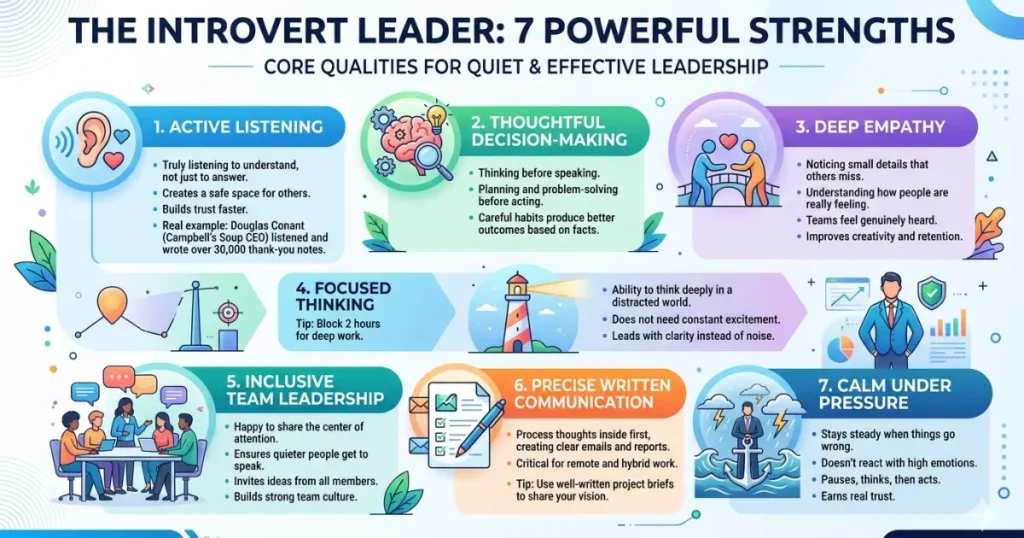
1. Active Listening
One of the most important introvert leadership qualities is the ability to truly listen. Introverts listen to understand what you are saying, not just to wait for their turn to talk. This creates a safe space for others to speak freely. It builds trust faster than any big speech ever could.
Real example: Douglas Conant became CEO of Campbell’s Soup in 2001 with the worst employee engagement scores in the Fortune 500. Instead of making big announcements, he listened. He personally wrote over 30,000 handwritten thank-you notes to employees. By 2008, during a tough recession, Campbell’s earnings rose 7%. All from a leader who led quietly.
read more: How to Improve Listening Skills as a Leader
2. Thoughtful Decision-Making
Introverts think before they speak. In fast meetings, some people think this means they are unsure. In reality, it is a big strength of quiet leadership. Brain scans show that introverted brains spend more time on planning and problem-solving before acting.
The introverted leader does not claim certainty unless they have the facts. That careful habit produces better outcomes than fast, confident-sounding decisions made without full information.
read more: Improve Decision-Making Skills
3. Deep Empathy
Introverted leaders notice small things that others miss. They see when a team member goes quiet or when someone’s idea gets ignored. Because they observe more than they talk, they understand how people are really feeling.
This empathy is one of the key qualities of a silent leader. It builds teams where people feel genuinely heard. That feeling of safety directly improves creative output, retention, and overall team performance.
4. Focused Thinking
In a world full of distractions, being able to think deeply about a problem is rare and very valuable. Introverts are naturally good at this. They do not need constant excitement to stay interested in a project. This focused nature is one of the strongest introvert leadership qualities in any industry.
Tip: Block two hours each morning for deep work before you check your emails. Your team benefits when their leader shows up with clarity instead of reactive noise.
read more: How to Stay Focused on Your Goals
5. Inclusive Team Leadership
Since introverts do not need to be the center of attention, they are happy to share it. In meetings, introverted leaders make sure the quieter people get a chance to speak. They ask follow-up questions. They invite the person who has not said anything yet. This naturally leads to better ideas and a stronger team culture.
This naturally leads to better ideas and a stronger team culture. Learn how to motivate team members as a leader with these proven strategies.
6. Precise Written Communication
Many introverts are great at writing. Because they process thoughts inside their heads first, their emails and reports are usually very clear and organized. This is one of the introvert leadership strengths that matters most in today’s remote and hybrid work world.
Tip: Use well-written project briefs and updates to share your vision. A clear written message often carries more weight than a rushed meeting.
7. Calm Under Pressure
When things go wrong, the team looks at the leader. An introverted leader stays calm and steady. They do not react with high emotions. Instead, they pause, think, and then act. This calm is not weakness. It is a different kind of strength, and it earns real trust over time.
read more: How to Control Your Mind
Famous Introverted Leaders
History is full of famous introverted leaders who made a huge impact without needing to be the loudest person in the room:
- Bill Gates — Built Microsoft through deep focus and careful analysis.
- Warren Buffett — Spends hours reading quietly before making any big investment decisions.
- Mahatma Gandhi — Led India’s independence movement through quiet, steady, and principled work.
- Eleanor Roosevelt — A self-described shy person who became one of the most powerful voices for human rights in the 20th century.
- Barack Obama — Known worldwide for his calm, measured, and thoughtful introverted leadership style.
- Richard Branson — Openly calls himself shy. His quiet nature did not stop him from building a global business empire with over 60,000 employees.
The pattern is clear. Quiet leadership is not a limitation. For the right person, it is a real competitive edge.
Challenges Introverted Leaders Face
Being Overlooked
Many people still believe you have to be loud to lead. This is one of the biggest obstacles for anyone with strong introvert leader traits.
Tip: Practice being visible in small, intentional ways. Make at least two strong, specific points in every important meeting. One sharp contribution is worth more than ten generic comments.
Assertiveness
It can be hard for introverted leaders to push back on loud ideas or claim credit for their work.
Tip: Remember that you are speaking up for the good of the project and the team, not just for yourself. That small shift in thinking makes assertiveness feel much more natural.
Social Energy Drain
Being around people all day can be genuinely tiring for someone with an introverted leadership style. This is not a weakness. It is simply how introverts are wired.
Tip: Schedule 15 minutes of quiet time between meetings to recharge. Protecting your energy is a smart leadership decision, not a personal luxury.
Wondering if you should change? Read How to change Personality from Introvert to Extrovert to understand your options.
How to Grow as an Introverted Leader
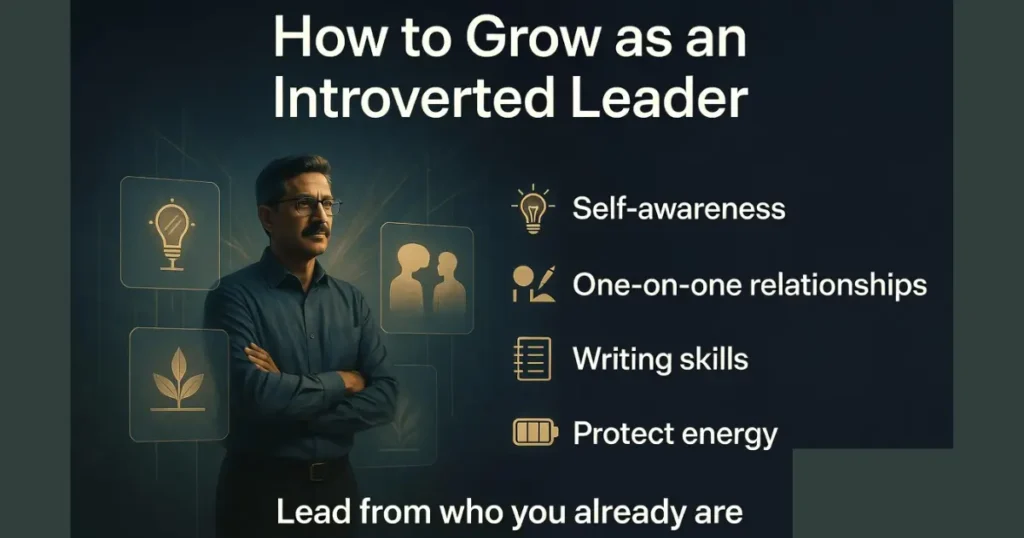
First, know your own strengths. You do not need to become a different person to be a great leader. The goal of developing introvert leadership qualities is to lead from who you already are.
Build strong one-on-one relationships. Large groups may feel draining, but talking to people individually is where introverted leaders truly shine. These personal connections become the foundation of your influence.
Use your writing skills to share your ideas and establish your voice. If you write a clear and thoughtful update, people will start to seek out your opinion. Over time, this becomes one of your strongest introvert leadership strengths.
Always protect your energy like a resource. Schedule recovery time the same way you schedule meetings. An introvert running on empty starts to look like a less effective leader, not because they are, but because they are simply depleted.
Qualities of a Silent Leader
Quiet leadership is its own distinct style. Silent leaders lead by what they do, not just by what they say. They are patient. They watch what others miss. They make decisions that hold up long after the meeting ends.
These introvert leader traits include deep observation, long-term thinking, and leading by consistent example. Silent leaders do not measure success by applause. They measure it by the growth of their team and the trust they have built over time.
Conclusion
Leadership has never been about volume. The biggest changes in companies, communities, and history are often made by people who think more and talk less. They listen when others are talking. They give credit to their team. They stay steady when everything around them is moving fast.
The introverted leadership style is a proven path to real, lasting results. If you are an introvert, stop waiting until you feel “loud” enough to lead. Your team does not need you to be the most outspoken person in the room. They need you to think clearly, listen well, and be a steady presence when things get hard.
Those are introvert leadership qualities. And you already have them.
FAQs
Q1. Can introverts really be effective leaders?
Yes. Studies from Wharton, the Journal of Applied Psychology, and the University of Iceland all confirm that introverted leaders perform just as well as extroverted ones. They often do even better when their team members are self-motivated and proactive.
Q2. What are the top introvert leadership qualities?
The main introvert leadership qualities are listening well, thinking before acting, showing empathy for others, writing clearly, staying calm under pressure, and empowering team members to do their best work.
Q3. How can an introvert become more confident as a leader?
The best way is through preparation. If you know your facts and your key points, you will feel more grounded. Also, focus on building strong relationships one-on-one. This is where introverted leaders naturally build the most trust.
Q4. Are introverts or extroverts better leaders?
Neither is always better. Extroverts often do well leading a quiet team that needs direction. Introverted leaders do better with teams that already have strong ideas and just need space to use them.
Q5. What is the biggest challenge for introverted leaders?
The biggest challenge is visibility. Many organizations still overlook introvert leadership strengths because they associate leadership with being outgoing. The solution is to be intentional, speak up at key moments, and let your consistent results speak over time.

Ayanshi is the founder of PersonaGuru.in, a blog focused on personality development, career, relationships, and mental well-being. With over 3 years of writing experience, she turns psychology and everyday experiences into practical, easy-to-understand advice for real life.