
Last updated on October 22nd, 2026 at 09:59 am
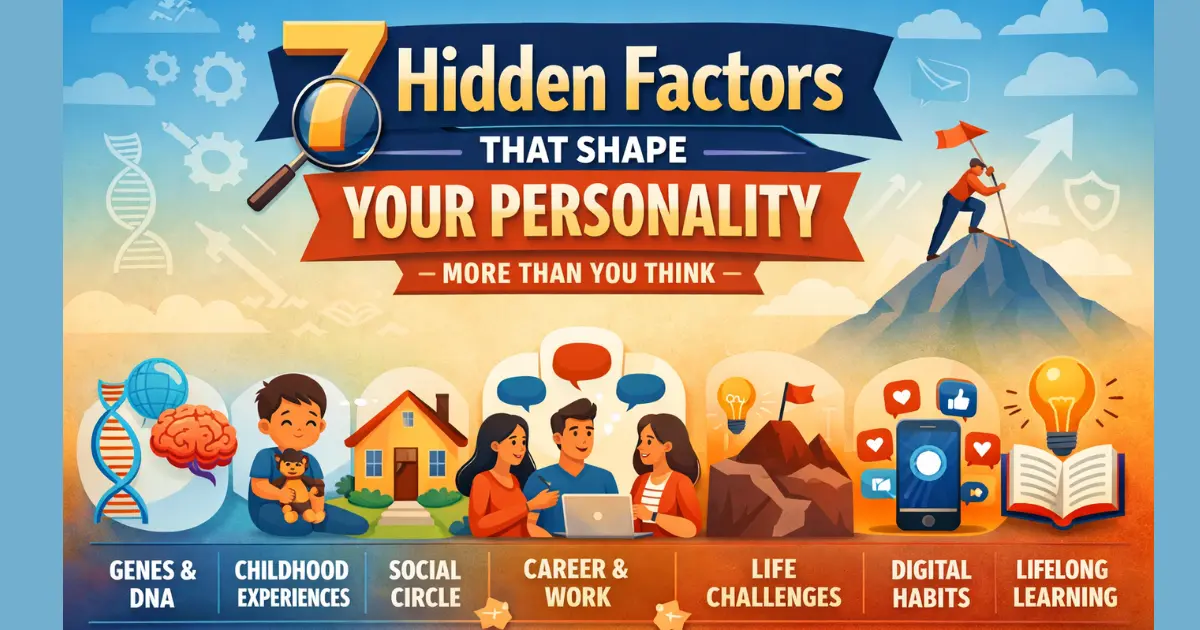
The personality you have today is not set in stone from birth. It changes based on what you go through. Your genetics give a starting point, but your environment and daily habits are the real factors affecting developing your personality. For the full picture, read our complete guide to personality development.
Understanding these points helps you take control and become the person you want to be.
Key Points at a Glance
- Genetics set your starting point (40–60% influence), but daily choices build your character.
- You unconsciously adopt habits, language, and attitude from people around you.
- Your toughest challenges often drive your biggest personality growth.
- How you view your career directly shapes your confidence in every area of life.
1. The Genetic Foundation — Your Starting Point
Before your first memory, your DNA had already shaped your temperament. Some babies are naturally relaxed and easy-going; others are highly sensitive to noise, change, or new faces. This biological wiring is the first major factor affecting developing your personality.
“Genetic variants influence neurotransmitter systems that regulate emotional reactivity, impulsivity, and sociability from birth.” — Nature Human Behaviour, 2024 (Yale University)
A landmark 2024 study published in Nature Human Behavior by Yale University identified specific genetic loci tied to Big Five personality traits. The research confirms that genetics accounts for 40–60% of trait variance in traits like neuroticism, agreeableness, and extraversion — consistent with decades of twin study data.
But here is the key: tendencies are not destiny. A genetic lean toward anxiety does not mean you will always be anxious. Environment, habits, and conscious effort can reshape how those tendencies express themselves over time.
💡 Tip: Track your natural reactions for one week — not to judge them, but to understand your baseline. Awareness is where change begins.
2. Your Home Life and Early Experiences
Family is the first classroom. The home you grew up in taught you how the world works, whether it was safe or unpredictable, encouraging or critical. These early experiences are among the deepest factors affecting developing your personality.
A 2025 study in the International Journal of Indian Psychology found that strong family cohesion, meaning warmth, communication, and stability, positively predicts agreeableness and conscientious decision-making in adulthood. Importantly, researchers noted these early experiences explain certain behaviors; they do not permanently define them.
“Children from cohesive families show measurably higher agreeableness and conscientiousness scores in adult personality assessments.” — International Journal of Indian Psychology, 2025
If your early home life was difficult, and many people’s were, this does not mean you are fixed in place. Adults who deliberately rebuild their sense of safety and belonging, through therapy, supportive relationships, or community, consistently show meaningful personality shifts.
💡 Tip: Reflect on one belief about the world you formed before age 12. Ask yourself: Is this belief still accurate today, or is it outdated data?

3. The People You Choose to Spend Time With
As you grow older, friends and coworkers replace family as the mirror showing you who you are and who you are becoming. Your social circle is one of the most underrated factors affecting developing your personality in adulthood.
Research on socioemotional selectivity and social influence, including 2023 Pew Research Center surveys on adult social networks, suggests that social connections account for approximately 20–30% of personality variance in adulthood. Put simply: the group shapes the individual.
Think about it practically. Spend forty hours a week around people who complain constantly, and you will start noticing more things to complain about. Not sure if someone in your life has toxic traits? Read this: Toxic Personality Traits. Spend time with people who are building things, learning, and growing, and your brain starts looking for opportunities instead of obstacles.
“You are the average of the five people you spend the most time with.” — Jim Rohn, motivational speaker and author
💡 Tip: Do a quick audit list three people you spend the most time with. Write one trait each person has that you have started adopting. Is it a trait you want?
4. Your Career and How You See Your Work
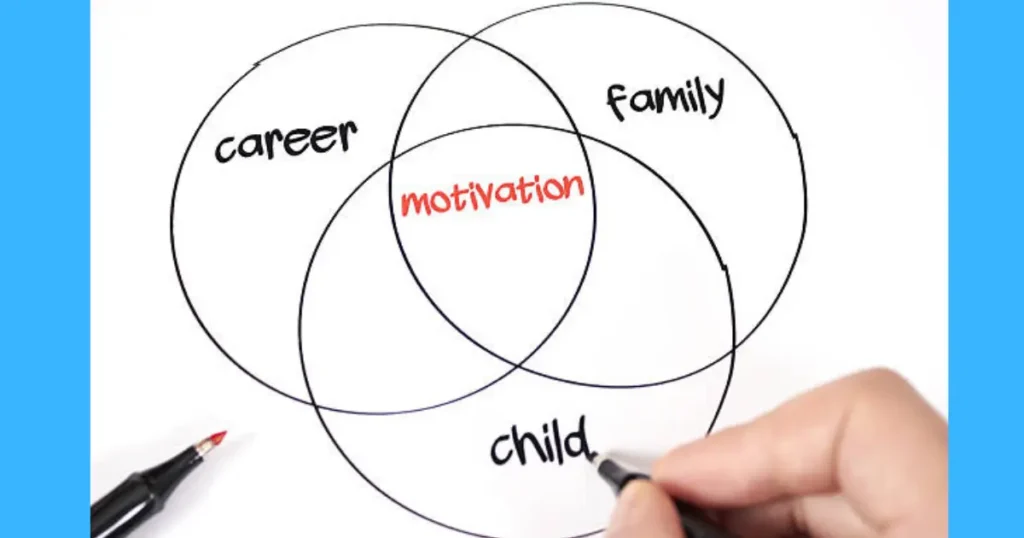
Work is not just what you do; it is a major part of how you see yourself. Your professional life sits at the core of the factors affecting developing your personality in adult years.
Studies on emotional intelligence at work, including meta-analyses published in 2025, show that emotional stability correlates with 20–40% higher job satisfaction, and this relationship runs both ways. Feeling valued and purposeful at work builds emotional stability, which then carries over into how you show up at home, in relationships, and in your own self-image.
A person who feels like their work means something becomes proactive everywhere. A person stuck in a dead-end job they resent often carries that frustration into every other area of life. The good news: updating how you view your career, even before changing the job itself, can shift your personality meaningfully.
💡 Tip: Whether you love your job or hate it, identify one way your work is developing a skill or strength in you. Finding meaning reframes the experience.
read more: Self-Career Perception in Personality Development
5. How You Handle Life’s Challenges
Your real character is not revealed in comfortable times it shows up when things fall apart. This is why resilience consistently tops the list of factors affecting developing your personality.
Job loss, a broken relationship, a health scare — each one presents you with a choice: become bitter and closed, or become resourceful and wiser. The direction you choose, even slightly, compounds over time.
“Resilience is not a trait that people either have or do not have. It involves behaviors, thoughts, and actions that can be learned and developed in anyone.” — American Psychological Association (APA)
A 2025 study highlighted at the APA Annual Meeting found that structured resiliency training programs led to 20–30% reductions in burnout indicators among healthcare professionals. Crucially, resilience was found to be a learnable skill, not a fixed personality trait; anyone can build it through practice.
💡 Tip: Next time something goes wrong, ask: “What is this teaching me?” Repeat this once a day for a week. Watch how your default response starts to shift.
6. Your Digital Habits and Social Media Use
Your phone is with you more than any person in your life. The content you consume daily is quietly but consistently shaping the factors affecting developing your personality — for better or worse.
Research from 2025–2026 studies on social media and mental health consistently shows that spending 3 or more hours daily on social media is associated with 1.5 to 3 times higher rates of anxiety and depression in young adults. Passive scrolling, especially through highlight reels of other people’s lives, breeds comparison, self-criticism, and a sense of inadequacy.
Flip it around: the same technology becomes a powerful personality tool when used intentionally. Learning accounts, skill-building communities, and positive support groups actively build optimism, curiosity, and a growth mindset.
💡 Tip: Follow one account this week that teaches you something new. Unfollow one account that consistently makes you feel worse about yourself. Small edits to your feed change what your brain normalizes.
read more: Social Media is Bad Pink
7. Staying Curious and Committing to Lifelong Learning
Curiosity is the antidote to rigidity. When you keep learning, whether through books, new skills, travel, or simply asking better questions, your personality stays flexible and adaptive.
UNESCO’s 2025 Global Education Report highlights that lifelong learners demonstrate up to 30% greater adaptability in responding to life changes and crises, compared to those who stop formal or self-directed learning after school. The report also notes that the habit of learning not just the content is what builds the mental flexibility that prevents rigid, stuck thinking.
“An investment in knowledge pays the best interest.” — Benjamin Franklin
You do not need to enroll in a course or get a degree. Reading one book a month on an unfamiliar topic, picking up a new hobby, or regularly challenging your own assumptions creates the same neurological and psychological effect: a mind that stays open.
💡 Tip: Choose one topic outside your usual interest area. Spend 15 minutes on it today. Notice how it feels to be a beginner again, that discomfort is growth.
Nature vs. Nurture: How the Key Factors Compare
| Factor | Influence Type | Estimated Impact | Can You Change It? |
|---|---|---|---|
| Genetics / DNA | Nature | 40–60% | Partially |
| Family Environment | Nurture | 30–40% | Yes (over time) |
| Social Circle | Nurture | 20–30% | Yes |
| Career Satisfaction | Nurture | 20–35% | Yes |
| Resilience & Challenges | Nurture | Varies | Yes |
| Digital Habits | Nurture | Growing (1.5–3x risk) | Yes |
| Lifelong Learning | Nurture | ~30% adaptability | Yes |
Conclusion
The factors affecting developing your personality are a mix of what you were born with and what you actively do every day. You cannot erase the past, but you can choose your circle, your habits, and your mindset starting right now.
The most transformative thing you can take from this article is not a tip or a statistic. It is this: personality is not something that happens to you. It is something you participate in building every single day.
Start with one small change this week. Track it for seven days. Then add another. That is how real personality development works, not through one dramatic moment, but through the quiet accumulation of intentional choices.
Related Reading:
FAQs
1. What are the main factors that affect personality development?
Genetics, early family environment, social circle, career satisfaction, resilience, digital habits, and lifelong learning are the core factors. No single factor works alone. They continuously interact and build on one another throughout one’s life.
2. Can your personality change after age 25?
Yes. Traits such as conscientiousness, agreeableness, and emotional stability continue to shift well into adulthood. Daily habits, new relationships, and major life experiences are the biggest drivers. Your brain stays far more adaptable than most people assume.
3. How does childhood trauma affect personality development?
Trauma shapes emotional patterns and stress responses, but it does not lock them in permanently. With the right support, therapy, or community, adults consistently rebuild healthy personality traits. Healing is well-documented in psychology research.
4. What role does the environment play in shaping your personality?
A massive one. Your home life, social circle, workplace, and daily digital content all shape how your personality expresses itself. Two people with identical genetics can develop very different personalities based on environment alone.
5. How does social media affect personality development?
Passive scrolling for hours daily links to higher anxiety, lower self-esteem, and increased self-comparison. Intentional use for learning and community building has the opposite effect. What your feed normalizes gradually becomes what your brain expects from real life.
6. Which factor has the biggest impact, nature or nurture?
Neither dominates alone. Genetics set your starting point, while environment and daily choices shape the rest. Most psychologists agree that it is the interaction between both that truly determines who you become.
7. How can I improve my personality as an adult?
Audit your social circle first. Add 15 minutes of daily learning. Reframe setbacks as lessons. Limit passive scrolling. Find meaning in your work. Small, consistent choices compound into real personality shifts over months.

Ayanshi is the founder of PersonaGuru.in, a blog focused on personality development, career, relationships, and mental well-being. With over 3 years of writing experience, she turns psychology and everyday experiences into practical, easy-to-understand advice for real life.