
Last updated on March 7th, 2026 at 07:16 am
Have you ever finished a conversation and thought,
“Why do I feel so tired?”
“Why am I doubting myself?”
“Why does this always happen with the same person?”
That feeling is not random.
It is often your mind reacting to toxic personality traits.
Toxic traits don’t always look loud or aggressive. Many appear calm, intelligent, caring, or even charming. But over time, they create emotional exhaustion, self-doubt, and stress that’s hard to explain.
In this article, you’ll understand:
- What toxic personality traits really are
- Examples of toxic personality traits in daily life
- The psychology behind toxic behavior
- How to recognize toxic people early
- How toxic traits affect mental health
- What to do if you notice toxic traits in yourself
What Is a Toxic Personality?
A toxic personality is defined by a consistent pattern of harmful behaviors that negatively affect others emotionally, mentally, or psychologically.
This does not mean:
- Someone who gets angry once
- Someone who makes mistakes
- Someone imperfect
Toxicity starts when harmful behavior becomes:
- Repeated
- Predictable
- Emotionally damaging
- Unaccountable
According to the American Psychological Association (APA), harmful interpersonal behavior often involves manipulation, lack of empathy, and chronic negativity—especially when it appears across multiple relationships.
Toxic personality traits psychology (simple explanation)
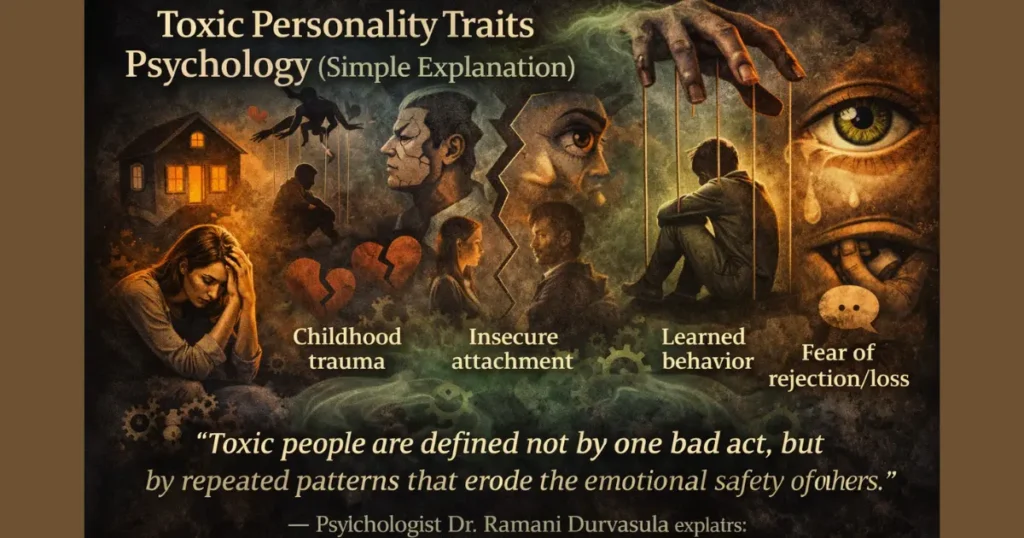
Psychologists explain toxic traits as coping mechanisms that once helped someone survive emotionally but now harm others. Common roots include:
- Childhood trauma or neglect
- Insecure attachment styles
- Learned behavior from caregivers
- Deep fear of rejection or loss of control
As psychologist Dr. Ramani Durvasula explains:
“Toxic people are defined not by one bad act, but by repeated patterns that erode the emotional safety of others.”
Toxic traits vs normal personality flaws
Everyone has flaws. Toxic traits differ in impact and repetition.
| Normal human behavior | Toxic personality traits |
| Occasional insecurity | Chronic jealousy |
| Stress reactions | Emotional manipulation |
| Making mistakes | Refusing accountability |
| Needing reassurance | Controlling others |
Example:
Someone who always plays the victim, avoids responsibility, and makes others feel guilty for their mistakes isn’t just “sensitive.” That’s a toxic pattern.
How Do Toxic Personality Traits Develop?
Toxic traits are learned, reinforced, and repeated over time.
1. Childhood trauma
People raised in unstable, emotionally unsafe homes often develop control, manipulation, or emotional withdrawal as survival tools.
2. Learned behavior
If guilt-tripping, shouting, or silent treatment were normal in childhood, it may feel “natural” in adulthood—even when it harms others.
3. Personality patterns
Some toxic behaviors overlap with Cluster B personality patterns (as described in the DSM-5), including narcissistic and borderline traits.
Important note:
This article explains behavior patterns, not diagnoses. Only trained professionals can diagnose mental health conditions.
Psychologist Shahida Arabi writes:
“Toxic people condition you to believe the problem isn’t the abuse—it’s your reaction to it.”
What Are the Most Common Toxic Personality Traits?
Below are the most common toxic personality traits, with clear explanations and real-life logic.
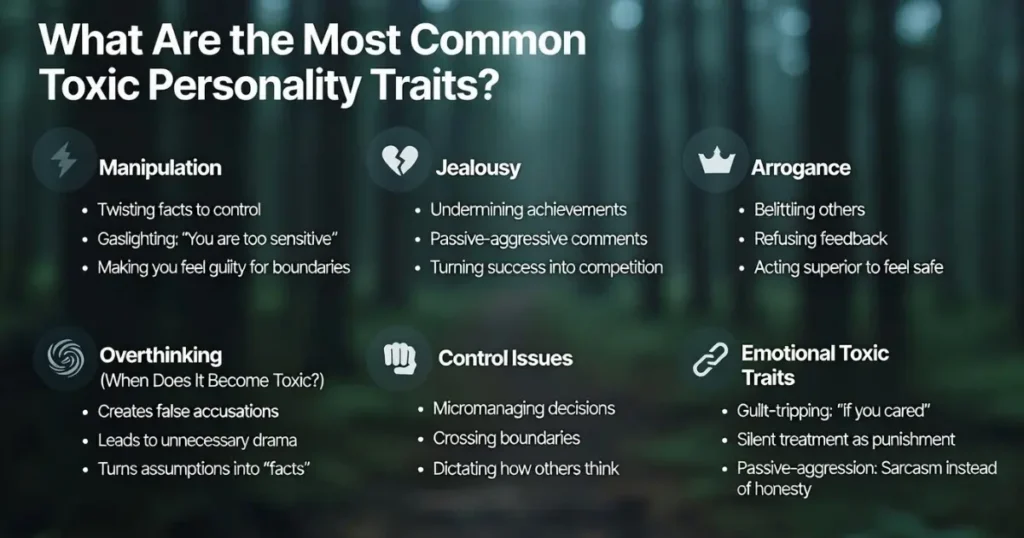
1. Manipulation (Including Gaslighting)
Manipulation means twisting facts, emotions, or situations to control others.
Examples of toxic manipulation:
- “You are too sensitive.”
- “That never happened.”
- Making you feel guilty for setting boundaries
Gaslighting is especially harmful because it makes people doubt their memory, judgment, and reality.
2. Jealousy
Healthy jealousy passes. Toxic jealousy attacks.
Signs include:
- Undermining achievements
- Passive-aggressive comments
- Turning your success into competition
Toxic jealousy comes from insecurity, not love.
These are some of the most common signs, but toxic traits can be even more varied. For an expanded list of 41 traits with practical advice, see this guide: 41 research-backed toxic traits.
3. Arrogance
Arrogance is insecurity wearing confidence.
It shows up as:
- Belittling others
- Refusing feedback
- Acting superior to feel safe
Confidence builds people up. Arrogance pushes them down.
4. Overthinking (When Does It Become Toxic?)
Is overthinking a toxic personality trait?
Not always.
Overthinking becomes toxic when it:
- Creates false accusations
- Leads to unnecessary drama
- Turns assumptions into “facts.”
Replaying conversations is human. Attacking others based on imagined scenarios is toxic.
5. Control Issues
Control often disguises itself as care.
Toxic control includes:
- Micromanaging decisions
- Crossing boundaries
- Dictating how others should think or act
Control is driven by fear, not responsibility.
6. Emotional Toxic Traits
Some of the most damaging traits are subtle:
- Guilt-tripping: “If you really cared, you’d do this.”
- Silent treatment: Emotional withdrawal as punishment
- Passive-aggression: Sarcasm instead of honesty
These behaviors don’t shout, but they slowly destroy trust.
How Can You Recognize a Toxic Person Early?
You don’t need psychology degrees. You need awareness.
Common behavioral signs
- Constant negativity
- Lack of empathy
- Boundary violations
- Blame-shifting
- Emotional inconsistency
Psychologist Dr. Michele Leno notes:
“Feeling drained, defensive, or on edge around someone is often a sign you are dealing with toxic behavior.”
Red Flags vs Subtle Signs
| Overt toxicity | Subtle toxicity |
| Yelling | Silent treatment |
| Insults | Backhanded compliments |
| Public humiliation | Playing the victim |
| Direct control | Guilt-tripping |
Subtle toxicity often hurts more because it’s harder to explain.
read more: 10 Biggest Red Flags in a Guy
Real Impact of Toxic Personality Traits
Toxic traits don’t just “feel bad.” They affect real health.
Research in psychology consistently shows that chronic emotional stress from unhealthy relationships is linked to:
- Anxiety disorders
- Depression
- Burnout
- Low self-esteem
Studies referenced by the APA show that long-term exposure to emotionally manipulative behavior increases stress hormones like cortisol, which directly affects sleep, mood, and focus.
In workplaces and relationships, toxic traits:
- Destroy trust
- Increase conflict
- Reduce performance
- Damage mental well-being
In simple words: your nervous system remembers toxic people, even when you try to ignore it.
read more:
When Toxic Traits Show Up in Yourself
This part matters.
Sometimes, toxic traits don’t only belong to “other people.”
Ask yourself honestly:
- Do I overthink and accuse without evidence?
- Do I use silence to punish?
- Do I struggle with control when I feel insecure?
Self-awareness is not self-shaming. It’s growth.
Psychologists agree that recognizing unhealthy patterns is the first step to change. Toxic traits can be unlearned with accountability, therapy, and emotional regulation.
read more:
How to Protect Yourself from Toxic Personality Traits
You can’t change someone who doesn’t want to change, but you can protect yourself.
- Set clear boundaries
- Trust discomfort, it’s data
- Stop over-explaining
- Seek support from emotionally safe people
As Dr. Sherrie Campbell says:
“You don’t owe anyone access to you at the cost of your mental health.”
read more: How to Get Out of a Toxic Relationship
Final Thoughts
Understanding toxic personality traits is not about labeling people.
It’s about protecting your peace, clarity, and emotional safety.
The moment you stop trying to explain yourself to someone committed to misunderstanding you, life becomes lighter.
Ready to go deeper?
Explore our detailed guides on:
- Toxic personality traits in relationships
- Toxic traits at work
Build awareness. Build boundaries. Build peace.
FAQs
1. Is overthinking a toxic personality trait?
Overthinking itself is a mental habit, but it becomes toxic when it is weaponized. If your overthinking leads to constant false accusations, creating unnecessary drama, or attacking others based on imagined scenarios, it becomes a toxic behavior that destroys trust and emotional safety.
2. What is a toxic personality trait?
A toxic personality trait is a consistent, repeated pattern of behavior that causes emotional or psychological harm to others. Unlike a one-time mistake, these traits are predictable, lack accountability, and consistently drain the energy and self-esteem of the people around the individual.
3. What are common toxic traits?
While toxicity varies, the most common traits include:
1. Manipulation: Twisting facts to control others.
2. Gaslighting: Making someone doubt their own reality.
3. Lack of Empathy: Disregarding others’ feelings.
4. Chronic Jealousy: Undermining others’ success.
5. Passive-Aggression: Using silence or sarcasm as a weapon.
4. What does toxic personality traits psychology say?
Psychology explains these traits as “maladaptive coping mechanisms.” They often stem from childhood trauma, insecure attachment styles, or learned behaviors from toxic caregivers. In some cases, they may align with Cluster B personality patterns, such as Narcissism or Borderline traits.
5. What do “toxic traits” mean in simple words?
In simple terms, toxic traits are “people-draining habits.” They are behaviors that make you feel confused, exhausted, and small. It is like an emotional poison that slowly kills the trust and happiness in a relationship, friendship, or workplace.
6. Are there different toxic traits?
Yes. Toxic traits show up differently depending on the setting:
At Work: Micromanagement and credit-stealing.
In Relationships: Extreme jealousy and control.
In Friendships: Passive-aggressive “jokes” and constant victimhood.
Emotional: Guilt-tripping and the silent treatment.

Ayanshi | MBA (HR) & Personality Coach
MBA in HR | 250+ posts helping 50,000+ readers build confidence, emotional intelligence, and healthy relationships. Over 3 years transforming real-life experience into practical, proven growth strategies.
From corporate HR professional to full-time blogger sharing actionable personal development insights.