

Last updated on March 28th, 2026 at 12:33 pm
Here is a number worth thinking about: according to LinkedIn’s 2024 Workforce Confidence Survey, nearly 7 out of 10 workers in the United States said they would quit their jobs because of a bad manager, not a bad company.
That one statistic says more about leadership qualities of a good leader than most books on the subject.
Because here is the truth: most people who struggle at work are not struggling because of the work itself. They are struggling because the person leading them makes them feel invisible, undervalued, or stuck. And on the flip side, the best workplace experiences most people have had were shaped by one specific person who made them feel like they were genuinely capable of more.
That is what leadership actually is.
Not a title. Not a corner office. Not the authority to tell people what to do. Leadership is the ability to bring out something better in the people around you, consistently, over time.
The good news is that leadership qualities are not fixed at birth. Research from Northeastern University confirms that only about one-third of leadership tendencies are linked to genetics. The rest can be learned, practiced, and built over time by anyone willing to put in the work.
In this article, we are going to walk through 13 leadership qualities that genuinely define great leaders in the real world today. Each one is grounded in research and comes with practical examples you can actually use.
.webp "13 Leadership Qualities of a Good Leader") |
| 13 Leadership Qualities of a Good Leader |
What Is a Good Leader?
A good leader is someone who guides others toward a shared goal in a way that makes those people want to follow, not feel forced to. The best definition is also the simplest: leadership is influence.
A good leader is not the smartest person in the room. They are the person who creates conditions where everyone in the room can do their best work.
According to the Centre for Creative Leadership, which has spent over 50 years studying leadership across thousands of organizations, the best leaders consistently produce three things:
- A shared sense of direction
- Alignment among team members
- Genuine commitment to the goal.
Everything else, every quality, every skill, every habit, feeds into those three outcomes and reflects real leadership qualities of a good leader.
read more: Leadership Trends That Will Shape 2026
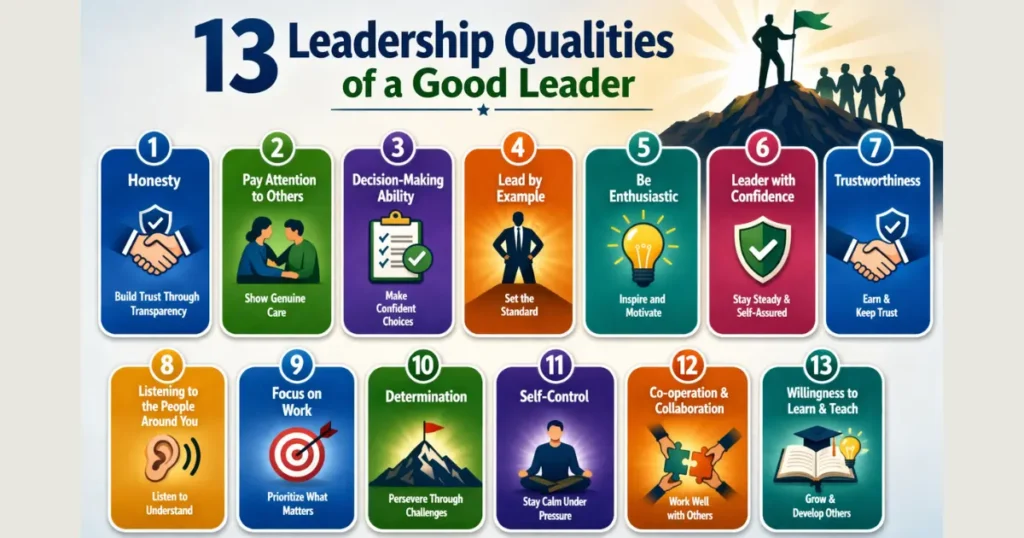
13 Leadership Qualities of a Good Leader
To become a leader, it is very important to have some special qualities inside a person, only then he can become a good leader. So, to become a good and great leader, what leadership qualities should one have, today we will talk about that.
1. Honesty
.webp "13 Leadership Qualities of a Good Leader") |
| 13 Leadership Qualities of a Good Leader |
Honesty is the starting point for every other leadership quality on this list. Without it, nothing else holds.
A leader who is honest with their team earns something that cannot be faked or shortcut: real trust. And when a team genuinely trusts their leader, they work harder, communicate more openly, and hold themselves to a higher standard because they know their leader does the same.
Honesty in practice does not mean being harsh or blunt without care. It means:
- Being transparent about challenges.
- Admitting when a decision did not work out.
- Keeping commitments even when it would be easier not to.
What it looks like in practice: When a project fails, an honest leader does not redirect blame. They say clearly what went wrong, what they would do differently, and what the path forward looks like.
read more: Emotional Intelligence in Leadership
2. pay attention to others
.webp "13 Leadership Qualities of a Good Leader") |
| 13 Leadership Qualities of a Good Leader |
One of the most overlooked leadership qualities is also one of the most powerful: genuinely caring about the people you lead.
Leaders who think only about their own results, their own advancement, and their own reputation have a ceiling. Leaders who
- Pay real attention to the people around them,
- Notice when someone is struggling before that person says a word,
- Take time to invest in others’ growth, often surpass every expectation.
This quality has become especially important as more teams work across remote and hybrid environments. When you cannot read a room or catch someone in the hallway, the leaders who check in personally, not just professionally, are the ones who keep people engaged over time.
People do not give their best work to someone who sees them as a resource. They give their best to someone who sees them as a person.
read more: Balancing Leadership Responsibilities with Personal Well-being
3. Decision-Making Ability
.webp "13 Leadership Qualities of a Good Leader") |
| 13 Leadership Qualities of a Good Leader |
A team cannot move forward if the person leading it cannot make a clear call.
Good decision-making does not mean having all the answers before deciding. It means gathering what information is available, bringing in the right perspectives, and then confidently committing to a direction. Leaders who delay decisions repeatedly or keep reversing them under pressure create confusion and slow everything down.
According to LinkedIn’s 2024 Workforce Confidence Survey, nearly seven out of ten workers said they would quit their jobs over a bad manager, and indecisiveness is one of the most consistently cited frustrations employees have with the people who lead them.
Strong decision-making also means staying open to genuinely new information, not changing direction because of discomfort, but adjusting when facts change.
A useful habit: When facing a difficult decision, ask yourself what you would wish you had done six months from now. That question cuts through short-term pressure faster than almost anything else.
read more: AI in Leadership Decision-Making: Future Organizational Strategy
4. Lead by example
The standard a leader sets through their own behavior is the standard the team adopts. Not the words on a values poster. Not what gets said in all-hands meetings. What people observe in the person leading them.
If you want your team to be on time, be early. If you want people to own their mistakes, own yours first and do it publicly. If you are asking your team to push through a difficult stretch, make sure they can see you doing the same.
As one long-studied rule of good leadership states: you cannot expect of others what you would not expect of yourself. Leading by example is not about being perfect. It is about being consistent enough that people know what you stand for.
This quality matters especially with younger employees. They have a sharp sense for the gap between what a leader says and what they actually do. Closing that gap is how you earn credibility with people who are not impressed by titles alone.
read more: Leadership and Management
5. Be enthusiastic
The energy a leader carries into a room, into a meeting, into a message, sets the emotional temperature for everyone around them.
This does not mean being loud or forcing positivity when things are genuinely hard. It means carrying real belief in the mission and in the team, especially during the stretches when things are not going well. That kind of quiet, grounded enthusiasm is contagious in a way that no amount of motivational language can manufacture.
There is an old saying that has held up well: a lion leading a group of sheep makes them brave, while a sheep leading a group of lions makes them timid. The spirit a leader brings shapes what the people around them believe is possible. And that spirit is one of the key leadership qualities of a good leader.
read more: Self-Development in Leadership
6. Leader with Confidence
People follow confident leaders partly because confidence signals safety. When a leader approaches a hard situation with steadiness and clarity, the team feels like things are going to be manageable, even before they are.
The distinction between confidence and arrogance matters here. Confidence says we can work through this. Arrogance says I already know everything and do not need input.
Real leadership confidence comes from knowing your strengths honestly, acknowledging your gaps without shame, and being willing to say you do not have the answer yet while still holding the team’s trust. A leader who pretends to have certainty they do not have tends to lose credibility the moment the gap becomes visible. A leader who is honest about uncertainty, while still being steady, often earns more trust than one who performs with confidence they do not feel.
7. Trustworthiness
According to PwC’s Global Workforce Hopes and Fears Survey 2025, only about half of workers say they trust top leadership, and even fewer say that top management genuinely cares about their well-being.
That is a significant problem because trustworthiness is the foundation of leadership qualities of a good leader. Without it, even technically skilled leaders struggle to get real commitment from the people they lead.
Trust is built in small moments:
- Following through on what you said you would do,
- Keeping confidences,
- Giving credit to others publicly,
- Taking responsibility for failures rather than deflecting them.
It is also destroyed quickly, usually by a single visible act of inconsistency or self-interest at the team’s expense.
If the people you lead are wondering whether you will back them up when it counts, you have not built real trust yet.
8. listening to the people around you
Most people listen to respond. Good leaders listen to understand.
Active listening means
- Being fully present when someone is speaking.
- Not mentally preparing your reply.
- Not checking a device.
- Not steering the conversation back to your own perspective before the other person has finished.
It means asking follow-up questions, letting the silence sit after someone makes a point, and making people feel that what they said actually landed.
A 2025 Inpulse study found that leaders who genuinely support their teams have 3.4 times more engaged workers, and employees whose managers trust them are 53% more likely to be engaged at work. Both of those outcomes start with a leader who actually listens and practices this key leadership quality of a good leader.
Leaders who listen well uncover problems earlier, make better decisions because they have more complete information, and build the kind of loyalty that keeps good people from leaving.
Try this: In your next one-on-one conversation, commit to spending more time listening than talking. Notice what you learn that you would not have found out otherwise.
9. Focus on work
Focused leaders prioritize what matters most right now and protect that priority from the constant pressure of things that feel urgent but actually are not.
This is harder than it sounds. Most leaders are surrounded by competing demands, back-to-back meetings, and requests that come in faster than they can be addressed. The leaders who rise above this noise are the ones who can clearly identify what deserves genuine attention today, and say no, politely but firmly, to everything else.
Focus is also something that transfers. When a team sees their leader working with real depth and commitment rather than constantly switching between half-done things, it signals that serious work deserves serious attention. That models something important.
10. Determination
Every meaningful goal hits a wall somewhere. What separates leaders who get things done from those who drift is almost always the same thing: the determined ones kept going.
Work Institute’s employee retention report from 2025, based on over 120,000 exit interviews, found that 3 out of 4 employee departures were preventable with better leadership, development, and follow-through. Determined leaders who stay committed to developing and supporting their people reduce this kind of preventable loss.
Determination is not stubbornness. It is resilience with direction. It means:
- Assessing honestly when something is not working,
- Adjusting what needs to change,
- Then continuing forward rather than abandoning the goal.
Teams draw real strength from a leader who simply will not quit. That is one of the most powerful leadership qualities of a good leader.
11. Self-control
How a leader behaves when things go wrong tells you more about their actual character than how they behave when everything is going well.
A leader who loses their temper under pressure, or who reacts to problems with blame rather than problem-solving, creates a culture where people hide issues until they become crises. Nobody wants to surface a problem to someone who makes them feel worse for raising it.
A leader who stays steady under pressure, who responds to setbacks with clarity rather than heat, creates an environment where people feel safe bringing problems forward early, when they are still manageable. That kind of psychological safety is one of the most valuable things a leader can build.
Self-control also means managing your ego well enough to let someone else’s idea win, to ask for help when you need it, and to give credit generously. These things sound small, but they have an outsized effect on how a team functions.
12. Co-operation and Collaboration
Gallup’s State of the Global Workplace report found that global employee engagement dropped to 21% in 2024, a decline associated with $438 billion in lost productivity worldwide. One of the clearest predictors of where engagement is highest is whether the team’s leader genuinely values collaboration or runs things in a top-down, siloed way.
Great leaders build environments where people feel safe to:
- Contribute ideas,
- Push back on decisions,
- Think out loud without worrying about how it will be received.
They make it clear through their own behavior that the best idea wins, regardless of where it came from.
Collaboration is not a threat to a leader’s authority. It is what makes that authority worth having.
13. Willingness to Learn and Teach
The leaders who stay effective over the long term are the ones who never stop being students.
This quality has taken on new importance as industries evolve faster, roles change more frequently, and the skills that were sufficient five years ago may not be enough today. Leaders who stop learning, who assume they have arrived and no longer need to grow, find themselves falling behind in ways that are gradual and then sudden.
But the best leaders do not just learn for themselves. They bring that learning back to their teams. They share what they discover. They invest real time and attention in developing the people around them, not just pushing toward targets, but genuinely building capability and confidence in others.
A good leader creates capable followers. A great leader creates the next generation of great leaders.
Conclusion
Leadership qualities of a good leader are not something you achieve once and then maintain. They are a practice that gets refined every single day through the choices you make, the way you treat people, and the standard you set through your own behavior.
Every quality on this list can be developed. None of them requires a specific personality type or a particular background. They require intention, honest self-reflection, and the willingness to keep improving even when improvement is uncomfortable.
The leaders who leave a lasting impact are rarely the ones who demanded the most from their teams. They are the ones who gave the most back: their full attention, their honesty, their trust, and their genuine belief in the people they were leading.
Start with one quality from this list this week. Work on it on purpose. Then add another. That is how real leadership development works, not in one dramatic moment, but in the quiet, steady choices you make every day.
Frequently Asked Questions
Q1: Can leadership qualities be developed, or are some people just born with them?
Leadership qualities can absolutely be developed. Research from Northeastern University found that only around one-third of leadership tendencies are linked to heredity. Core skills like communication, decision-making, active listening, and emotional self-control can all be strengthened through deliberate practice and real-world experience.
Q2: Which leadership quality matters most?
Most research points to trustworthiness as the most foundational quality. Without trust, a leader’s influence stays limited regardless of how skilled or experienced they are. Honesty, consistency, and genuine care for the people you lead are the main building blocks of trust.
Q3: How can I build leadership qualities without a management role?
Leadership does not require a formal title. You can build real leadership presence by taking initiative on projects, listening actively to the people around you, making confident decisions when opportunities arise, and investing in others’ development. These habits create leadership credibility long before any official role comes along.
Q4: What is the difference between a good leader and a good manager?
A manager coordinates tasks, timelines, and resources. A leader shapes culture and inspires people toward a shared purpose. The best professionals develop both over time, but real leadership is always grounded in influence, not just authority.
Q5: Which leadership qualities are most important for managing people in today’s workplace?
Active listening, clear communication, genuine attention to team members as individuals, honest decision-making, and the ability to stay steady under pressure are consistently ranked as the most important qualities for today’s workplace environment, whether your team works in person, remotely, or somewhere in between.

Ayanshi is the founder of PersonaGuru.in, a blog dedicated to personality development, relationships, and mental health. With 3+ years of writing experience and 250+ published articles, she simplifies psychology into practical, everyday advice for real people.